Wize High School Grade 11 Math Textbook > Trigonometry
Trig Ratios for Angles Between 0° and 360°

0:00 / 0:00
Trig Ratios for Angles Between 0° and 360°
Standard Position
An angle in standard position starts at the initial arm (flat along the positive x-axis) and rotates counter-clockwise around the origin to a terminal arm.

Angles Greater Than
The angle in standard position is called the principal angle (between and ).
The principle angle can be negative if the angle is measured clockwise.
When the angle is greater than , the angle between the terminal arm and the x-axis is called the related acute angle (or reference angle).

Wize Tip
Trig ratios of a principal angle are the same as the trig ratios of the reference angle, except they may be negative.
CAST Rule
Trig ratios of a principal angle are the same as the trig ratios of the reference angle, except they may be negative.
Ex. Given a principal angle of , the reference angle is . To calculate , we can instead calculate !
We can decide whether we should negate the result of using the reference angle by applying the CAST rule.
Looking at the quadrant where the terminal arm lies:

C - Cosine Positive (Quadrant IV)
A - All Positive (Quadrant I)
S - Sine Positive (Quadrant II)
T - Tangent Positive (Quadrant III)
0:00 / 0:00
Example: Trig Ratios for Angles Between 0° and 360°
Evaluate as an exact value.
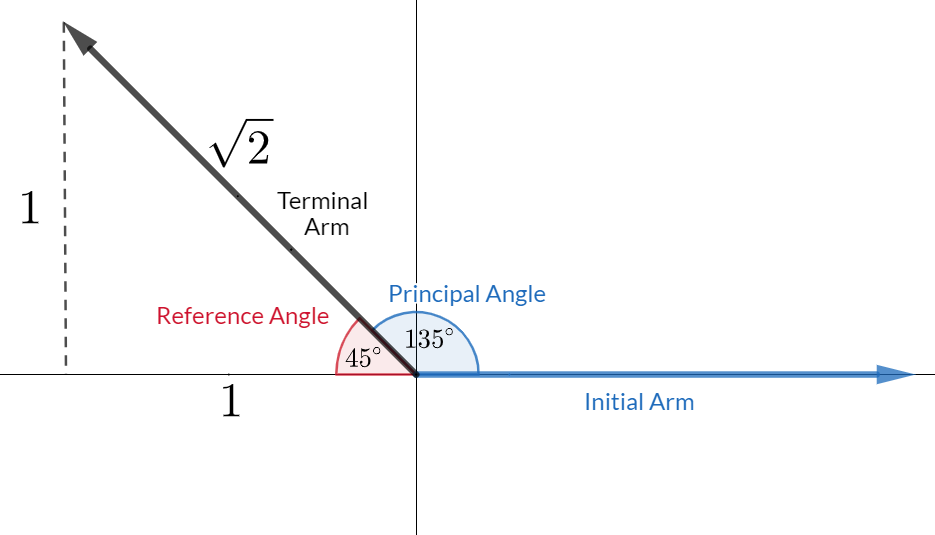
To evaluate , we find the reference angle.
Together, these angles must make , so the reference angle is .
Now, we know that either or .
By the CAST rule, the terminal arm is in quadrant 2 (S), so the Sine of this angle is positive.
Therefore, .
Filling in the special triangle, we see that:
Practice: Trig Ratios for Angles Between 0° and 360°
Match each reference angle with the corresponding principal angle.
A.
B.
C.
D.
Practice: Trig Ratios for Angles Between 0° and 360°
Complete the following table, given the reference angle (related acute angle) and the quadrant of the terminal arm.
You'll need to:
- find the principal angle, and
- determine whether or not the Cosine of the principal angle is positive
| Reference Angle | Quadrant | Principal Angle | Cosine Positive? |
| 12° | IV | ||
| 81° | I | ||
| 29° | II | ||
| 7° | III |
Practice: Trig Ratios for Angles Between 0o and 360o
Evaluate the exact values of the following trig ratios without using a calculator.
a)
b)
c)
d)
e)
f)