Wize High School Grade 11 Math Textbook > Sequences & Series
Geometric Sequences
Popular Courses
Grade 11 Functions
Ontario High School
MATH 208
Concordia University
Grade 11 Math
Canada High School
Math 20-1
Alberta High School
Pre-Calculus 11
British Columbia High School
MAT133Y1
University of Toronto
MATH*1030
University of Guelph
QMS 110
Toronto Metropolitan University
MATH 1314
Tarrant County College District
MATH 16B
University of California - Berkeley
MTH 116
Michigan State University
MATH 1302
University of Texas at Arlington
0:00 / 0:00
Geometric Sequences
A geometric sequence is a sequence where every number is the result of multiplying the previous number by some constant multiple.
We call this multiple the common ratio, we can find it by taking any number in the sequence and dividing it by the previous number.
Examples
- Is a geometric sequence?Yes
- What is the common ratio?2
- Is a geometric sequence?Yes
- What is the common ratio?0.8
- Is a geometric sequence?Yes
- What is the common ratio?-3
- Is a geometric sequence?No
- What is the common ratio?No common ratio -- this is an arithmetic sequence with common difference of 2
General Term
If the first term is and the common ratio is , then the geometric sequence looks like this:
The general term of a geometric sequence is an exponential relation given by:
0:00 / 0:00
Example: Geometric Sequences

A petri dish contains 10 individual bacterial cells at the end of the first day of an experiment. It is observed that each cell splits into 2 daughter cells every 8 hours. Researchers are interested in predicting the number of bacteria after days.
a) What is the common ratio if we want to model the number of bacteria at the end of each day?
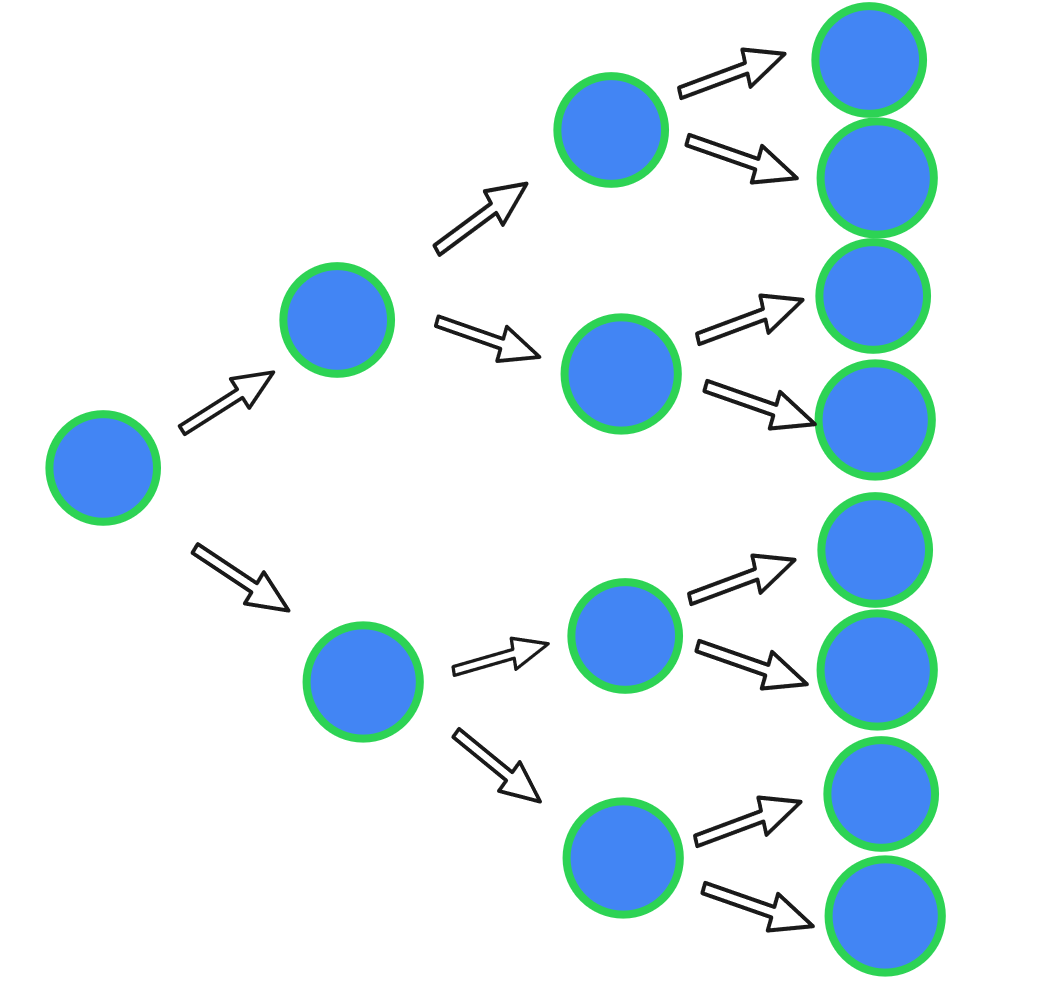
Since each cell splits into 2 after 8 hours, those two cells split into 4 after 16 hours, and finally into 8 cells after 24 hours.
That means that every day, each cell from the day before turns into 8 new cells, so the common ratio is .
b) How many bacterial cells are there at the end of the fourth day?
Let's write out the first four terms of the resulting sequence:
We can see that there are 5120 bacteria after four days.
c) Write the general term for the number of bacteria, , at the end of the day.
- The first term is the number of bacteria after the first day:
- The common ratio we found to be
Using the formula for a geometric sequence, , we can write the general term:
Practice: Geometric Sequences
Given the sequence
a) is this a geometric sequence?
b) what is the next term in the sequence?
c) write an expression for the general term of the sequence.
Practice: Geometric Sequences
Given a geometric sequence with terms and , determine .
Practice: Geometric Sequences
A radioactive substance loses a (constant) fraction of its mass every year as seen in the table below.
After how many years is there 128 kg of mass remaining?
[Use technology to graph the general term as a function of ]
Summary - Geometric Sequence
Consecutive terms in a geometric sequence differ by the same common ratio (can be a positive, negative integer or fraction). So, to get the next number in a geometric sequence, we multiply the current number by this common ratio.
We can use this formula to find the nth term in a geometric sequence:
where,
- is the nth term in the geometric sequence
- is the first term in the geometric sequence
- is the common ratio (we get this by dividing any number in the geometric sequence by the previous number)