Wize High School Grade 11 Math Textbook > Sequences & Series
Recursive Sequences and Rules for Defining Sequences
Popular Courses
Grade 11 Functions
Ontario High School
Grade 11 Math
Canada High School
Math 20-1
Alberta High School
Pre-Calculus 11
British Columbia High School
MATH*1030
University of Guelph
QMS 110
Toronto Metropolitan University
MATH 1314
Tarrant County College District
MTH 116
Michigan State University
MATH 1302
University of Texas at Arlington
0:00 / 0:00
Recursive Sequences
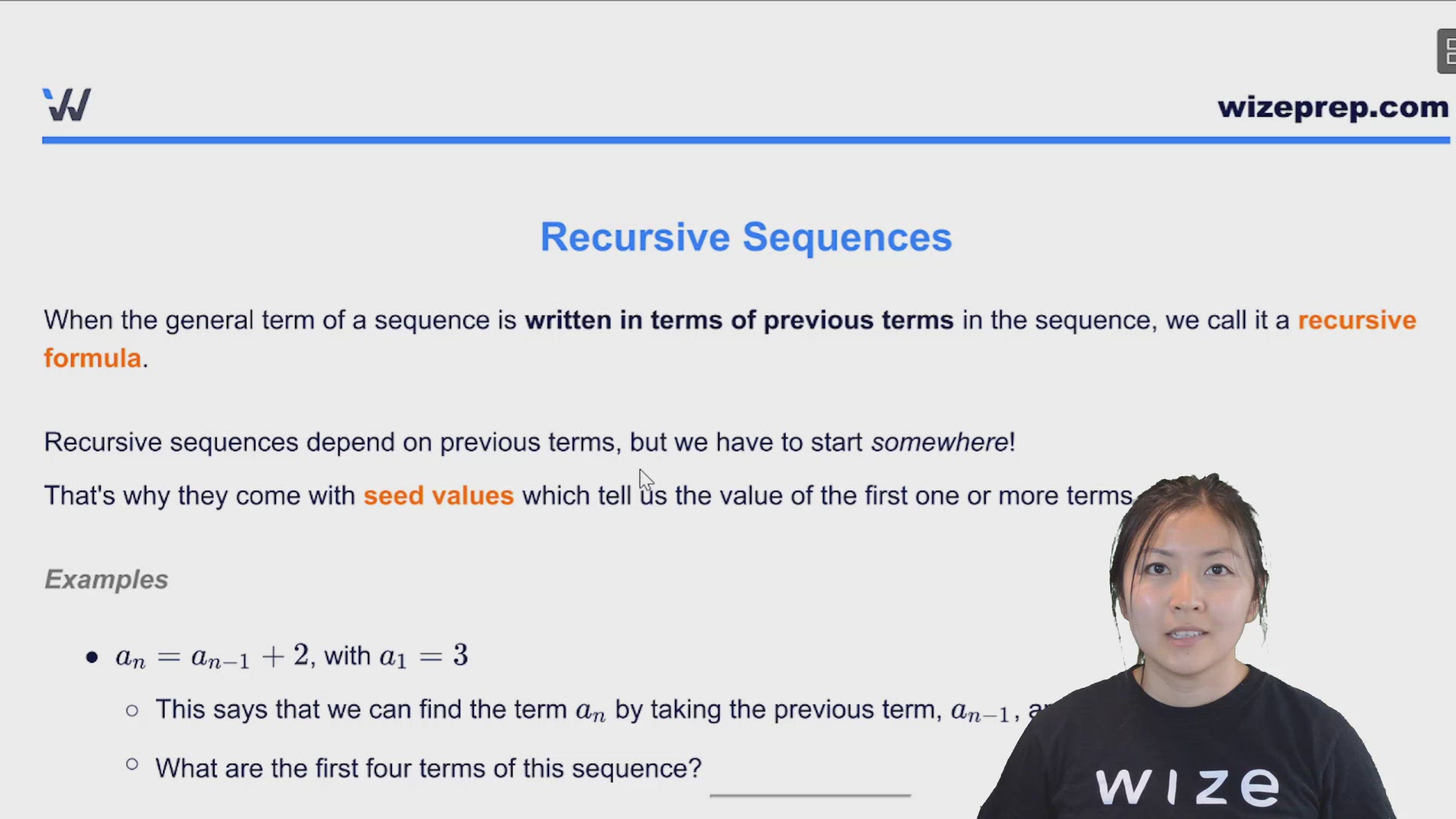
When the general term of a sequence is written in terms of previous terms in the sequence, we call it a recursive formula.
Recursive sequences depend on previous terms, but we have to start somewhere!
That's why they come with seed values which tell us the value of the first one or more terms.
Examples
- , with
- This says that we can find the term by taking the previous term, , and adding .
- What are the first four terms of this sequence?3, 5, 7, 9, ...
- What kind of sequence is this?Arithmetic
- What is the general term of this sequence in terms of ?
- , with
- We can find the term by taking the previous term, , and multiplying it by .
- What are the first four terms of this sequence?5, 20, 80, 320, ...
- What kind of sequence is this?Geometric
- What is the general term of this sequence in terms of ?
- , with
- This is called the Fibonacci sequence
- We can find the term by taking the previous term, , and adding the term that came before that, .
- What are the first six terms of this sequence?1, 1, 2, 3, 5, 8, ...
- What kind of sequence is this?Neither arithmetic nor geometric
0:00 / 0:00
Example: Creating Rules to Define Sequences
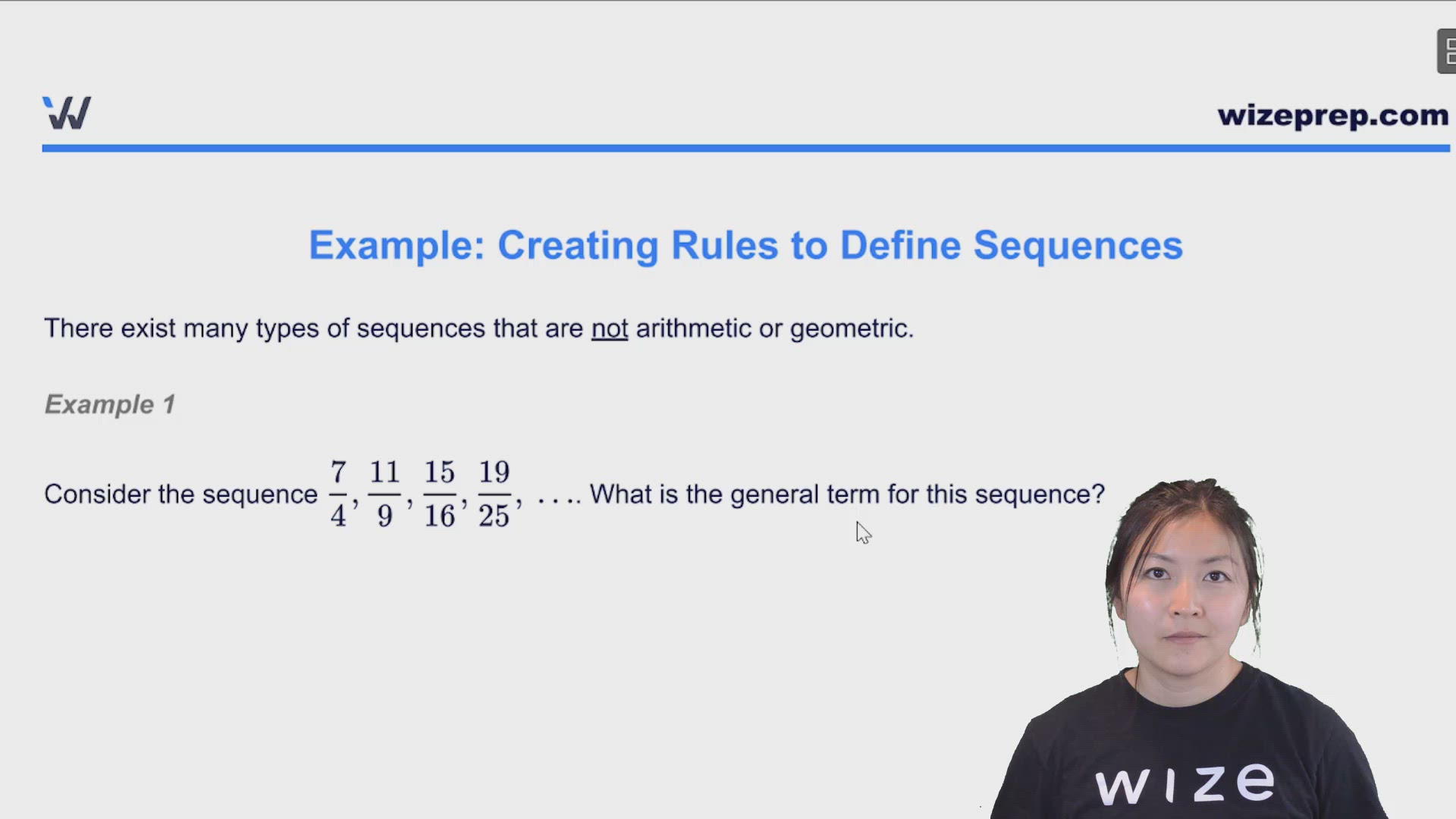
There exist many types of sequences that are not arithmetic or geometric.
Example 1
Consider the sequence . What is the general term for this sequence?
- The numerators are which form an arithmetic sequence with first term 7 and common difference of 4.
- The general term for the numerator is
- The denominators are which is a sequence of perfect squares .
- The general term for the denominator is
- Putting them together, the general term of this sequence is:
Finding First and Second Differences
We can sometimes spot a pattern by calculating first differences and second differences.
Example 2
Find the next number of the sequence .
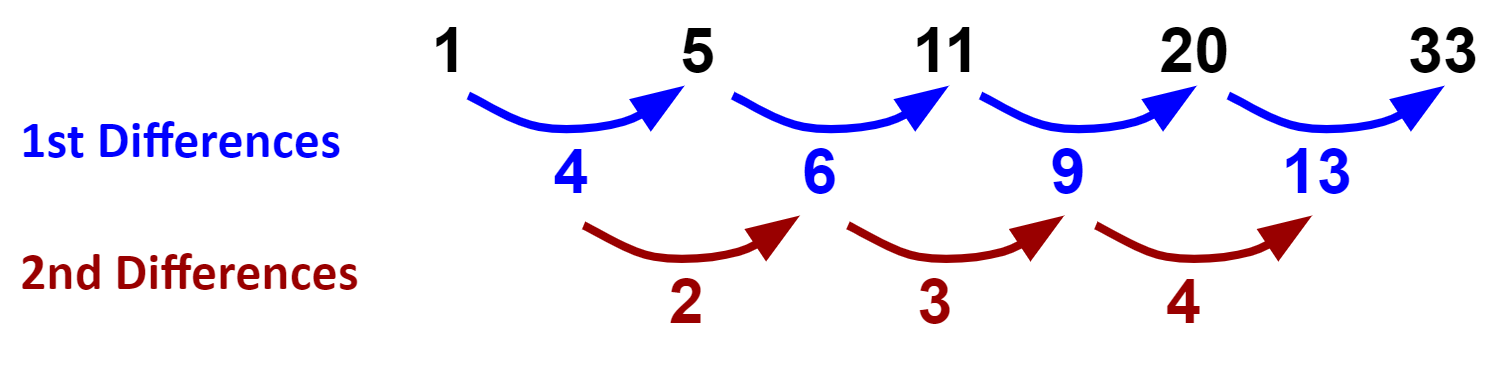
Now that we see the pattern in the second differences, we can work our way backward to find the next number:
- The next second difference will be , so the next first difference will be .
- Applying this first difference to the last known number of the sequence, we get .
Recursive Sequences
Many sequences are most naturally defined in a recursive way. Try checking to see if the previous two terms combine in some way to make the next term.
Example 3
Find a recursive rule for the sequence
How can we combine the first two terms to get the third?
Notice that , so the rule might be:
Check with the next terms:
Practice: Recursive Sequences
Write out the given sequences and determine whether each one is either arithmetic, geometric, or neither.
What are the first 4 terms of the sequence:
with
Practice: Creating Rules to Define Sequences
Consider the sequence
What is a recursive formula for the general term of this sequence?
[Hint: This sequence is "almost" geometric: find the ratio of each adjacent pair of terms -- does it approach some number?]
Practice: Recursive Sequences and Creating Rules to Define Sequences
Find the next term for each of the following sequences:
a)
b)