Popular Courses
Grade 11 Functions
Ontario High School
MATH 208
Concordia University
Grade 11 Math
Canada High School
Math 20-1
Alberta High School
Pre-Calculus 11
British Columbia High School
MAT133Y1
University of Toronto
MATH*1030
University of Guelph
QMS 110
Toronto Metropolitan University
MATH-1980
University of Windsor
MATH-1524
Virginia Tech
0:00 / 0:00
Simple Interest
Borrowing/Loaning Money
When someone borrows money, they will eventually have to pay back the original amount of money they borrowed (principal) plus an additional amount of money (interest).
Investing Money
When someone invests their money, they are hoping to "grow" their money so that eventually, they will get back the original amount of money that they invested (principal) plus an additional amount of money (interest).
Simple Interest
To calculate how much "interest" needs to be added on top of the principal, some people use the idea of simple interest -- the interest will be a fraction/percentage of the original principal, this is indicated by the interest rate.
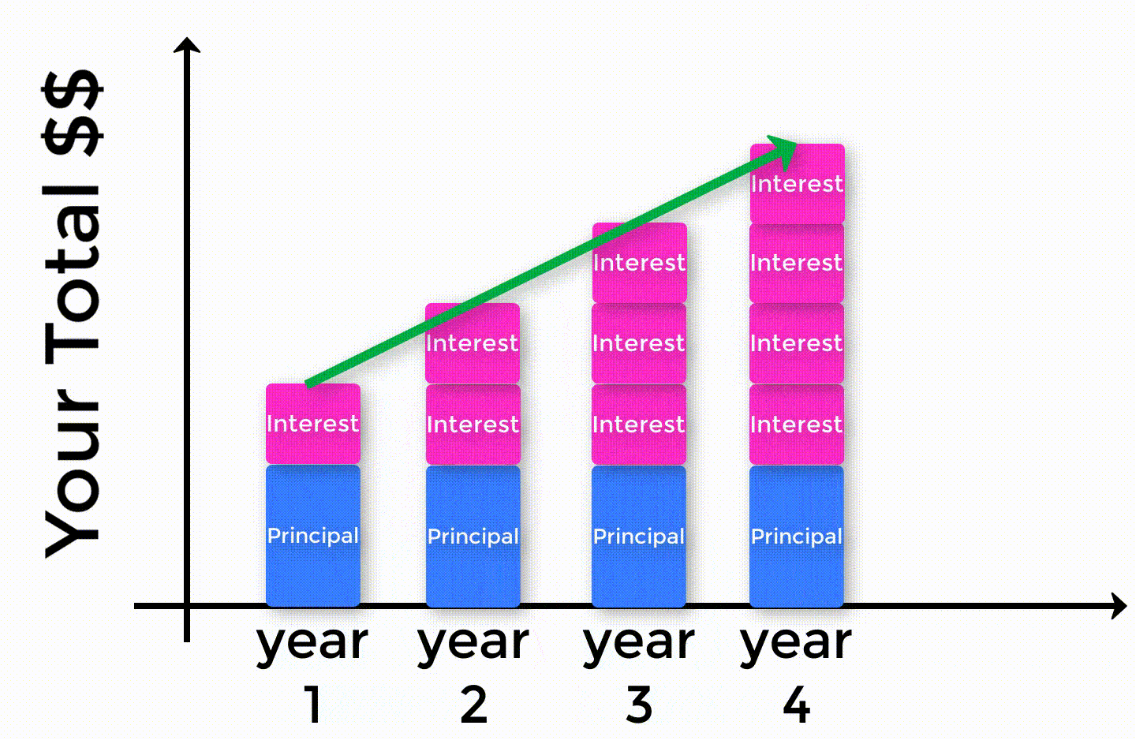
Notice that the total amount of money (principal + interest) grows linearly.
Wize Tip
- Interest rates are usually given as a percentage "per year", this can also be called "per annum". For example: 3% or 3%/a both mean that each year, the interest will be 3% of the original principal.
- In calculations, use the decimal form of the percentage by dividing it by 100 E.g.
Example
James borrows $1000 from the bank at 5%/a simple interest.
- How much interest is owed every year?$1000(0.05) = $50
- After 10 years, how much total interest must be repaid?10($50) = $500
- After 10 years, what is the total amount owed?$1000 + $500 = $1500
Simple Interest Formulas
Total Interest
The total interest of an investment or loan with principal for years at simple interest is:
Total Amount
The total amount earned on an investment (or owed on a loan) is the sum of the principal and the total interest:
Substituting the formula for the total interest, , and the common factoring, we get:
Wize Tip
Both the total interest, , and the total amount, , are linear functions of time.


0:00 / 0:00
Example: Simple Interest
Amanda gets a line of credit (loan) from the bank for $12,000 at 9%/a simple interest.
When she returns to pay it back in 18 months, how much must she repay the bank?
Start by listing the given values:
- The principal is
- The interest rate is
- The time must be in years, so we must divide the number of months by 12:
Now we can simply apply the formula for the total amount:
Therefore, Amanda must pay $13620 to pay off her loan after 18 months.
How much goes towards paying interest?
We could use the formula , or we can use our previous result.
Since the total amount is the principal plus the interest, , we can simply subtract the principal from the total amount:
Therefore, after 18 months, Amanda must pay $1620 more than the original amount of the loan.
Practice: Simple Interest
Calculate the total amount of an investment of $3500 at 6.8%/a simple interest for the following time periods:
a) 35 weeks
b) 500 days
c) 99 months
Practice: Simple Interest
Terry takes out a loan for $7000 at 8.9%/a simple interest.
If Terry wants to ensure that the amount of interest paid does not exceed $500, what is the last day Terry can repay the loan?
Practice: Simple Interest
Abdul forgets the amount of money he contributed to a new savings account on June 1, 2019. He earns simple interest, and his records (semi-annual) show the following balances in his account:
a) How much did Abdul contribute initially?
b) What is the annual interest rate for this savings account?