Wize High School Grade 11 Math Textbook > Financial Applications
Compound Interest
Popular Courses
Grade 11 Functions
Ontario High School
MATH 208
Concordia University
Grade 11 Math
Canada High School
Math 20-1
Alberta High School
MATH 206
Concordia University
Pre-Calculus 11
British Columbia High School
MAT133Y1
University of Toronto
MATH*1030
University of Guelph
QMS 110
Toronto Metropolitan University
MATH 122
McGill University
MATH-1980
University of Windsor
MATH-1524
Virginia Tech

0:00 / 0:00
Compound Interest
Terminology Review
- Principal: original amount of money invested or borrowed
- Interest: an amount of money that is added on to the principal at a certain interest rate (%)
- Simple interest: when the amount of interest is calculated as a percentage of just the original principal
Compound interest
When the interest is calculated as a percentage of the original principal AND the amount of interest accumulated so far.

Notice that the total amount of money (principal + interest) grows exponentially.
Compound Interest Terminology
- A compounding period is the time period after which interest is calculated. We use to represent the number of compounding periods.
- If we compound annually, that means the amount of interest is calculated once a year.
- If we compound quarterly, that means the amount of interest is calculated 4 times per year.
- If we compound monthly, that means the amount of interest is calculated 12 times per year.
- When we talk about compound interest,
- we call the original principal the present value (denoted by or )
- we call the total amount of money after some time the future value (denoted by or ).
- : the interest rate over a single compounding period
- If we compound annually, is the annual interest rate (usually denoted )
- If we compound quarterly, for example: we divide the annual interest rate by 4, so .
Compound Interest Formulas -- Calculating Future Value
If we know the present value (principal), we can calculate the total amount of money at a future time (future value) using this future value formula:
Compound Interest Formulas -- Calculating Present Value
If we know the total amount of money at a future time (future value), we can calculate the principal (present value) using this present value formula:
Wize Tip
The exponent is positive when going "forward in time" to find the future value!
The exponent is negative when going "backward in time" to find the present value!

0:00 / 0:00
Example: Compound Interest (Future Value)
Aisha invests $10,000 into a high-interest savings account that pays 8%/a compounded quarterly.
What is the future value of her investment after 20 years? How much total interest did she earn?
Let's make a table to see how Aisha's money grows every year. Fill in values for the first three quarters:
Before starting, we need to find the interest rate per compounding period, .
Since we are compounding quarterly, so we must divide the annual rate by 4:
Wize Concept
Notice that each number in the sequence of ending balances is 1.02 times the previous number.
This means that compound interest forms a geometric sequence!
We can check our work using the compound interest formula with , and quarters:
Watch Out!
Notice that , the number of compounding periods, is measured in quarters.
The units of the exponent must always match the interest rate compounding period.
Calculating Future Value After 20 Years
We are compounding quarterly (4x per year) for 20 years, so .
We can find out how much of this total amount is earned from interest by subtracting the original amount invested:
This is the power of compound interest and exponential growth!
After 20 years, Aisha earned $38,754.39 in interest, turning $10,000 into a total of $48,754.39.
0:00 / 0:00
Example: Compound Interest (Present Value)

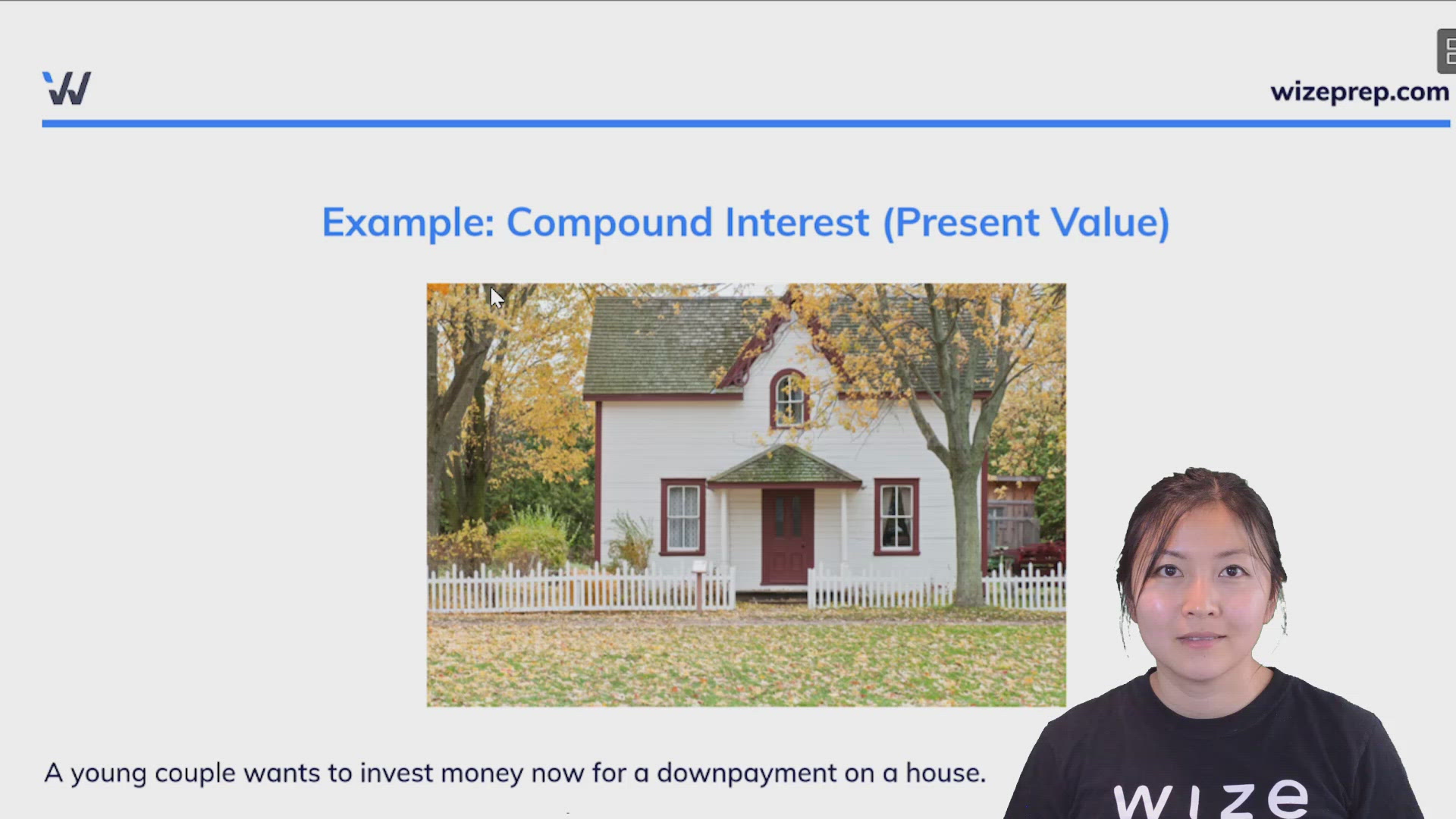
A young couple wants to invest money now for a downpayment on a house.
If they expect to need a downpayment of $70,000 in 6 years, how much do they need to invest now at 6.4%/a compounded semi-annually?
It can be helpful to make a timeline to visualize the situation:
Determining the Values of Variables
- The principal, or present value, is unknown. The future value .
- The annual interest rate is , but since we are compounding semi-annually, we must divide by 2. Therefore, .
- Since we are compounding semi-annually (twice per year), the number of compounding periods for a 6-year investment is .
Applying the Present Value Formula (Compound Interest)
Since we are going back 12 compounding periods, remember to use a negative exponent:
Therefore, the couple should invest $47,966.90 now in order to have $70,000 in 6 years.
Practice: Compound Interest
Match the following durations and interest rates to the correct values, referring to the future value formula for compound interest:
A.
21 years at 1.5% compounded annually
B.
42 years at 3% compounded semi-annually
C.
5 years at 6% compounded monthly
D.
15 years at 3% compounded quarterly
,
Practice: Compound Interest
The bank demands to be paid $6421.29 after 3 years since a loan was issued.
If interest is 20.4% compounded monthly, how much money was borrowed initially?
Practice: Compound Interest
Cameron maxes out a credit card whose limit is $2000. The interest rate on the card is 20% compounded daily.
Cameron pays off half of the balance in 30 days.
a) What will be the remaining balance after this payment?
b) What is the balance another 40 days after that?
c) If Cameron pays off the entire balance after these 70 days, how much total interest must have been paid?