Wize High School Grade 11 Math Textbook > Financial Applications
Investments and Loans with Regular Payments (Ordinary Simple Annuities)
Popular Courses
Grade 11 Functions
Ontario High School
MATH 208
Concordia University
Grade 11 Math
Canada High School
Math 20-1
Alberta High School
Pre-Calculus 11
British Columbia High School
MAT133Y1
University of Toronto
MATH*1030
University of Guelph
QMS 110
Toronto Metropolitan University
MATH 156
University of Alberta
MATH 16B
University of California - Berkeley

0:00 / 0:00
Investments and Loans with Regular Payments
An ordinary simple annuity is a series of payments made at the end of each compounding period.
Future Value
If represents the amount of each regular payment, and the interest rate is compounded at the same frequency as the payments, we can create a timeline:
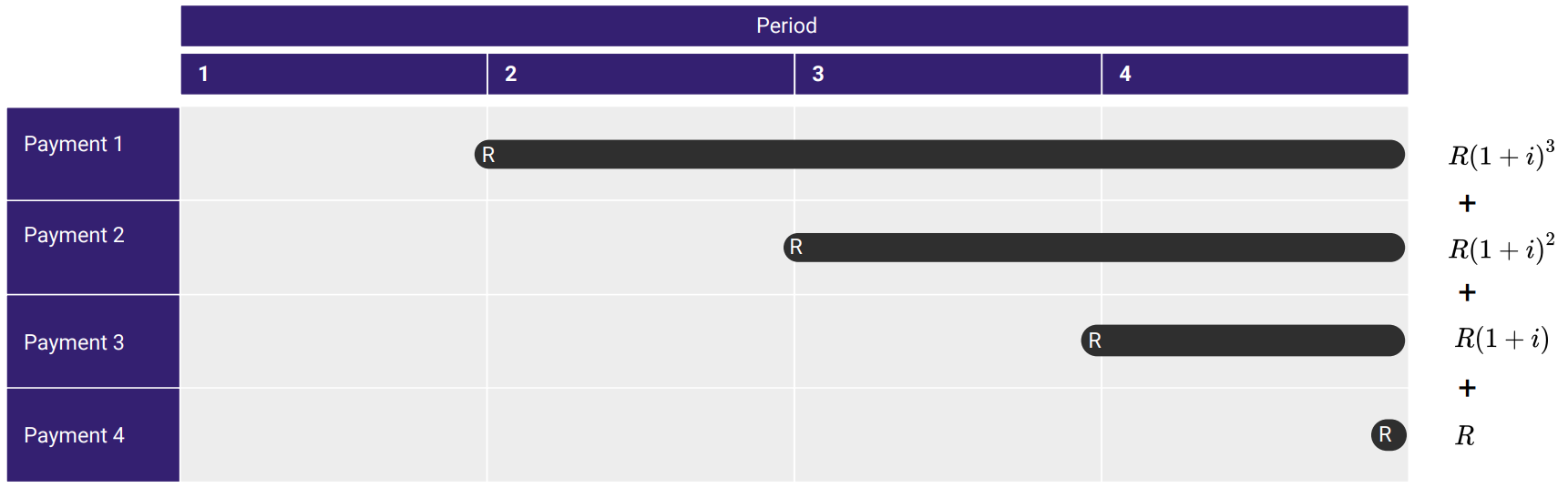
Here, a payment of is made at the end of each period.
- Payment 1 earns interest for 3 periods, so its future value at the end of the 4th period is
- Payment 2 earns interest for 2 periods, so its future value at the end of the 4th period is
- Payment 3 earns interest for 1 period, so its future value at the end of the 4th period is
- Payment 4 is made right at the end of the 4th period, so it does not earn any interest and its value is still .
Wize Tip
These future values are all terms of a geometric sequence with first term and common ratio .
To find the total ending balance, we add up each of these terms -- this is a geometric series!
Future Value of Annuities Formula
We can use the geometric series formula to write a formula for the ending balance after many regular payments:
Present Value
If instead we want to know how much future regular payments would be worth in total now, we need a present value calculation.
If represents the amount of each regular payment, and the interest rate is compounded at the same frequency as the payments, we can create a timeline:
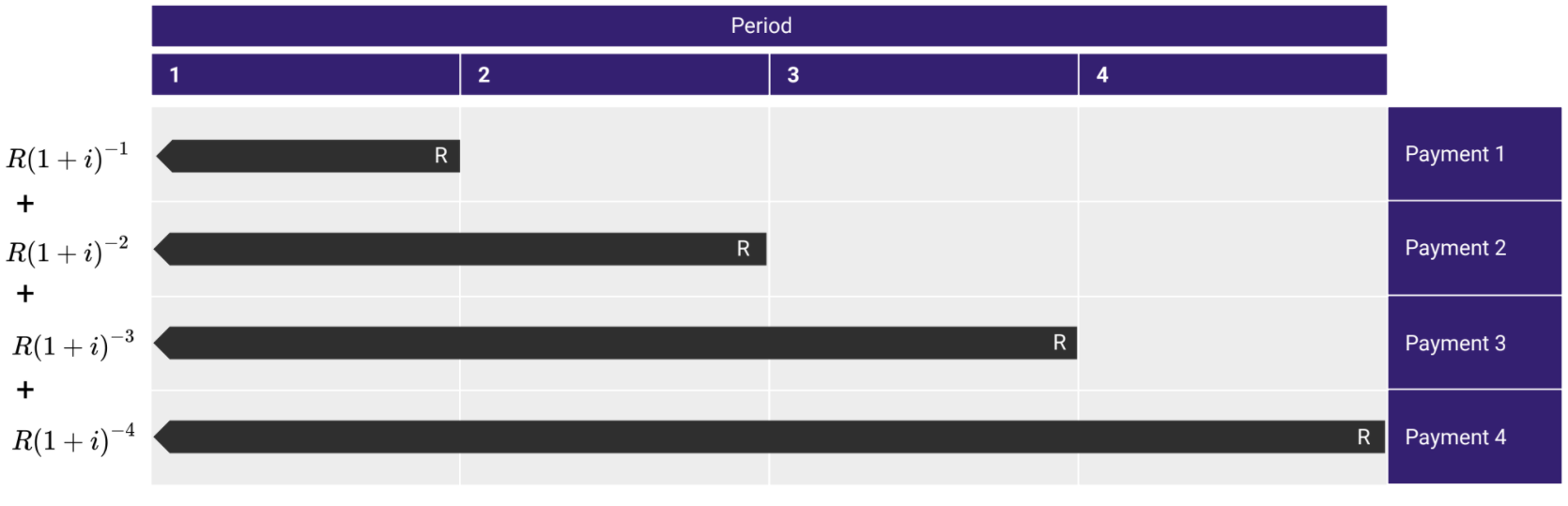
Here, a payment of is made at the end of each period.
- Payment 1 is "pulled back" 1 period to its present value, given by
- Payment 2 is "pulled back" 2 periods to its present value, given by , etc.
Wize Tip
This time, the first term of the geometric series is , and the common ratio is .
Present Value of Annuities Formula
Using the geometric series formula, we can simplify to get the formula:
0:00 / 0:00
Example: Regular Payments (Future Value)
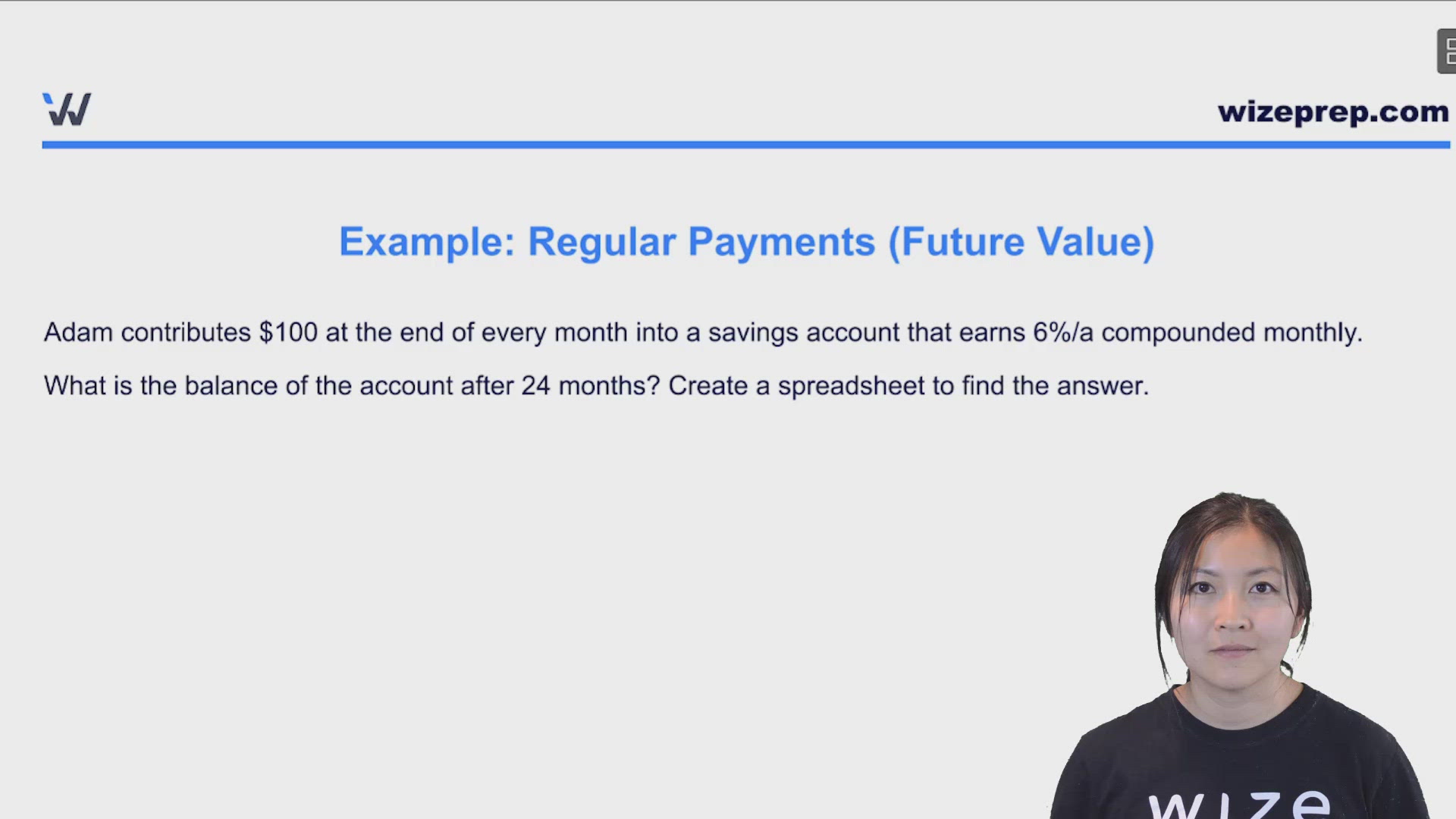
Adam contributes $100 at the end of every month into a savings account that earns 6%/a compounded monthly.
What is the balance of the account after 24 months? Create a spreadsheet to find the answer.
Since interest is compounded monthly, we calculate the monthly interest to be:
The first month's payment earns no interest since it occurs at the end of the month.
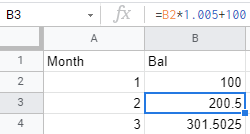
At the end of every month, we multiply the previous balance by .
Technology: we can use a spreadsheet to complete the Ending Balance column.
How can we express the future value (ending balance) after the 24th month as a geometric series?
Confirm the ending balance using two different methods.
To evaluate, we can use the geometric series formula with first term , common ratio , and .
If we use the future value of an annuity formula instead, use the interest rate .

0:00 / 0:00
Example: Regular Payments (Present Value)
Sharon is ready to retire and her bank offers to pay her an annuity in exchange for all of her savings.
The annuity would consist of a regular payment of $9200 every 3 months for 25 years.
If her money can earn 6.4% compounded quarterly, how much money must she have now for this to be a fair offer?
Since interest is compounded quarterly, it occurs 4x per year for 25 years:
Moreover, we have to divide te annual interest rate by 4 to get:
Throughout our calculations, we use:
Using the Present Value Formula
Using Technology
Method 1: Find the Present Value of Each Payment, then Sum
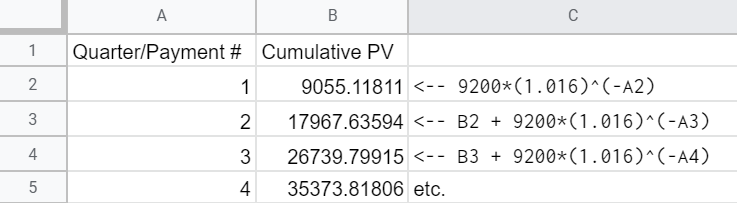
Method 2: Accumulate the PV of Each Payment
Practice: Regular Payments
Annual payments of $6000 are made for 5 years. Money earns interest of 10.3%/a compounded annually.
Use the formulas to answer the following questions.
a) What is the total future value of these payments?
b) What is the total present value of these payments?
Practice: Regular Payments
Annual payments of $6000 are made for 5 years. Money earns interest of 10.3%/a compounded annually.
Use a spreadsheet or graphing calculator to answer the following questions.
a) What is the total future value of these payments?
b) What is the total present value of these payments?
Practice: Regular Payments
Match each situation with the correct equation.
A.
B.
C.
D.
$500 is invested every year at 2% compounded annually. What is the balance in 15 years?
How much is owed in total if you borrow money at 9% compounded monthly and agree to repay with monthly payments of $100 over 2 years?
How much money now is equivalent to monthly payments of $500 for 15 months if money can earn 2% compounded monthly?
You buy a $100 item on a credit card charging 9% compounded monthly. To pay it off in 1 year, how much will each monthly payment be?
Practice: Regular Payments
Rue is buying a car and the salesperson proposes two options, both with annual interest of 7.2% compounded monthly:
a) The car can be paid off in 8 years, and the future value of all monthly payments will amount to $30,000
b) Buy the car at its advertised price of $21,000 and pay it off with monthly payments for 10 years
Which scenario has the cheaper monthly payment?