Wize High School Grade 11 Math Textbook > Sinusoidal Functions (degrees)
Sinusoidal Functions (Sine and Cosine Graphs)
Activity
Fill in the following table of values. Use your special triangles and enter the exact values (do not round your answers).
The sine function
| x (in degrees) | y = sin(x) |
| 0 | |
| 30 | |
| 60 | |
| 90 | |
| 120 | |
| 150 | |
| 180 | |
| 210 | |
| 240 | |
| 270 | |
| 300 | |
| 330 | |
| 360 |
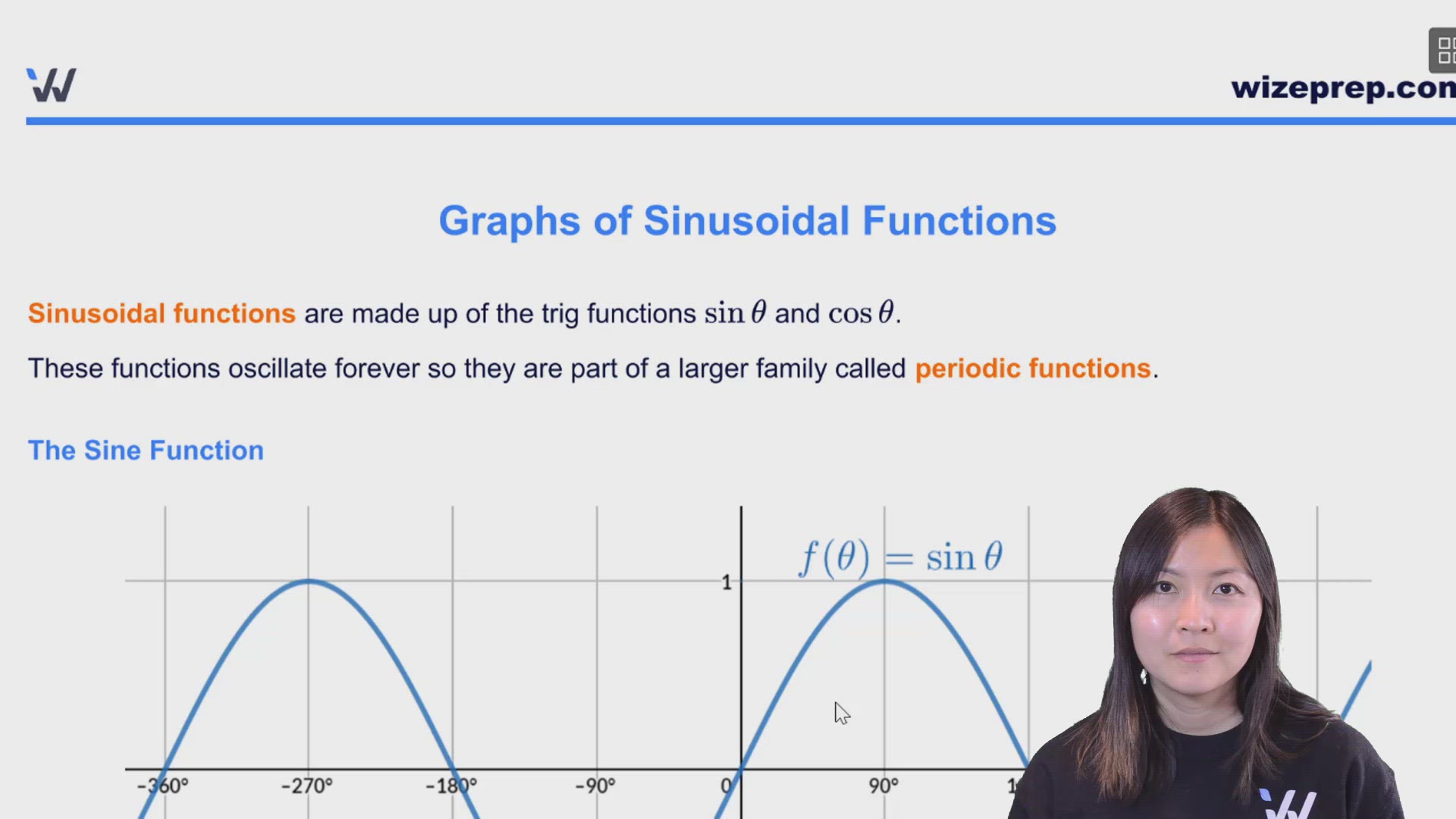
0:00 / 0:00
Graphs of Sinusoidal Functions
Sinusoidal functions are made up of the trig functions and .
These functions oscillate forever so they are part of a larger family called periodic functions.
The Sine Function
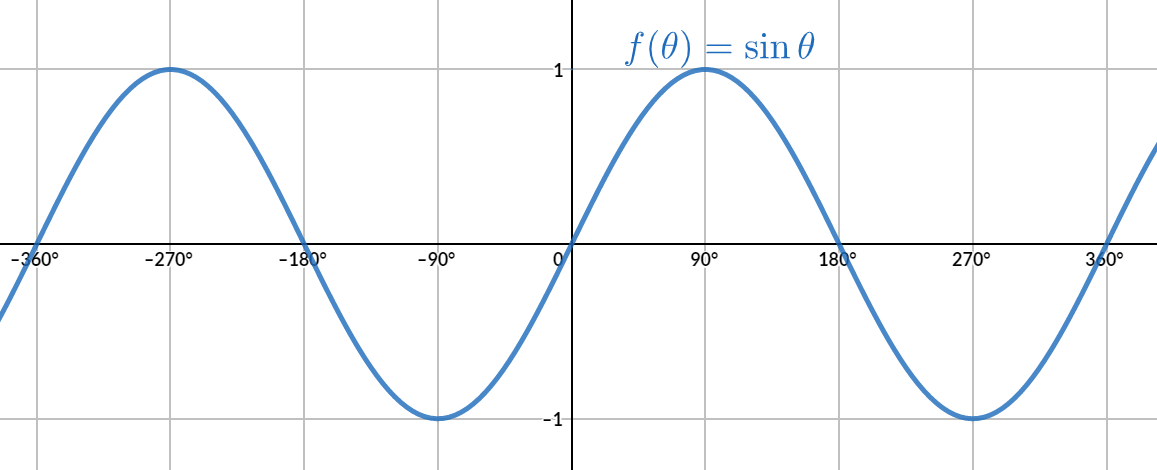
The sine function tells us the vertical distance of a point from the -axis as it rotates around a circle of radius 1.
The Cosine Function
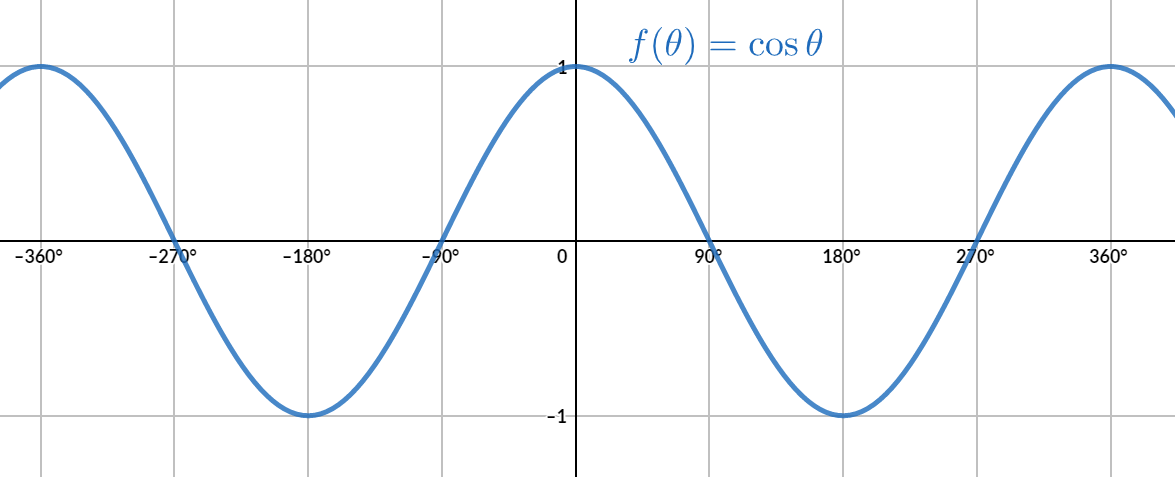
The cosine function tells us the horizontal distance of a point from the -axis as it rotates around a circle of radius 1.
Notes:
- is symmetric about the y-axis
- is the same as except that it has been shifted left by
Tips for Graphing and
If you have to sketch the graph of or by hand without a graphing calculator, here are some helpful steps:
- On your x-axis (horizontal axis), draw a mark at and
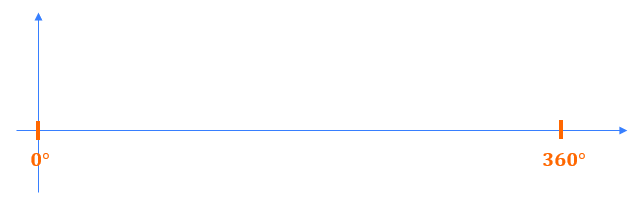
- Half-way between those marks, draw another mark for

- Cut the two existing halves into halves again, mark them with and
- For , start at the "middle" , then at each of the next x-markings, do the following: go up 1 ➡ go back to the "middle" ➡ go down 1 ➡ go back to the middle
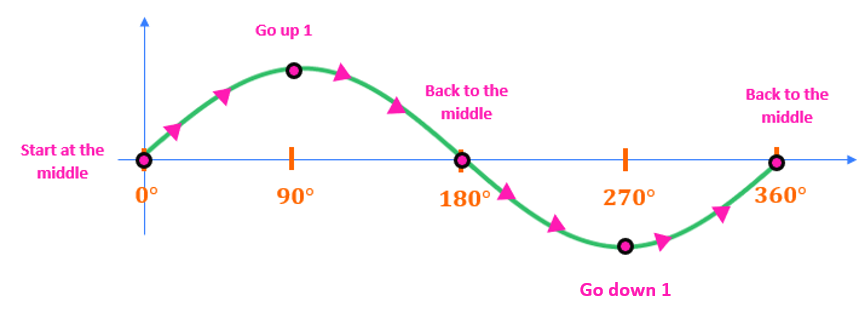
- Alternatively, you can memorize these 5 points:
- For , start at the "top" , then at each of the next x-markings, do the following: go back to the middle ➡ go down 1 ➡ go back to the middle ➡ go up 1
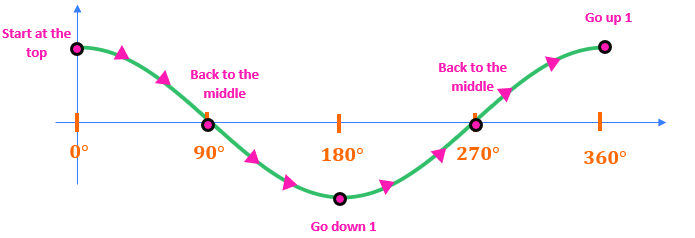
- Alternatively, you can memorize these 5 points:
0:00 / 0:00
Example: Periodic Functions
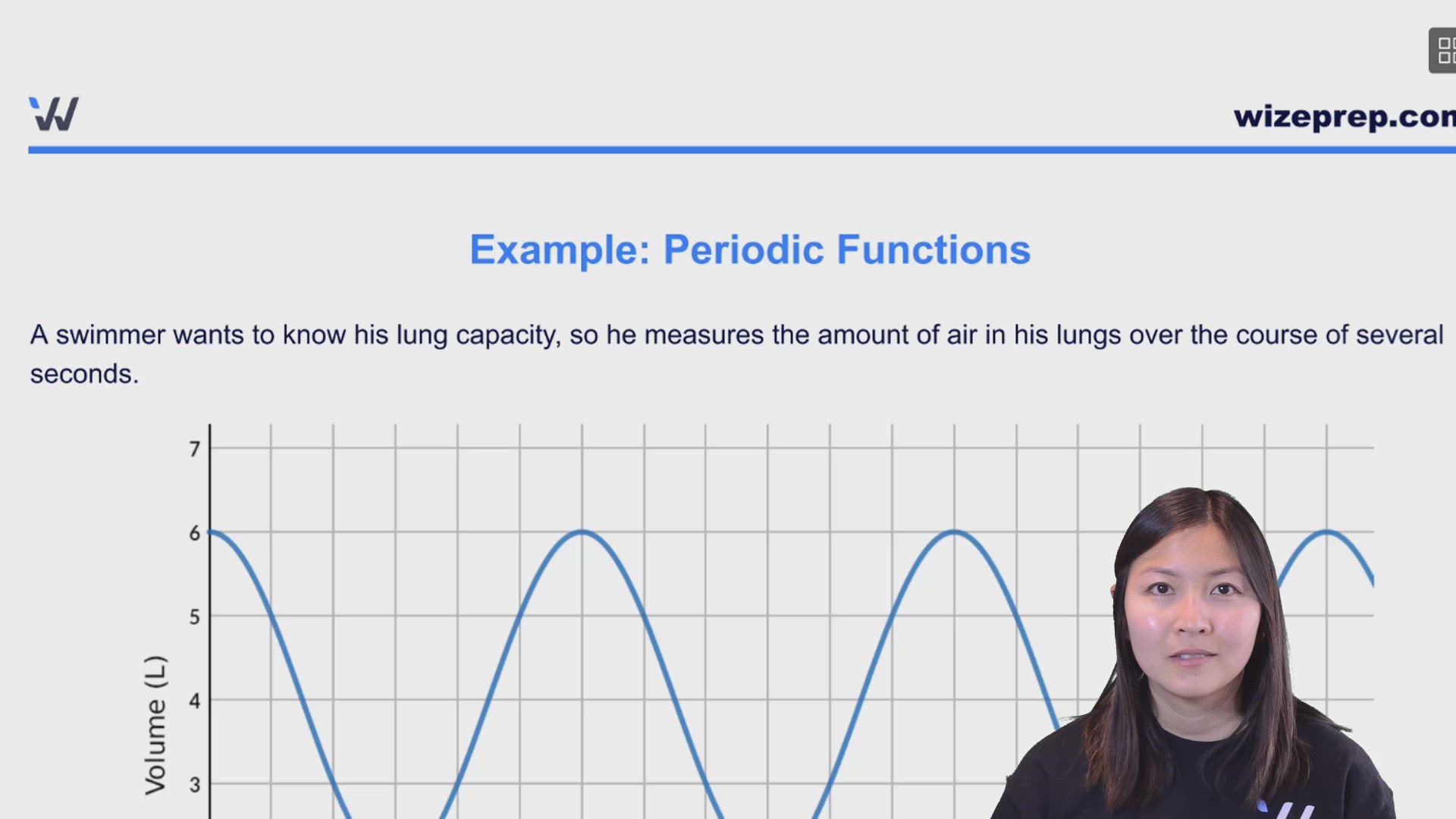
A swimmer wants to know his lung capacity, so he measures the amount of air in his lungs over the course of several seconds.
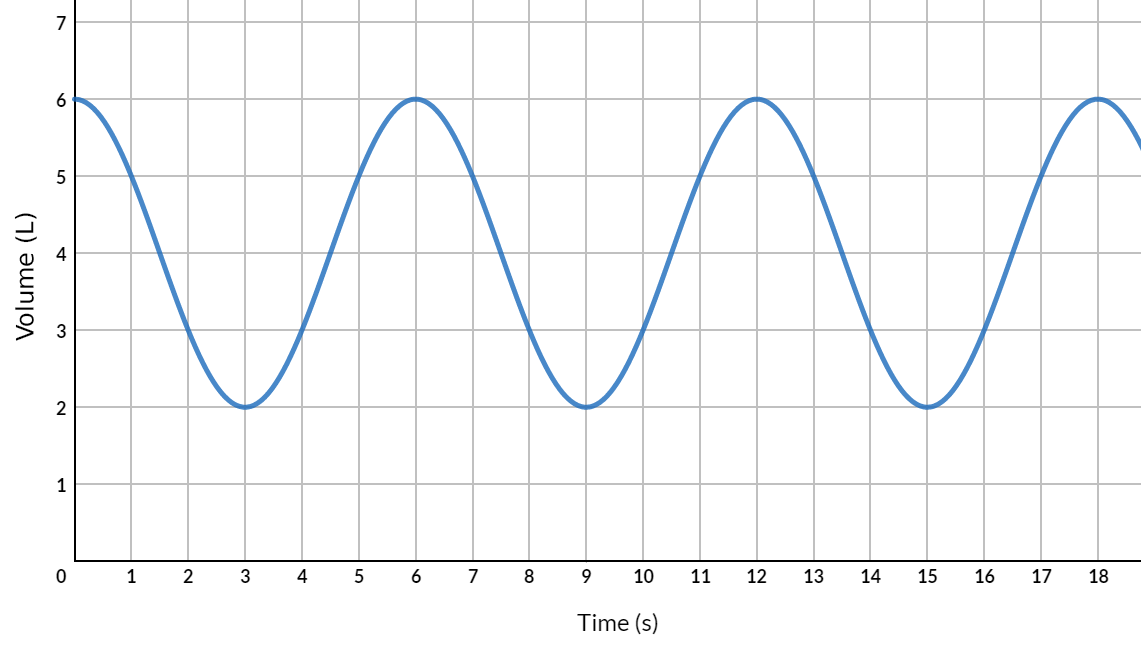
a) Find the period of the graphed function.
We can see a full cycle between 0s and 6s, so the period is .
So, starting with a full breath, the bodybuilder exhales and inhales back to full over the course of 6s.
b) Max value:
6
c) Min value:
2
d) Equation of the axis:
e) Amplitude:
f) How much air is in his lungs at 27s?
The swimmer's lungs are at max capacity when
The swimmer's lungs are at min capacity when
Continuing the pattern for min capacity, we see that at 27s, his lungs reach the minimum value: 2L
g) How much air is in his lungs at 7s?
5L
The function is given by . Use this to check your answers for parts f) and g).
Practice: Periodic Functions
The height of a wave is measured (in inches) relative to a marking on a dam. The data are graphed:
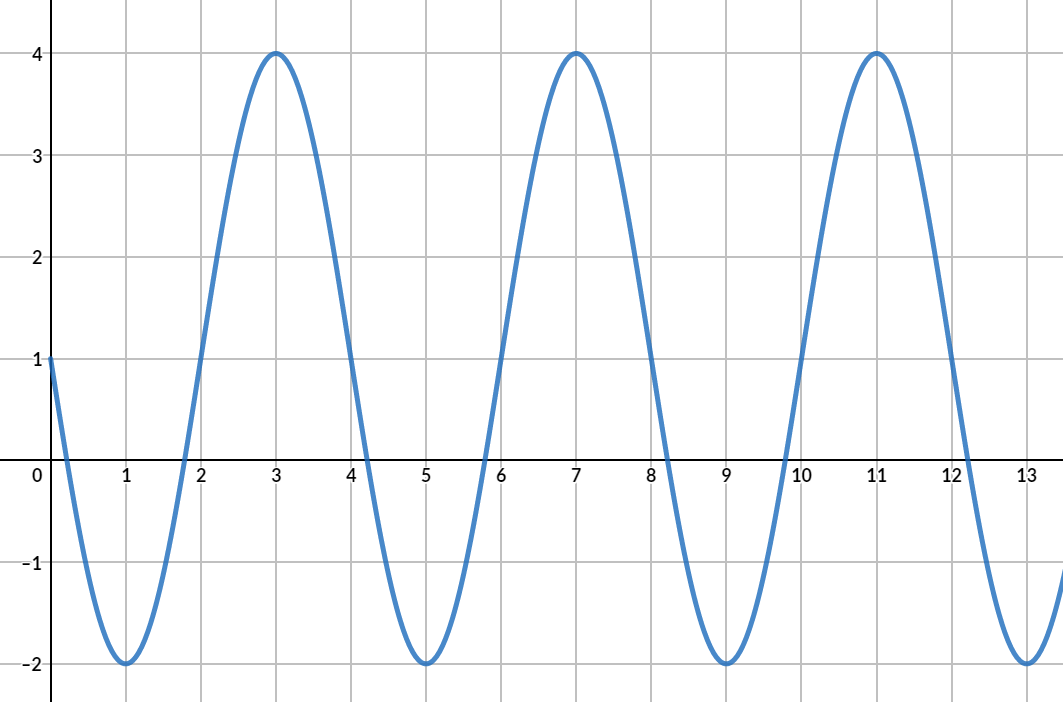
a) What is the period?
b) What is the maximum value?
c) What is the minimum value?
d) What is the equation of the axis?
e) What is the amplitude?
f) When does the next peak occur (after 13s)?
g) When does the next trough occur (after 13s)?
h) The function is given by . What is ? [Round to the nearest tenth]
0:00 / 0:00
Example: Sinusoidal Functions
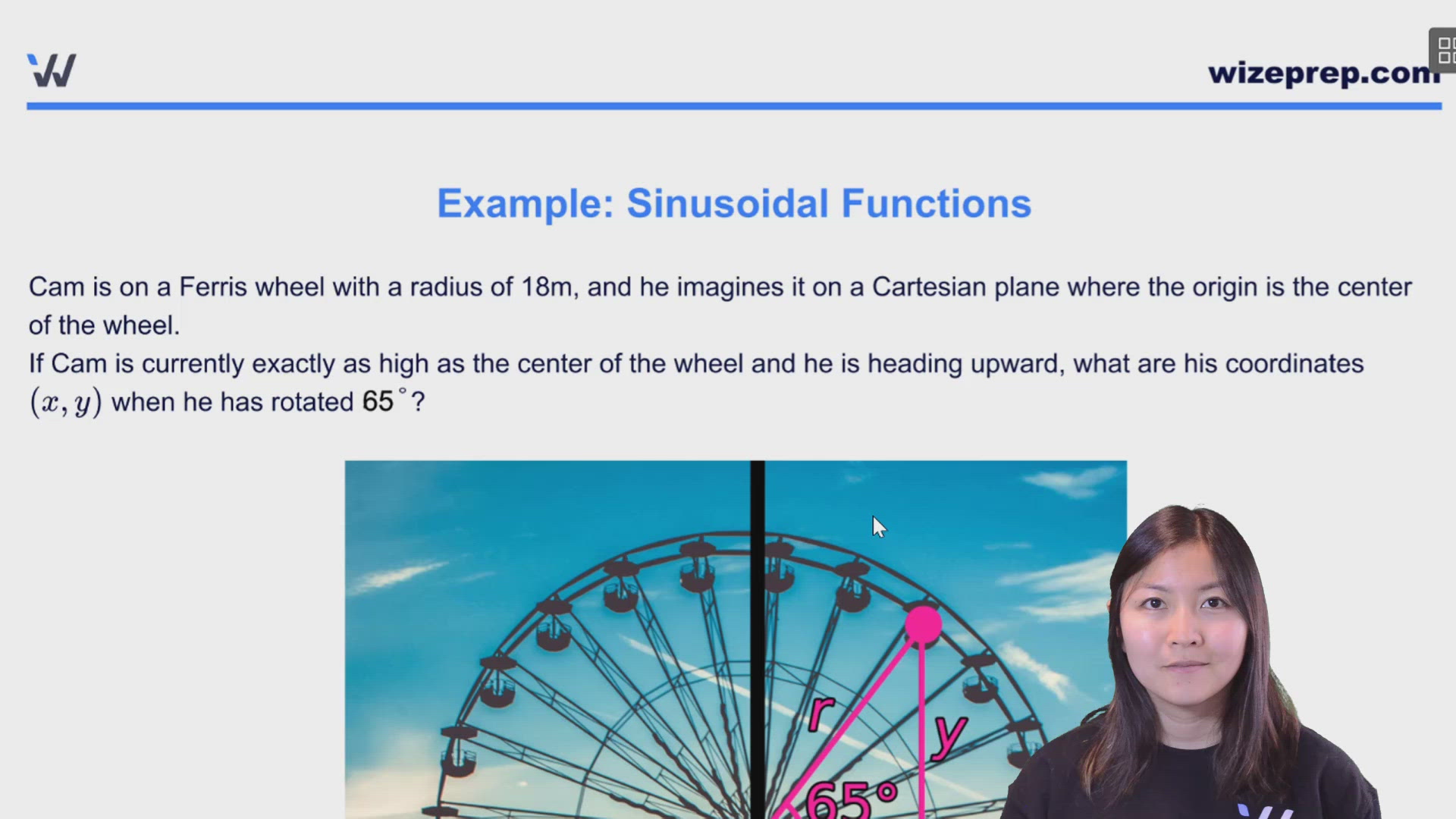
Cam is on a Ferris wheel with a radius of 18m, and he imagines it on a Cartesian plane where the origin is the center of the wheel.
If Cam is currently exactly as high as the center of the wheel and he is heading upward, what are his coordinates when he has rotated ?
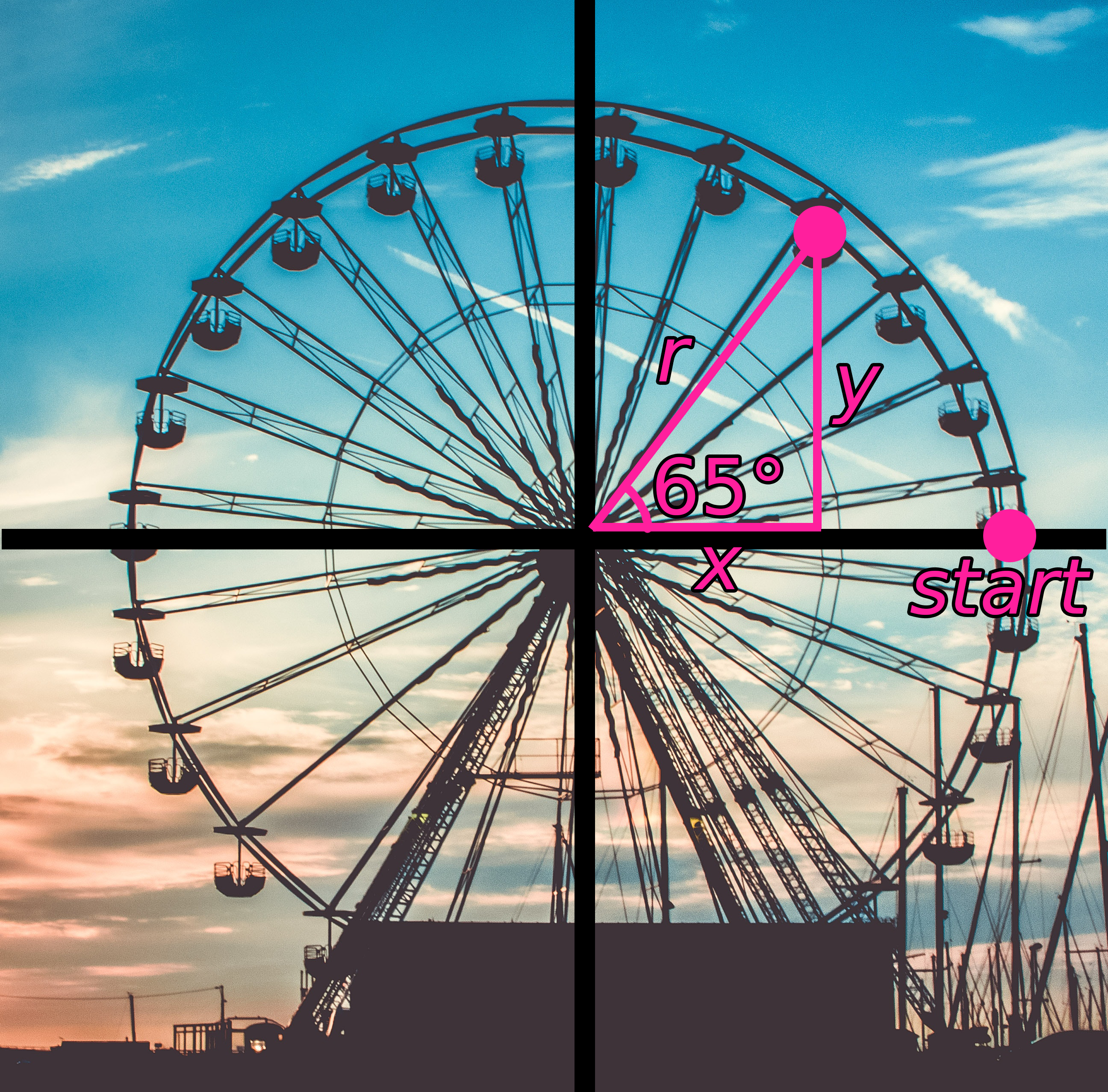
Cam starts at , since the center of the wheel is and the radius is 18m.
Looking at the right triangle in the image, we can rewrite and using trig ratios:
This works for any circle! We can always write a point on a circle as .
Now all we have to do is sub in the values given in the question:
Practice: Sinusoidal Functions
The point on the unit circle (circle with radius 1) is rotated counter-clockwise.
What are the coordinates of the new point?
Practice: Sinusoidal Functions
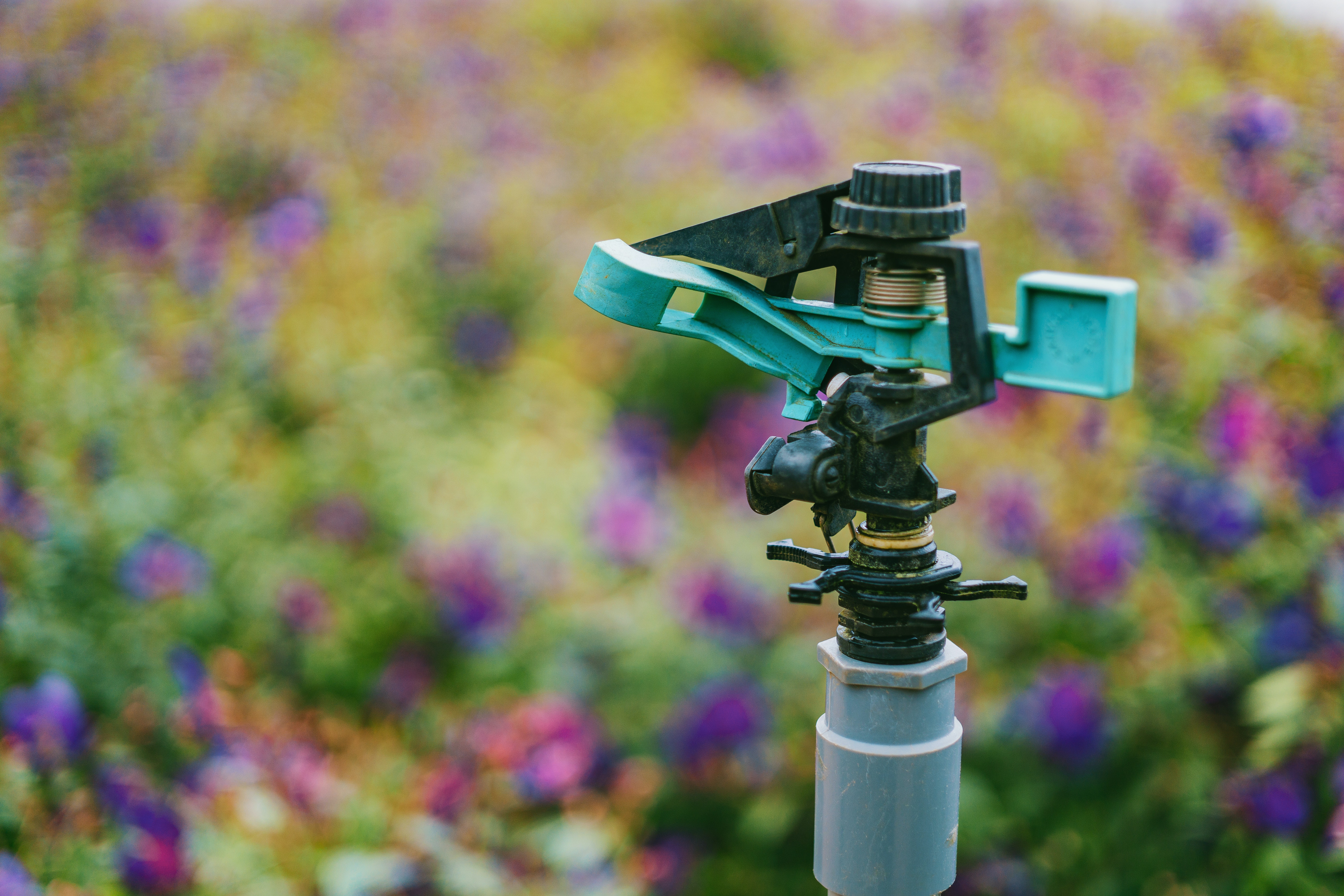
A sprinkler oscillates left and right from its neutral position.
Its motion can be modelled by , where is in seconds, is in centimeters, and right is represented as positive.
Use technology to produce a graph of the first 40 seconds [make sure your graph is in DEGREES!].
a) What is the period? What does this represent?
b) How many times will the sprinkler return to its neutral position within the first two minutes?
c) What is the range of this sprinkler (i.e. how much distance is covered between the furthest left and furthest right positions)?