Wize High School Grade 9 Math Textbook > Investigating Relationships
Interpreting Graphs & Situations
0:00 / 0:00
Interpreting Graphs & Situations
A hypothesis or conjecture is a guess that you can make about a situation. When it comes to numerical data, we often want to hypothesize whether two variables are related, and if so, how they are related.

To test whether your hypothesis is true or not about two variables, we need to be given some numerical data. Then, we can create a scatter plot to see if there's a pattern (or trend) in our data.

0:00 / 0:00
Example: Social Media Posts VS Followers
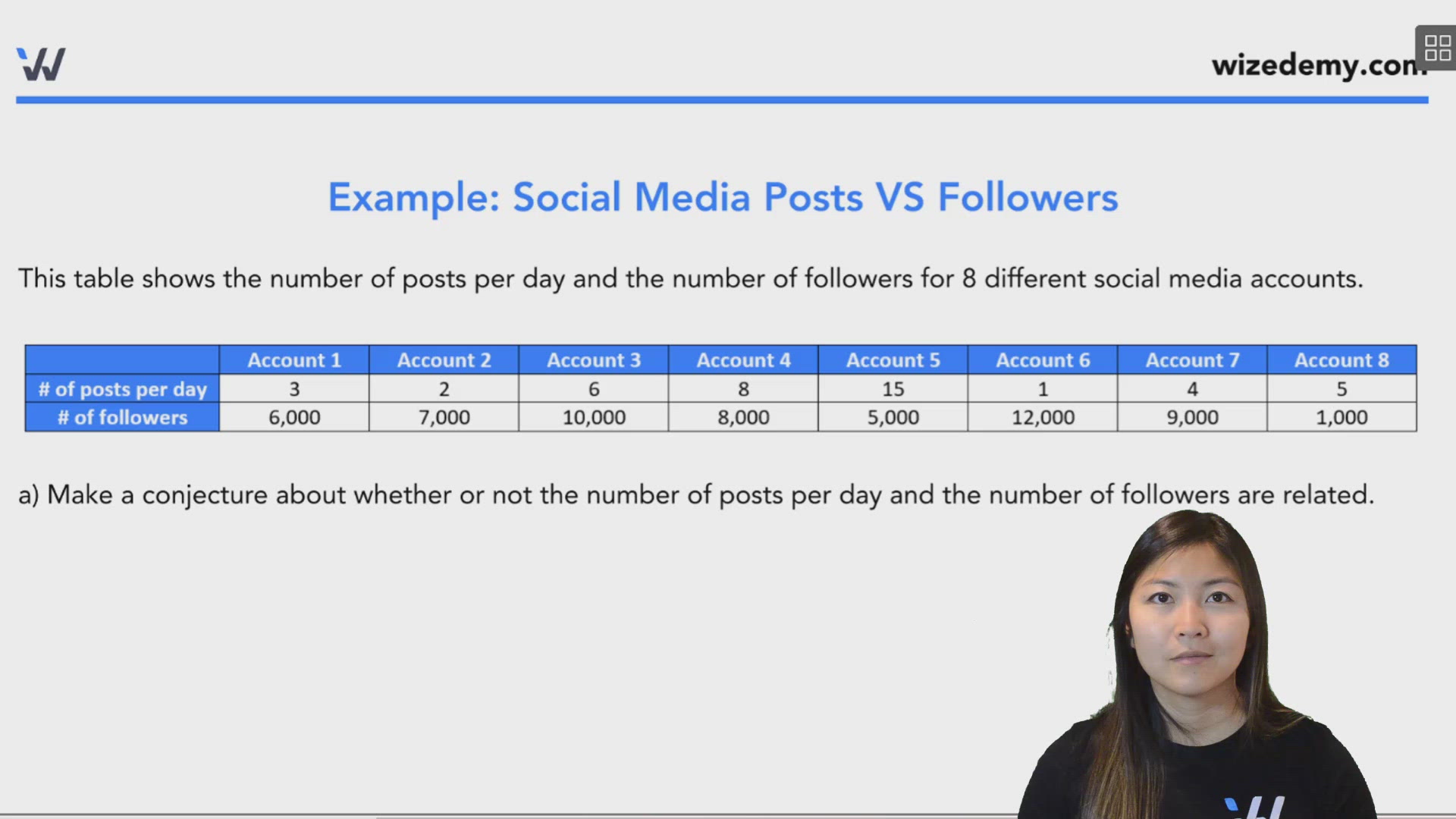
This table shows the number of posts per day and the number of followers for 8 different social media accounts.

a) Make a conjecture about whether or not the number of posts per day and the number of followers are related.
If we use the # of posts per day as our independent variable and the # of followers per day as our dependent variable, then it seems like our data is all over the place!
- The account with the most followers only posts once a day
- The account with the least followers posts 5 times a day
- It doesn't seem like the the # followers follows any sort of pattern in terms of the number of posts per day
Conjecture: The # of posts per day and the # of followers of a social media account are not related.
b) Create a scatter plot for your data.
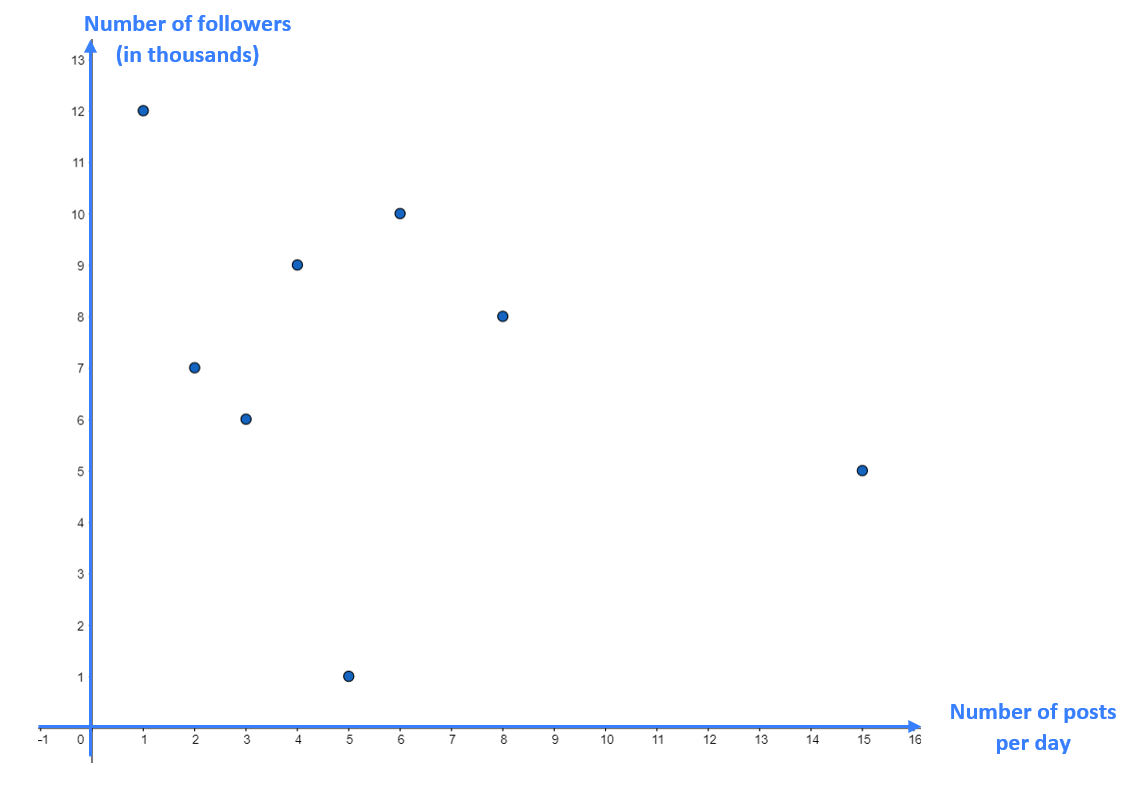
c) Use the scatter plot to either support or reject your conjecture.
Based on our scatter plot, there's no clear pattern or trend (we can't draw in a clear line or curve of best fit). So, we can support our conjecture and say that the # of posts per day and the # of followers of a social media account are not related.

Mark Yourself Question
- Grab a piece of paper and try this problem yourself.
- When you're done, check the "I have answered this question" box below.
- View the solution and report whether you got it right or wrong.
Practice: Running Speed VS Age
Mariel has been completing 10km runs since she was young. She recorded her race completion times in the following table.

a) Make a hypothesis about Mariel's age and the time it takes her to complete a 10km race.
b) Construct a scatter plot for your data.
c) Use your scatter plot to either support or reject your hypothesis.
Example: Amusement Park Rides
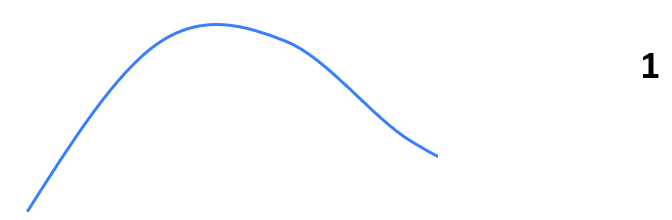
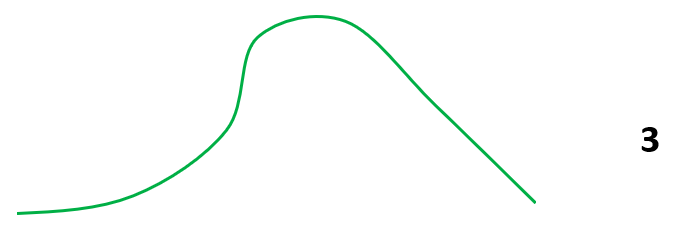
Andrew recorded the height of a rider for the first 25 seconds on 3 different roller coasters -- Sled-Dog, Scardy-Cat, and The Death Drop. He then provided sketches of the beginning part of each roller coaster. Try to match the sketch to its respective ride, and explain your choices.

A.
Scardy-Cat
B.
The Death Drop
C.
Sled-Dog

0:00 / 0:00
Displacement (Distance) & Velocity (Speed)
We often see problems that involved physical movement.
Examples
- A bird diving into water to catch a fish
- Michael Phelps swimming laps in an Olympic pool
- Usain Bolt leaving home and jogging to the library
- A car travelling down the 401 high way and making pit-stops along the way
- A plane's flight path
Displacement & Velocity
When a problem involves physical movement, we are often interested in displacement and velocity.
- Displacement
- Commonly known as distance, depth, or height
- This is the length measurement of a point relative to its starting point
- In the problems we solve, displacement is usually considered the dependent variable, and it depends on time
- Example Jayson leaves home and walks 3km east, he then walks 2km west back towards his house. His displacement is1km east
- Velocity
- Commonly known as speed
- This is the rate of change of distance over a period of time -- it is calculated as
- The units are usually meters/second or miles/hour or kilometers/hour
- Velocity also reflects the direction in which the object is moving
- Example Let's say that east is + and west is - Jayson leaves home and walks 10km west in 2 hours. His velocity is-10/2 = -5 km/hr
0:00 / 0:00
Example: Displacement VS Time Graphs
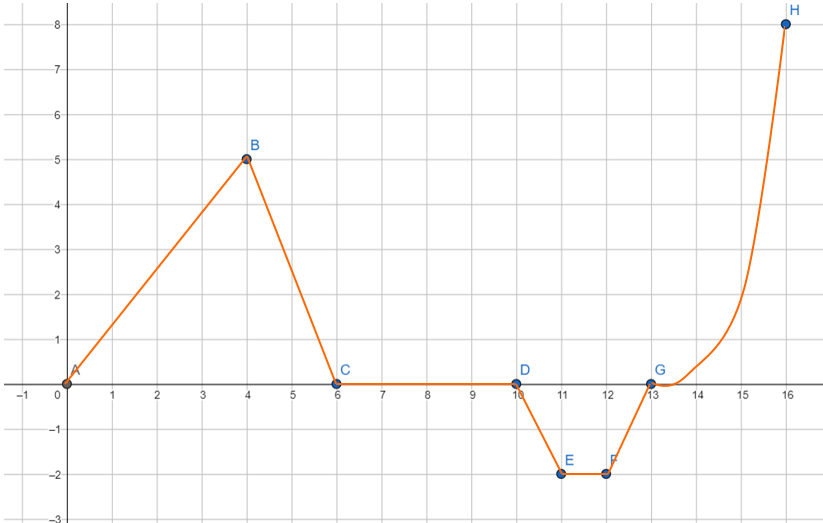
The following graph represents the first 16 seconds of Kevin's journey to school from home on the first of class. The vertical axis is given in meters.
a) What is the independent variable?
Time (in seconds)
b) What is dependent variable?
Displacement (in meters)
c) How far did Kevin walk in total in the first 4 seconds of his journey?
5 meters
d) How far did Kevein walk in total in the first 6 seconds of his journey?
10 meters
e) Where is Kevin at 8 seconds into his journey?
Home
f) What is Kevin's velocity (speed) between 0 and 4 seconds?
Slope = 5m/4s = 1.25 m/s
g) What is Kevin's velocity (speed) between 4 and 6 seconds?
Slope = -5m/2s = -2.5 m/s
h) What does the flat line between 6 and 10 seconds mean?
His speed or velocity from 6 to 10 seconds is . So, the flat line means that Kevin's speed or velocity is 0, meaning that he is not moving away from his house at that point
i) Between which 2 points is Kevin's speed the fastest?
Although we don't have a straight line between points G and H (between 13 and 16 seconds), we can see that the curve is the steepest between those 2 points. So, Kevin's speed is the fastest between G and H.
j) Create a possible story that can be described by this displacement-time graph.
- A-B: Kevin starts leaves home and walks towards his school at 1.25m/s for 4 seconds.
- B-C: He realizes that he forgot his keys, so he quickly turns around and walks faster at a pace of 2.5 m/s towards home for 2 seconds
- C-D: He gets home and searches for his keys for 4 seconds
- D-E: He then realizes that his keys are in the shed behind his house, so he walks at a pace of 2m/s away from his house towards his shed (in the opposite direction of school)
- E-F: He takes 1 second to find his keys in the shed
- F-G: He walks back towards his house at a pace of 2m/s
- G-H: He then slowly leaves his house, but quickly picks up his pace and starts jogging towards school.
Mark Yourself Question
- Grab a piece of paper and try this problem yourself.
- When you're done, check the "I have answered this question" box below.
- View the solution and report whether you got it right or wrong.
Practice: Displacement VS Time Graphs
Here is a displacement (speed) vs time graph for an object. The horizontal axis is in seconds and the vertical axis is in feet.
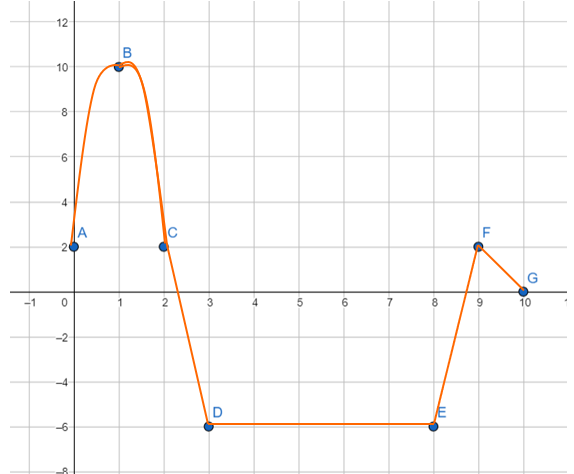
a) Identify the sections of this graph that are linear (constant speed/velocity)
b) What is the total distance travelled between point C and D?
c) What is the speed between point C and point D?
d) What is the speed between point D and point E?
e) Where is the speed of this object the fastest? Between C and D, between E and F, or between F and G?
f) Create a story for this displacement vs time graph.