Curve of Best Fit
Sometimes the data points in a scatter plot can follow a pattern/trend that is not a straight line. In these situations, it might be more appropriate to draw a smooth curve that follows the pattern of the data points -- this is called the curve of best fit.
Note
In this case, the two variables do not follow a linear relation!

Example: Curve or Line of Best Fit

a) Construct a scatter plot representing the data from the table above.
b) Sketch a line of best fit for these data points.
c) Sketch a curve of best fit for these data points.
d) Would a line of best fit or curve of best fit be better for approximating the value when ? Explain.
e) Would a line of best fit or curve of best fit be better for approximating the value when ? Explain.
f) Is a good estimate for when the value of ?
g) Is a good estimate for when the value of ?
Parts a), b), and c)
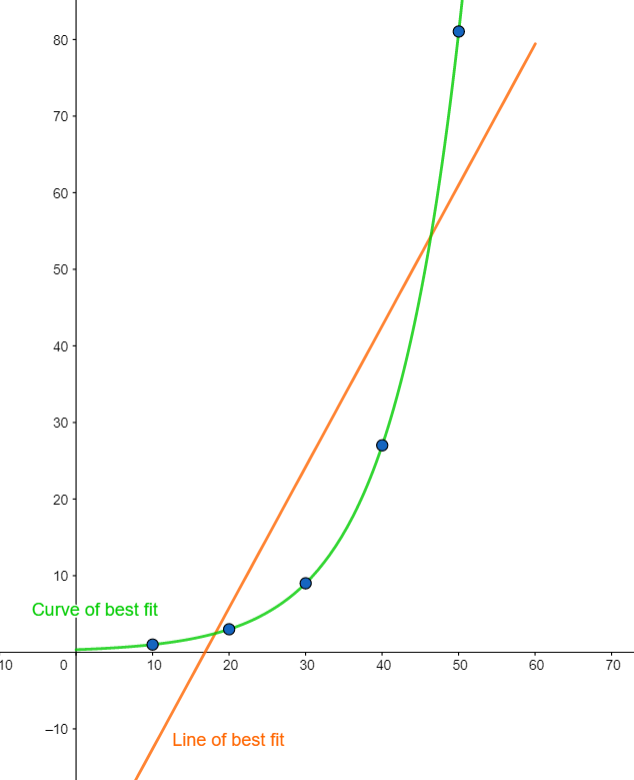
Parts d) and e)
In either case, the curve of best fit gives us a better approximation because it follows the data points more closely.
Part f)
According to the curve of best fit, when , the value should be somewhere close to the middle between 1 and 9. So, is a good estimate.
Part g)
According to the curve of best fit, when , the value should be much larger than the 81, which is the value when . Although is larger than 81, it's not much larger. So, is NOT a good estimate.
*Consider the "y-gap" between and , the different in values is . Seeing how the curve of best fit curves up steeper and steeper as increases, we know that the value when will be larger than .