0:00 / 0:00
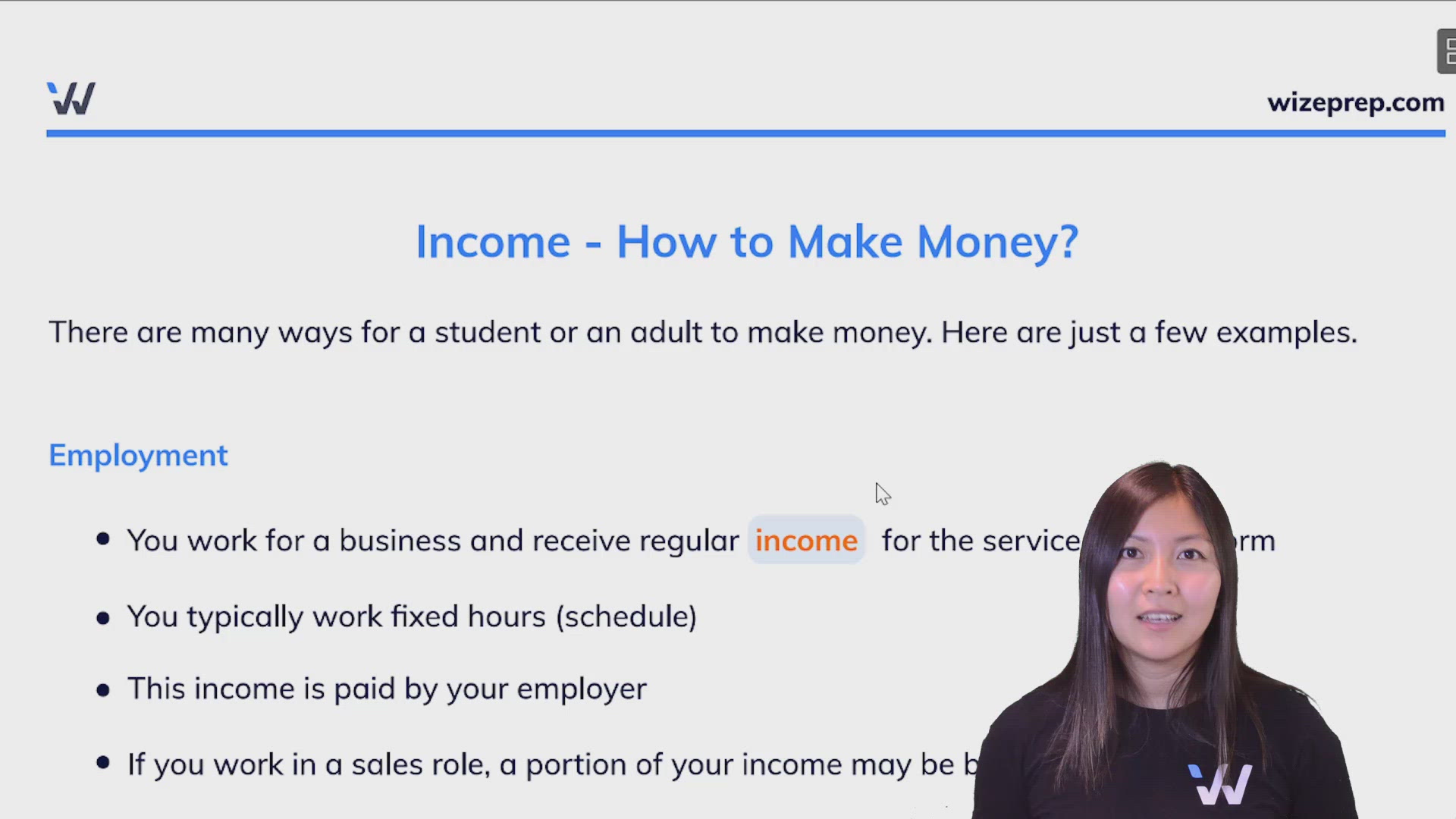
Income - How to Make Money?
There are many ways for a student or an adult to make money. Here are just a few examples.
Employment
- You work for a business and receive regular income for the services you perform
- You typically work fixed hours (schedule)
- This income is paid by your employer
- If you work in a sales role, a portion of your income may be based on commission
- Examples
- A cashier working at a grocery store
- A librarian working at a high school

Self-Employment/ Freelance Worker
- You are the business and set your own working hours and pay rate for performing a service
- Earn based on how much you work or how much you sell
- Income may not be predictable
- Paid by customer
- Examples
- A tutor
- An Uber (ride-share program) driver

Business Owner
- You own a business that sells a service or a product
- You may employ other people to help generate income
- Income may not be predictable and the business may involve some risk
- Can take up very little or very much of your time
- Examples
- An owner of a McDonald’s restaurant
- An owner of local car wash

Investment
- Your own assets that generate continuous income
- The earnings are usually a percentage of the value of your assets
- Income may not be predictable and investments usually involve risks
- Can take up very little of your time
- Examples
- A landlord collecting rent from tenants
- A retired person with stocks and bonds

To learn more about investments, check out the section on Interest, Investments, Appreciation & Depreciation.
0:00 / 0:00
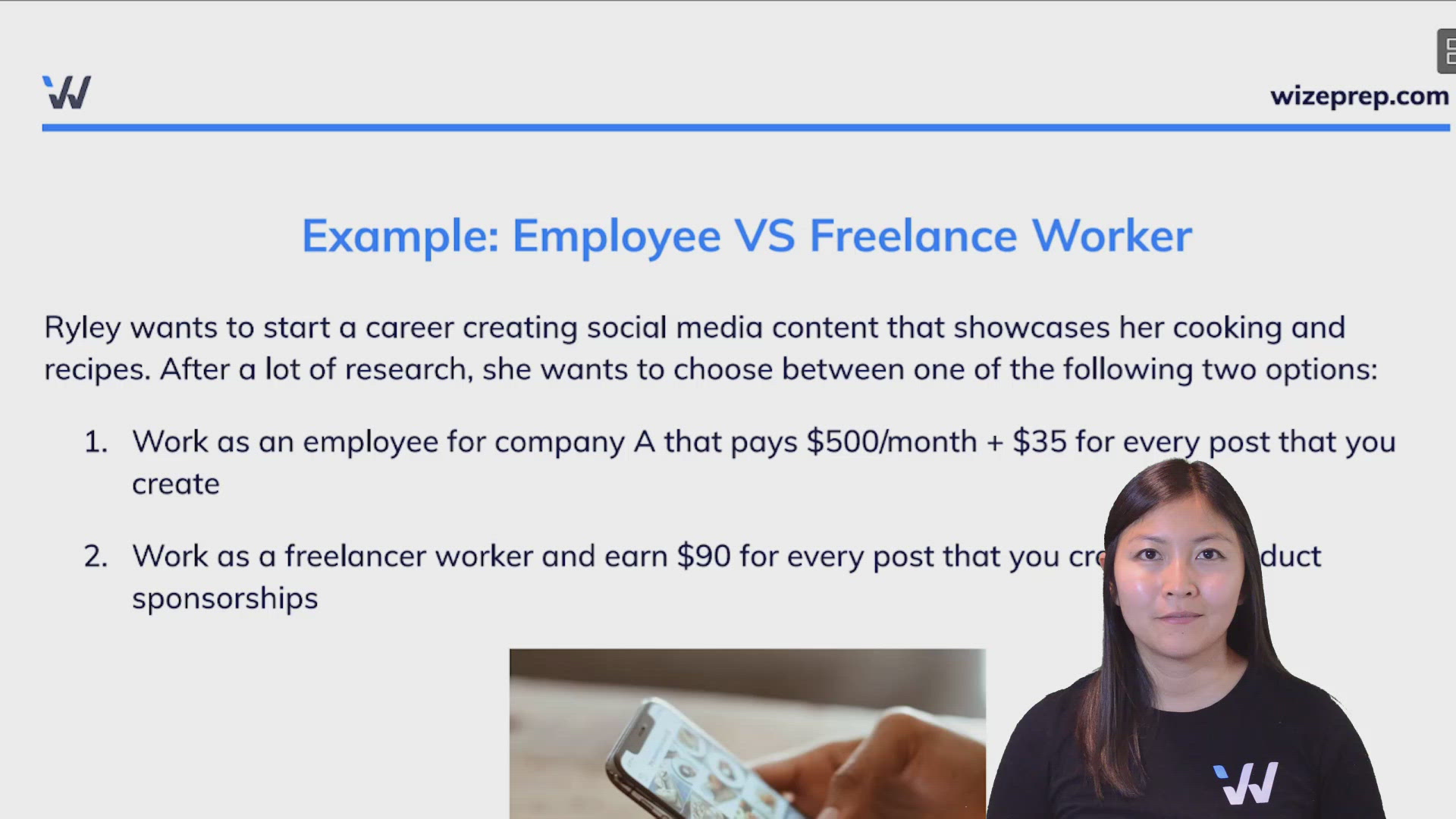
Example: Employee VS Freelance Worker
Ryley wants to start a career creating social media content that showcases her cooking and recipes. After a lot of research, she wants to choose between one of the following two options:
- Work as an employee for company A that pays $500/month + $35 for every post that you create
- Work as a freelancer worker and earn $90 for every post that you create for product sponsorships

If you were Ryley, which work option will you choose? Make sure to state the factors that will influence your decision.
The pay for the two work option have something in common, and that is the number of posts. Let represent the number of posts that Ryley can make in a month.
We can create algebraic expressions that represent the monthly pay (in $) for both options:
- Option 1:
- Option 2:
We can also create a table of values for the monthly pay in both options:
We can also graph these two pay models:

In order for Ryley to decide on which work option to pick, she will need to have an estimate of how many posts she thinks she's able to make in a month (she needs to know on average how long it takes her to make one post).
- If Ryley can only make 9 or fewer posts in a month, then option 1 will have the higher pay
- If Ryley can make 10 or more posts in a month, then option 2 will have a higher pay
Practice: Commission VS Wages
A local car dealership is advertising for a junior sales associate position that come with two monthly pay options:
- The employee can earn a 3% commission on the total amount of sales they make in a month, plus a base salary of $1200/month
- The employee can earn a 5% commission on the total amount of sales they make in a month, plus a base salary of $500/month

Create two algebraic expressions that represent an employee's monthly pay if they make $x worth of sales in a month.
Use decimals (NOT percentages) in your expressions.
Practice: Starting Your Own Business
Steve wants to start his own business selling products online. He is choosing between the following product ideas:
- He could sell kitchen sponges with cartoon designs on them:
- This will cost him $100 to start the business, then each sponge will cost $3 to make
- Each sponge can sell for $5
- He could sell smart vacuums:
- This will cost him $2000 to start the business, then each vacuum will cost $250 to make
- Each vacuum can sell for $450


Mark Yourself Question
- Grab a piece of paper and try this problem yourself.
- When you're done, check the "I have answered this question" box below.
- View the solution and report whether you got it right or wrong.
What factors should you consider when deciding between a low cost but high volume business (like sponges) VS a high cost but low volume business (like vacuums)?
There's really no wrong answer, so think of as many factors as you can 😄
0:00 / 0:00
Paychecks, Taxes, and Deductions
If you are an employee of a company, you will receive a paycheck (sometimes called pay stub or statement of earnings and deductions) usually monthly or bi-weekly. Here's a made-up example:
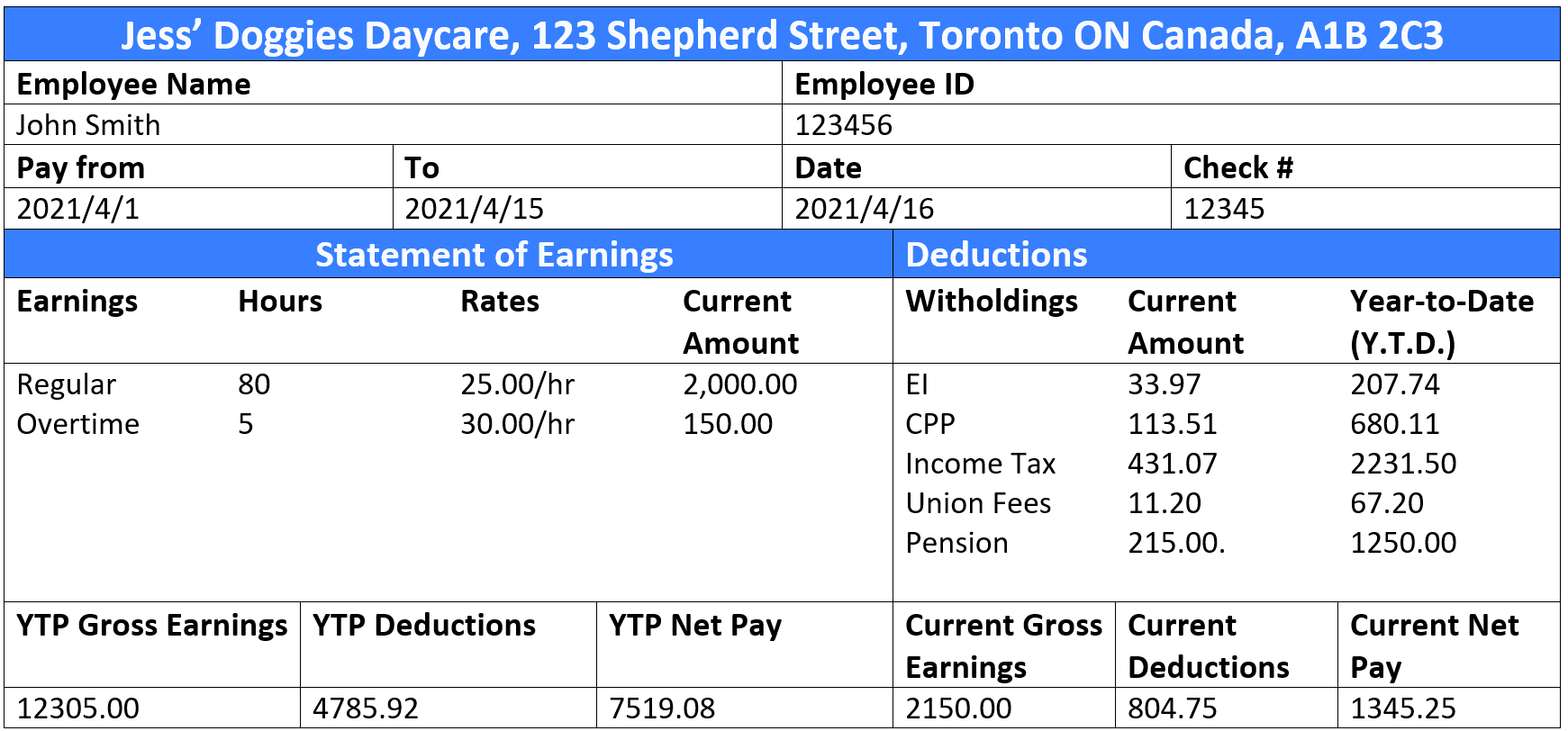
Some terminology explained:
- Gross earnings: this is how much you made based on your hourly rate and the number of hours you worked
- Deductions: the things that are subtracted from your gross earnings
- EI: employment insurance, which is a temporary income support to unemployed workers while they look for employment, upgrade their skills, or are unable to work due to some illnesses
- CPP: Canadian pension plan retirement pension is a monthly, taxable benefit that replaces part of your income when you retire. If you qualify, you’ll receive the CPP retirement pension for the rest of your life
- Income tax: the government takes a portion of earned income in the form of federal and provincial/territorial income tax to fund public services, pay government obligations, and provide goods for citizens.
- Net pay: the amount of money you get to take home after all deductions