Wize High School Grade 12 Calculus Textbook > Rate of Change

Evaluating 00\frac{0}{0} Limits -- with Radicals

Create a free account to get started

Unlock full course notes by signing up

  • Video lessons taught by top educators
  • Practice questions with guided solutions
  • Written review notes for reference
  • Expert answers anytime from course tutors

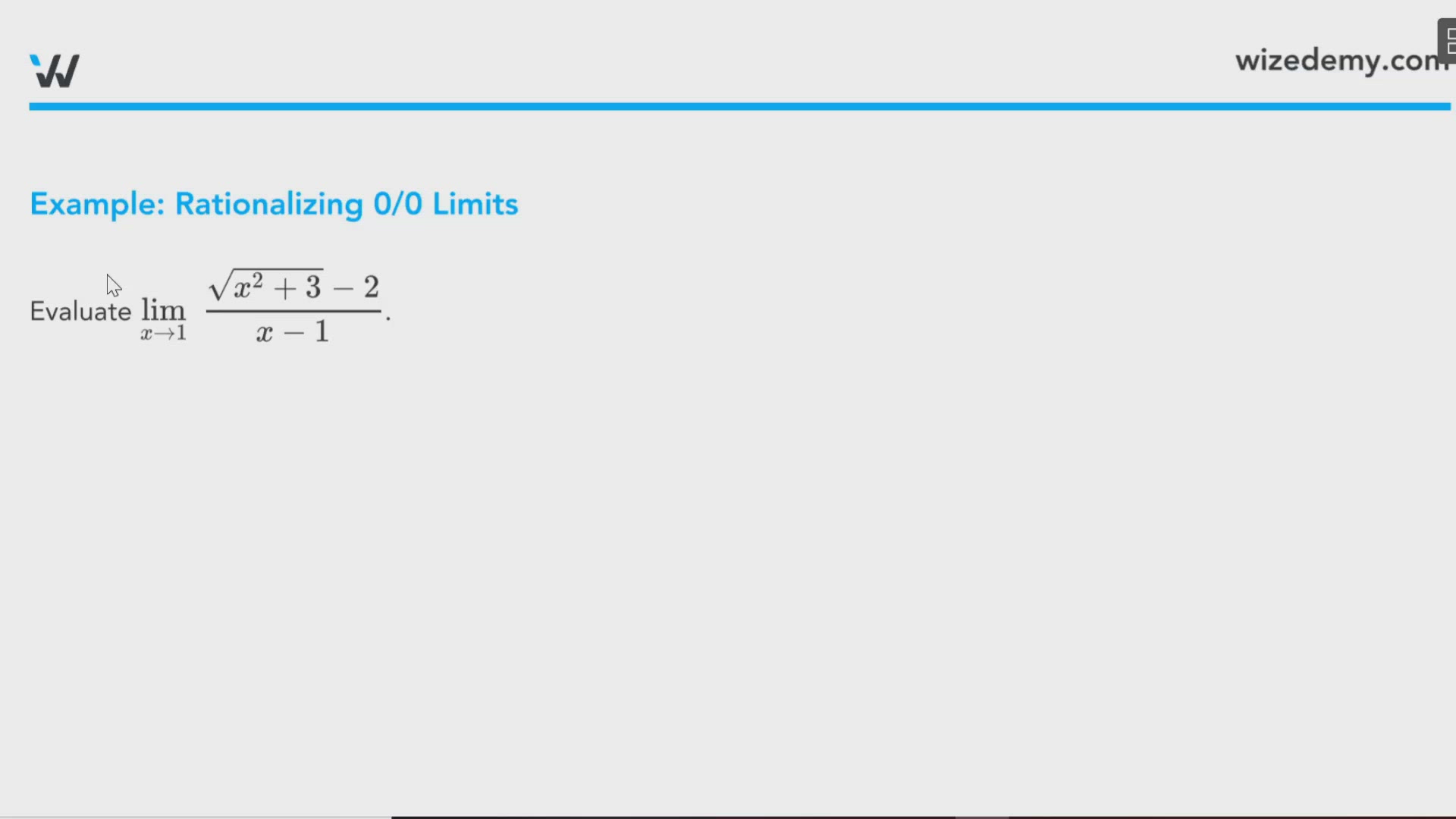
Example: Rationalizing 0/0 Limits

Evaluate lim⁡x→1 x2+3−2x−1\displaystyle\lim_{x\to1}\ \frac{\sqrt{x^2+3}-2}{x-1}.


Direct substitution gives us 00\frac{0}{0}.


Multiply top and bottom by the conjugate:

lim⁡x→1 x2+3−2x−1\displaystyle\lim_{x\to1}\ \frac{\sqrt{x^2+3}-2}{x-1}

=lim⁡x→1 x2+3−2x−1×x2+3+2x2+3+2=\displaystyle\lim_{x\to1}\ \frac{\sqrt{x^2+3}-2}{x-1}\times \frac{\sqrt{x^2+3}+2}{\sqrt{x^2+3}+2}

*Recall the difference of squares: (a−b)(a+b)=a2−b2\color{red}(a-b)(a+b)=a^2-b^2


So we can simplify the numerator:

=lim⁡x→1 (x2+3)2−22(x−1)(x2+3+2)=\displaystyle\lim_{x\to1}\ \frac{(\sqrt{x^2+3})^2-2^2}{(x-1)(\sqrt{x^2+3}+2)}

=lim⁡x→1 x2+3−4(x−1)(x2+3+2)=\displaystyle\lim_{x\to1}\ \frac{x^2+3-4} {(x-1)(\sqrt{x^2+3}+2)}

=lim⁡x→1 x2−1(x−1)(x2+3+2)=\displaystyle\lim_{x\to1}\ \frac{x^2-1} {(x-1)(\sqrt{x^2+3}+2)}

=lim⁡x→1 (x−1)(x+1)(x−1)(x2+3+2)=\displaystyle\lim_{x\to1}\ \frac{(x-1)(x+1)} {(x-1)(\sqrt{x^2+3}+2)}

=lim⁡x→1 x+1x2+3+2=\displaystyle\lim_{x\to1}\ \frac{x+1} {\sqrt{x^2+3}+2}

=1+11+3+2=\frac{1+1}{\sqrt{1+3}+2}

=24=\frac{2}{4}

=12=\frac{1}{2}

Practice: Rationalizing 0/0 Limits

lim⁡x→0 xx+4−4−x=\displaystyle\lim_{x\to0}\ \frac{x}{\sqrt{x+4}-\sqrt{4-x}}=

Your answers

Create a free account to get started

Unlock full course notes by signing up

  • Video lessons taught by top educators
  • Practice questions with guided solutions
  • Written review notes for reference
  • Expert answers anytime from course tutors