Wize High School Grade 12 Calculus Textbook > Rate of Change

Evaluating 00\frac{0}{0} Limits -- with Absolute Values

0:00 / 0:00

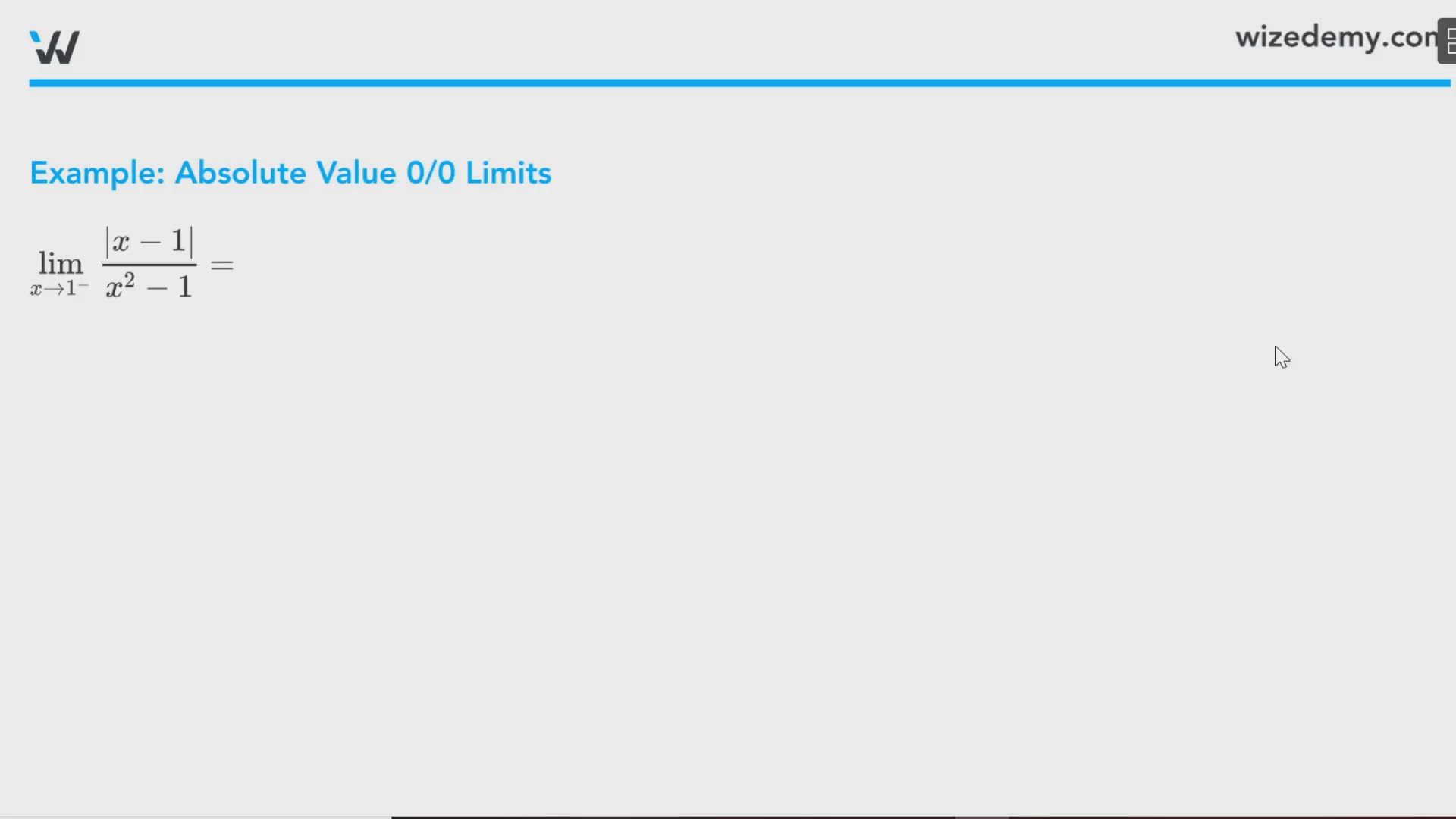
Example: Absolute Value 0/0 Limits

lim⁡x→1−∣x−1∣x2−1=\displaystyle\lim _{x\rightarrow1^-}\frac{\left|x-1\right|}{x^2-1}=

Direct substitution gives us 00\frac{0}{0}.

As x→1−x\rightarrow1^-, x−1x-1 is negative, so ∣x−1∣=−(x−1)\left|x-1\right|=-\left(x-1\right).
Let's rewrite the limit without absolute values.
lim⁡x→1−∣x−1∣x2−1\displaystyle\lim _{x\rightarrow1^-}\frac{\left|x-1\right|}{x^2-1}
=lim⁡x→1−−(x−1)x2−1=\displaystyle\lim _{x\rightarrow1^-}\frac{-(x-1)}{x^2-1}
=lim⁡x→1−−(x−1)(x−1)(x+1)=\displaystyle\lim _{x\rightarrow1^-}\frac{-(x-1)}{(x-1)(x+1)}
=lim⁡x→1−−1x+1=\displaystyle\lim_{x\to1^-}-\frac{1}{x+1}
=−12=-\frac{1}{2}

Practice: Absolute Value 0/0 Limits

lim⁡x→0 ∣3−2x∣−∣2x−3∣x=\displaystyle\lim_{x\to0}\ \frac{\left|3-2x\right|-\left|2x-3\right|}{x}=

Practice: Absolute Value 0/0 Limits

Evaluate lim⁡x→2 x−2∣5x−10∣\displaystyle\lim_{x\to2}\ \frac{x-2}{|5x-10|}, if it exists.