Wize High School Grade 12 Calculus Textbook > Intersections of Lines & Planes
Intersection of 3 Planes
Intersection of 3 Planes
Example: Intersection of 3 Planes (p.o.i. = point)
Example: Intersection of 3 Planes (p.o.i. = line)
Example: Intersection of 3 Planes (p.o.i. = line)
Example: Intersection of 3 Planes (p.o.i. = plane)
Practice: Intersection of 3 Planes
Example: Intersection of 3 Planes (no p.o.i.)
Example: Intersection of 3 Planes (no p.o.i.)
Example: Intersection of 3 Planes (no p.o.i.)
Practice: Intersection of 3 Planes
Popular Courses
Find My Course
0:00 / 0:00
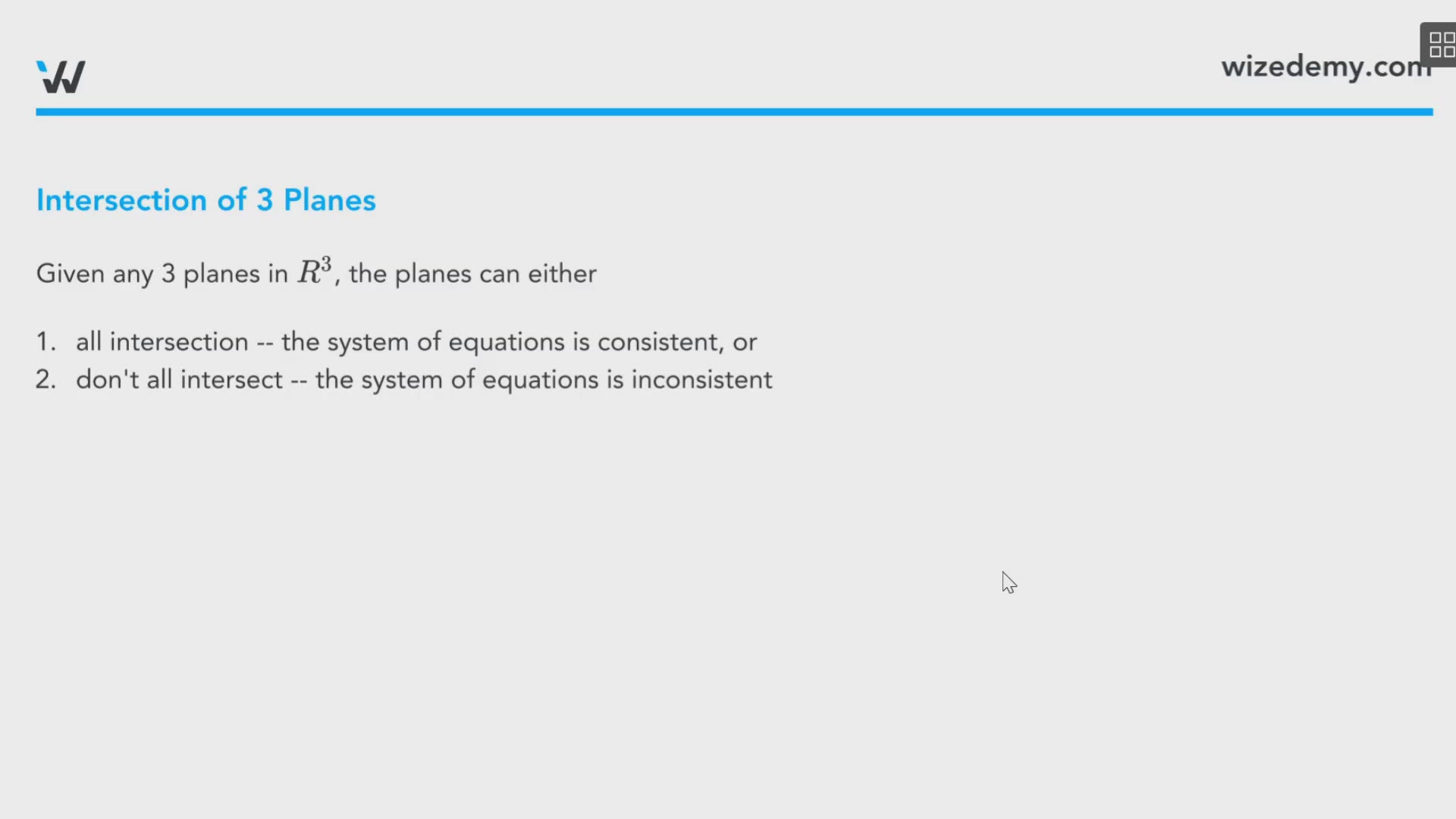
Intersection of 3 Planes
Given any 3 planes in , the planes can either
- all intersection -- the system of equations is consistent, or
- don't all intersect -- the system of equations is inconsistent
Consistent: 4 Possible Scenarios
1) The planes intersect at a single point → there is exactly one point of intersection.
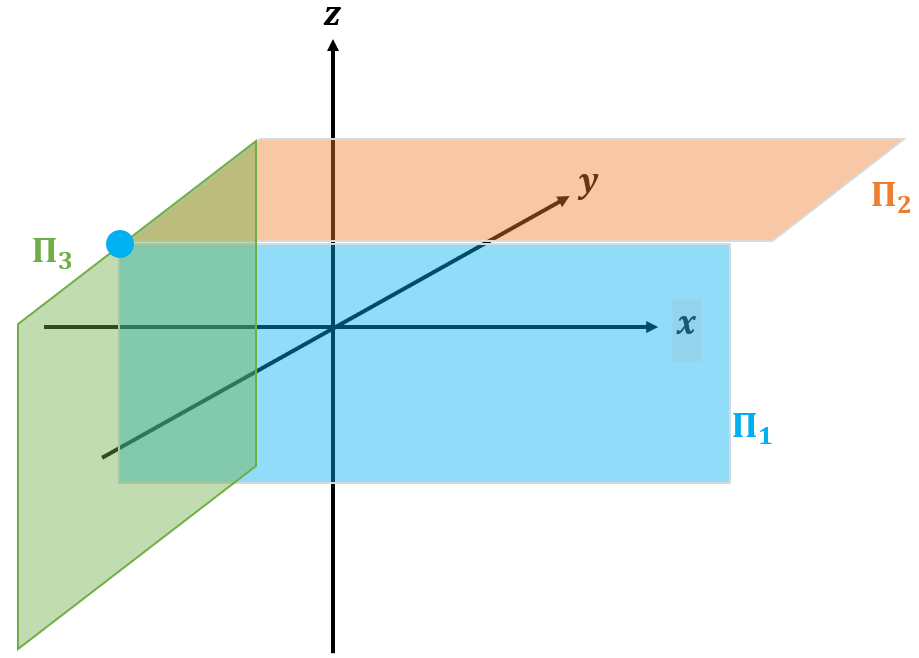
2) The planes intersect in a single line → none of the planes are parallel or exactly 2 of the planes are parallel

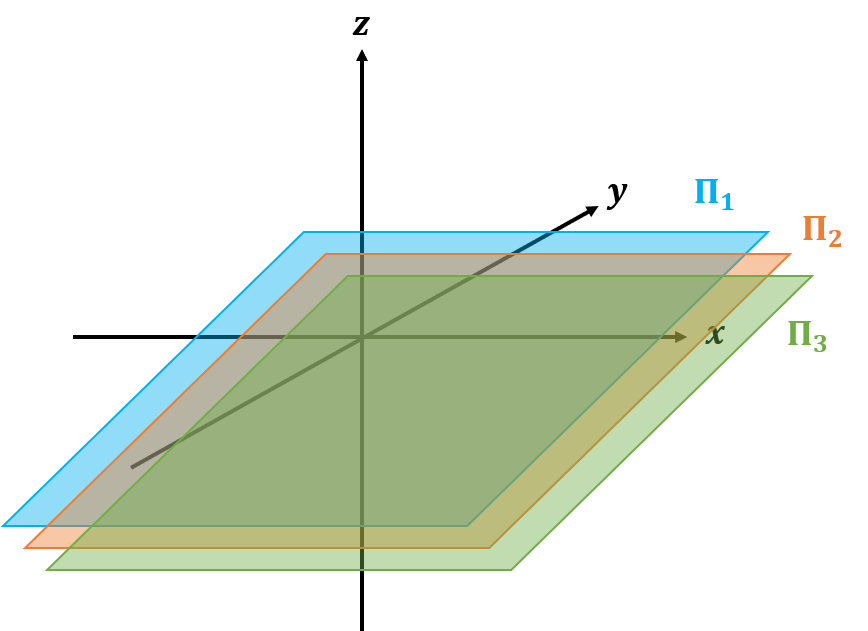
3) The planes coincide → the intersection is the entire plane itself
Inconsistent: 4 Possible Scenarios
1) The 3 planes are parallel and at least one is distinct → there are no points of intersection between the 3 planes
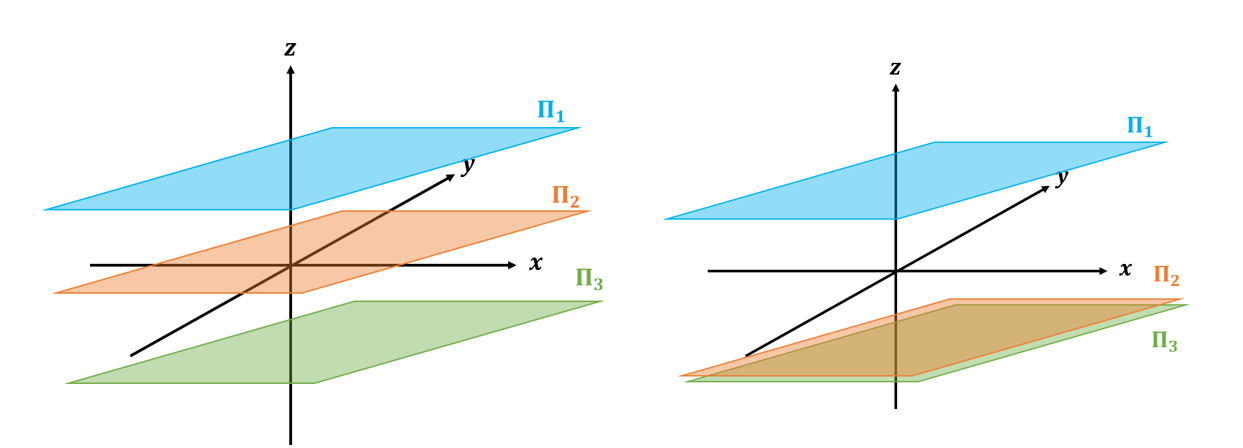
2) The planes form an "H" pattern → there are no points of intersection between the 3 planes
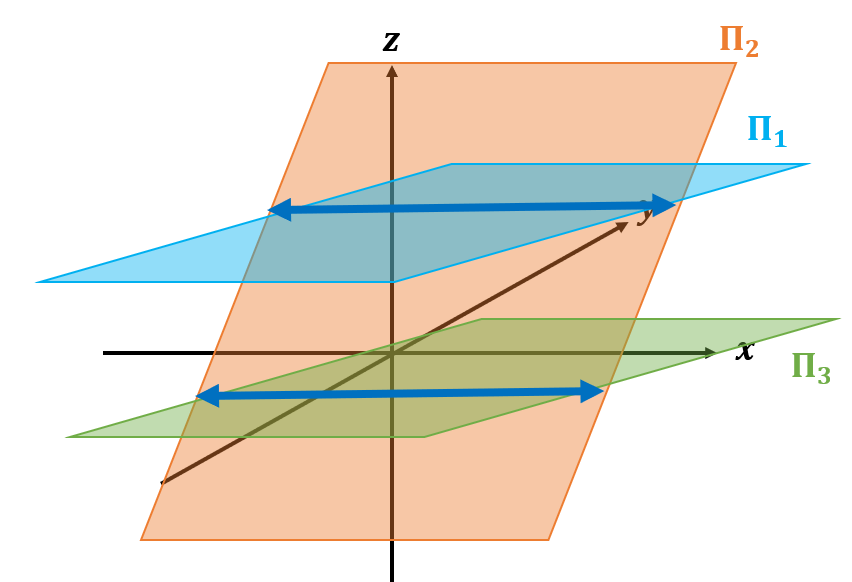
4) The planes form a triangular prism ("" patter) → there are no points of intersection between the 3 planes
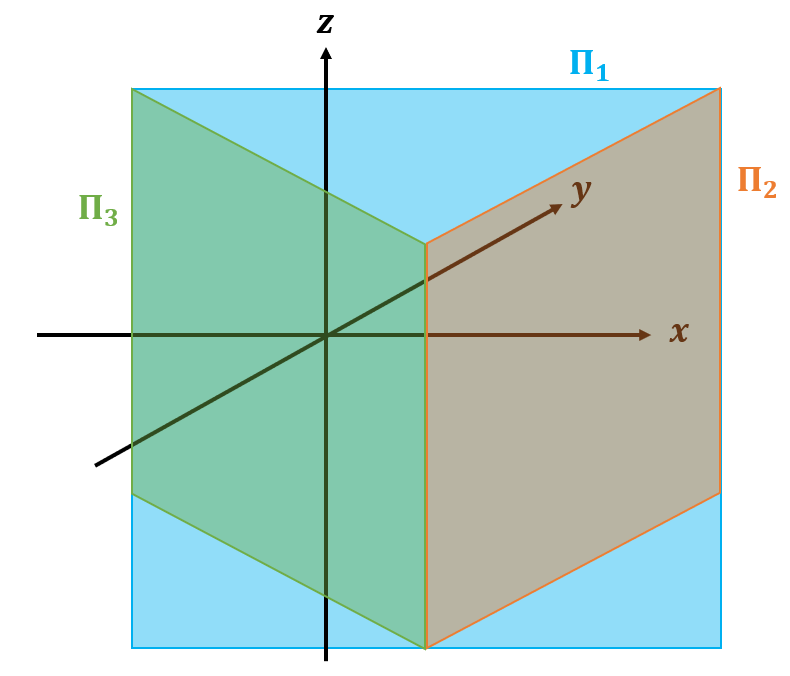
Finding Points of Intersection
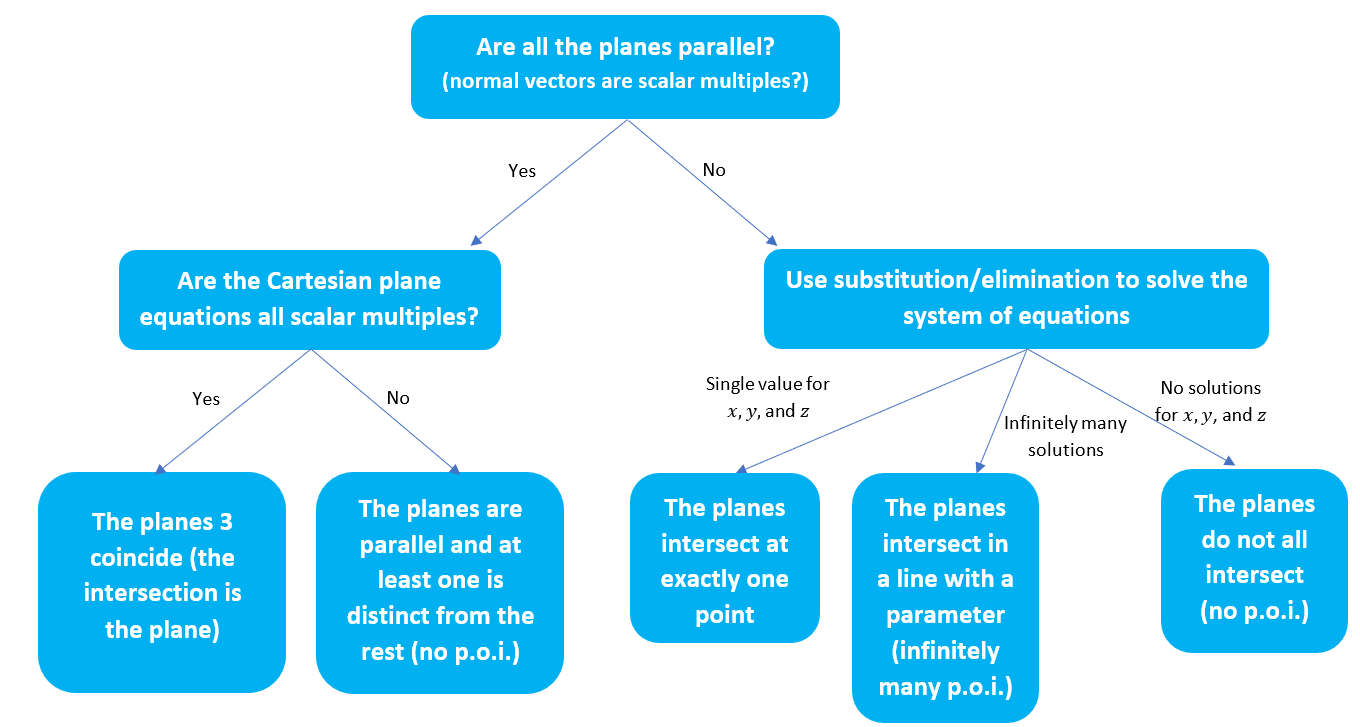
To determine if the 3 planes intersect, we can use substitution or elimination to solve the system of 3 equations.
- If we get an exact point ➝ the 3 planes intersect at exactly one point
- If we get an equation tha makes sense for any values of x, y, or z (ex. ) ➝ the 3 planes either intersect in a line or a plane
- If we get an equation that does make sense for any values of x, y, or z (ex. ) ➝ the 3 planes don't intersect
0:00 / 0:00
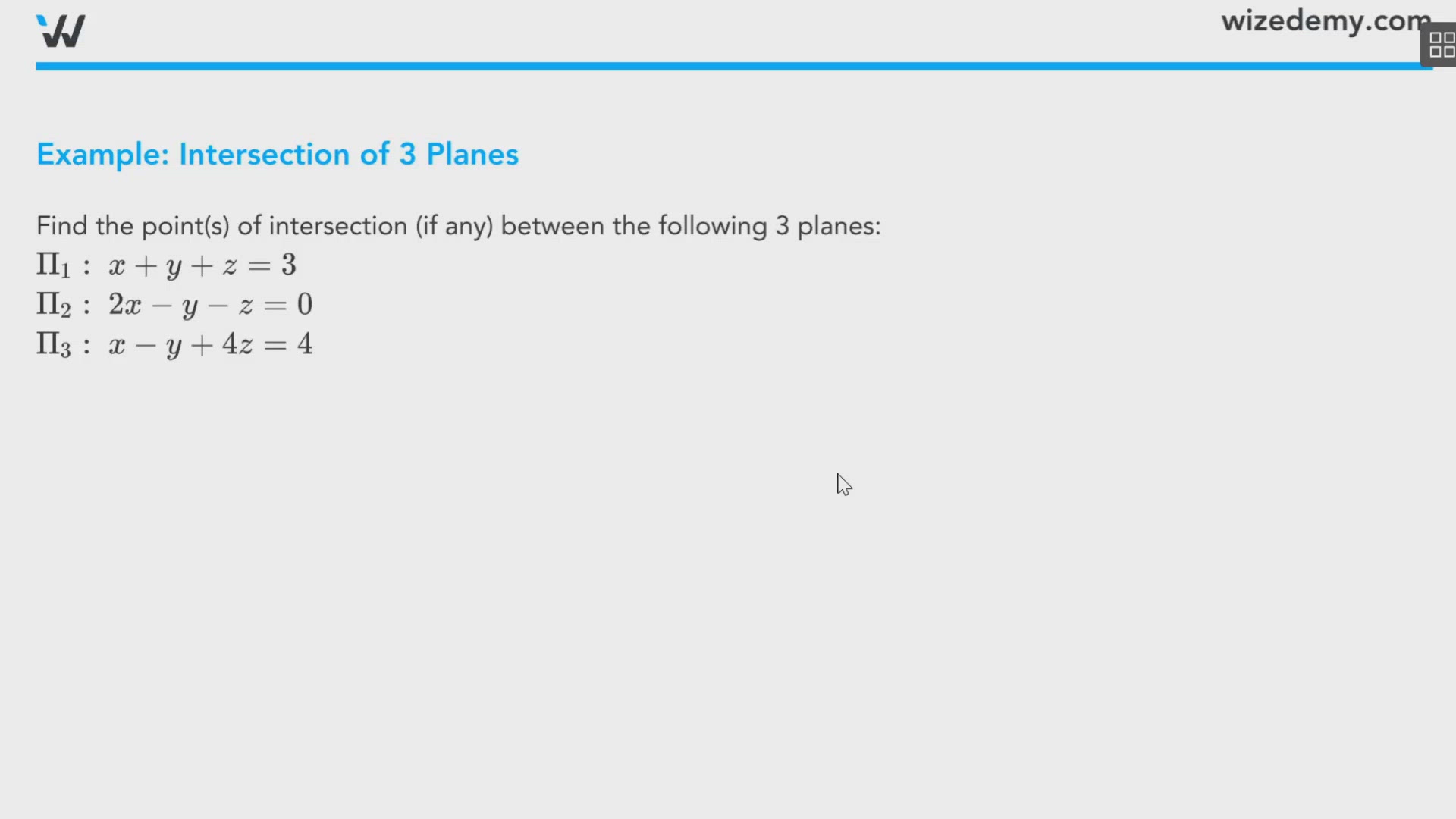
Example: Intersection of 3 Planes
Find the point(s) of intersection (if any) between the following 3 planes:
Check if the planes are parallel
None of , , or are scalar multiples of one another, so the planes are not parallel.
Solve for one variable in plane 1
Equation 1:
Substitute this into both equations 2 and 3:
Equation 2: ➝
Equation 3: ➝
Now we need to solve these two equations
From the new Equation 2:
Substitute this into the new equation 3: ➝ ➝
Back substitute
Therefore, the planes intersect at an exact point
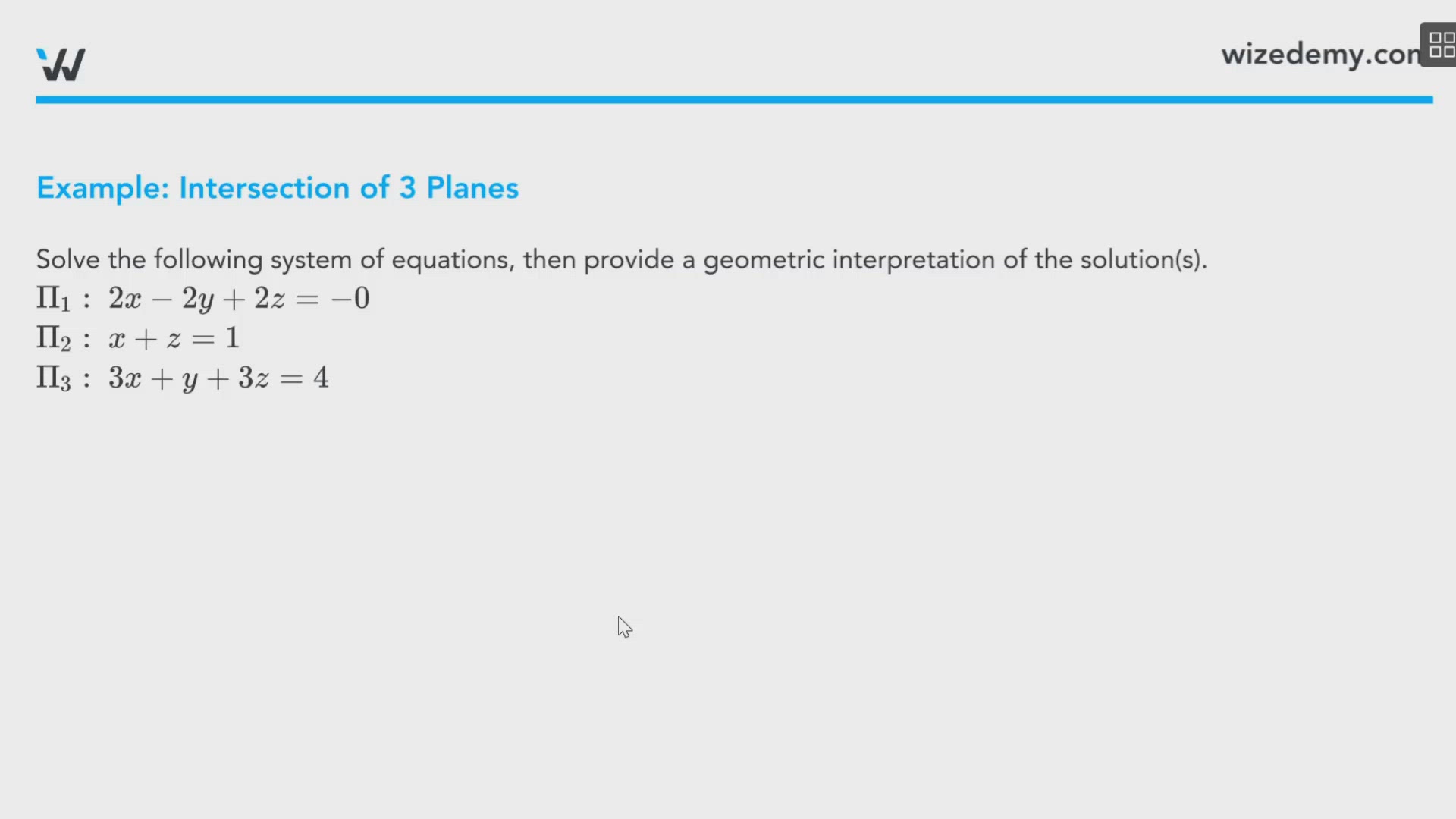
0:00 / 0:00
Example: Intersection of 3 Planes
Solve the following system of equations, then provide a geometric interpretation of the solution(s).
Check if the planes are parallel
None of , , or are scalar multiples of one another, so the planes are not parallel.
Solve for one variable in plane 1
Equation 1:
Substitute this into both equations 2 and 3:
Equation 2: ➝
Equation 3: ➝ ➝
Assign a parameter
Since can take on any value, let's assign
Substitute the value and into the equation :
Therefore, the planes intersect in a line
0:00 / 0:00
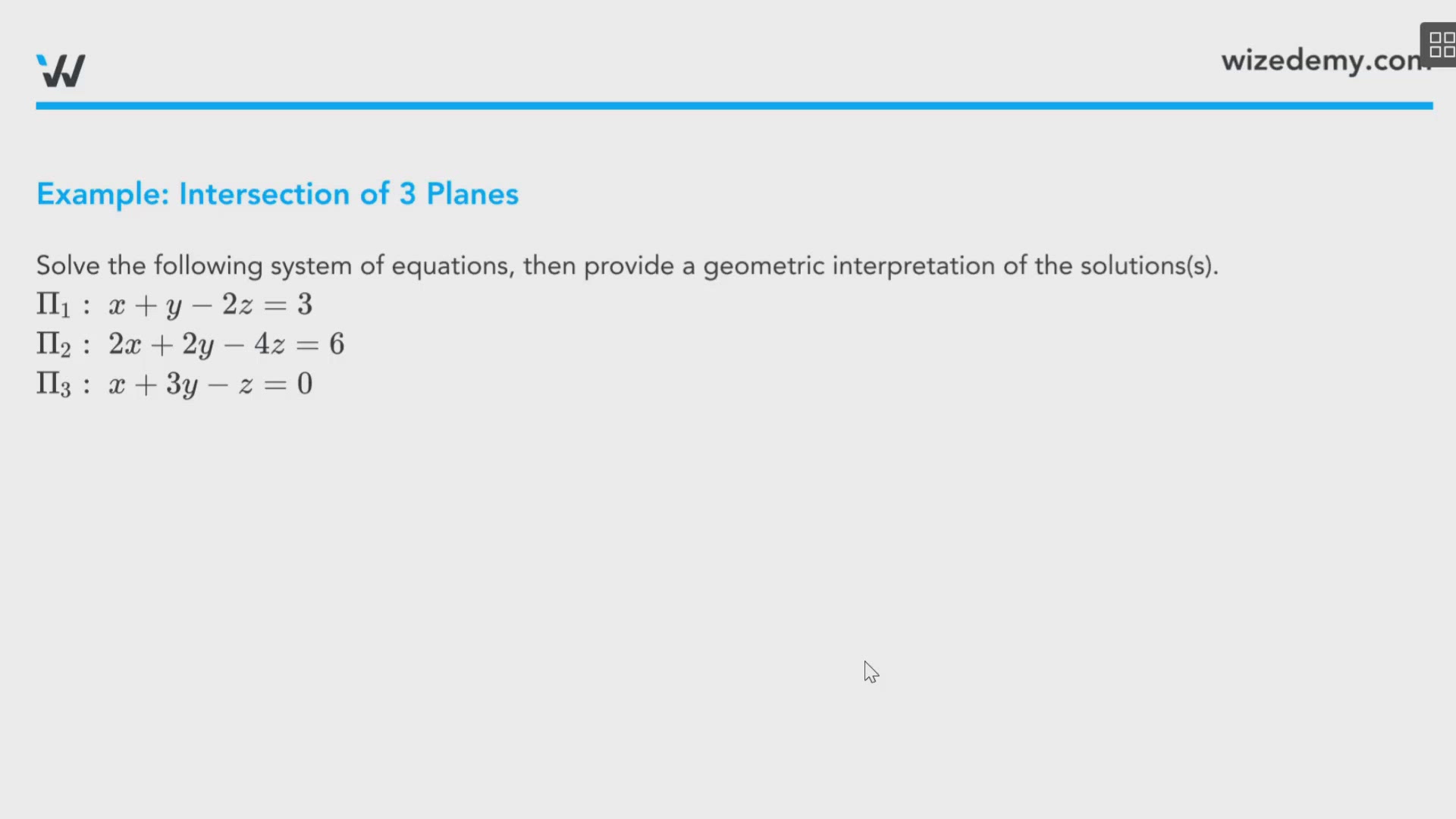
Example: Intersection of 3 Planes
Solve the following system of equations, then provide a geometric interpretation of the solutions(s).
Check if the planes are parallel
and are scalar multiples of one another, meaning that the planes are identical.
has a normal vector that is not a scalar multiple of the normal vectors of and , meaning that the three planes must intersect in a line.
Solve for one variable in plane 1
Equation 1:
Substitute this into equation 3:
Assign a parameter
Let
Substitute this into :
Substitute and into :
Therefore, the planes intersect in a line
0:00 / 0:00
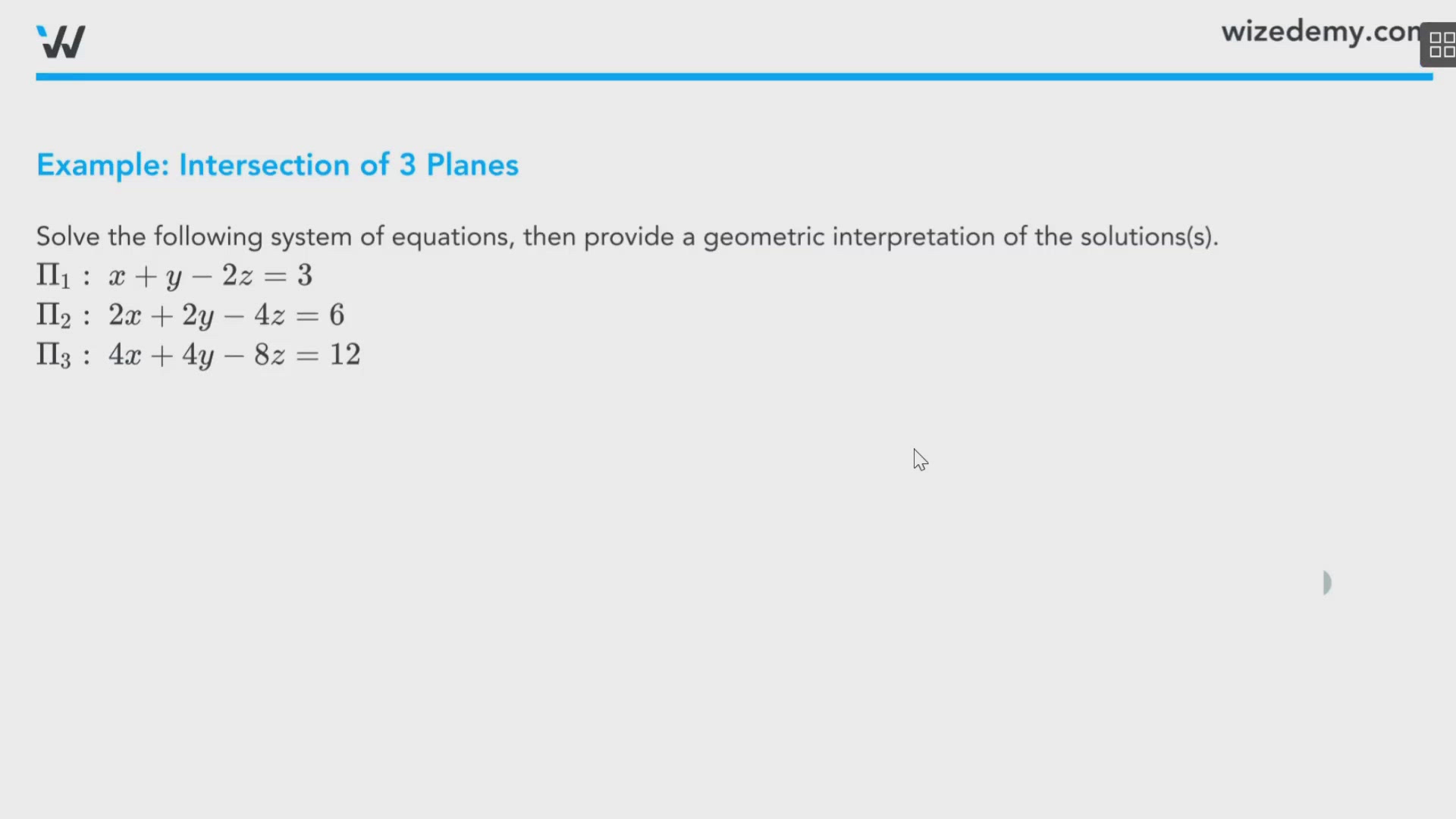
Example: Intersection of 3 Planes
Solve the following system of equations, then provide a geometric interpretation of the solutions(s).
Check if the planes are parallel
, , and are scalar multiples of one another, meaning that the planes are identical.
Therefore, the 3 planes intersect at infinitely many points. The intersection is the plane itself.
Practice: Intersection of 3 Planes
Solve the following system of equations, then provide a geometric interpretation of the solution(s).
0:00 / 0:00
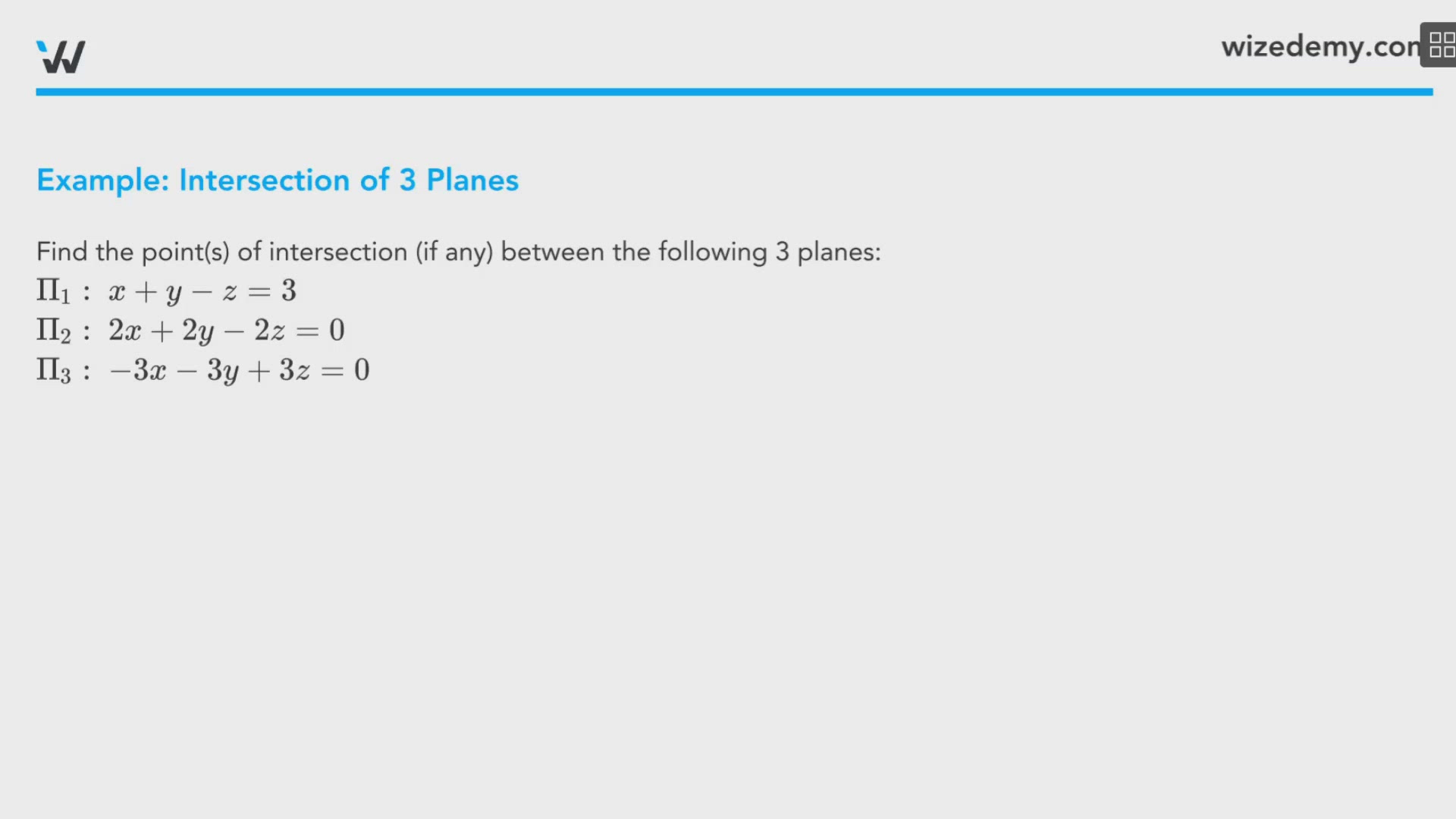
Example: Intersection of 3 Planes
Find the point(s) of intersection (if any) between the following 3 planes:
Check if the planes are parallel
Planes 1, 2, and 3 all have parallel normal vectors. However, only planes 2 and 3 have Cartesian equations that are scalar multiples of one another.
This manes that planes 2 and 3 are identical, and plane 1 is a distinct parallel plane.
Therefore, there are no points of intersection between the 3 planes.
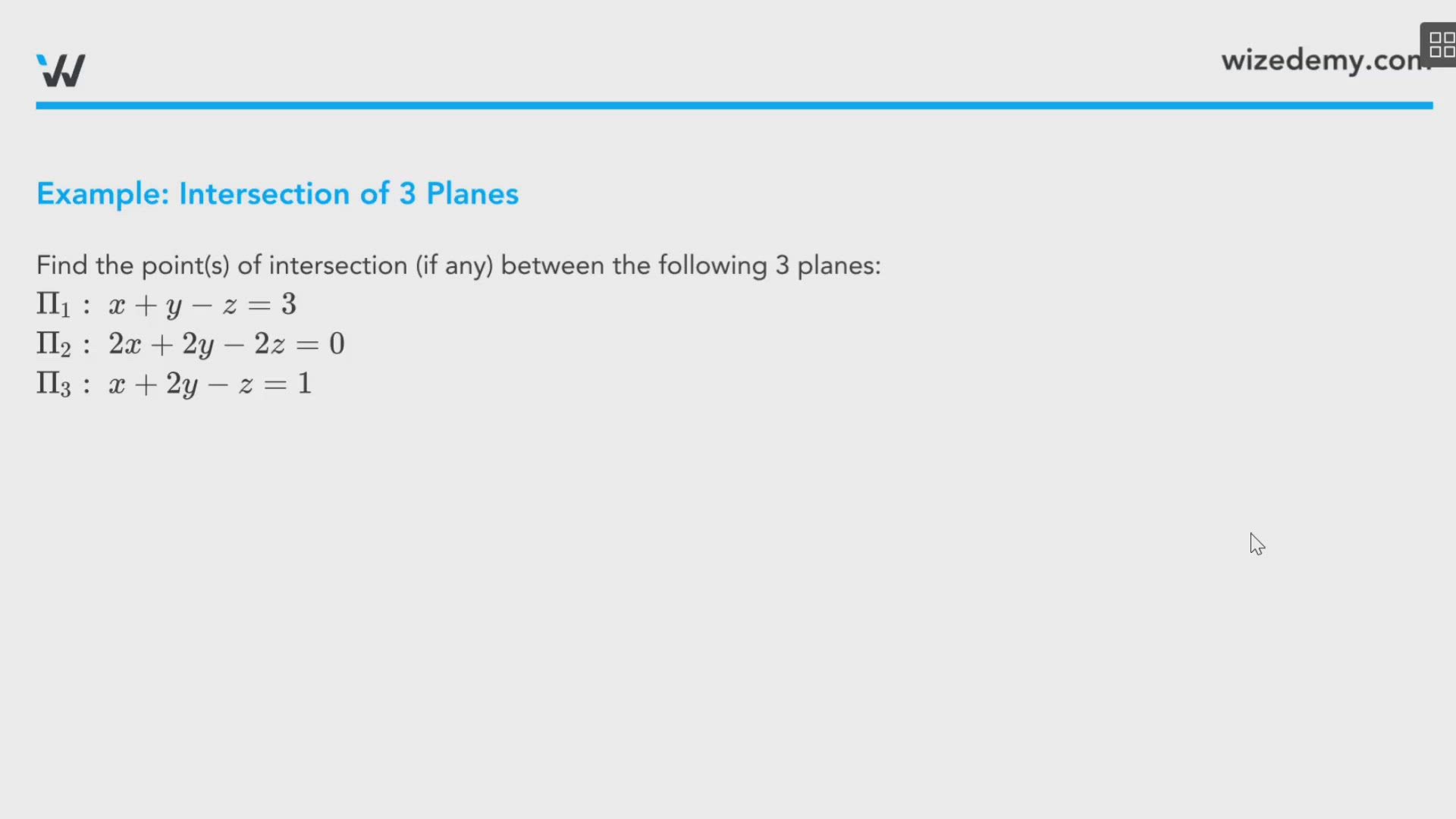
0:00 / 0:00
Example: Intersection of 3 Planes
Find the point(s) of intersection (if any) between the following 3 planes:
Check if the planes are parallel
Planes 1 and 2 have parallel normal vectors but their Cartesian equations are not scalar multiples of one another. This manes that planes 1 and 2 are parallel but distinct.
Therefore, there are no points of intersection between the 3 planes.
Alternatively
Solve for one variable in plane 1:
Substitute this into both equations 2 and 3:
Equation 2: ➝
Equation 3: ➝
Since we get the equation which doesn't make sense for any values of x, y, or z, we know that these 3 planes do not intersect.

0:00 / 0:00
Example: Intersection of 3 Planes
Find the point(s) of intersection (if any) between the following 3 planes:
Check if the planes are parallel
None of the planes are parallel
Solve for one variable in plane 1:
Equation 1:
Substitute this into both equations 2 and 3:
Equation 2: ➝ ➝
Equation 3: ➝
Since we get different values of x, there are no points of intersection between the 3 planes.
Practice: Intersection of 3 Planes
Solve the following system of equations, then provide a geometric interpretation of the solution(s).