Wize High School Grade 12 Calculus Textbook > Intersections of Lines & Planes
Intersection of 2 Planes
Intersection of 2 Planes
Example: Intersection of 2 Parallel Planes
Practice: Intersection of 2 Parallel Planes
Example: Intersection of 2 Coincident Planes
Practice: Intersection of 2 Coincient Planes
Example: Intersection of 2 Planes (free choice for parameter)
Example: Intersection of 2 Planes (no choice for parameter)
Practice: Intersection of 2 Planes
Practice: Intersection of 2 Planes
Popular Courses
Find My Course
0:00 / 0:00
Intersection of 2 Planes
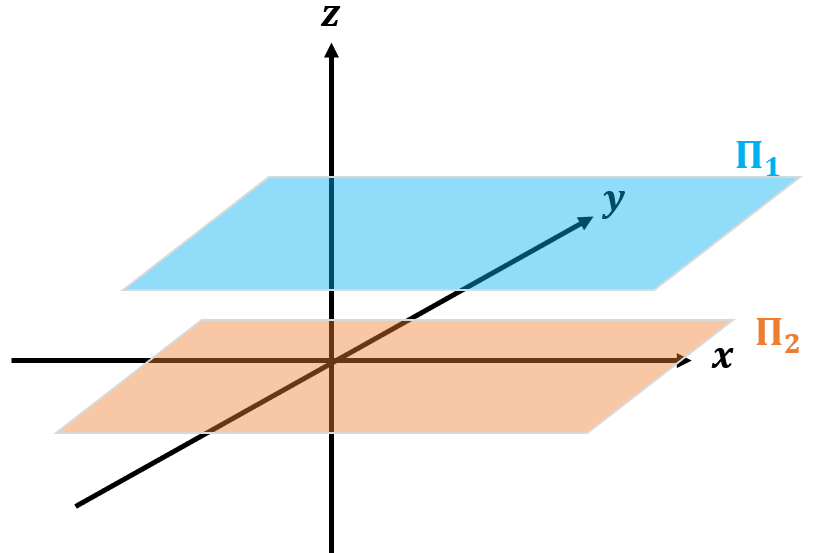
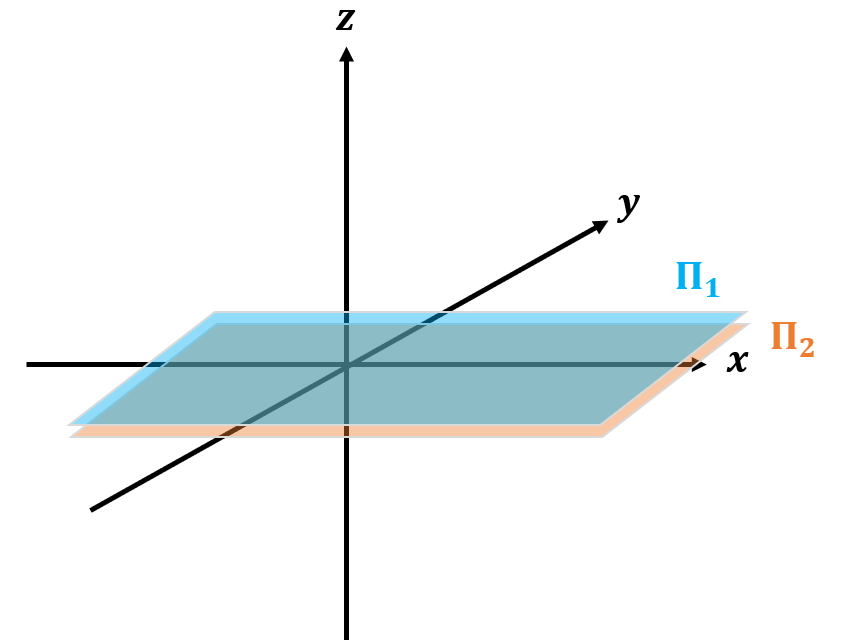
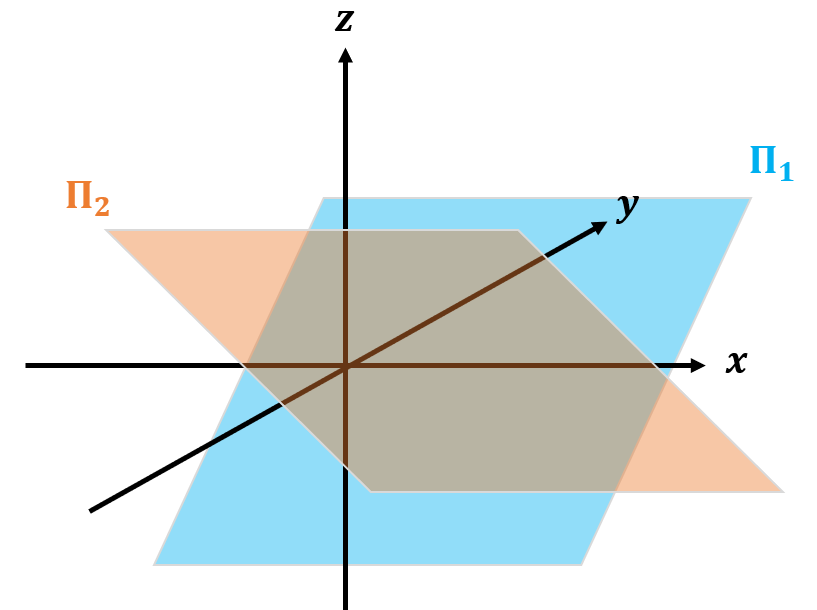
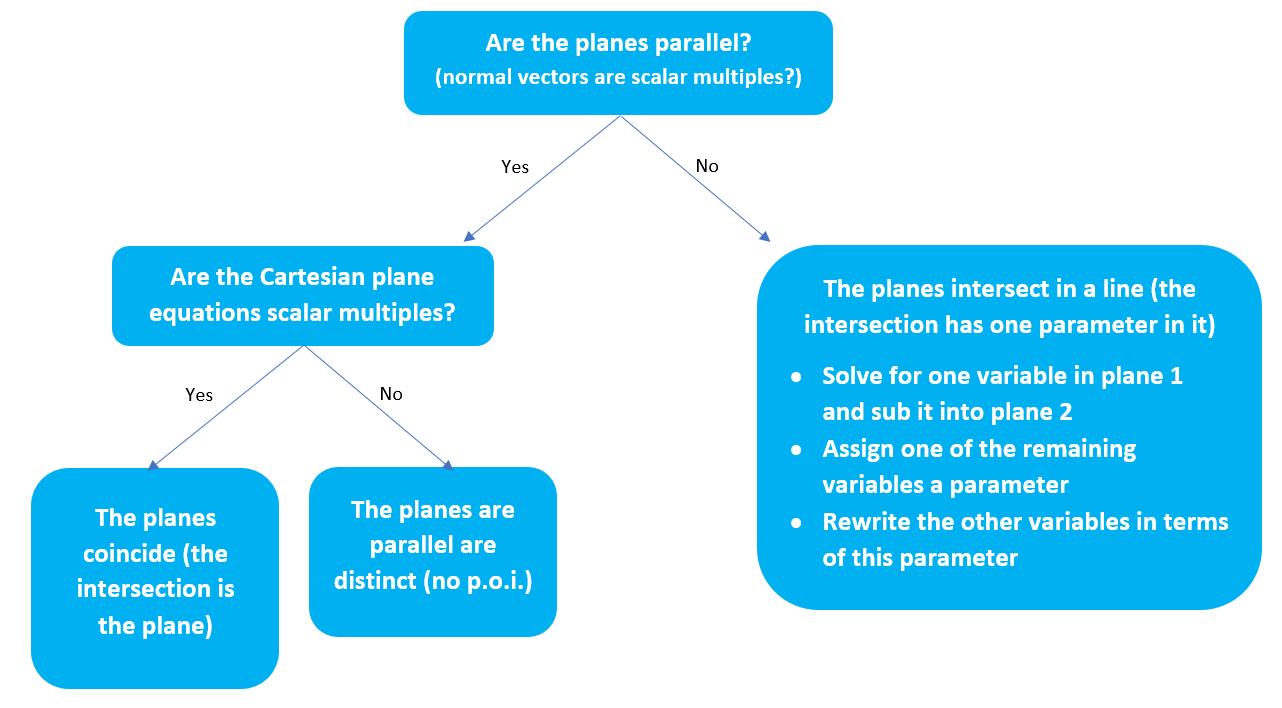
Given any 2 planes in , there are 3 possible scenarios.
1) The planes are parallel and are distinct → there are no points of intersection
2) The planes coincide → the intersection is a plane, there are infinitely many points of intersection
3) The planes intersect in a line → there are infinitely many points of intersection
Finding Points of Intersection
❓ Is it possible for two planes to intersect at a single point?
No. If two planes intersect, they either intersect in a line or the planes coincide and the intersection is the entire plane.
Wize Tip
Finding the intersection between equations of planes is sometimes called finding the solutions to a system of equations.
If at least one solution exists, we say that the system of equations is consistent. Otherwise, it is inconsistent.
0:00 / 0:00
Example: Intersection of 2 Parallel Planes
Determine the solution(s) (if any) to the system of equations defined by the two planes and . Describe the intersection (if any) between the two planes.
Check if the planes are parallel
and are scalar multiples of one another, so the planes are parallel. They can either be parallel and distinct or the planes coincide and are the same plane.
Check the Cartesian equations
Although the normal vectors are scalar multiples of one another, the Cartesian equations are not scalar multiples of one another. So, the planes are parallel and distinct.
Therefore, there are no solutions to the system of equations, and the planes are distinct and do not intersect.
Alternatively
We can solve for one variable from plane 1, and substitute that into plane 2:
From plane 1:
Sub this into plane 2:
Since this equation doesn't make sense, there are no solutions, meaning the lines are parallel and do not intersect.
Practice: Intersection of 2 Planes
Find the point(s) of intersection (if any) of the following two planes. Provide a geometric description of the solution(s).
0:00 / 0:00
Example: Intersection of 2 Coincident Planes
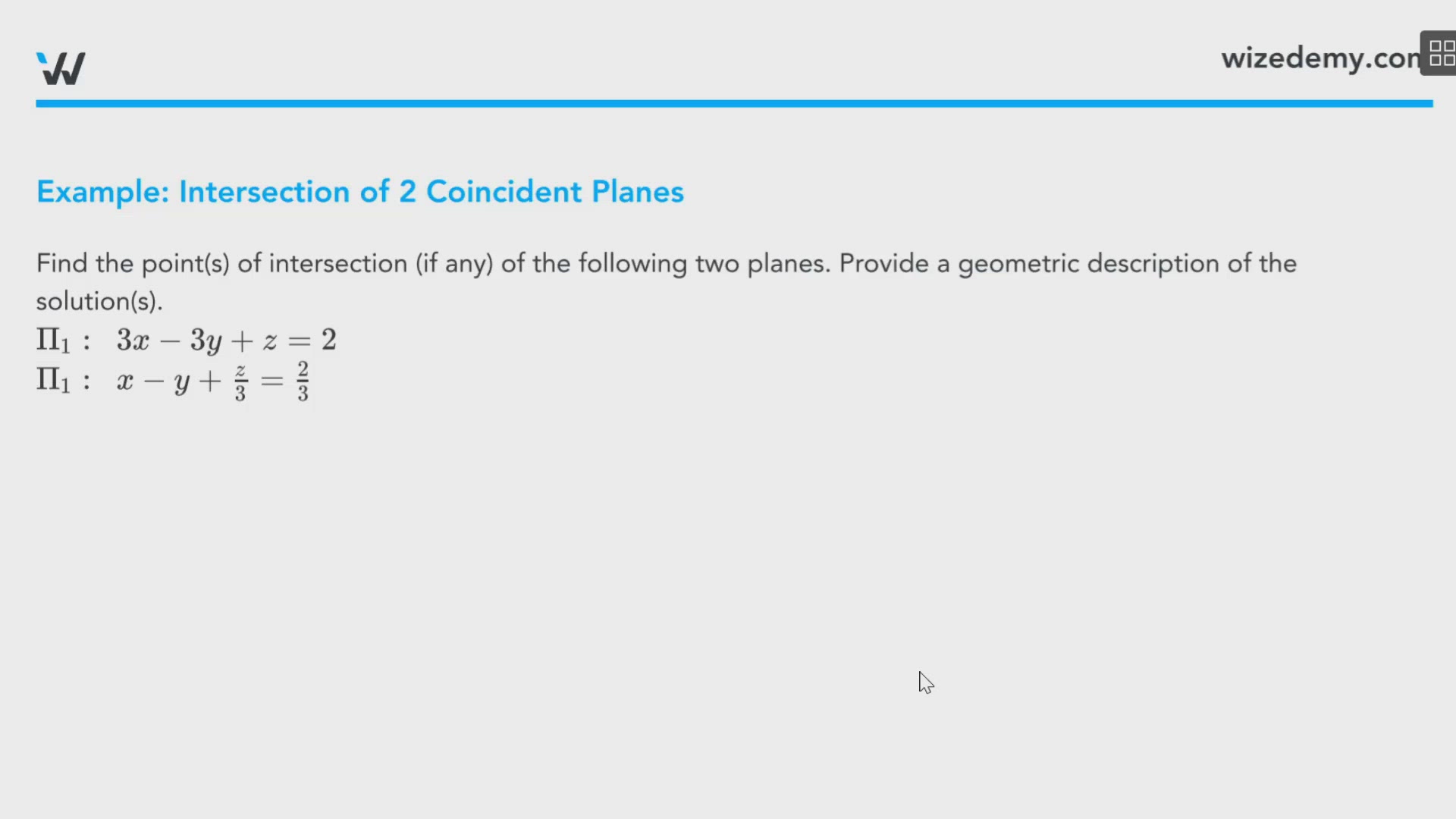
Find the point(s) of intersection (if any) of the following two planes. Provide a geometric description of the solution(s).
Check if the planes are parallel
and are scalar multiples of one another (). So, the planes are parallel.
The planes are either parallel and distinct (do not intersect), or they coincide and the intersection is the plane.
Check the Cartesian equations
, so the plane equations are scalar multiples of one another.
Therefore, the planes coincide and the intersection is the plane itself.
Alternatively
We can solve for one variable from plane 1:
Substitute this into plane 2:
Since this equation makes sense for any values of x, y, or z, we know that there are infinitely many solutions to this system of equations, meaning that the planes coincide and the intersection is the entire plane itself.
Practice: Intersection of 2 Planes
Determine the solution(s) (if any) to the following system of equations defined by the two planes and . Describe the intersection (if any) between the two planes.
0:00 / 0:00
Example: Intersection of 2 Planes
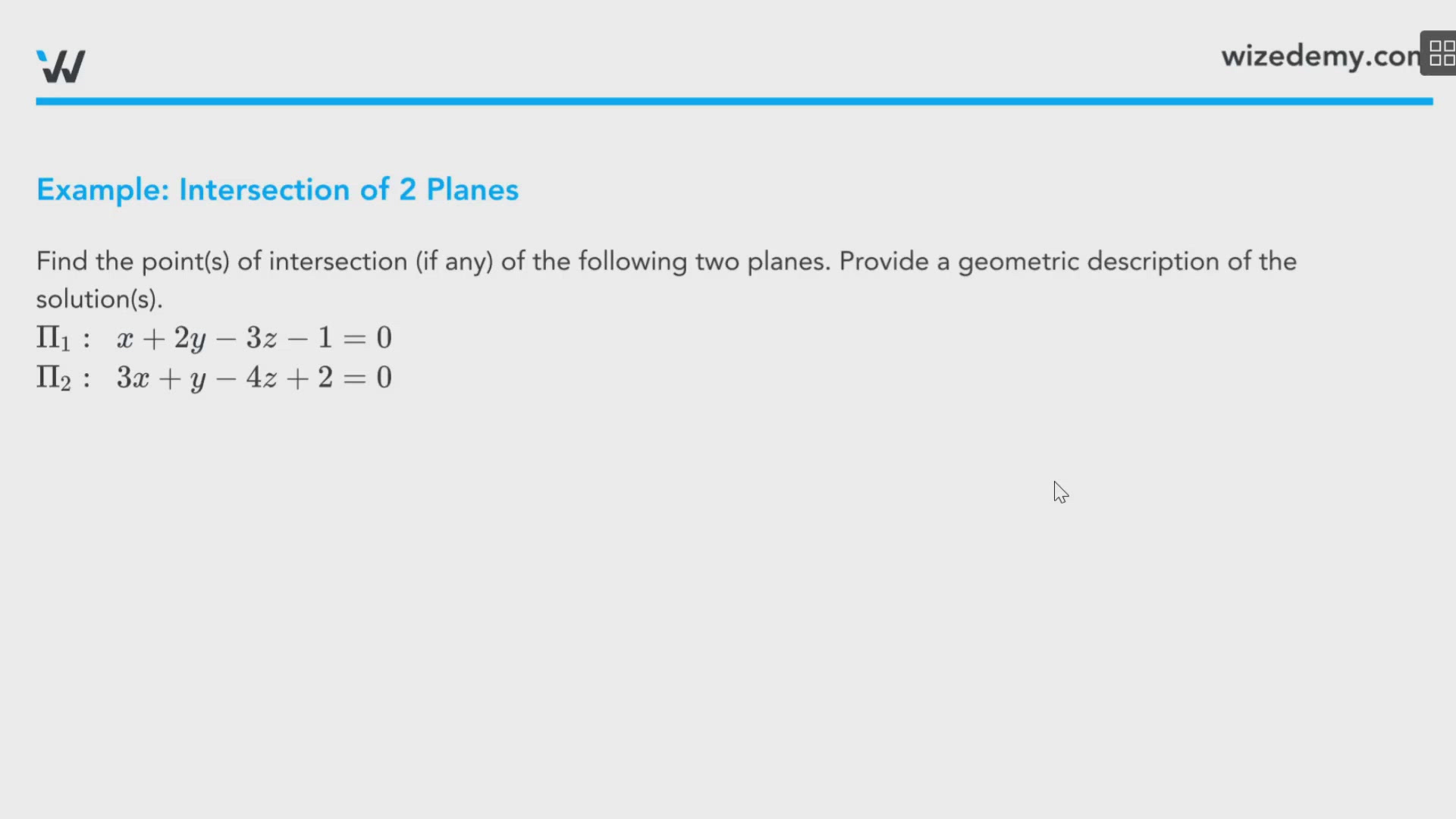
Find the point(s) of intersection (if any) of the following two planes. Provide a geometric description of the solution(s).
Check if the planes are parallel
and are not scalar multiples.
Therefore, the planes are not parallel and will intersect in a line.
Find the line of intersection
Solve for one variable in plane 1:
Substitute this into plane 2:
Assign a parameter
We can , , or be the parameter, you will get the equation of the same line (although it may look a bit different)
Let , then we have
Substitute and into the equation :
Therefore, the intersection is the line or .
0:00 / 0:00
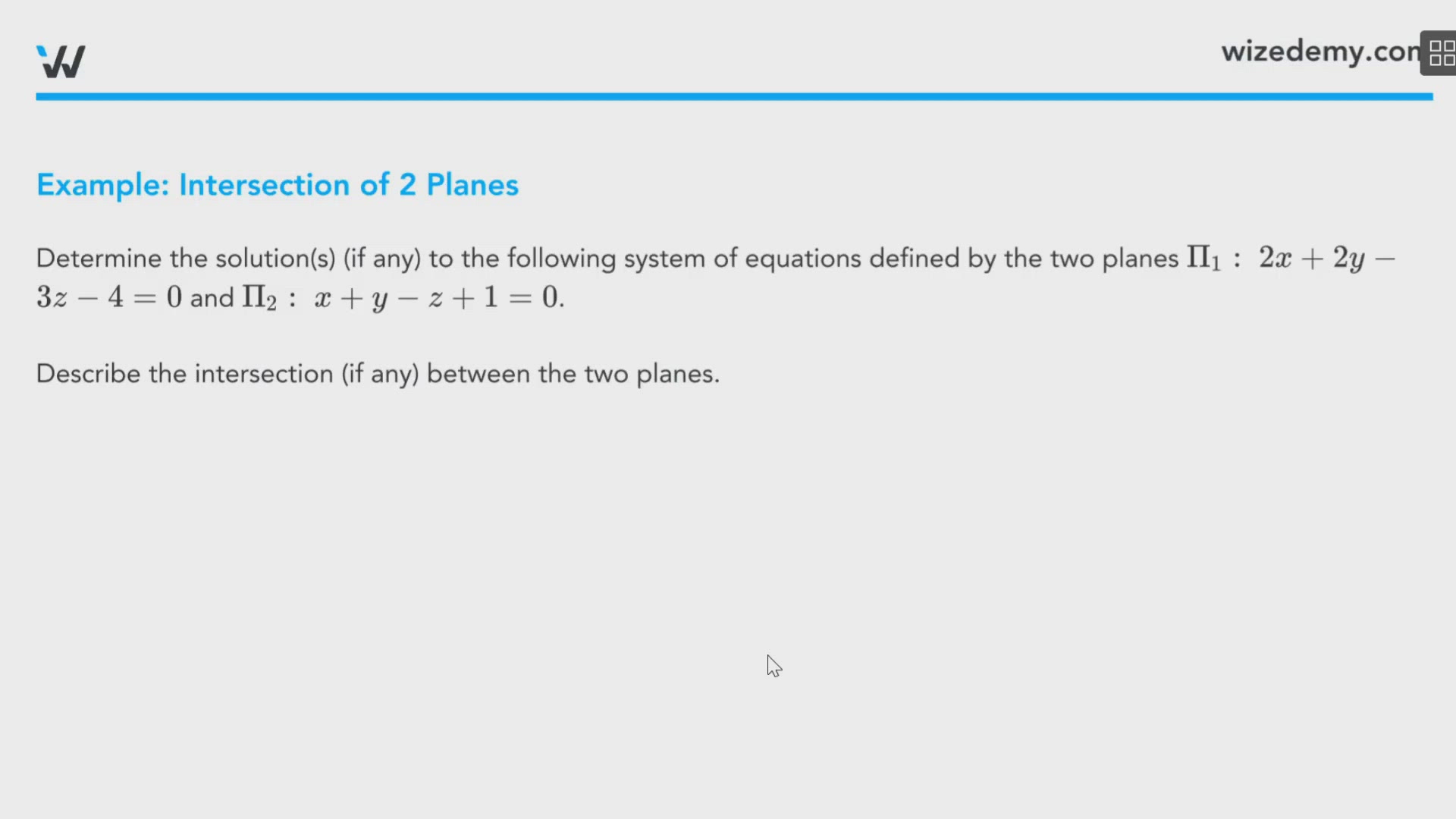
Example: Intersection of 2 Planes
Determine the solution(s) (if any) to the following system of equations defined by the two planes and .
Describe the intersection (if any) between the two planes.
Check if the planes are parallel
and are not scalar multiples.
Therefore, the planes are not parallel and will intersect in a line.
Find the line of intersection
Solve for one variable in plane 1:
Substitute this into plane 2:
Assign a parameter
Since can take on any value, let , then we have
Therefore, the intersection is the line or .
Practice: Intersection of 2 Planes
Determine the solution(s) (if any) to the following system of equations defined by the two planes and .
Describe the intersection (if any) between the two planes.
Practice: Intersection of 2 Planes
Determine an equation of a line that passes through the point and is parallel to the line of intersection of the planes abd .