0:00 / 0:00

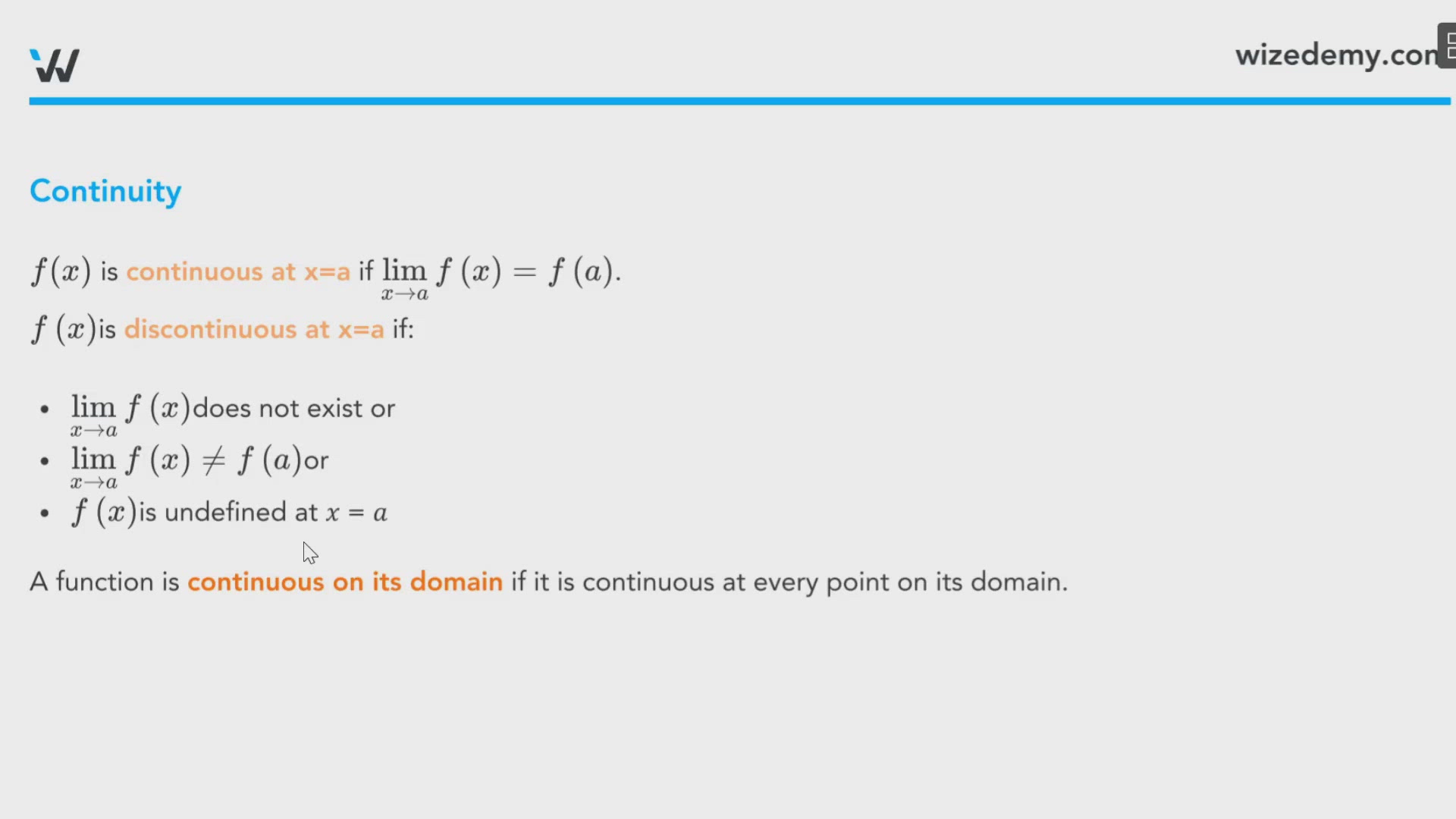
Continuity

f(x)f(x) is continuous at x=a if limxaf(x)=f(a)\displaystyle\lim_{x\to a}f\left(x\right)=f\left(a\right).
f(x)f\left(x\right)is discontinuous at x=a if:
  • limxaf(x)\displaystyle\lim_{x\to a}f\left(x\right)does not exist or
  • limxaf(x)f(a)\displaystyle\lim_{x\to a}f\left(x\right)\ne f\left(a\right)or
  • f(x)f\left(x\right)is undefined at 𝑥 = 𝑎
A function is continuous on its domain if it is continuous at every point on its domain.


PAGE BREAK

Types of Discontinuities


Note:
  1. Polynomials are continuous for all real numbers
  2. Rational functions f(x)g(x)\frac{f\left(x\right)}{g\left(x\right)} is continuous where f(x)f\left(x\right) and g(x)g\left(x\right) are continuous except for when g(x)=0g\left(x\right)=0
  3. Composition of continuous functions are also continuous
  4. Limits can "flow" through continuous functions
0:00 / 0:00

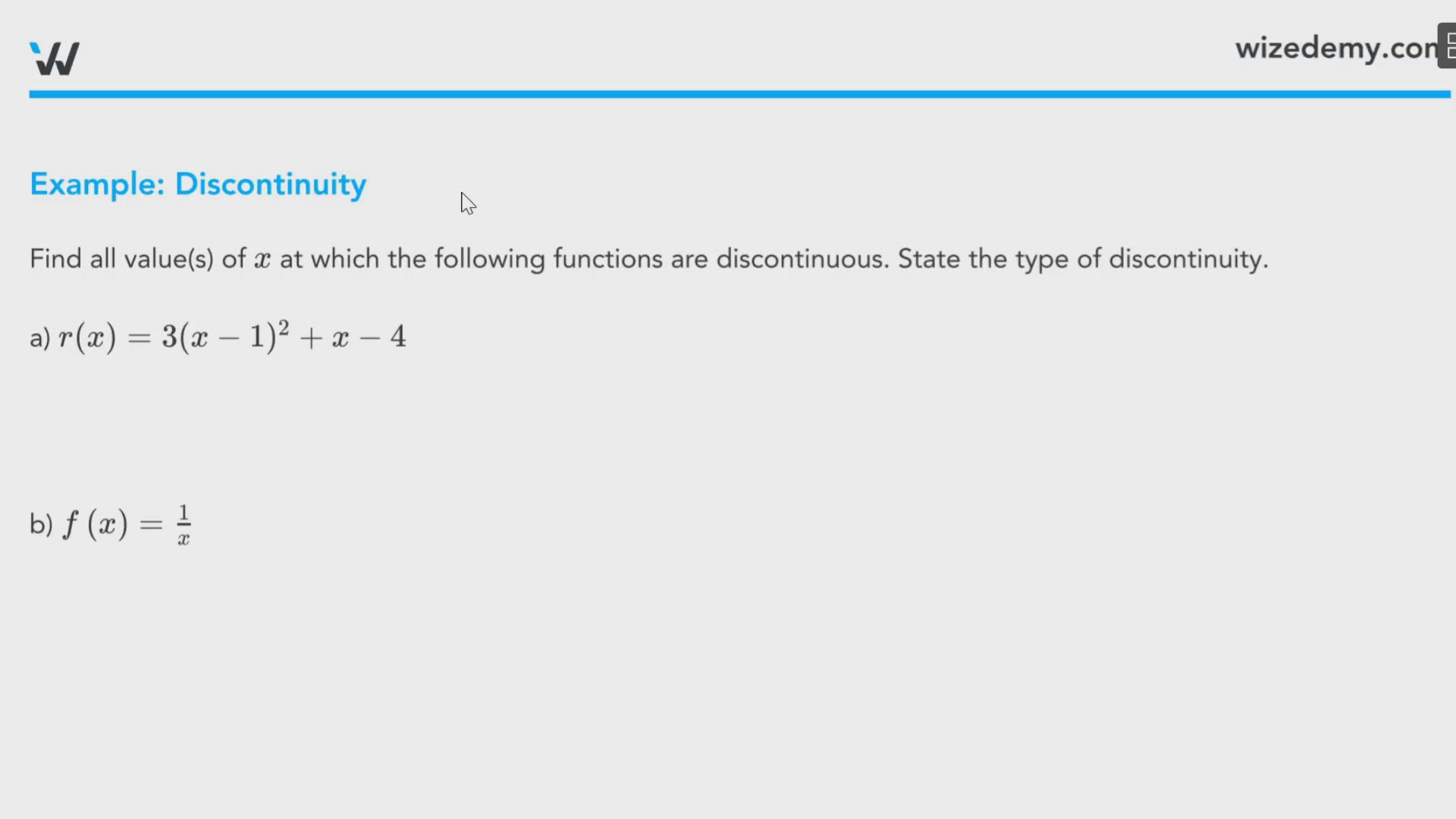
Example: Discontinuity

Find all value(s) of xx at which the following functions are discontinuous. State the type of discontinuity.

a) r(x)=3(x1)2+x4r(x)=3(x-1)^2+x-4

This function is continuous everywhere.

b) f(x)=1xf\left(x\right)=\frac{1}{x}

This is a rational function, it is discontinuous at x=0\boxed{x=0}.
  • The function is not defined at x=0x=0
  • limx0f(x)=\displaystyle \lim_{x\to0^-}f(x)=-\infty and limx0+f(x)=\displaystyle \lim_{x\to0^+}f(x)=\infty, so limx0f(x)\displaystyle \lim_{x\to0}f(x) DNE
This is an infinite discontinuity.

c) g(x)=x225x+5\displaystyle g\left(x\right)=\frac{x^2-25}{x+5}

This is a rational function, it is discontinuous at x=5\boxed{x=-5}.
  • The function is not defined at x=5x=-5
  • Factoring the numerator and denominator: g(x)=(x+5)(x5)x+5=(x+5)(x+5)(x5)g\left(x\right)=\frac{\left(x+5\right)\left(x-5\right)}{x+5}=\frac{\left(x+5\right)}{\left(x+5\right)}\left(x-5\right), so the function is continuous and equals y=x5y=x-5 everywhere else except for at x=5x=-5
This is a point discontinuity.

PAGE BREAK
d) h(x)=2x+1x2+3x+2\displaystyle h\left(x\right)=\frac{2x+1}{x^2+3x+2}

This is a rational function h(x)=2x+1(x+2)(x+1)\displaystyle h(x)=\frac{2x+1}{(x+2)(x+1)}, it is discontinuous at x=2  and  x=1\boxed{x=-2\ \text{ and }\ x=-1}
  • The function is not defined at x=2x=-2 or x=1x=-1
  • limx2h(x)=\displaystyle \lim_{x\to-2^-}h(x)=-\infty and limx2+h(x)=\displaystyle \lim_{x\to-2^+}h(x)=\infty, so limx2h(x)\displaystyle \lim_{x\to-2}h(x) DNE
This is an infinite discontinuity.

e) p(x)={x,if x<03x+2,if x0p\left(x\right)= \begin{cases} x,&\text{if }x<0\\ 3x+2,&\text{if }x\ge0 \end{cases}

This is a piecewise function, each of the "pieces" are continuous. We need to check the "connection" point.
  • p(0)=3(0)+2=2p\left(0\right)=3\left(0\right)+2=2, so the function is defined at x=0x=0
  • limx0p(x)=limx0x=0\displaystyle \lim_{x\to0^-}p(x)= \lim_{x\to0^-}x=0 and limx0+p(x)=limx0+3x+2=2\displaystyle \lim_{x\to0^+}p(x)= \lim_{x\to0^+}3x+2=2, so limx0p(x)\displaystyle \lim_{x\to0}p(x) DNE
So, the function is discontinuous at x=0\boxed{x=0}
This is a jump discontinuity.

f) q(x)=x5q(x)=\sqrt {x-5}

The function is not defined when x5<0x-5<0, so it is discontinuous when x<5\boxed {x<5}

Practice: Discontinuity From Graphs

The following is the graph of y=f(x)y=f\left(x\right). On what interval is g(x)=1f(x)1g\left(x\right)=\frac{1}{f\left(x\right)-1} discontinuous?


0:00 / 0:00

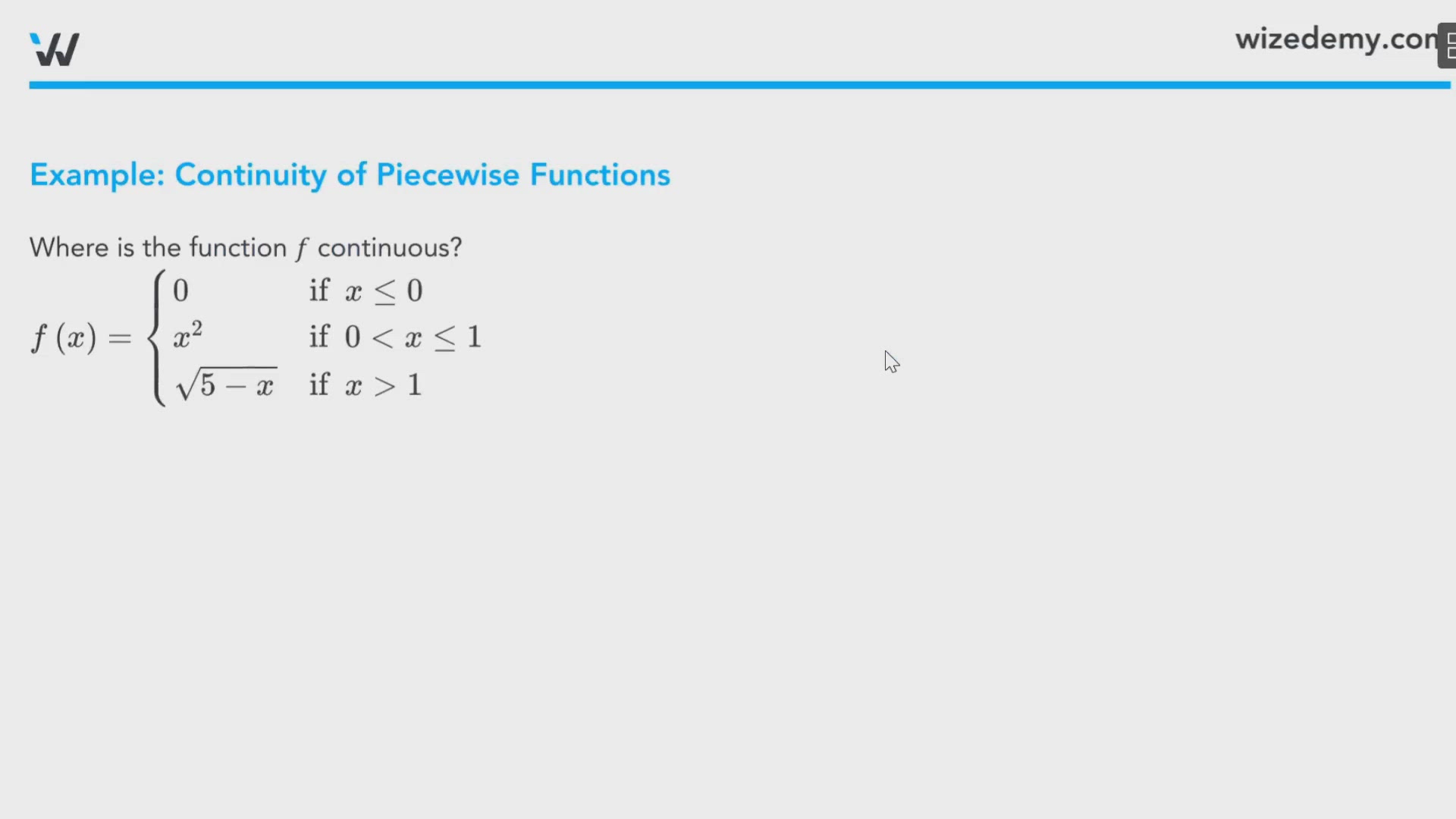
Example: Continuity of Piecewise Functions

Where is the function 𝑓 continuous?
f(x)={0if  x0x2if  0<x15xif  x>1f\left(x\right)= \begin{cases} 0 & \text{if }\space x\le0\\ x^2&\text{if }\space 0<x\le1 \\ \sqrt{5-x}& \text{if }\space x>1 \end{cases}

1. We need to check each piece to see if they're continuous:
  • 00 is continuous everywhere
  • x2x^2 is continuous everywhere
  • 5x\sqrt{5-x} is discontinuous when x>5x>5. This piece of the function has the domain x>1x>1. The overlapping part is x>5x>5 (Discontinuous points so far: x > 5)

2. We now check the connecting points:
x=0x=0
limx0f(x)=limx00=0\displaystyle\lim_{x\rightarrow0^-}f\left(x\right)=\lim_{x\rightarrow0^-}0=0
limx0+f(x)=limx0+x2=0\displaystyle\lim_{x\rightarrow0^+}f\left(x\right)=\lim_{x\rightarrow0^+}x^2=0
f(0)=0f\left(0\right)=0
Since the left limit, right limit, and function at that point all equal, the function is continuous at x=0x=0

x=1x=1
limx1f(x)=limx1x2=1\displaystyle\lim_{x\rightarrow1^-}f\left(x\right)=\lim_{x\rightarrow1^-}x^2=1

lim x1+f(x)=limx1+5x=4=2\displaystyle\lim\ _{x\rightarrow1^+}f\left(x\right)=\lim_{x\rightarrow1^+}\sqrt{5-x}=\sqrt{4}=2
Since the left and right hand limits don't equal, the function is discontinuous at x=1x=1
(Discontinuous point: x = 1)

Therefore, the function is discontinuous when x=1x=1 and x>5x>5.
So, the function is continuous when x<1 or  1<x5x<1\ or\ \ 1<x\le5.
Another way to write this is (,1)(1,5]\left(-\infty,1\right)\cup\left(1,5\right].
0:00 / 0:00

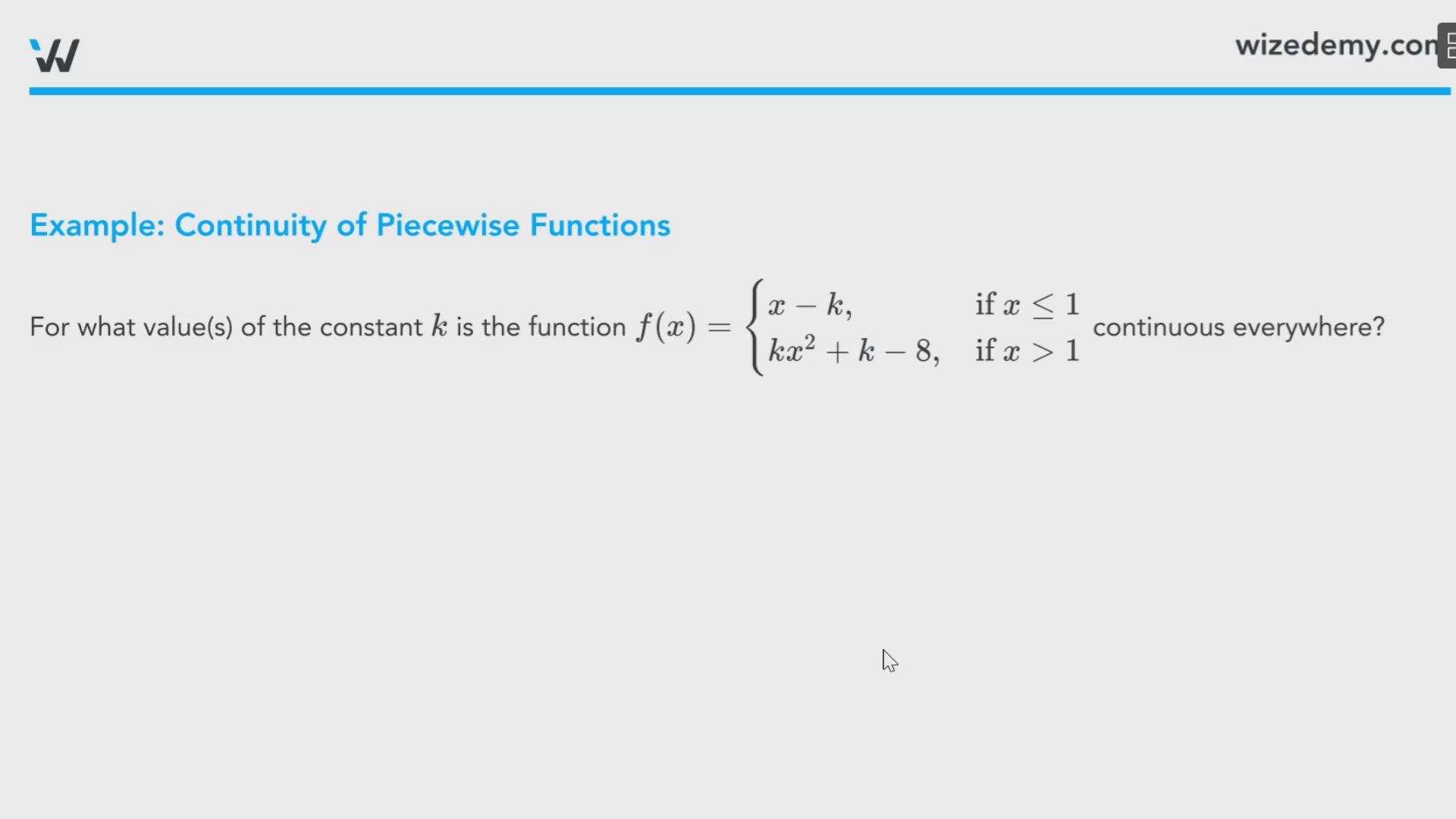
Example: Continuity of Piecewise Functions

For what value(s) of the constant kk is the function f(x)={xk,if x1kx2+k8,if x>1f(x)=\begin{cases} x-k,&\text{if } x\le1\\ kx^2+k-8,&\text{if }x>1 \end{cases} continuous everywhere?

Each piece of the function is a regular polynomial, so they are continuous on their domains, meaning that
  • xkx-k is continuous on x1x\le1 and
  • kx2+k8kx^2+k-8 is continuous on x>1x>1
We just have to make sure that the function is continuous at the connecting point x=1x=1:
  • f(1)=1kf\left(1\right)=1-k
  • limx1f(x)=limx1xk=1k\lim_{x\to1^-}f\left(x\right)=\lim_{x\to1^-}x-k=1-k
  • limx1+f(x)=limx1+kx2+k8=2k8\lim_{x\to1^+}f\left(x\right)=\lim_{x\to1^+}kx^2+k-8=2k-8
We need all 3 of these expressions to equal one another:
1k=2k81-k=2k-8
9=3k9=3k
k=3k=3

Therefore, the function is continuous everywhere if k=3k=3

Practice: Continuity of Piecewise Functions

Find the values of 𝑎 and 𝑏 that make 𝑓 continuous everywhere
f(x)={x22if  x<2axif  2x<32xbif  x3f\left(x\right)= \begin{cases} x^2-2 & \text{if }\space x<2\\ ax & \text{if }\space 2\le x<3\\ 2x-b & \text{if }\space x\ge3 \end{cases}

Practice: Continuous Functions

Suppose that f(x)f\left(x\right) and g(x)g\left(x\right) are continuous functions on the interval 3<x<2-3<x<2.

If g(1)=3g\left(1\right)=-3 and limx1(4x+g(x)g(x)xf(x))=2\displaystyle\lim_{x\to1}\left(4x+g\left(x\right)-\frac{g\left(x\right)}{x{f\left(x\right)}}\right)=2, determine the value of f(1)f\left(1\right).
Extra Practice