0:00 / 0:00

Intro to Derivatives

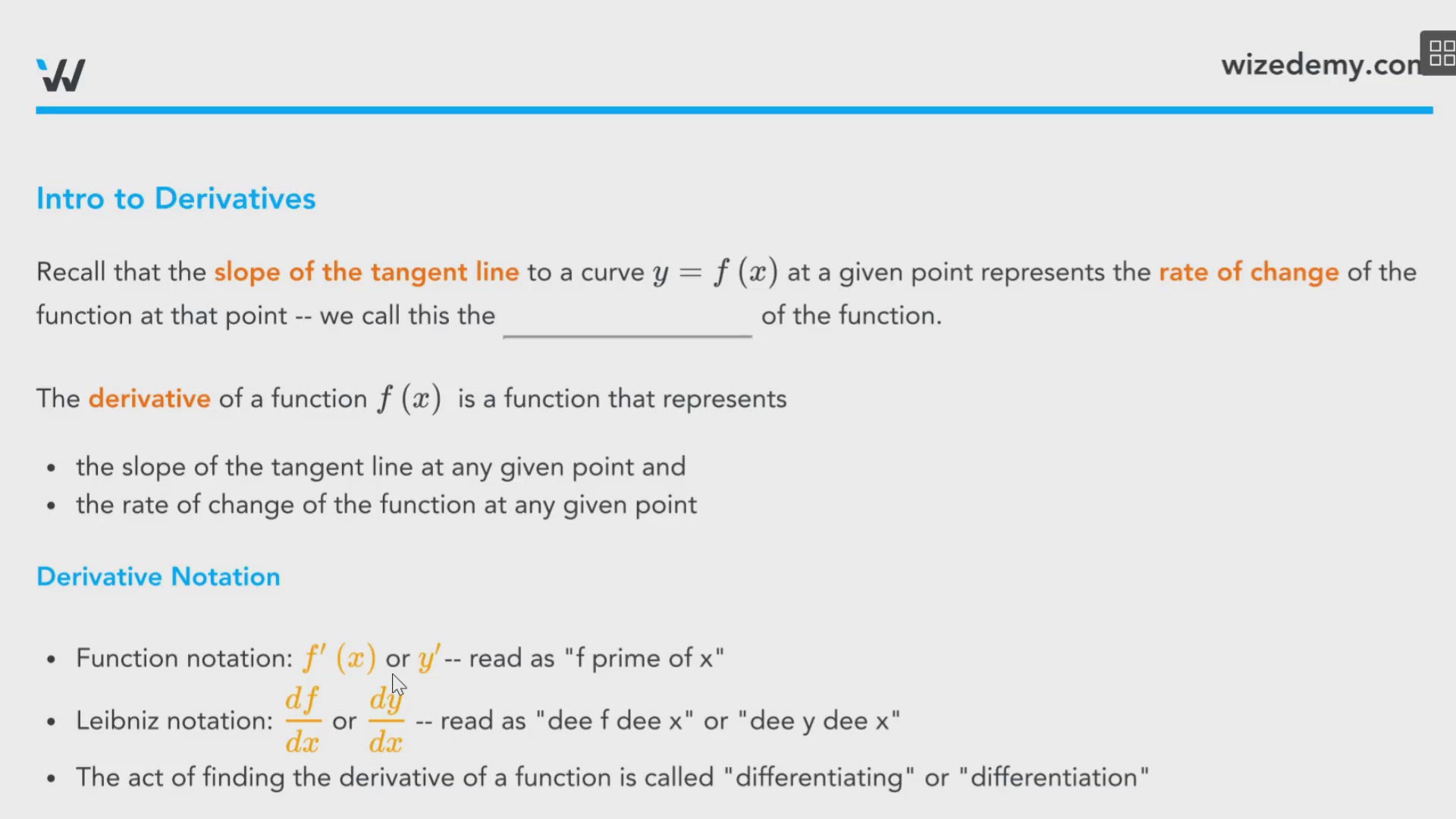
Recall that the slope of the tangent line to a curve y=f(x)y=f\left(x\right) at a given point represents the rate of change of the function at that point -- we call this the
derivative
of the function.

The derivative of a function f(x)f\left(x\right) is a function that represents
  • the slope of the tangent line at any given point and
  • the rate of change of the function at any given point

Derivative Notation

  • Function notation: f(x)\orange{f'\left(x\right)} or y\orange{y'}-- read as "f prime of x"
  • Leibniz notation: dfdx\displaystyle \orange{\frac{df}{dx}} or dydx\displaystyle \orange{\frac{dy}{dx}} -- read as "dee f dee x" or "dee y dee x"
  • The act of finding the derivative of a function is called "differentiating" or "differentiation"

Limit Definition of a Derivative (First Principles)

f(x)=limh0 f(x+h)f(x)h\displaystyle f'(x)=\lim_{h\to0}\ \frac{f\left(x+h\right)-f\left(x\right)}{h}

The derivative of the function at a particular point x=ax=a is a number calculated by
  • f(a)=limh0f(a+h)f(a)h\displaystyle f'(a)=\lim_{h\to0}\frac{f\left(a+h\right)-f\left(a\right)}{h} or
  • f(a)=limxa f(x)f(a)xa\displaystyle f'\left(a\right)=\lim_{x\to a}\ \frac{f\left(x\right)-f\left(a\right)}{x-a}


PAGE BREAK

Differentiability

  • A function is differentiable at a point x=ax=a if the limit for f(a)f'(a) exists
  • A function is differentiable on an interval if the limit exists for each point on that interval

Wize Tip
A function is not differentiable at a point if
  • the function is discontinuous at that point or
  • the tangent line at that point is vertical or
  • there is more than one possible tangent line at that point (a "corner" or "cusp")
0:00 / 0:00

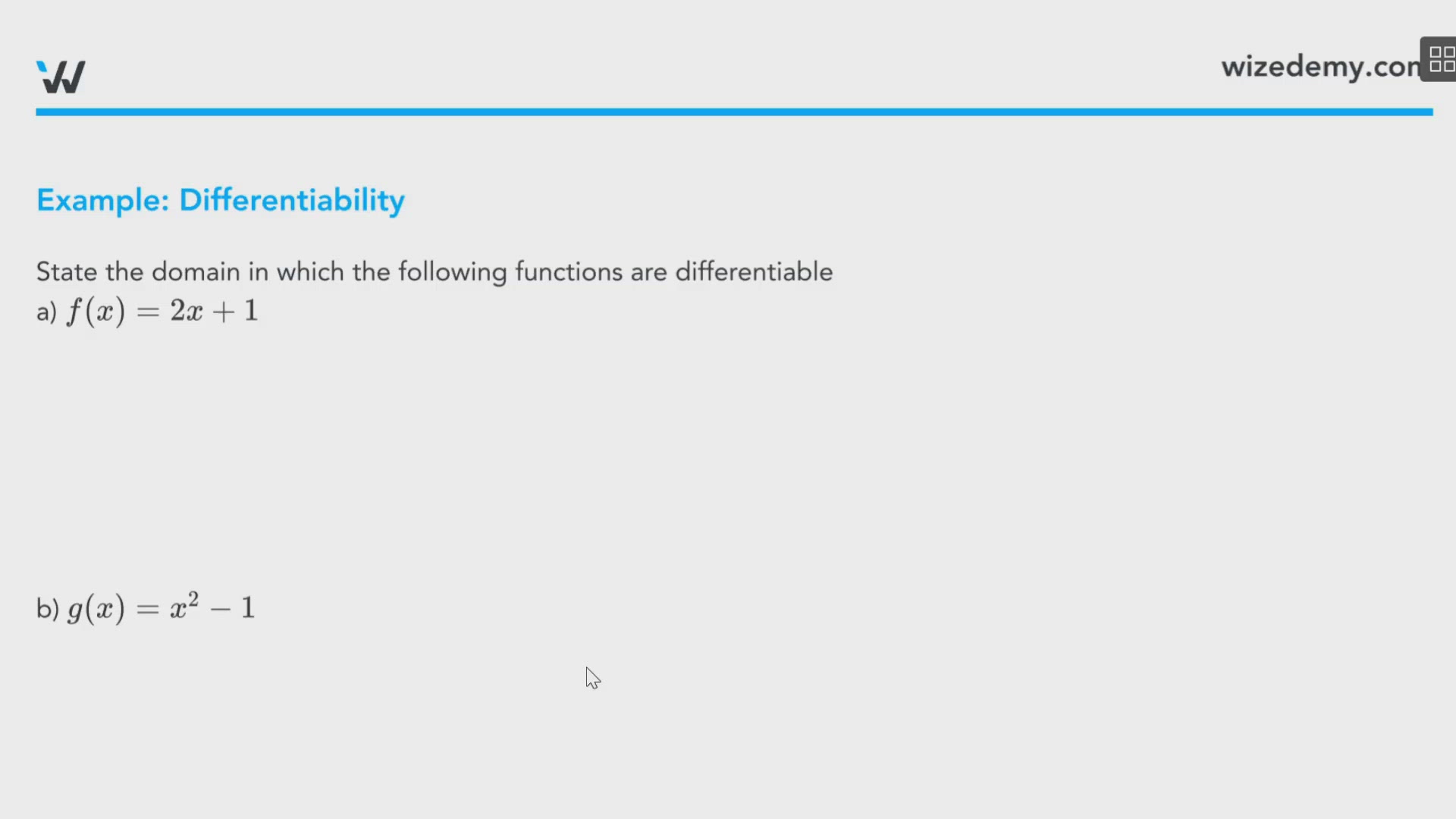
Example: Differentiability

State the domain in which the following functions are differentiable
a) f(x)=2x+1f(x)=2x+1

The graph of this function is continuous and is just a straight diagonal line.
The tangent line at any point is the same as the line itself.
Therefore, the function is differentiable everywhere.


b) g(x)=x21g(x)=x^2-1

The graph of thsi function is continuous and is a parabola.
We can draw a tangent line to this curve at any point.
Therefore, the function is differentiable everywhere.


c)
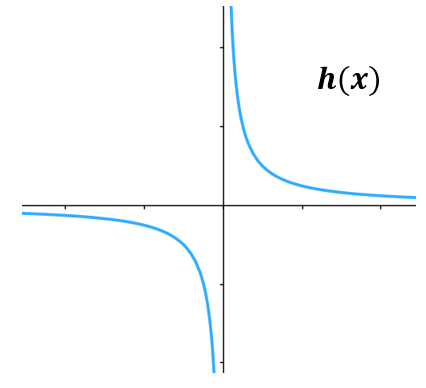
The graph is discontinuous at x=0x=0, so we cannot draw a tangent line at this point.
Therefore, the function is not differentiable at x=0x=0
PAGE BREAK
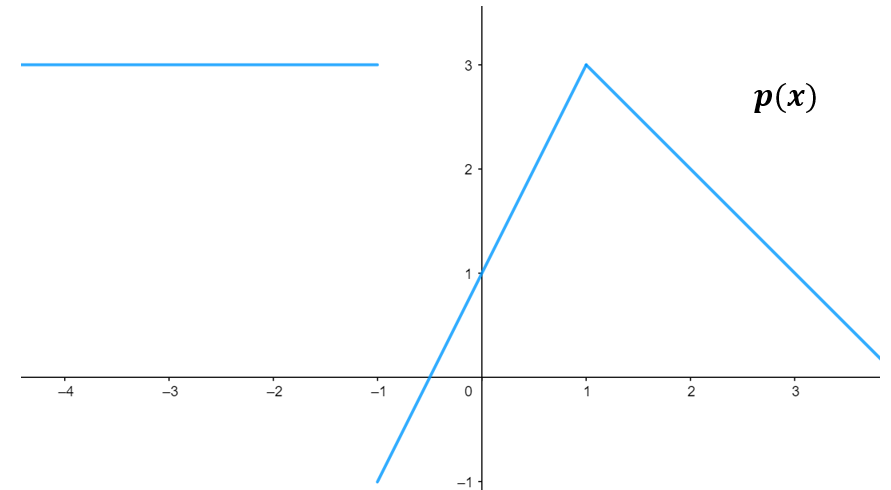
d)

The graph is discontinuous at x=1x=-1, so we cannot draw a tangent line at this point.
The graph has a "corner" at x=1x=1, so there are more than one possible tangent lines at the this point.
Therefore, the function is not differentiable at x=1x=-1 and x=1x=1

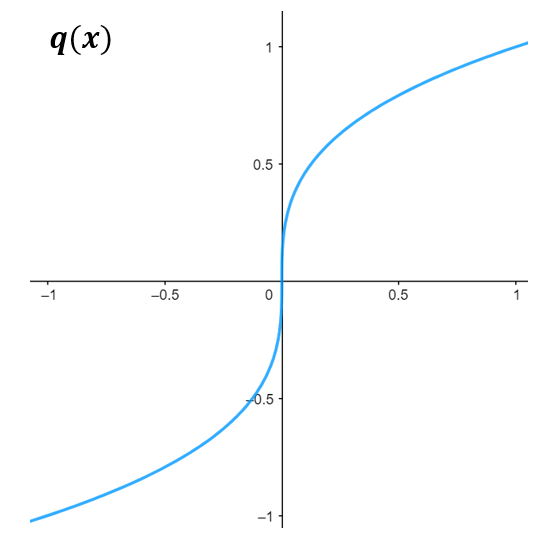
e)

If we draw a tangent line at the point x=0x=0, we get a vertical tangent line.
Therefore, the function is not differentiable at x=0x=0
0:00 / 0:00

Example: Derivative of a Function at a Point

Find the derivative f(a)f'\left(a\right)of the function f(x)=x3f(x)=\sqrt {x-3} at a=4a=4

f(4)=limh0 f(4+h)f(4)hf'(4)=\displaystyle \lim_{h\to0}\ \frac{f\left(4+h\right)-f\left(4\right)}{h}
=limh0 (4+h)343h\displaystyle =\lim_{h\to0}\ \frac{\sqrt{\left(4+h\right)-3}-\sqrt{4-3}}{h}
=limh0 1+h1h=\lim_{h\to0}\ \frac{\sqrt{1+h}-\sqrt{1}}{h}
=limh0 1+h1h×1+h+11+h+1\displaystyle =\lim_{h\to0}\ \frac{\sqrt{1+h}-1}{h}\times\frac{\sqrt{1+h}+1}{\sqrt{1+h}+1}
=limh0 (1+h)1h(1+h+1)\displaystyle =\lim_{h\to0}\ \frac{\left(1+h\right)-1}{h\left(\sqrt{1+h}+1\right)}
=limh0 hh(1+h+1)\displaystyle =\lim_{h\to0}\ \frac{h}{h\left(\sqrt{1+h}+1\right)}
=limh0 11+h+1\displaystyle =\lim_{h\to0}\ \frac{1}{\sqrt{1+h}+1}
= 11+0+1\displaystyle =\ \frac{1}{\sqrt{1+0}+1}
=12\displaystyle =\frac{1}{2}

or

f(4)=limx4 f(x)f(4)x4\displaystyle f'(4)=\lim_{x\to4}\ \frac{f\left(x\right)-f\left(4\right)}{x-4}
=limx4 x343x4\displaystyle =\lim_{x\to4}\ \frac{\sqrt{x-3}-\sqrt{4-3}}{x-4}
=limx4 x31x4\displaystyle =\lim_{x\to4}\ \frac{\sqrt{x-3}-1}{x-4}
=limx4 x31x4×x3+1x3+1\displaystyle =\lim_{x\to4}\ \frac{\sqrt{x-3}-1}{x-4}\times\frac{\sqrt{x-3}+1}{\sqrt{x-3}+1}
=limx4 (x3)1(x4)(x3+1)\displaystyle =\lim_{x\to4}\ \frac{\left(x-3\right)-1}{\left(x-4\right)\left(\sqrt{x-3}+1\right)}
=limx4 x4(x4)(x3+1)\displaystyle =\lim_{x\to4}\ \frac{x-4}{\left(x-4\right)\left(\sqrt{x-3}+1\right)}
=limx4 1x3+1\displaystyle =\lim_{x\to4}\ \frac{1}{\sqrt{x-3}+1}
=143+1\displaystyle =\frac{1}{\sqrt{4-3}+1}
=12\displaystyle =\frac{1}{2}

Practice: Derivative of a Function of a Point

Find the derivative f(a)f'(a) of the function f(x)=2xf(x)=\frac{2}{x} at a=1a=1.
0:00 / 0:00

Example: Derivative of a Function

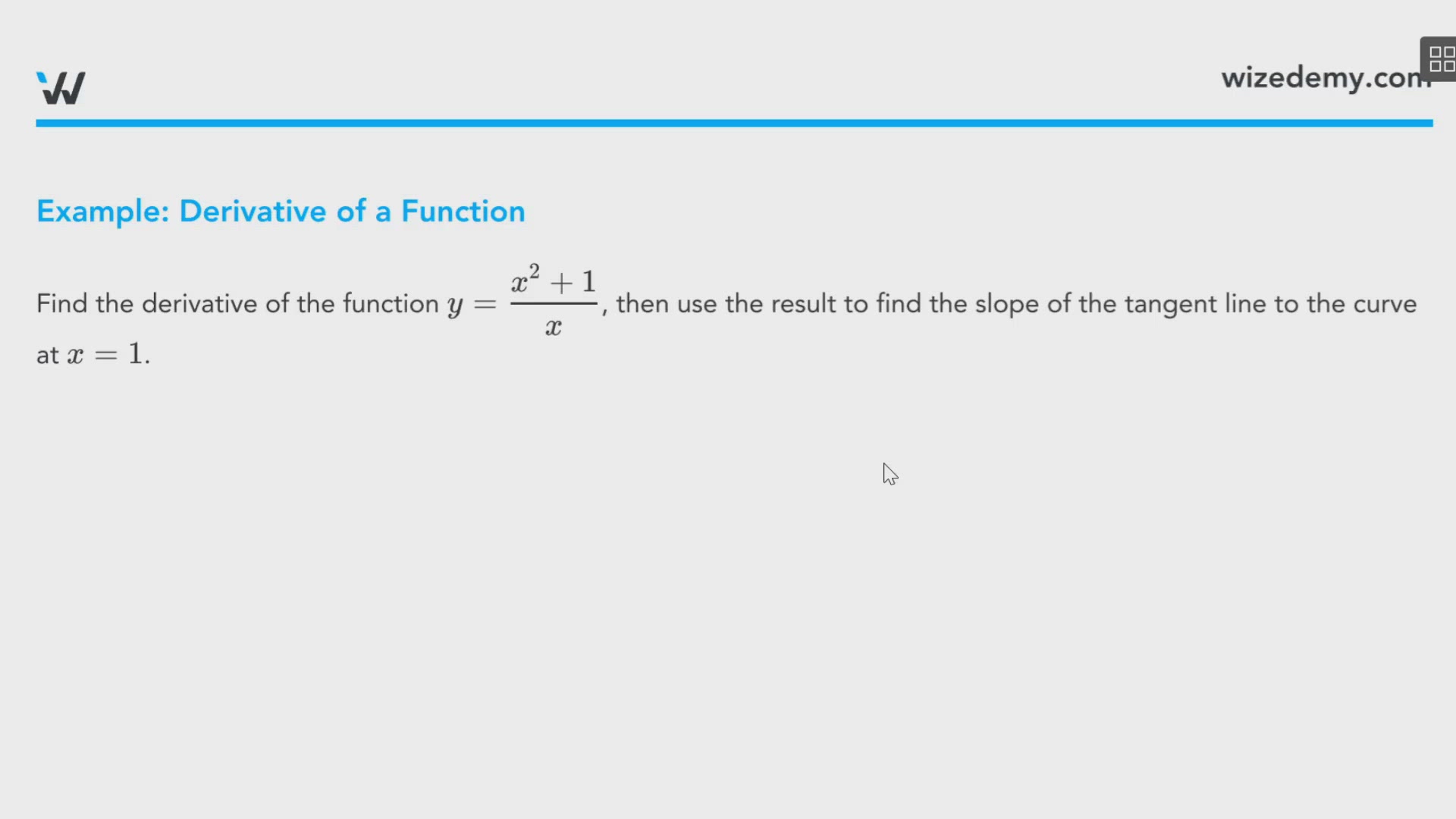
Find the derivative of the function y=x2+1x\displaystyle y=\frac{x^2+1}{x}, then use the result to find the slope of the tangent line to the curve at x=1x=1.

dydx=limh0 f(x+h)f(x)h\displaystyle \frac{dy}{dx}=\lim_{h\to0}\ \frac{f\left(x+h\right)-f\left(x\right)}{h}
=limh0 f(x+h)f(x)h\displaystyle =\lim_{h\to0}\ \frac{f\left(x+h\right)-f\left(x\right)}{h}
=limh0 [(x+h)2+1(x+h)][x2+1x]h\displaystyle =\lim_{h\to0}\ \frac{\left[\frac{\left(x+h\right)^2+1}{\left(x+h\right)}\right]-\left[\frac{x^2+1}{x}\right]}{h}
=limh0 [x2+2xh+h2+1x+h][x2+1x]h\displaystyle =\lim_{h\to0}\ \frac{\left[\frac{x^2+2xh+h^2+1}{x+h}\right]-\left[\frac{x^2+1}{x}\right]}{h}
=limh0 [(x2+2xh+h2+1)x(x+h)x][(x2+1)(x+h)x(x+h)]h\displaystyle =\lim_{h\to0}\ \frac{\left[\frac{\left(x^2+2xh+h^2+1\right)x}{\left(x+h\right)x}\right]-\left[\frac{\left(x^2+1\right)\left(x+h\right)}{x\left(x+h\right)}\right]}{h}
=limh0 [(x2+2xh+h2+1)x(x2+1)(x+h)(x+h)x]h\displaystyle =\lim_{h\to0}\ \frac{\left[\frac{\left(x^2+2xh+h^2+1\right)x-\left(x^2+1\right)\left(x+h\right)}{\left(x+h\right)x}\right]}{h}
=limh0 [(x3+2x2h+xh2+x)(x3+x2h+x+h)(x+h)x]h\displaystyle =\lim_{h\to0}\ \frac{\left[\frac{\left(x^3+2x^2h+xh^2+x\right)-\left(x^3+x^2h+x+h\right)}{\left(x+h\right)x}\right]}{h}
=limh0 [x2h+xh2h(x+h)x]h\displaystyle =\lim_{h\to0}\ \frac{\left[\frac{x^2h+xh^2-h}{\left(x+h\right)x}\right]}{h}
=limh0 [h(x2+xh1)(x+h)x]h\displaystyle =\lim_{h\to0}\ \frac{\left[\frac{h\left(x^2+xh-1\right)}{\left(x+h\right)x}\right]}{h}
=limh0(x2+xh1)(x+h)x\displaystyle =\lim_{h\to0}\frac{\left(x^2+xh-1\right)}{\left(x+h\right)x}
=(x2+x(0)1)(x+0)x\displaystyle =\frac{\left(x^2+x\left(0\right)-1\right)}{\left(x+0\right)x}
=x21x2\displaystyle =\frac{x^2-1}{x^2}

Therefore, the derivative of the function iss dydx=x21x2\displaystyle \frac{dy}{dx}=\frac{x^2-1}{x^2}

dydxx=1=12112=0\displaystyle \frac{dy}{dx}|_{x=1}=\frac{1^2-1}{1^2}=0

Therefore, the slope fo the tangent line to the curve at x=1x=1 is 0.

Practice: Equation of Tangent Line

Given the function f(x)=x1x+1f(x)=\frac{x-1}{x+1}, find the equation of the tangent line to the curve that passes through the point (2, 13)\left(2,\ \frac{1}{3}\right).
0:00 / 0:00

Example: Derivatives & Their Graphs

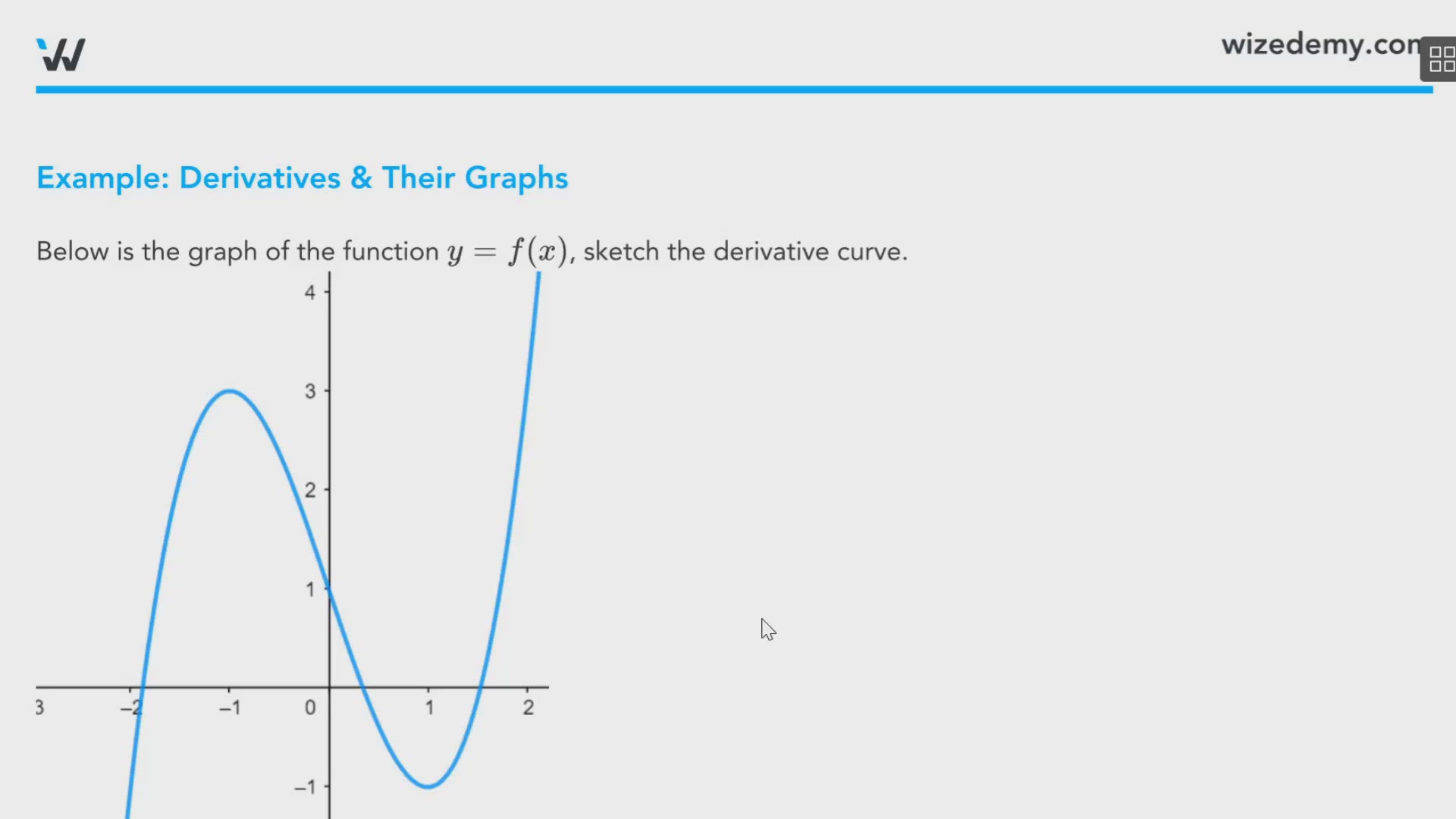
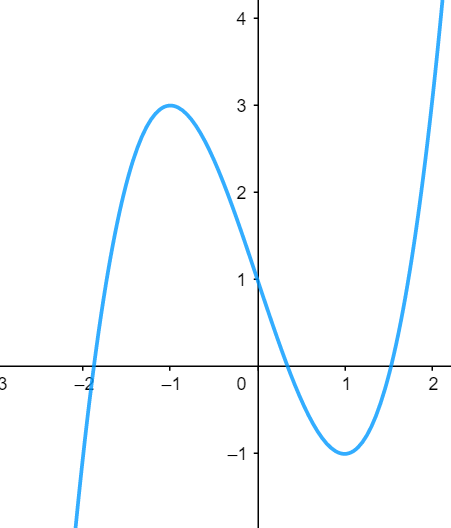
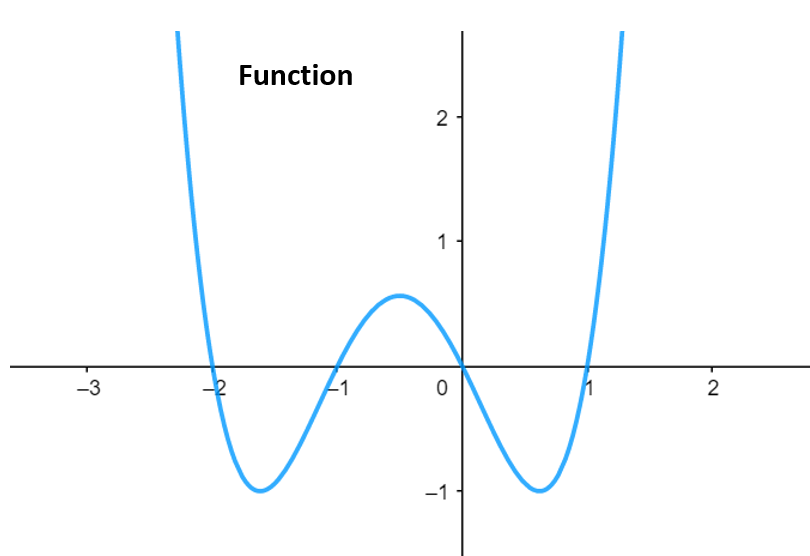
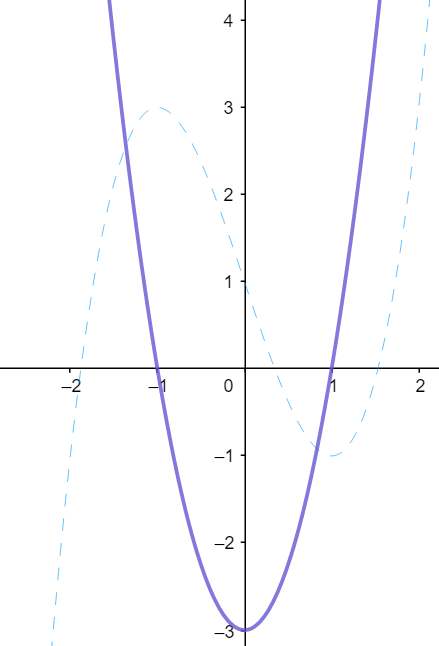
Below is the graph of the function y=f(x)y=f(x), sketch the derivative curve.


We estimate the slope of the tangent lines at each point of the graph and plot those to get the derivative curve.
Practice: Derivatives & Their Graphs

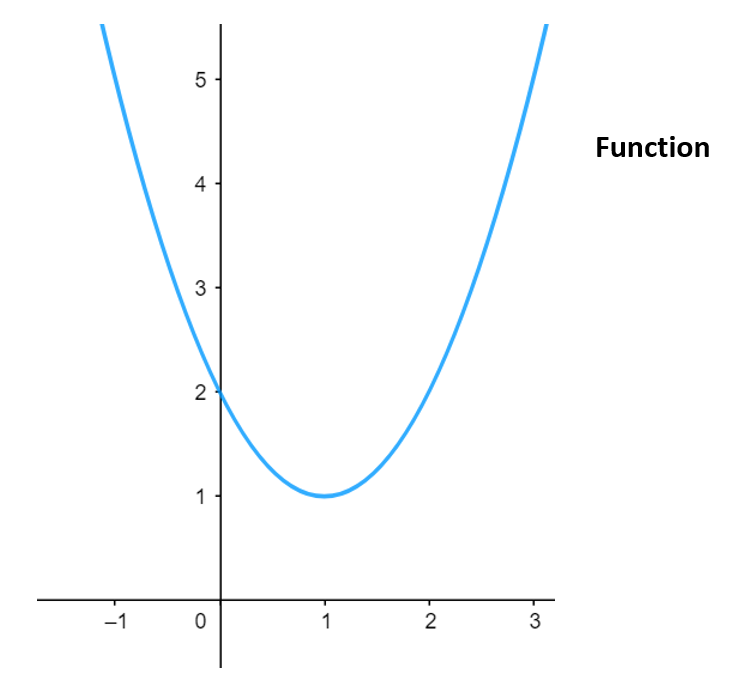
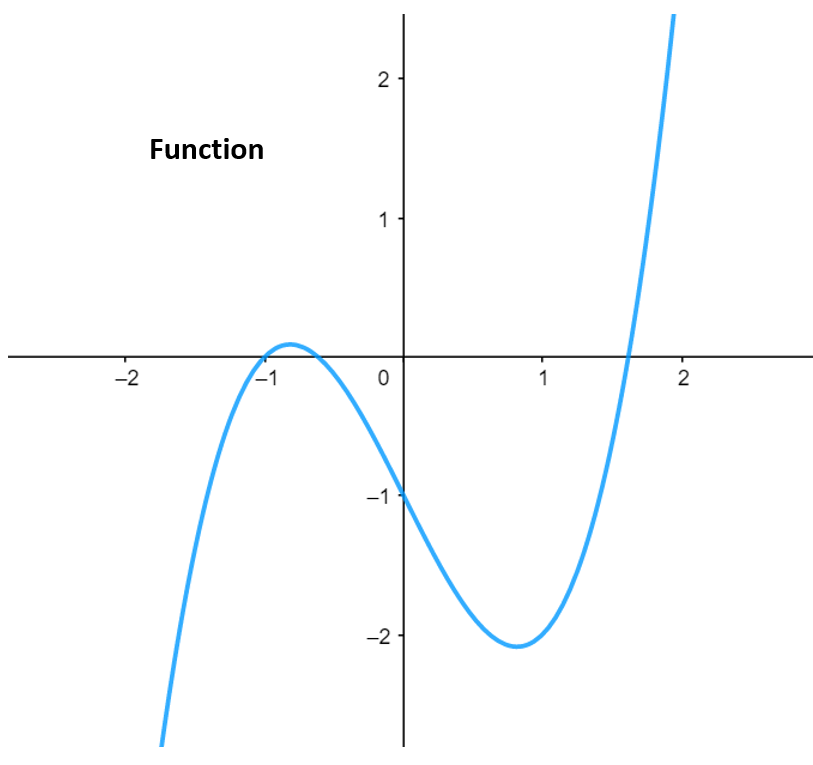
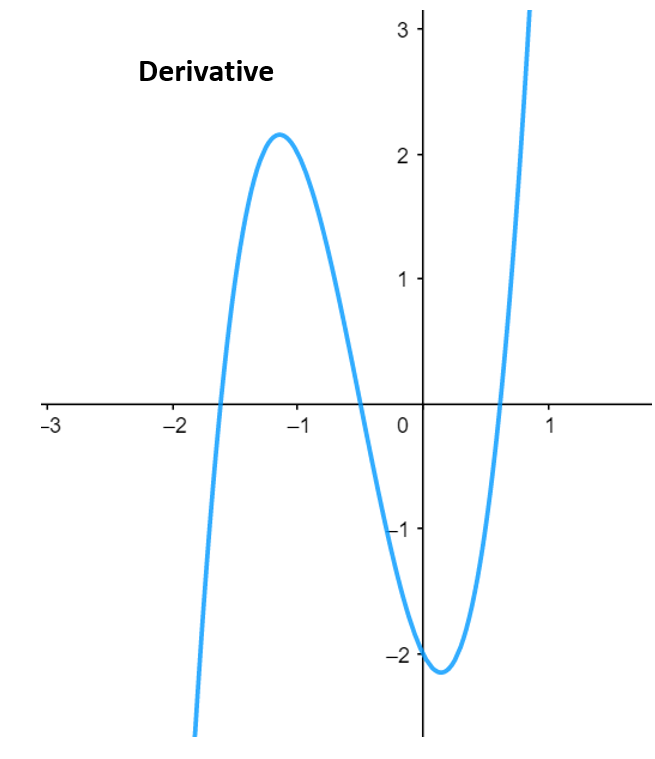
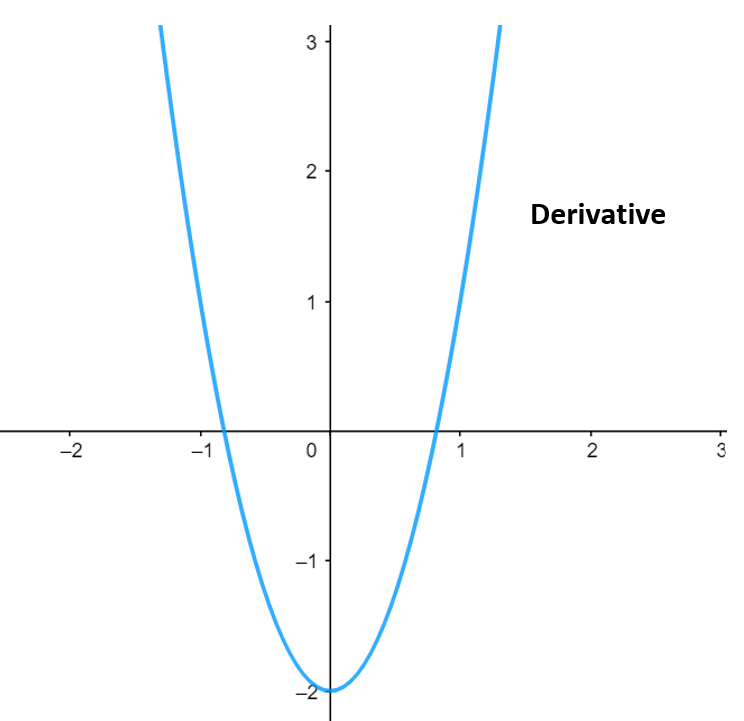
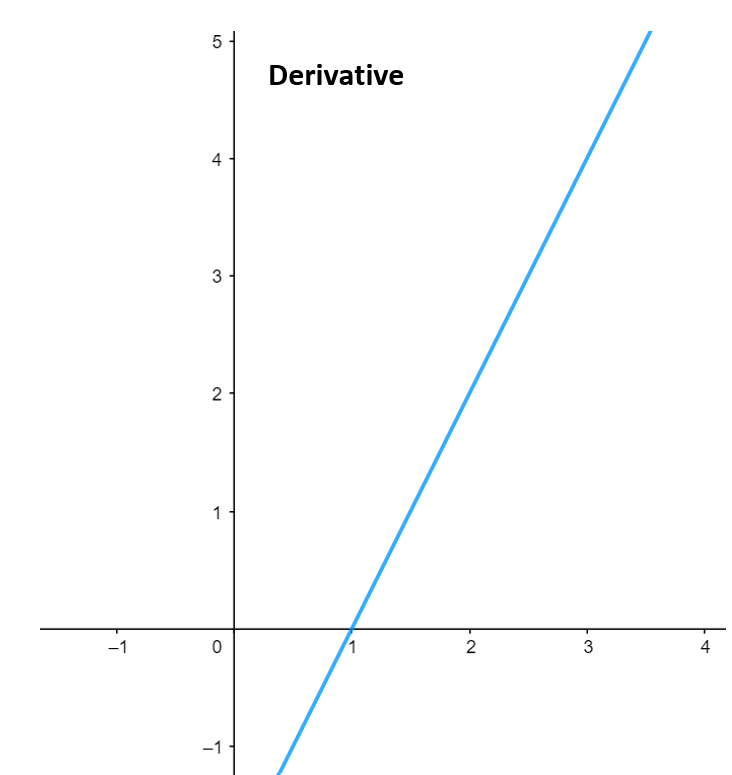
Match the following graphs with their derivatives.
A.

B.

C.


Practice: Definition of Derivatives

If f(a)=0f\left(a\right)=0 and f(a)=10f'\left(a\right)=10, find limh0 f(a+h)3h\displaystyle \lim_{h\to0}\ \frac{f\left(a+h\right)}{3h}