0:00 / 0:00

Derivative Rules for Polynomials

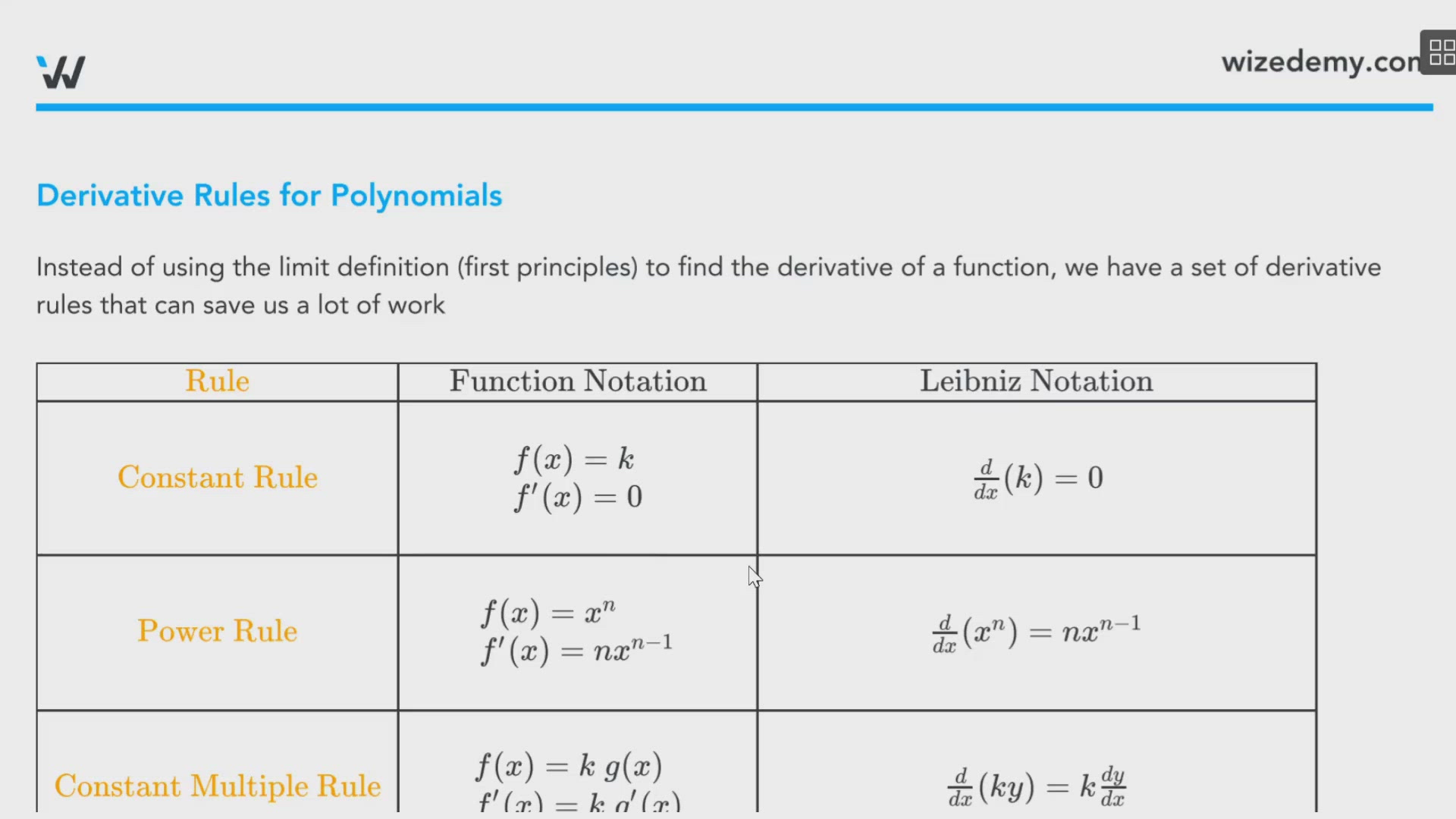
Instead of using the limit definition (first principles) to find the derivative of a function, we have a set of derivative rules that can save us a lot of work
RuleFunction NotationLeibniz NotationConstant Rulef(x)=kf(x)=0ddx(k)=0Power Rulef(x)=xnf(x)=nxn1ddx(xn)=nxn1Constant Multiple Rulef(x)=k g(x)f(x)=k g(x)ddx(ky)=kdydxSum/Difference Rulef(x)=g(x)±h(x)f(x)=g(x)±h(x)ddx(f(x)±g(x))=ddx[f(x)]±ddx[g(x)]\begin{array}{|c|c|c|} \hline \orange{\text{Rule}}&\text{Function Notation}&\text{Leibniz Notation}\\ \hline\\ \orange{\text{Constant Rule}}& \begin{array}{l}f(x)=k\\ f'(x)=0\end{array}& \frac{d}{dx}(k)=0\\\\ \hline\\ \orange{\text{Power Rule}}& \begin{array}{l}f(x)=x^n\\ f'(x)=nx^{n-1}\end{array}& \frac{d}{dx}(x^n)=nx^{n-1}\\\\ \hline\\ \orange{\text{Constant Multiple Rule}}& \begin{array}{l}f(x)=k\ g(x)\\ f'(x)=k\ g'(x)\end{array}& \frac{d}{dx}(ky)=k\frac{dy}{dx}\\\\ \hline\\ \orange{\text{Sum/Difference Rule}}& \begin{array}{l}f(x)=g(x)\pm h(x)\\ f'(x)=g'(x)\pm h'(x)\end{array}& \frac{d}{dx}(f(x)\pm g(x))=\frac{d}{dx}[f(x)]\pm\frac{d}{dx}[g(x)]\\\\ \hline \end{array}

0:00 / 0:00

Example: Derivative Rules

Find the derivatives of the following functions.
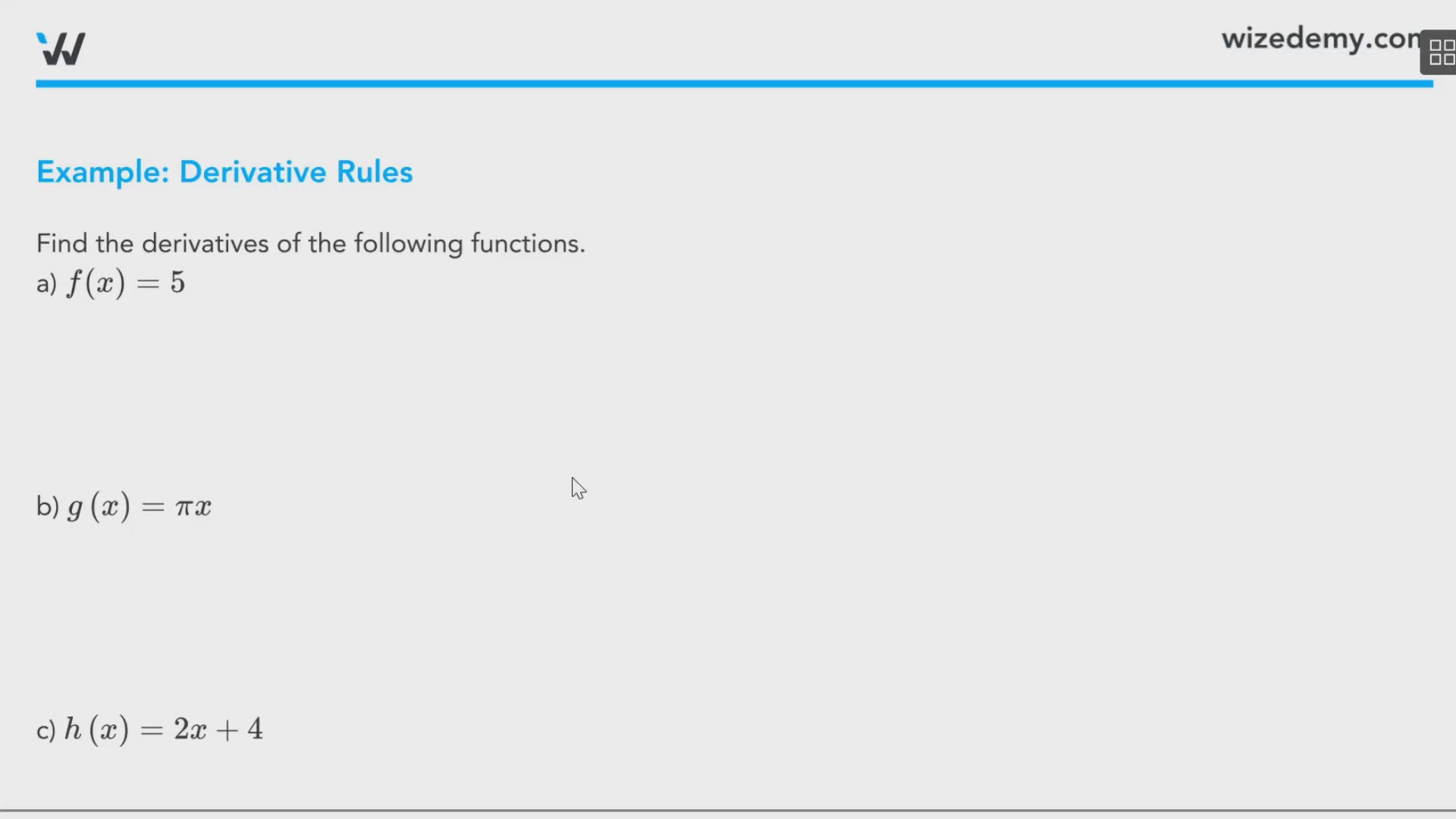
a) f(x)=5f(x)=5
f(x)=0f'\left(x\right)=0


b) g(x)=πxg\left(x\right)=\pi x
g(x)=π(1x0)=πg'\left(x\right)=\pi\left(1x^0\right)=\pi


c) h(x)=2x+4h\left(x\right)=2x+4
h(x)=2(1x0)+0=2h'\left(x\right)=2\left(1x^0\right)+0=2


d) y=3x74x3+x9y=3x^7-4x^3+x-9
y or dydx=3(7x6)4(3x2)+1x0=21x612x2+1y'\ or\ \frac{dy}{dx}=3\left(7x^6\right)-4\left(3x^2\right)+1x^0=21x^6-12x^2+1


e) f(x)=4x5+2x+8x2+1f\left(x\right)=-4x^5+2x+8x^2+1
f(x)=20x4+2+16xf'\left(x\right)=-20x^4+2+16x

Practice: Derivative Rules

Determine the slope of the tangent to the following graphs at the given points.
f(x)=3x4x+1f(x)=3x^4-x+1 at x=0x=0
0:00 / 0:00

Example: Derivative Rules

Find the derivatives of the following functions.
[Hint: Rewrite the functions before applying derivative rules]

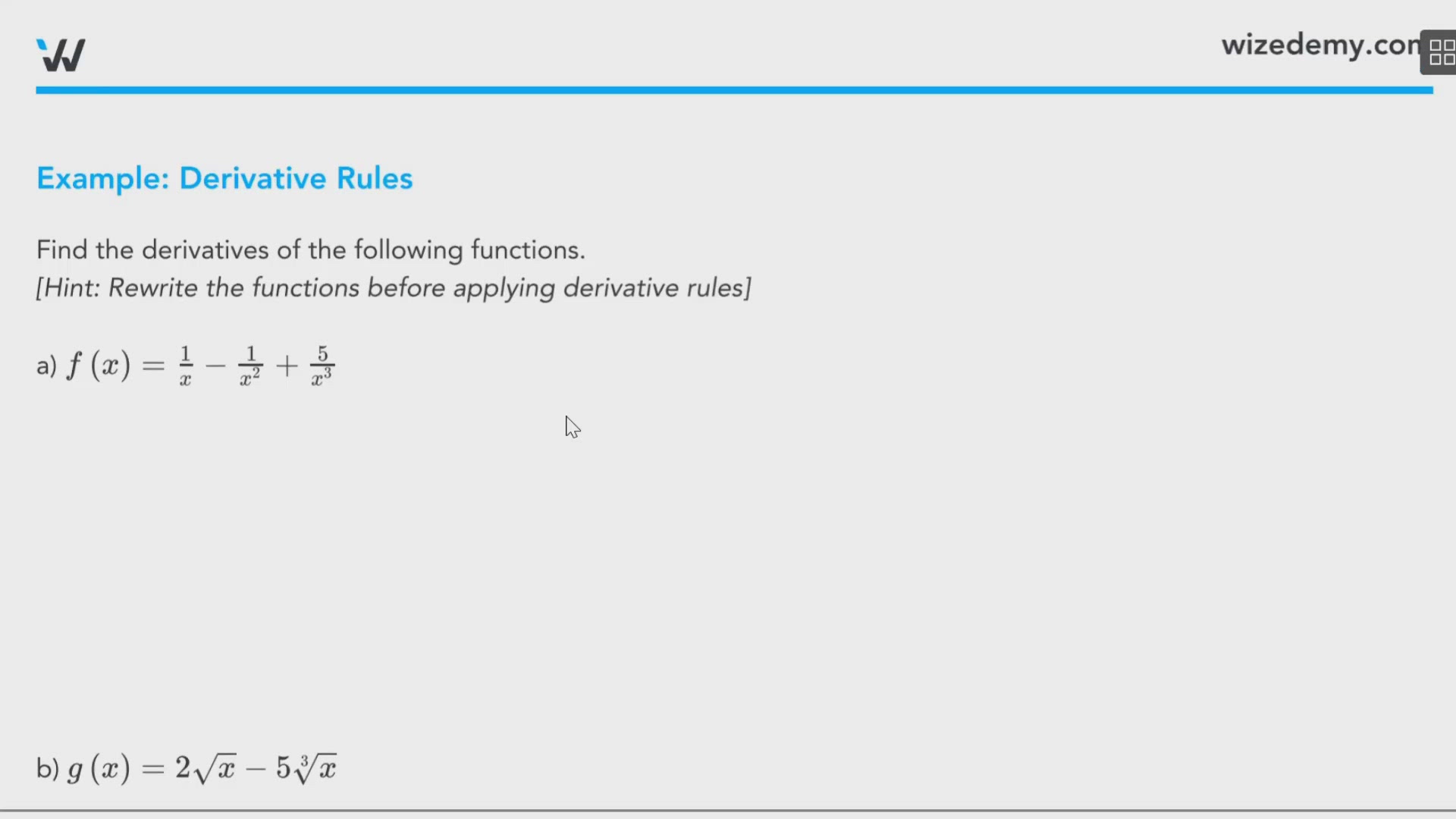
a) f(x)=1x1x2+5x3f\left(x\right)=\frac{1}{x}-\frac{1}{x^2}+\frac{5}{x^3}
f(x)=x1x2+5x3f\left(x\right)=x^{-1}-x^{-2}+5x^{-3}
f(x)=x2(2x3)+5(3x4)f'\left(x\right)=-x^{-2}-\left(-2x^{-3}\right)+5\left(-3x^{-4}\right)
f(x)=1x2+2x315x4\displaystyle f'\left(x\right)=-\frac{1}{x^2}+\frac{2}{x^3}-\frac{15}{x^4}


b) g(x)=2x5x3g\left(x\right)=2\sqrt{x}-5\sqrt [3]{x}
g(x)=2(x12)5(x13)\displaystyle g\left(x\right)=2\left(x^{\frac{1}{2}}\right)-5\left(x^{\frac{1}{3}}\right)
g(x)=2(12x12)5(13x23)\displaystyle g'\left(x\right)=2\left(\frac{1}{2}x^{-\frac{1}{2}}\right)-5\left(\frac{1}{3}x^{-\frac{2}{3}}\right)
g(x)=x1253x23\displaystyle g'\left(x\right)=x^{-\frac{1}{2}}-\frac{5}{3}x^{-\frac{2}{3}}
g(x)=1x53x23\displaystyle g'\left(x\right)=\frac{1}{\sqrt{x}}-\frac{5}{3\sqrt[3]{x^2}}

Practice: Derivative Rules

Find the rate of the change of the function f(x)=5xx32+13x\displaystyle f(x)=\frac{5}{\sqrt{x}}-\frac{\sqrt[3]{x}}{2}+\frac{1}{3x} at the point x=1x=1.
0:00 / 0:00

Example: Derivative Rules

Find the derviatives of the following functions.
[Hint: Rewrite the functions before applying derivative rules]

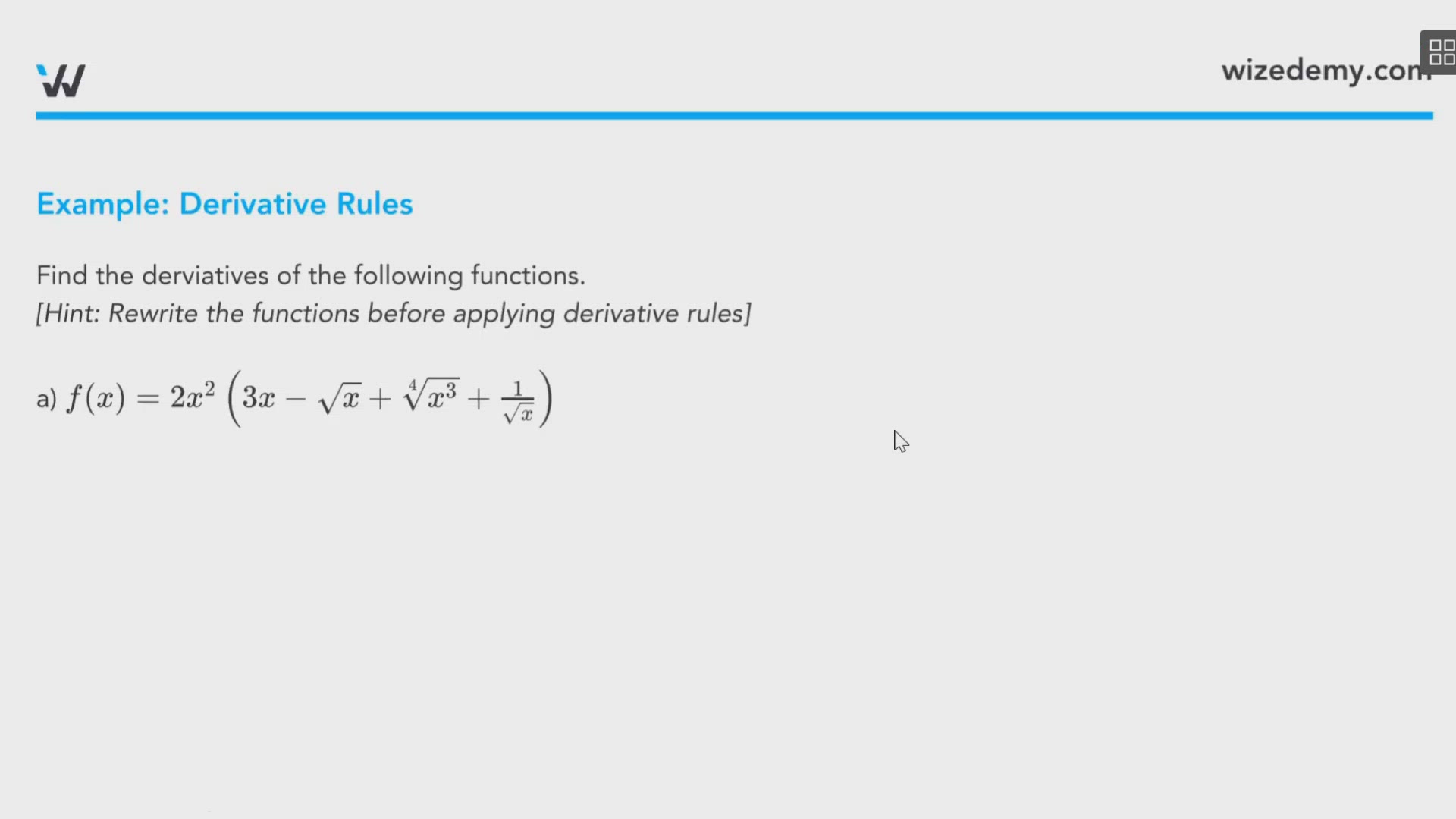
a) f(x)=2x2(3xx+x34+1x)f(x)=2x^2\left(3x-\sqrt{x}+\sqrt[4]{x^3}+\frac{1}{\sqrt{x}}\right)
f(x)=2x2(3xx12+x34+x12)f(x)=2x^2\left(3x-x^{\frac{1}{2}}+x^{\frac{3}{4}}+x^{-\frac{1}{2}}\right)
f(x)=6x32x52+2x114+2x32f(x)=6x^3-2x^{\frac{5}{2}}+2x^{\frac{11}{4}}+2x^{\frac{3}{2}}
f(x)=6(3x2)2(52x32)+2(114x74)+2(32x12)f'\left(x\right)=6\left(3x^2\right)-2\left(\frac{5}{2}x^{\frac{3}{2}}\right)+2\left(\frac{11}{4}x^{\frac{7}{4}}\right)+2\left(\frac{3}{2}x^{\frac{1}{2}}\right)
f(x)=18x25x32+112x74+3x12f'\left(x\right)=18x^2-5x^{\frac{3}{2}}+\frac{11}{2}x^{\frac{7}{4}}+3x^{\frac{1}{2}}
f(x)=18x25x3+112x74+3xf'\left(x\right)=18x^2-5\sqrt{x^3}+\frac{11}{2}\sqrt[4]{x^7}+3\sqrt x


b) g(x)=2t4t+4t3\displaystyle g(x)=\frac{2t^4-t+4}{t^3}
g(x)=2t4t3tt3+4t3\displaystyle g(x)=\frac{2t^4}{t^3}-\frac{t}{t^3}+\frac{4}{t^3}
g(x)=2tt2+4t3g(x)=2t-t^{-2}+4t^{-3}
g(x)=2(2t3)+4(3t4)g'\left(x\right)=2-\left(-2t^{-3}\right)+4\left(-3t^{-4}\right)
g(x)=2+2t312t4\displaystyle g'\left(x\right)=2+\frac{2}{t^3}-\frac{12}{t^4}

Practice: Derivative Rule

Given f(t)=2t3(t+1t)t\displaystyle f(t)=\frac{2t^3\left(t+\frac{1}{t}\right)}{\sqrt{t}}, find f(4)f'\left(4\right).

Practice: Derivatives

Do the functions y=1xy=-\frac{1}{x} and y=x33y=\frac{x^3}{3} ever have the same slope? If so, where?
0:00 / 0:00

Example: Horizontal Tangents

Find the coordinates of the point(s), if any, where the function f(x)=2x216x+35f\left(x\right)=2x^2-16x+35 has a horizontal tangent line.

The derivative is f(x)=4x16f'\left(x\right)=4x-16.

A tangent line is horizontal when the slope is 0, meaning when the derivative is 0:
0=4x160=4x-16
16=4x16=4x
x=4x=4

When x=4x=4, y=f(4)=2(4)216(4)+35=3y=f\left(4\right)=2\left(4\right)^2-16\left(4\right)+35=3.

Therefore, the coordinates of the point in which the function has a horizontal tangent is (4, 3)\left(4,\ 3\right)

Practice: Normal Line

Find the equation of the normal line to the curve y=2x+xy=2x+\sqrt{x} at the point where the normal line has a slope of 13-\frac{1}{3}.

Practice: Tangent Lines

Given the curve y=x2+1y=x^2+1,
a) find the equation of the tangent to the curve at the point (1, 2)\left(-1,\ 2\right).
b) find the equation of the tangent to the curve that is perpendicular to the line found in a)
c) find the coordinates of the single point of intersection between the tangent lines found in a) and b).
0:00 / 0:00

Example: Derivative of Piecewise Functions

Find the derivative of f(x)=2x28f\left(x\right)=\left|2x^2-8\right| and state any points where f(x)f'\left(x\right) does not exist.

We can break up the absolute values:
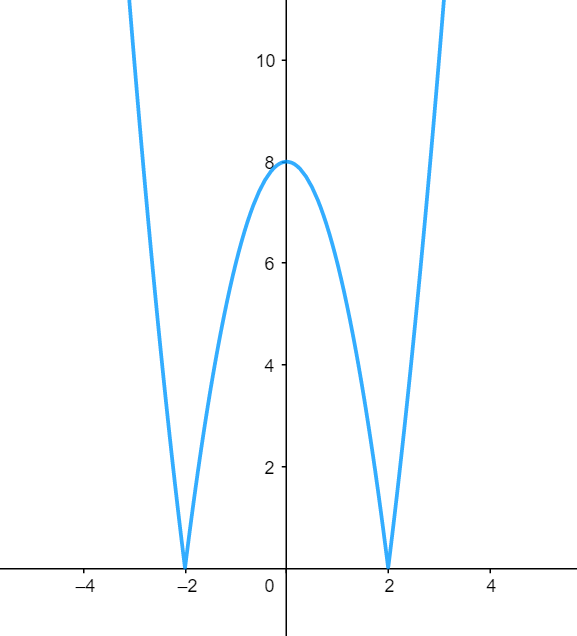
f(x)={2x28,if x2  or  x2(2x28),if 2<x<2f\left(x\right)= \begin{cases} 2x^2-8,&\text{if }x\ge2\ \text{ or }\ x\le-2\\ -(2x^2-8),&\text{if }-2<x<2 \end{cases}


So, we can find the derivatives of each part of the function.

When x2 or x2\underline{x\ge2\ \text{or}\ x\le-2}:
f(x)=2x28f\left(x\right)=2x^2-8
f(x)=4xf'\left(x\right)=4x

When 2<x<2\underline{-2<x<2}:
f(x)=(2x28)=82x2f\left(x\right)=-(2x^2-8)=8-2x^2
f(x)=4xf'\left(x\right)=-4x

At the points x=2x=-2 and x=2x=2, the function has a cusp, so the derivative at those points are not defined.