0:00 / 0:00

Product Rule

If h(x)=f(x)g(x)h\left(x\right)=f\left(x\right)g\left(x\right), then h(x)=f(x) g(x)+f(x) g(x)h'\left(x\right)=f'\left(x\right)\ g\left(x\right)+f\left(x\right)\ g'\left(x\right).

Example
Find the derivative of f(x)=(x+x2)(4x1)f\left(x\right)=\left(\sqrt{x}+x^2\right)\left(4x-1\right) using the product rule.

f(x)=(x12+x2)(4x1)f\left(x\right)=\left(x^{\frac{1}{2}}+x^2\right)\left(4x-1\right)
f(x)=(x12+x2) (4x1)+(x12+x2)(4x1)f'\left(x\right)=\orange{\left(x^{\frac{1}{2}}+x^2\right)'}\ \left(4x-1\right)+\left(x^{\frac{1}{2}}+x^2\right)\green{\left(4x-1\right)'}
f(x)=(12x12+2x)(4x1)+(x12+x2)(4)f'(x)=\orange{\left(\frac{1}{2}x^{-\frac{1}{2}}+2x\right)}\left(4x-1\right)+\left(x^{\frac{1}{2}}+x^2\right)\green{\left(4\right)}
f(x)=(12x+2x)(4x1)+(x+x2)(4)f'(x)=\left(\frac{1}{2\sqrt{x}}+2x\right)\left(4x-1\right)+\left(\sqrt{x}+x^2\right)\left(4\right)


PAGE BREAK

Power of a Function Rule

If h(x)=[f(x)]nh\left(x\right)=\left[f\left(x\right)\right]^n, then h(x)=n[f(x)]n1×f(x)h'\left(x\right)=n\left[f\left(x\right)\right]^{n-1}\times f'\left(x\right).

Example
Find the derivative of f(x)=(3x21)5f\left(x\right)=\left(3x^2-1\right)^5 using the generalized power rule.

f(x)=5[(3x21)]4×(3x21)f'\left(x\right)=5\left[\left(3x^2-1\right)\right]^4\times\orange{\left(3x^2-1\right)'}
f(x)=5(3x21)4×(6x)f'(x)=5\left(3x^2-1\right)^4\times\orange{\left(6x\right)}
f(x)=30x(3x21)4f'(x)=30x\left(3x^2-1\right)^4

Practice: Product Rule

Use the product rule to differentiate each of the following functions.
a) f(x)=(x21)(2x3)f\left(x\right)=\left(x^2-1\right)\left(2-x^3\right)
b) g(x)=(x+1)(3x2x+2)g\left(x\right)=\left(x+1\right)\left(3x^2-x+2\right)

Practice: Power of a Function Rule

Find the derivative of f(x)=(1x+2x3)4f\left(x\right)=\left(\frac{1}{x}+2x^3\right)^4 at the point x=1x=1
0:00 / 0:00

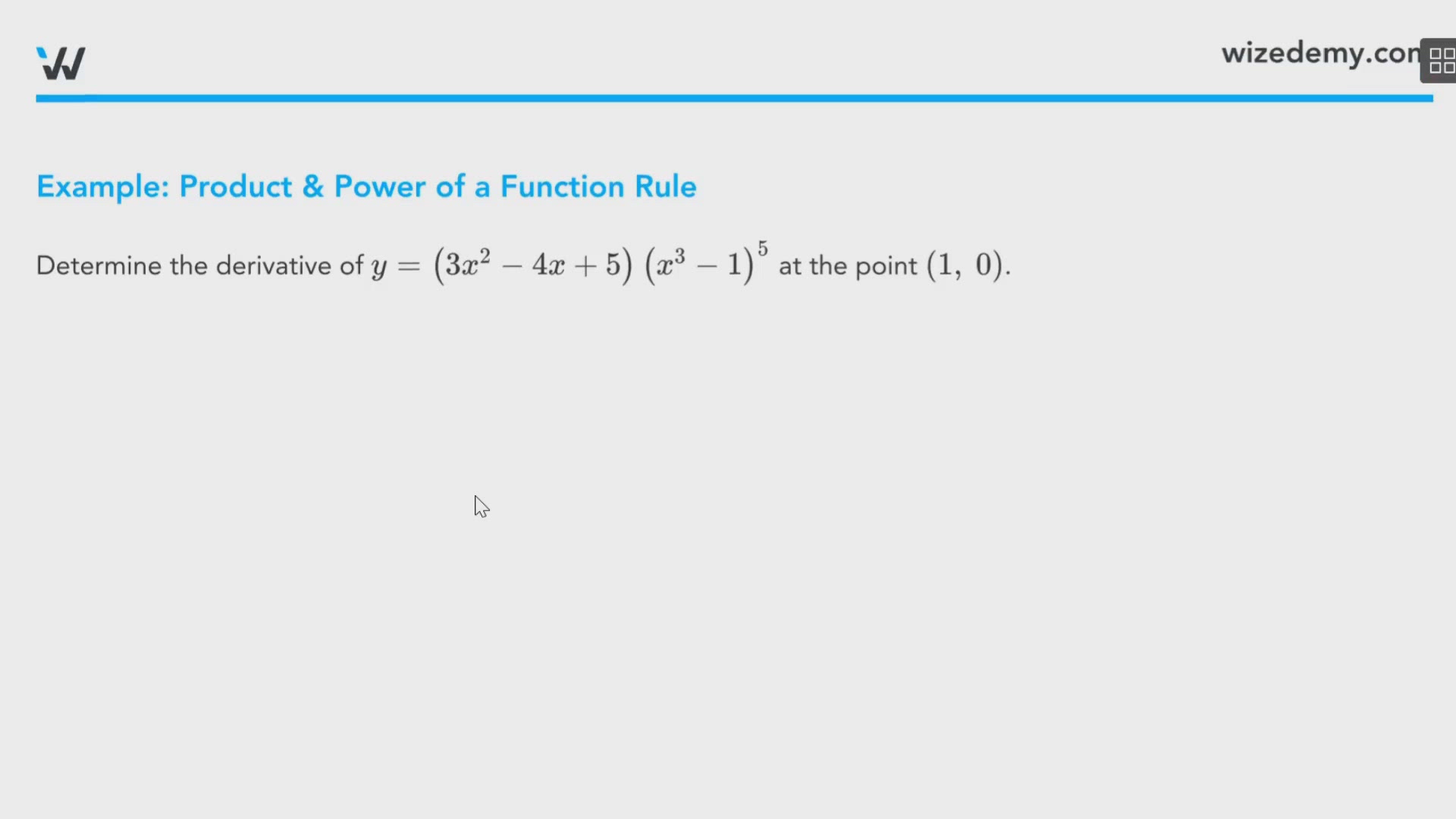
Example: Product & Power of a Function Rule

Determine the derivative of y=(3x24x+5)(x31)5y=\left(3x^2-4x+5\right)\left(x^3-1\right)^5 at the point (1, 0)\left(1,\ 0\right).

Since we see two terms involving xxs being multiplied together, we need to use the product rule to find the derivative:
y=(3x24x+5)(x31)5+(3x24x+5)((x31)5)y'=\orange{\left(3x^2-4x+5\right)'}\left(x^3-1\right)^5+\left(3x^2-4x+5\right)\green{\left(\left(x^3-1\right)^5\right)'}
y=(6x4)(x31)5+(3x24x+5)[5(x31)4×3x2]y'=\orange{\left(6x-4\right)}\left(x^3-1\right)^5+\left(3x^2-4x+5\right)\green{\left[5\left(x^3-1\right)^4\times3x^2\right]}

We can simplify this a bit:
y=(6x4)(x31)5+15x2(3x24x+5)(x31)4y'=\left(6x-4\right)\left(x^3-1\right)^5+15x^2\left(3x^2-4x+5\right)\left(x^3-1\right)^4

Sub in the value x=1x=1:
y(1)=(6(1)4)((1)31)5+15(1)2(3(1)24(1)+5)((1)31)4y'\left(1\right)=\left(6\left(1\right)-4\right)\left(\left(1\right)^3-1\right)^5+15\left(1\right)^2\left(3\left(1\right)^2-4\left(1\right)+5\right)\left(\left(1\right)^3-1\right)^4
y(1)=0+0y'\left(1\right)=0+0
y(0)=0y'\left(0\right)=0

Practice: Product & Power of a Function Rule

Find the rate of change of f(x)=(32x5)3(4x1)f\left(x\right)=\left(3-2x^5\right)^3\left(4x-1\right) at the point (0, 3)\left(0,\ -3\right).
0:00 / 0:00

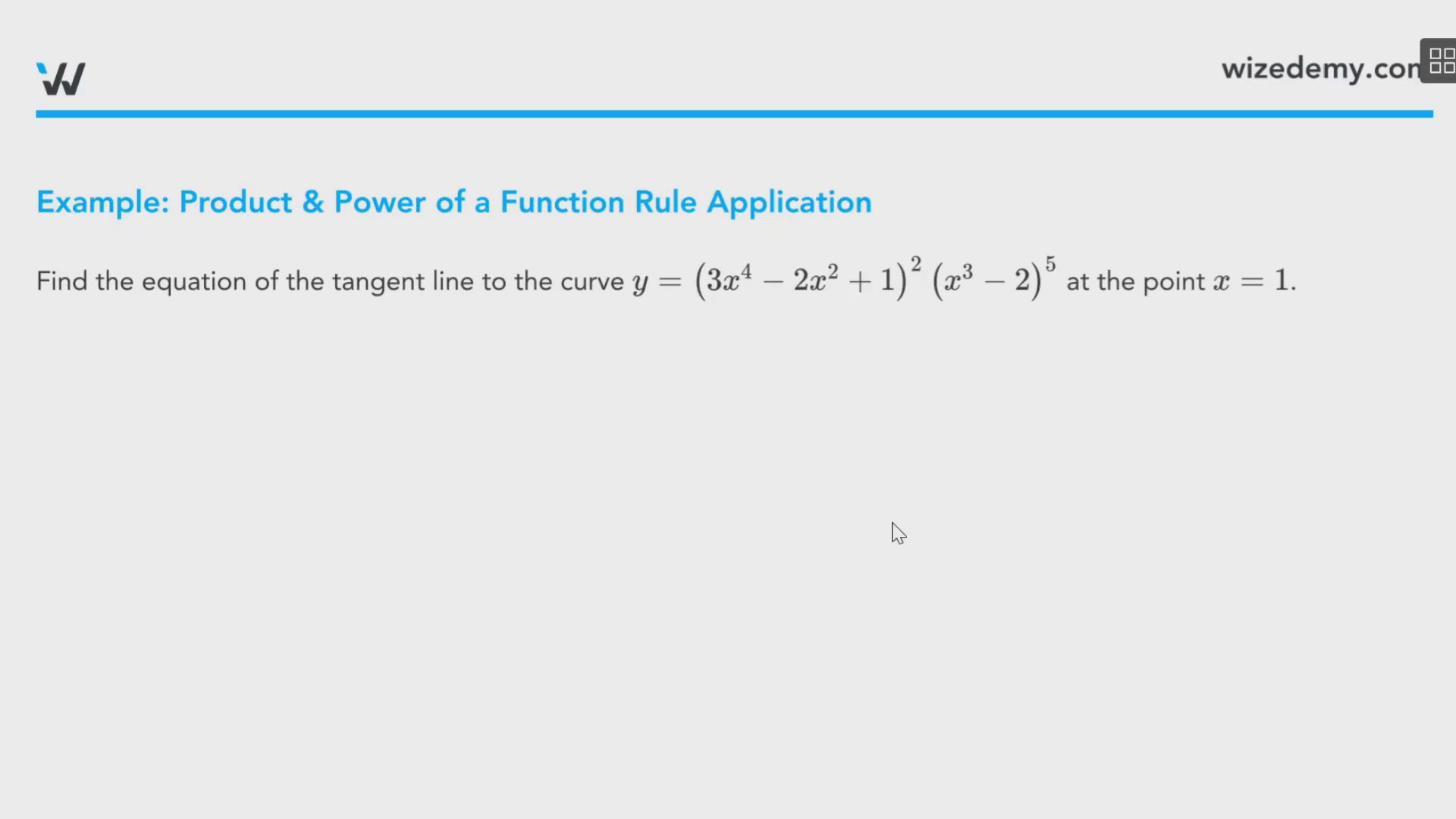
Example: Product & Power of a Function Rule Application

Find the equation of the tangent line to the curve y=(3x42x2+1)2(x32)5y=\left(3x^4-2x^2+1\right)^2\left(x^3-2\right)^5 at the point x=1x=1.

When x=1x=1, y=(3(1)42(1)2+1)2((1)32)5=4y=\left(3\left(1\right)^4-2\left(1\right)^2+1\right)^2\left(\left(1\right)^3-2\right)^5=-4. So a point on the tangent line is (1, 4)\left(1,\ -4\right).

The slope of this tangent line is the derivative of the curve at the point x=1x=1:
y=((3x42x2+1)2)(x32)5+(3x42x2+1)2((x32)5)y'=\orange{\left(\left(3x^4-2x^2+1\right)^2\right)'}\left(x^3-2\right)^5+\left(3x^4-2x^2+1\right)^2\green{\left(\left(x^3-2\right)^5\right)'}
y=(2(3x42x2+1)(12x34x))(x32)5+(3x42x2+1)2[5(x32)4(3x2)]y'=\orange{\left(2\left(3x^4-2x^2+1\right)\left(12x^3-4x\right)\right)}\left(x^3-2\right)^5+\left(3x^4-2x^2+1\right)^2\green{\left[5\left(x^3-2\right)^4\left(3x^2\right)\right]}
y=(24x38x)(3x42x2+1)(x32)5+15x2(3x42x2+1)2(x32)4y'=\left(24x^3-8x\right)\left(3x^4-2x^2+1\right)\left(x^3-2\right)^5+15x^2\left(3x^4-2x^2+1\right)^2\left(x^3-2\right)^4
y(1)=(24(1)38(1))(3(1)42(1)2+1)((1)32)5+15(1)2(3(1)42(1)2+1)2((1)32)4y'\left(1\right)=\left(24\left(1\right)^3-8\left(1\right)\right)\left(3\left(1\right)^4-2\left(1\right)^2+1\right) \left(\left(1\right)^3-2\right)^5+15\left(1\right)^2\left(3\left(1\right)^4-2\left(1\right)^2+1\right)^2\left(\left(1\right)^3-2\right)^4
y(1)=(16)(2)(1)5+15(2)2(1)4y'\left(1\right)=\left(16\right)\left(2\right)\left(-1\right)^5+15\left(2\right)^2\left(-1\right)^4
y(1)=32+60y'\left(1\right)=-32+60
y(1)=28y'\left(1\right)=28

Therefore, the equation of the tangent line is:
yy0=m(xx0)y-y_0=m\left(x-x_0\right)
y(4)=28(x1)y-\left(-4\right)=28\left(x-1\right)
y+4=28x28y+4=28x-28
y=28x32y=28x-32

Practice: Product & Power of a Function Rule Application

How many horizontal tangent lines are there to the curve y=(3x+1)3(x2)3y=\left(3x+1\right)^3\left(x-2\right)^3 ?
0:00 / 0:00

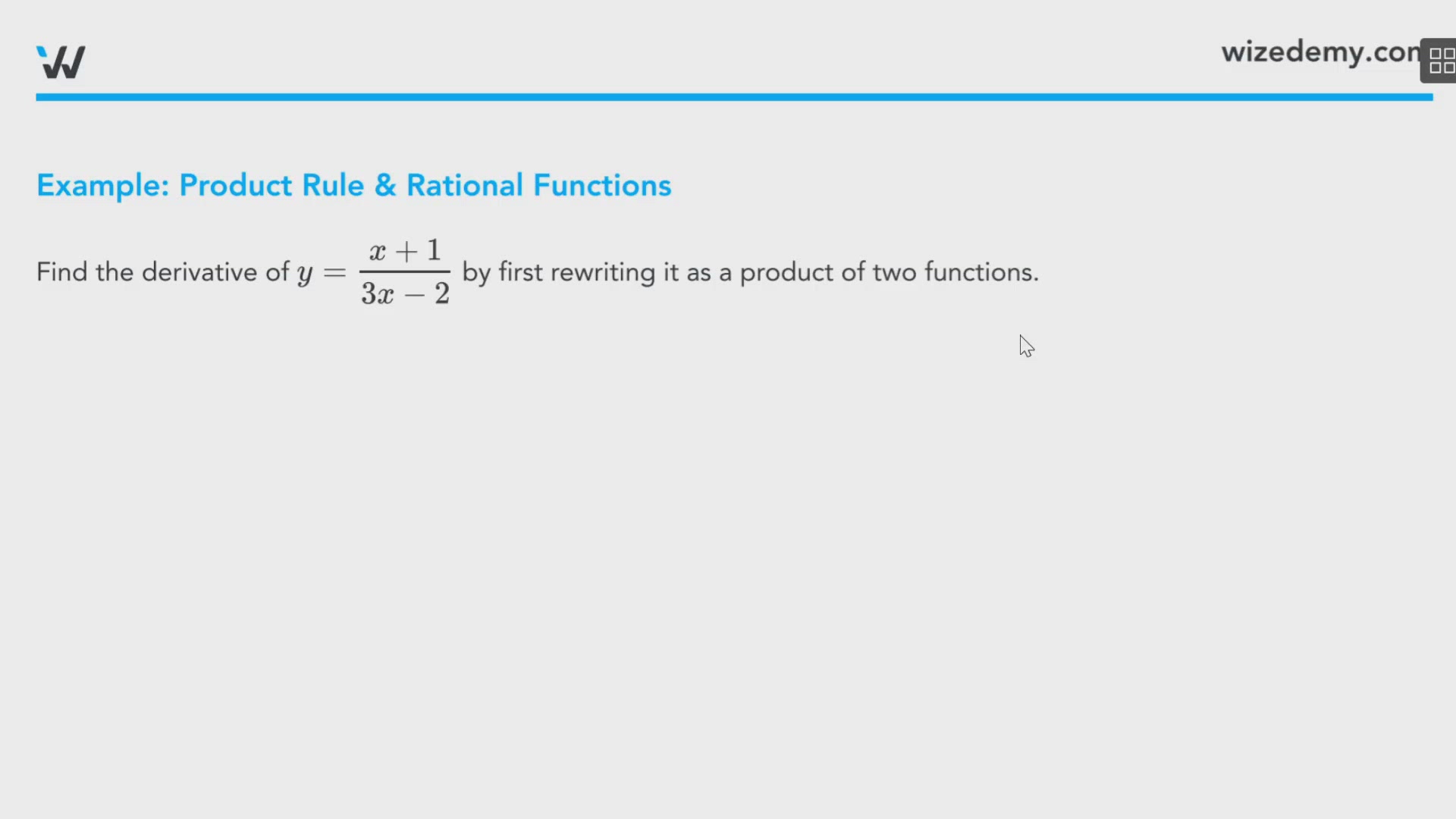
Example: Product Rule & Rational Functions

Find the derivative of y=x+13x2\displaystyle y=\frac{x+1}{3x-2} by first rewriting it as a product of two functions.

Rewrite
y=(x+1)(13x2)y=\left(x+1\right)\left(\frac{1}{3x-2}\right)
y=(x+1)(3x2)1y=\left(x+1\right)\left(3x-2\right)^{-1}

Using the product rule:
y=(x+1)(3x2)1+(x+1)[(3x2)1]y'=\orange{\left(x+1\right)'}\left(3x-2\right)^{-1}+\left(x+1\right)\green{\left[\left(3x-2\right)^{-1}\right]'}
*We need to use the power of a function derivative rule for the derivative of the second term
y=(1)(3x2)1+(x+1)[1(3x2)2×(3x2)]y'=\orange{\left(1\right)}\left(3x-2\right)^{-1}+\left(x+1\right)\green{\left[-1\left(3x-2\right)^{-2}\times\pink{\left(3x-2\right)'}\right]}
y=(1)(3x2)1+(x+1)[1(3x2)2×3]y'=\left(1\right)\left(3x-2\right)^{-1}+\left(x+1\right)\left[-1\left(3x-2\right)^{-2}\times\pink{3}\right]
y=13x2+(x+1)[3(3x2)2]\displaystyle y'=\frac{1}{3x-2}+\left(x+1\right)\left[-\frac{3}{\left(3x-2\right)^2}\right]
y=13x23x+3(3x2)2\displaystyle y'=\frac{1}{3x-2}-\frac{3x+3}{\left(3x-2\right)^2}
y=3x2(3x2)23x+3(3x2)2\displaystyle y'=\frac{3x-2}{\left(3x-2\right)^2}-\frac{3x+3}{\left(3x-2\right)^2}
y=3x23x3(3x2)2\displaystyle y'=\frac{3x-2-3x-3}{\left(3x-2\right)^2}
y=5(3x2)2\displaystyle y'=\frac{-5}{\left(3x-2\right)^2}

Practice: Product Rule & Rational Functions

The portion of cells in a body that are affected by a certain virus is modelled by the function A(t)=t1t+2\displaystyle A(t)=\frac{t-1}{t+2} where tt is the number of hours after the virus first enters the body, and t1t\ge1.

Determine how quickly the percentage of cells in the body are being affected when 40% of the cells in this body are affected.
0:00 / 0:00

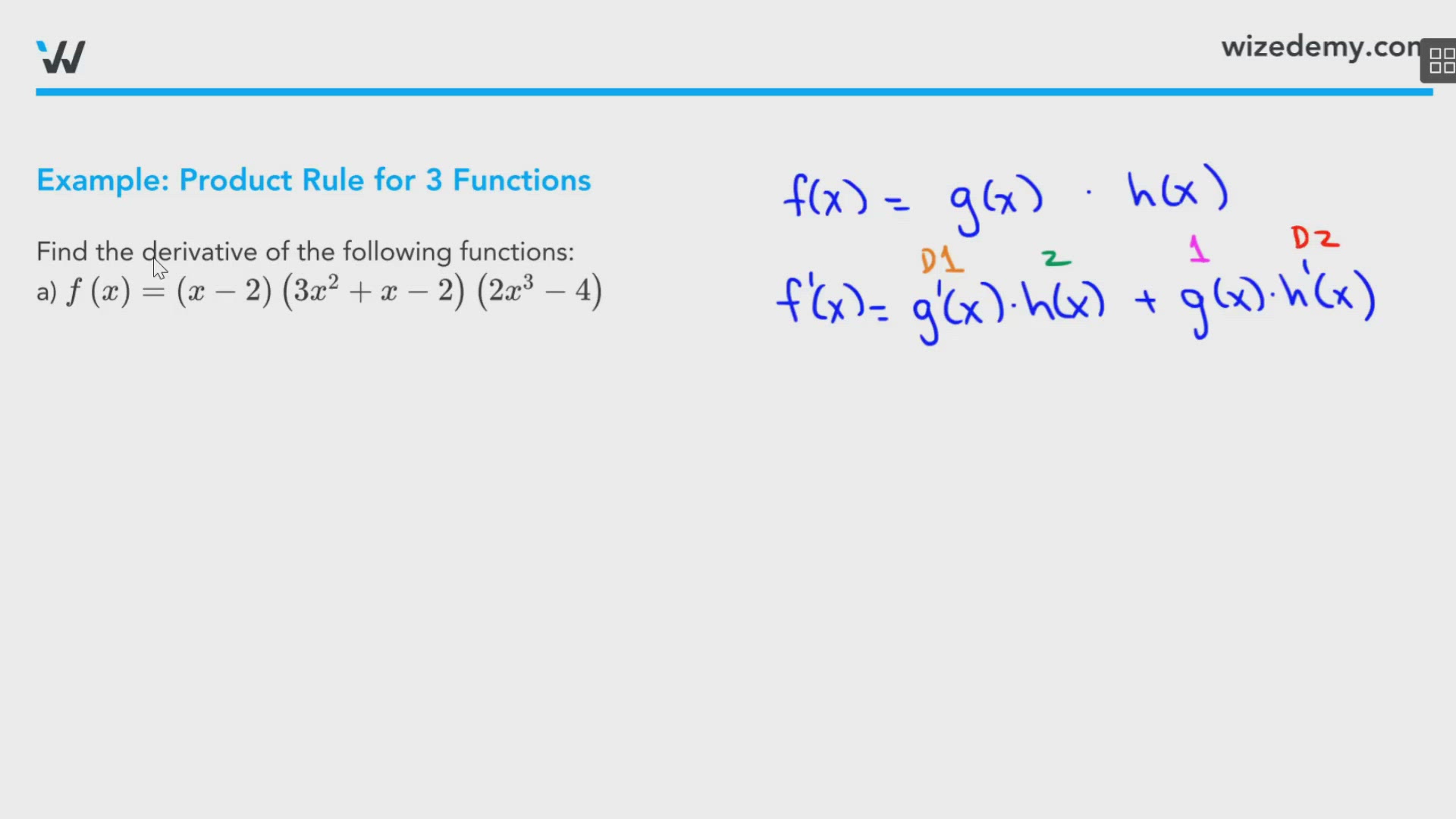
Example: Product Rule for 3 Functions

Find the derivative of the following functions:
a) f(x)=(x2)(3x2+x2)(2x34)f\left(x\right)=\left(x-2\right)\left(3x^2+x-2\right)\left(2x^3-4\right)

Group two of these factors together:
f(x)=[(x2)(3x2+x2)][2x34]f\left(x\right)=\left[\left(x-2\right)\left(3x^2+x-2\right)\right]\left[2x^3-4\right]

Now, we use the product rule to find the derivative:
f(x)=[(x2)(3x2+x2)][2x34]+[(x2)(3x2+x2)][2x34]f'\left(x\right)=\orange{\left[\left(x-2\right)\left(3x^2+x-2\right)\right]'}\left[2x^3-4\right]+\left[\left(x-2\right)\left(3x^2+x-2\right)\right]\green{\left[2x^3-4\right]'}

Use product rule again to find the derivative of the first part:
f(x)=[(x2)(3x2+x2)+(x2)(3x2+x2)][2x34]+[(x2)(3x2+x2)][6x2]f'\left(x\right)=\orange{\left[\red{\left(x-2\right)'}\left(3x^2+x-2\right)+\left(x-2\right)\blue{\left(3x^2+x-2\right)'}\right]}\left[2x^3-4\right]+\left[\left(x-2\right)\left(3x^2+x-2\right)\right]\green{\left[6x^2\right]}
f(x)=[(1)(3x2+x2)+(x2)(6x+1)][2x34]+[(x2)(3x2+x2)][6x2]f'\left(x\right)=\orange{\left[ \red{\left(1\right)} \left(3x^2+x-2\right)+\left(x-2\right) \blue{\left(6x+1\right)}\right]} \left[2x^3-4\right] +\left[\left(x-2\right)\left(3x^2+x-2\right)\right] \green{\left[6x^2\right]}

We can simplify this a bit:
f(x)=[3x2+x2+6x2+x12x2][2x34]+6x2(x2)(3x2+x2)f'\left(x\right)=\left[3x^2+x-2+6x^2+x-12x-2\right]\left[2x^3-4\right]+6x^2\left(x-2\right)\left(3x^2+x-2\right)
f(x)=(9x210x4)(2x34)+6x2(x2)(3x2+x2)f'\left(x\right)=\left(9x^2-10x-4\right)\left(2x^3-4\right)+6x^2\left(x-2\right)\left(3x^2+x-2\right)


PAGE BREAK
b) g(x)=(x+2)(34x)3(2x2+1)2g\left(x\right)=\left(x+2\right)\left(3-4x\right)^3\left(2x^2+1\right)^2

Group two of these factors together:
g(x)=[(x+2)(34x)3][(2x2+1)2]g\left(x\right)=\left[\left(x+2\right)\left(3-4x\right)^3\right]\left[\left(2x^2+1\right)^2\right]
g(x)=[(x+2)(34x)3][(2x2+1)2]+[(x+2)(34x)3][(2x2+1)2]g\left(x\right)= \orange{\left[\left(x+2\right)\left(3-4x\right)^3\right]'} \left[\left(2x^2+1\right)^2\right] + \left[\left(x+2\right)\left(3-4x\right)^3\right] \green{\left[\left(2x^2+1\right)^2\right]'}

Use product rule again to find the derivative of the first part:
g(x)=[(x+2)(34x)3+(x+2)((34x)3)][(2x2+1)2]+[(x+2)(34x)3][2(2x2+1)×(4x)]g\left(x\right)= \orange{\left[\red{\left(x+2\right)'}\left(3-4x\right)^3+\left(x+2\right)\blue{\left(\left(3-4x\right)^3\right)'}\right]} \left[\left(2x^2+1\right)^2\right] + \left[\left(x+2\right)\left(3-4x\right)^3\right] \green{\left[2\left(2x^2+1\right)\times\left(4x\right)\right]}
g(x)=[(1)(34x)3+(x+2)(3(34x)2×4)][(2x2+1)2]+[(x+2)(34x)3][2(2x2+1)×(4x)]g\left(x\right)= \orange{\left[\red{\left(1\right)}\left(3-4x\right)^3+\left(x+2\right) \blue{\left(3\left(3-4x\right)^2\times-4\right)}\right]} \left[\left(2x^2+1\right)^2\right] + \left[\left(x+2\right)\left(3-4x\right)^3\right]\green{\left[2\left(2x^2+1\right)\times\left(4x\right)\right]}

We can simplify this a bit:
g(x)=[(34x)312(x+2)(34x)2][(2x2+1)2]+8x(x+2)(34x)3(2x2+1)g\left(x\right)=\left[\left(3-4x\right)^3-12\left(x+2\right)\left(3-4x\right)^2\right]\left[\left(2x^2+1\right)^2\right]+8x\left(x+2\right)\left(3-4x\right)^3\left(2x^2+1\right)
g(x)=[(34x)2(34x12(x+2))][(2x2+1)2]+8x(x+2)(34x)3(2x2+1)g\left(x\right)=\left[\left(3-4x\right)^2\left(3-4x-12\left(x+2\right)\right)\right]\left[\left(2x^2+1\right)^2\right]+8x\left(x+2\right)\left(3-4x\right)^3\left(2x^2+1\right)
g(x)=(34x)2(16x21)(2x2+1)2+8x(x+2)(34x)3(2x2+1)g\left(x\right)=\left(3-4x\right)^2\left(-16x-21\right)\left(2x^2+1\right)^2+8x\left(x+2\right)\left(3-4x\right)^3\left(2x^2+1\right)
g(x)=(34x)2(2x2+1)[(16x21)(2x2+1)+8x(x+2)(34x)]g\left(x\right)=\left(3-4x\right)^2\left(2x^2+1\right)\left[\left(-16x-21\right)\left(2x^2+1\right)+8x\left(x+2\right)\left(3-4x\right)\right]

Practice: Product Rule for 3 Functions

Find the slope of the tangent line to the curve y=(2x2+1)(x1)(3x+1)4y=\left(2x^2+1\right)\left(x-1\right)\left(3x+1\right)^4 at the point (1, 0)\left(1,\ 0\right).

Practice: Product Rule

Suppose g(x)g\left(x\right) is differentiable, f(x)=x2g(x)f\left(x\right)=x^2g\left(x\right). Given that f(3)=30f'\left(3\right)=30, f(3)=19f''\left(3\right)=19, g(3)=2g\left(3\right)=2, what is g(3)g'\left(3\right) and g(3)g''\left(3\right)?