
Absolute Max & Min
Given a function on a closed interval ,
- the global (absolute) maximum value is the largest value on this interval
- the global (absolute) minimum value is the smallest value on this interval
The maximum and minimum values of a function on a closed interval are called extreme values or absolute extrema.
How do we find the maximum and minimum values?
A max or min value of on a closed interval must occur at
- at a turning point when
- an endpoint (i.e. or )
Example
Determine the absolute extrema of on the interval .
Step 1: Find the derivative and set it equal 0
Step 2: Evaluate the function values at the points found in step 1 and at the endpoints
Step 3: Compare these values and make a conclusion
The smallest of these values found in step 2 is .
The largest of these values found in step 2 are and
Therefore, the absolute minimum on this interval is at , the absolute maximum on this interval is at the points
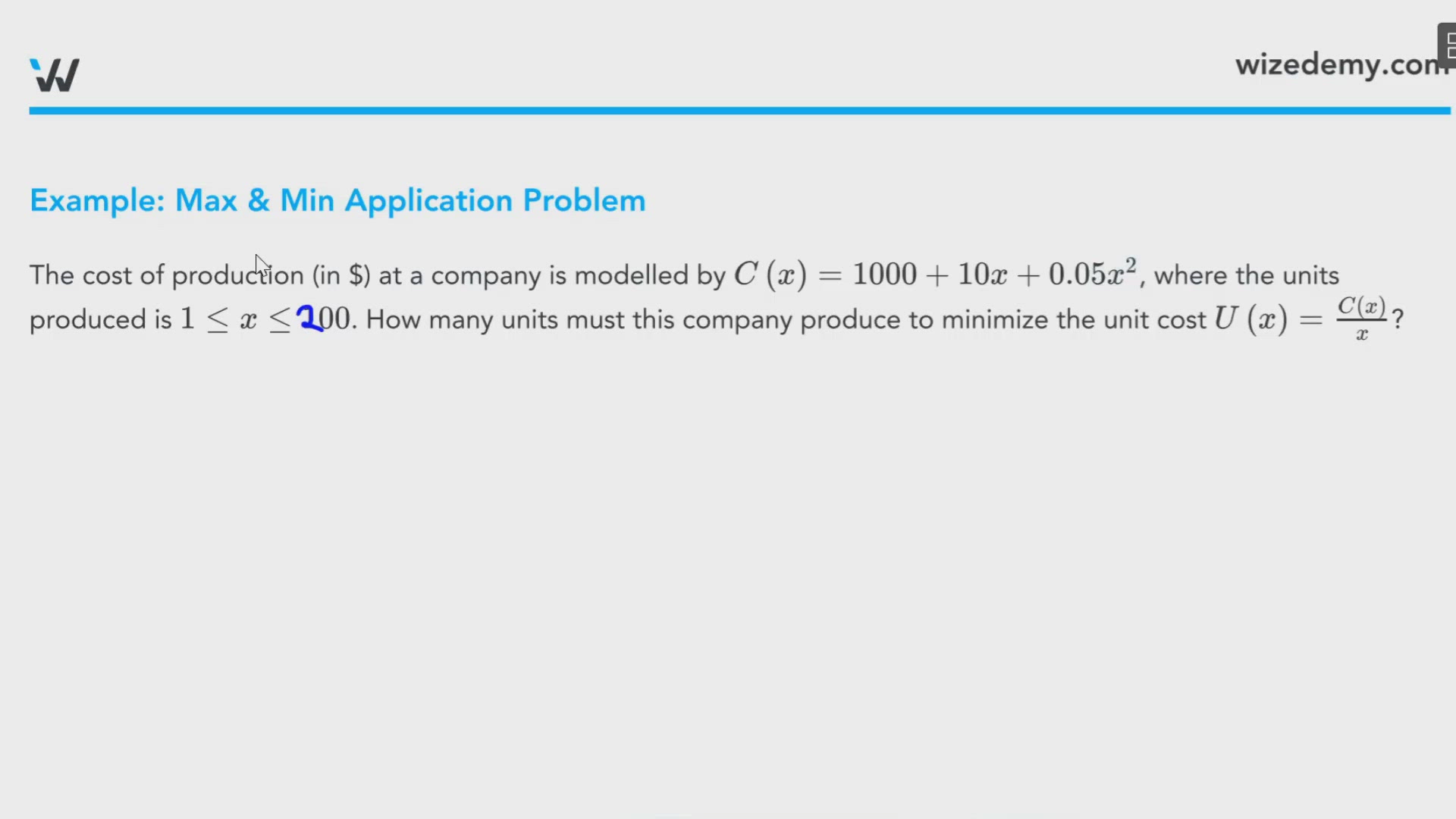
Example: Max & Min Application Problem
The cost of production (in $) at a company is modelled by , where the units produced is . How many units must this company produce to minimize the unit cost ?
The unit cost is .
We want to find the minimum value of this function:
Step 1. Find the derivative and set to 0
Step 2. Evaluate the function values
Step 3. Compare values
Therefore, the unit cost is minimized at approximately 141.42 units. However, since we cannot produce partial units, we either have to product 141 or 142 products:
Therefore, 141 units will minimize unit cost.
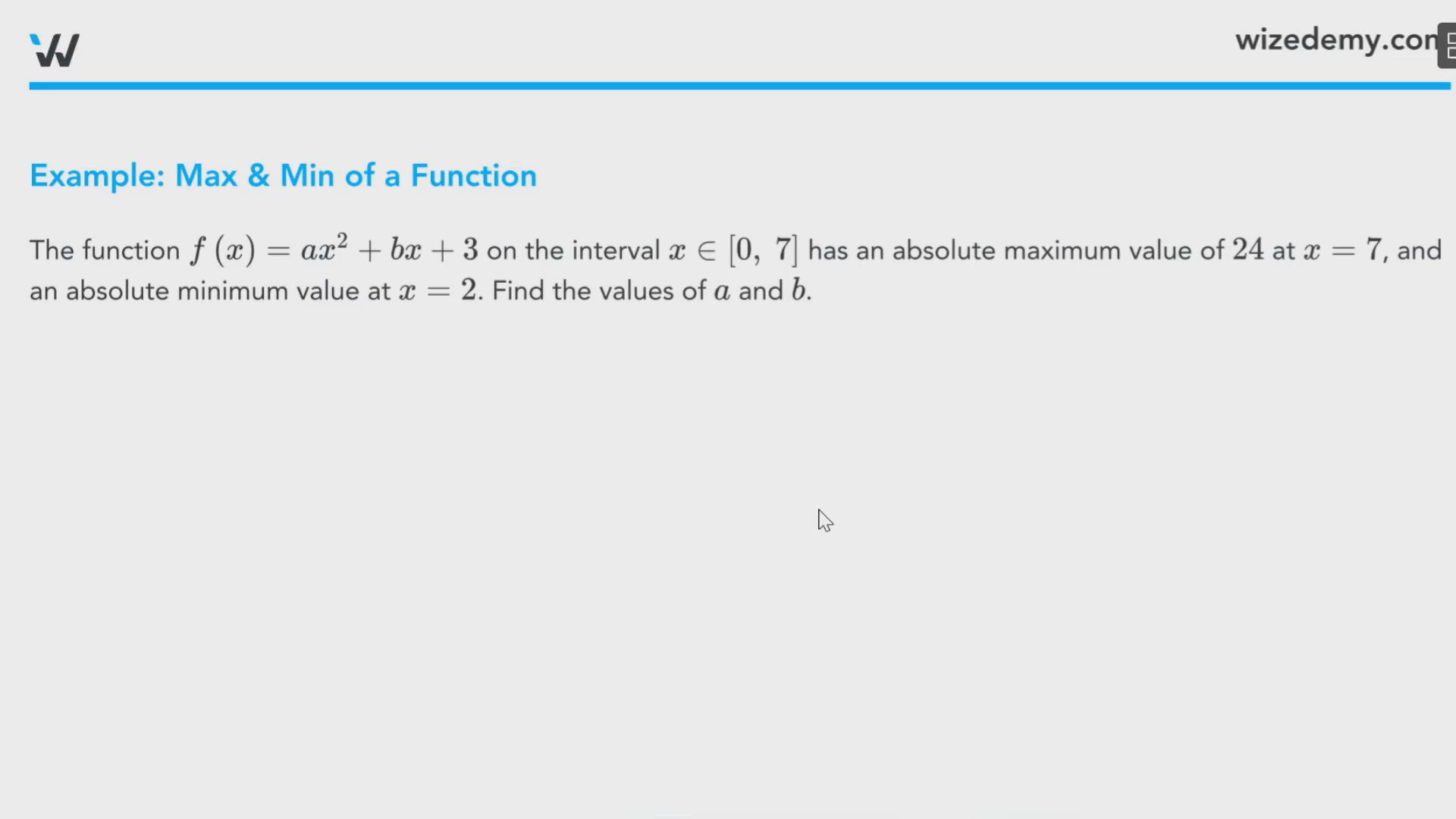
Example: Max & Min of a Function
The function on the interval has an absolute maximum value of at , and an absolute minimum value at . Find the values of and .
The absolute max and min must occur when or at the endpoints . Since the absolute minimum value is at , this must be the point where the derivative
Find the derivative:
Sub in and
- equation 1
We also know that the maximum value is 24 at :
- eqution 2
Now let's solve for a and b:
Equation 1:
Sub this into equation 2:
Solve for :
Therefore, and .