Wize High School Grade 12 Calculus Textbook > Derivative Applications
Higher Order Derivatives -- Displacement, Velocity & Acceleration

0:00 / 0:00
Higher Order Derivatives
The second derivative of is the derivative of .
We can write this in 2 ways:
- Lagrange: or
- Leibniz:
Wize Tip
We can continue this process to find third derivatives, fourth derivatives, etc.
Example
Find the first and second derivatives of
First derivative:
Second derivative:
Practice: Second Derivative
Find the second derivative of at

0:00 / 0:00
Displacement, Velocity, & Acceleration
An object moving along a straight line has
- position : where the object is at time -- usually measured in
- velocity : the rate of change of displacement over time -- usually measured in
- acceleration : the rate of change of velocity over time -- usually measured in

Write it Down
Velocity:
- If ,the object is moving in a negative direction (left or down)
- If ,the object is moving in a positive direction (right or up)
- If ,the object is stationary (not moving) - there's a possible change in direction
Acceleration:
- If ,the velocity is decreasing
- If ,the velocity is increasing
- If ,the velocity is constant
An object is
speeding up
when the velocity and acceleration have the same sign
An object is
slowing down
when the velocity and accerlation have opposite signs
0:00 / 0:00
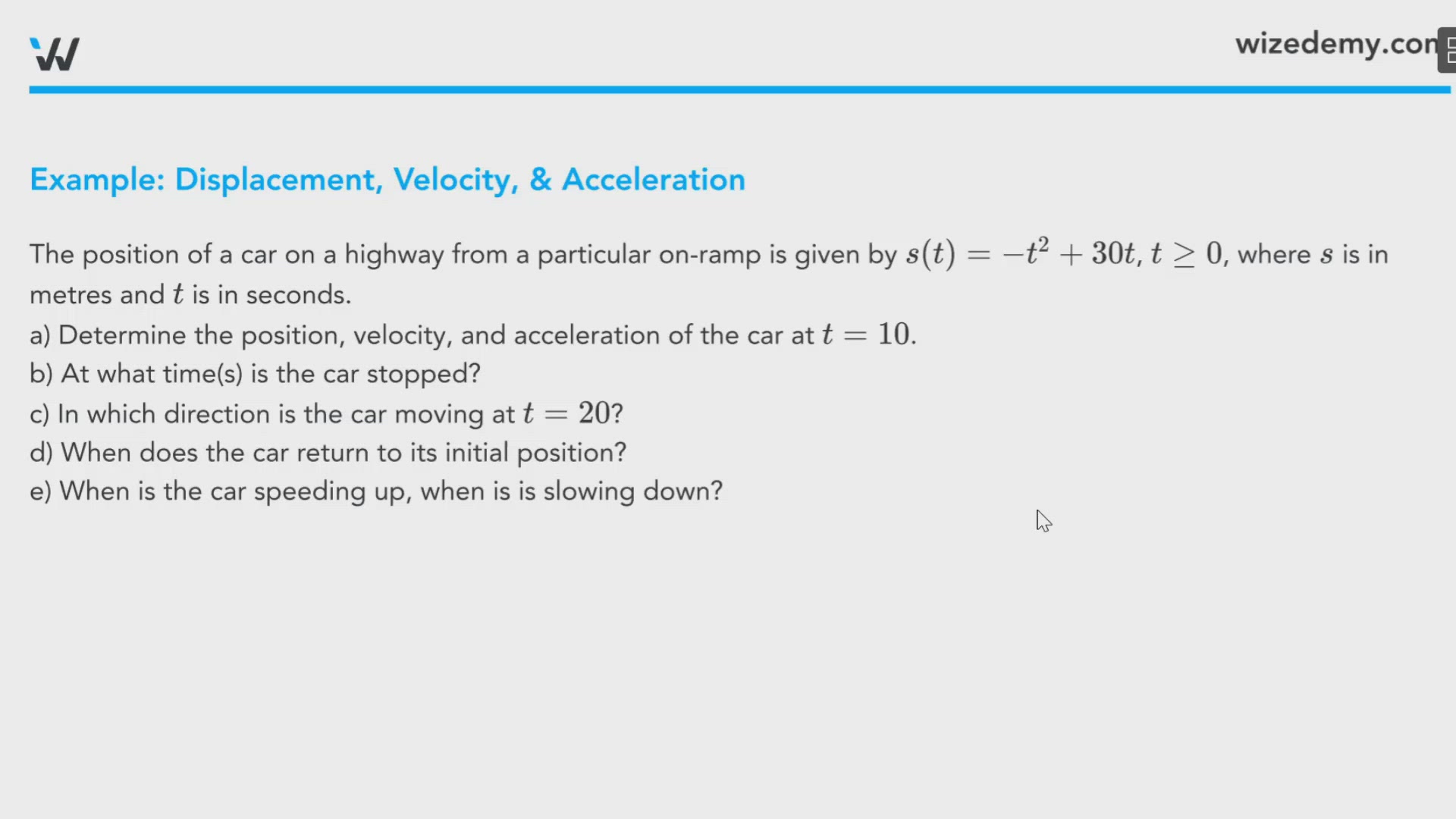
Example: Displacement, Velocity, & Acceleration
The position of a car on a highway from a particular on-ramp is given by , , where is in metres and is in seconds.
a) Determine the position, velocity, and acceleration of the car at .
b) At what time(s) is the car stopped?
c) In which direction is the car moving at ?
d) When does the car return to its initial position?
e) When is the car speeding up, when is is slowing down?
Part a)
Therefore, the position of the car at 10s is 200m.
Therefore, the velocity of the car at 10s is 10m/s (in the positive direction, going away from the on-ramp)
Therefore, the acceleration of the car at 10s is -2m/s2
Part b)
The car is stopped when the velocity is 0.
Therefore, the car is stopped at 15s.
Part c)
Therefore, at t=20s, the direction of the car is negative, meaning towards the on-ramp.
Part d)
The car is at its initial position when .
Therefore, the car returns to its initial position at t=15s.
Part e)
The acceleration of this car is always negative ( for all values).
The car is speeding up when the sign of the velocity and acceleration are the same, meaning when velocity is negative → , so it is negative when . Therefore, the car is speeding up when .
The car is slowing down when the sign of the velocity and acceleration are opposite, meaning when velocity is positive → , so it is positive when . Therefore, the car is slowing down when

0:00 / 0:00
Example: Displacement, Velocity, & Acceleration Graphs
The position of an object moving along a horizontal line is given by , , where is in metres and is in seconds.
a) Sketch the displacement-time graph of this object
b) Sketch the velocity-time graph of this object
c) Sketch the acceleration-time graph of this object
a)
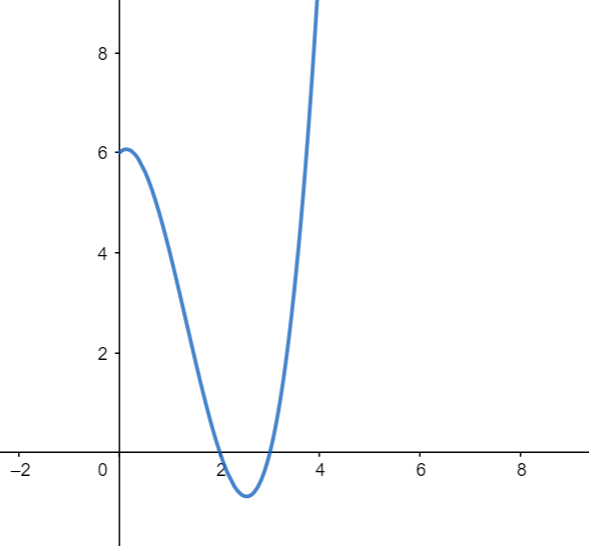
b)
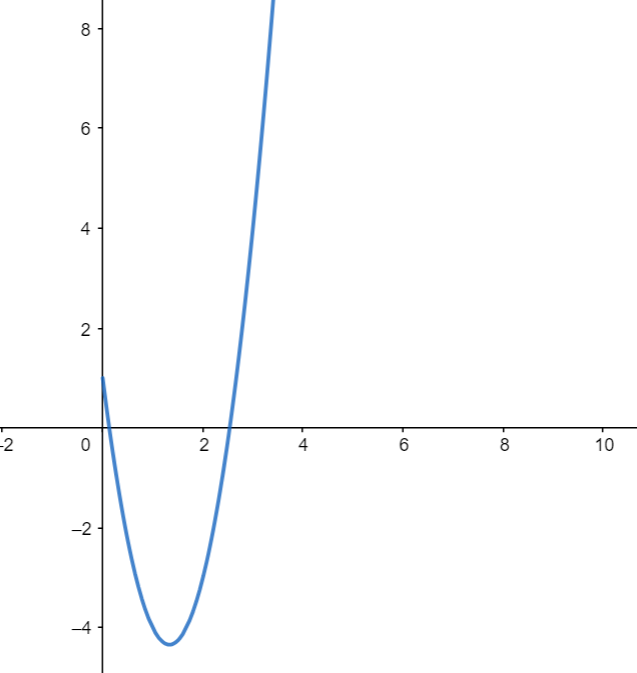
c)
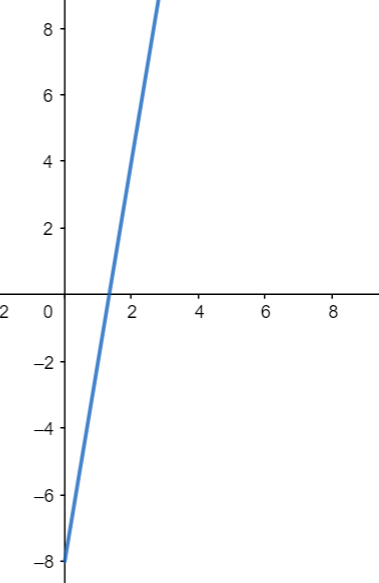
A rock is thrown upwards and its position (in meters) above the ground is given by , where is in seconds.
a) Find i) the maximum height the rock reaches, and ii) when it reaches this height.
b) Find the velocity of the rock when it is 22m above the ground.
c) Determine the velocity of the rock when it hits the ground