Wize High School Grade 12 Calculus Textbook > Derivatives of Polynomials
Composite Functions (Chain Rule)
0:00 / 0:00
Chain Rule
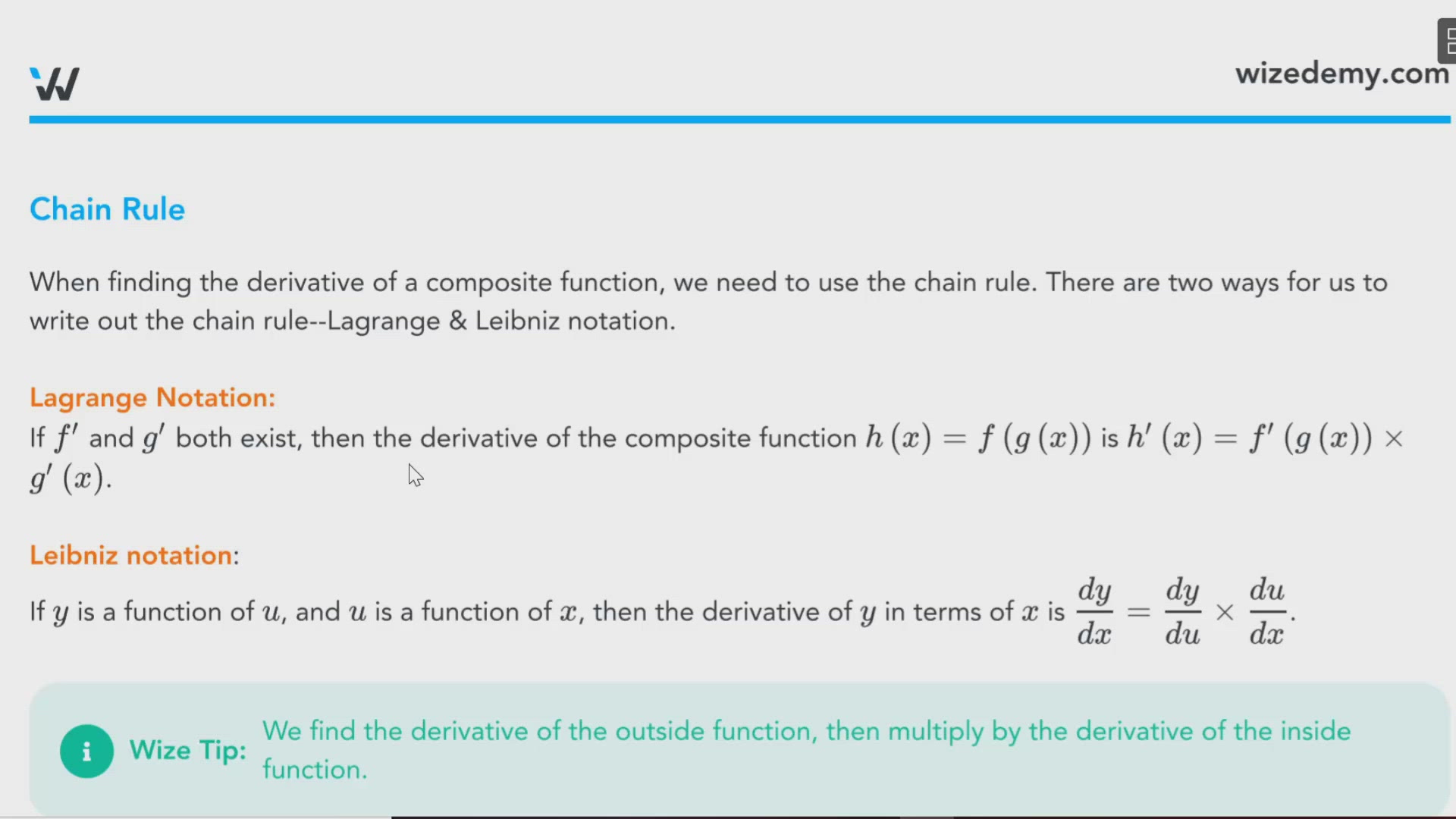
When finding the derivative of a composite function, we need to use the chain rule. There are two ways for us to write out the chain rule--Lagrange & Leibniz notation.
Lagrange Notation:
If and both exist, then the derivative of the composite function is .
Leibniz notation:
If is a function of , and is a function of , then the derivative of in terms of is .
Wize Tip
We find the derivative of the outside function, then multiply by the derivative of the inside function.
Power of a Function rule
This is just a special case of the chain rule:
If , then .
Example
Find the derivative of .
Rewrite:
Use the power of a function rule (special case of the chain rule) to find the derivative:
Simplify:
0:00 / 0:00
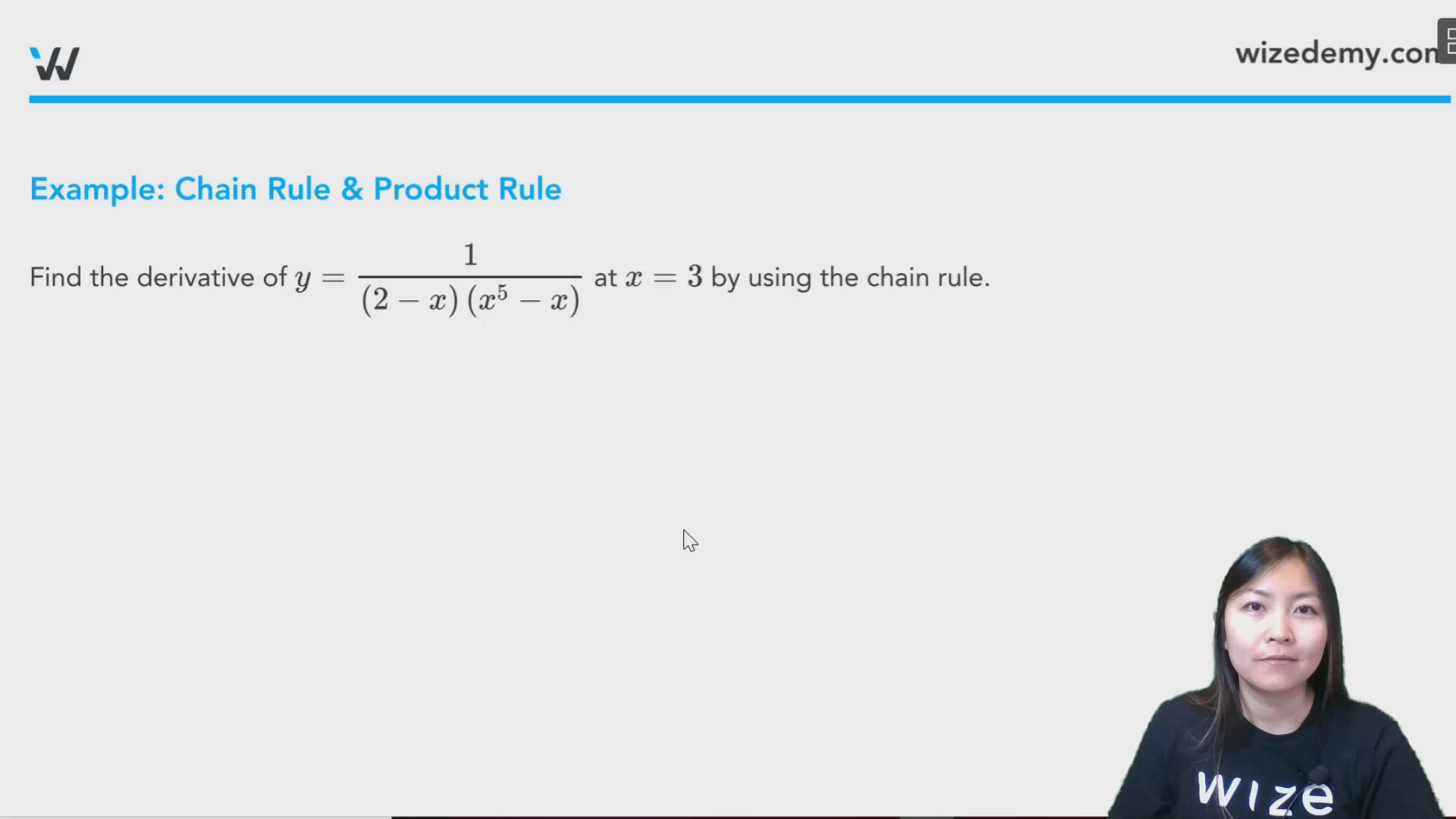
Example: Chain Rule & Product Rule
Find the derivative of at by using the chain rule.
We first rewrite this as .
Using chain rule:
At :
Practice: Chain Rule & Quotient Rule
Find the equation of the tangent line to the curve at .
0:00 / 0:00
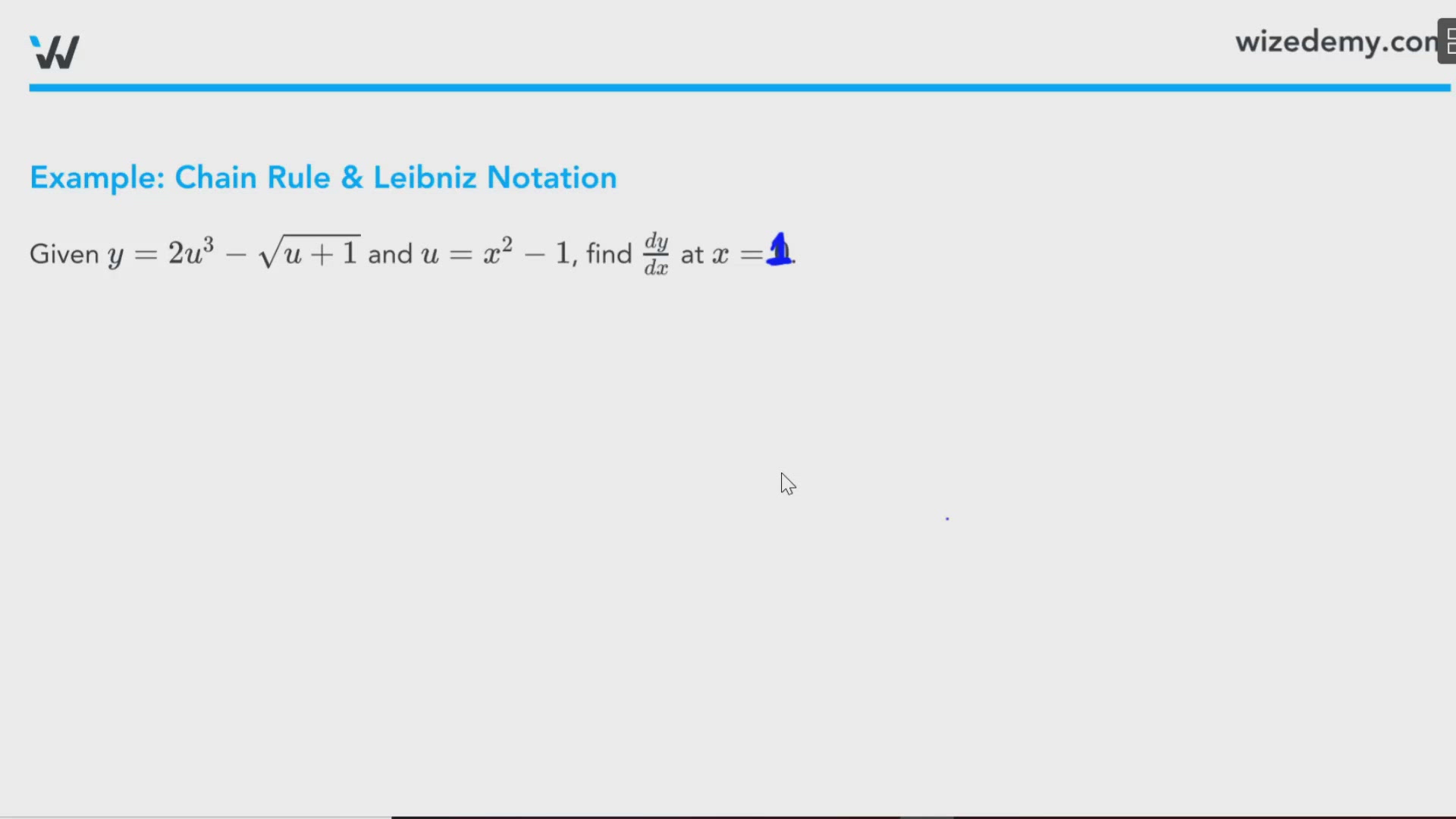
Example: Chain Rule & Leibniz Notation
Given and , find at .
Using Leibniz notation:
Sub in :
Simplify:
Sub in :
Practice: Chain Rule & Leibniz Notation
Given and , find the derivative at .
0:00 / 0:00
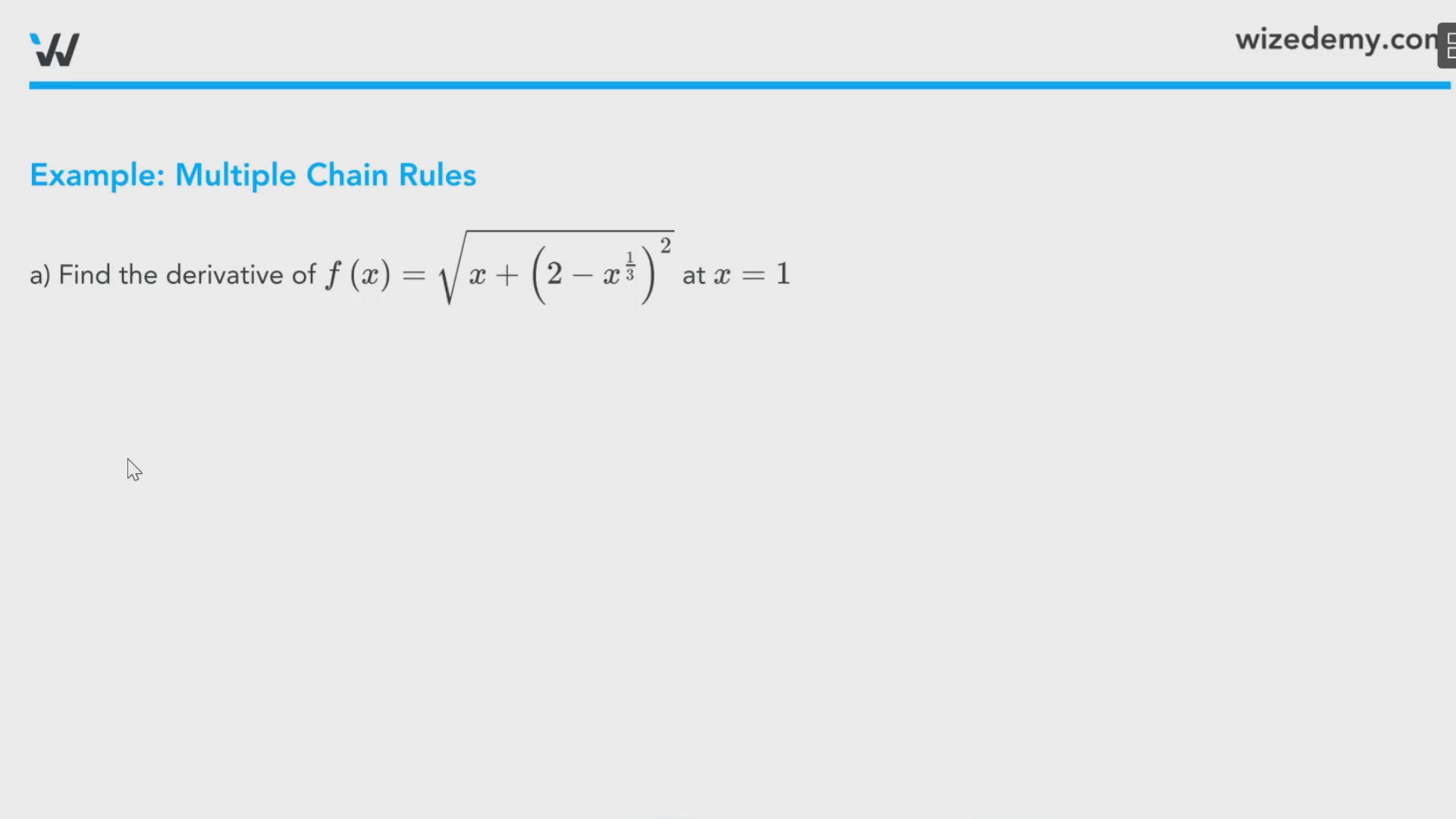
Example: Multiple Chain Rules
a) Find the derivative of at
Rewrite:
Using chain rule:
b) Find the derivative at , given that and .
Using chain rule:
When , :
Practice: Multiple Chain Rules
Find the derivative of at
0:00 / 0:00
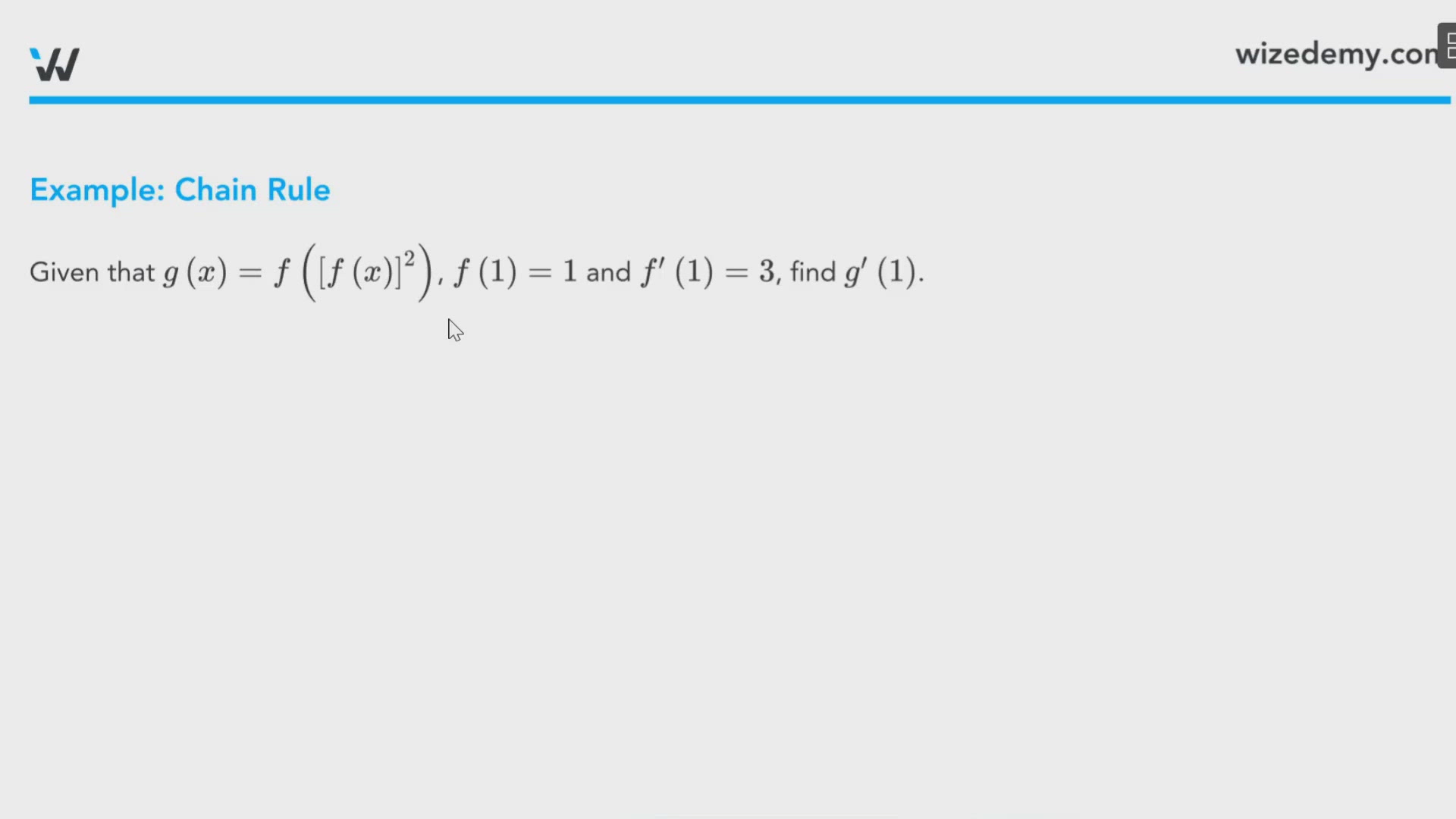
Example: Chain Rule
Given that , and , find .
The g function is a function wrapped inside another, wrapped inside another, so we need chain rule:
Now we sub in x=1:
Now we substitute the known given values
Given this table of values for below, answer the following questions.
If , then