Wize High School Grade 12 Calculus Textbook > Vectors
Vector Operations
0:00 / 0:00
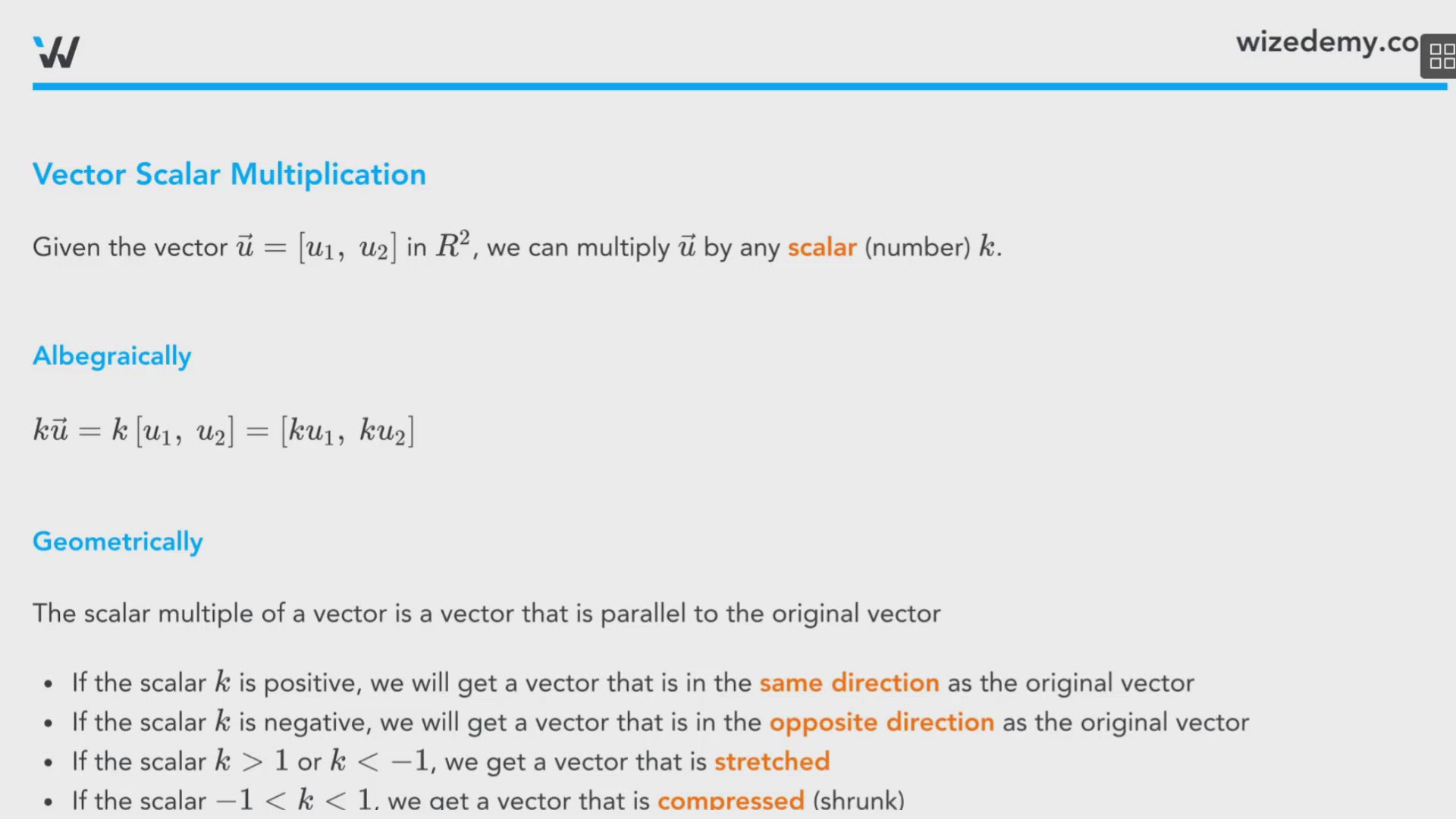
Vector Scalar Multiplication
Given the vector in , we can multiply by any scalar (number) .
Albegraically
Geometrically
The scalar multiple of a vector is a vector that is parallel to the original vector
- If the scalar is positive, we will get a vector that is in the same direction as the original vector
- If the scalar is negative, we will get a vector that is in the opposite direction as the original vector
- If the scalar or , we get a vector that is stretched
- If the scalar , we get a vector that is compressed (shrunk)
Example
If , find and .
Wize Tip
Scalar multiplication in works the same way as !
0:00 / 0:00
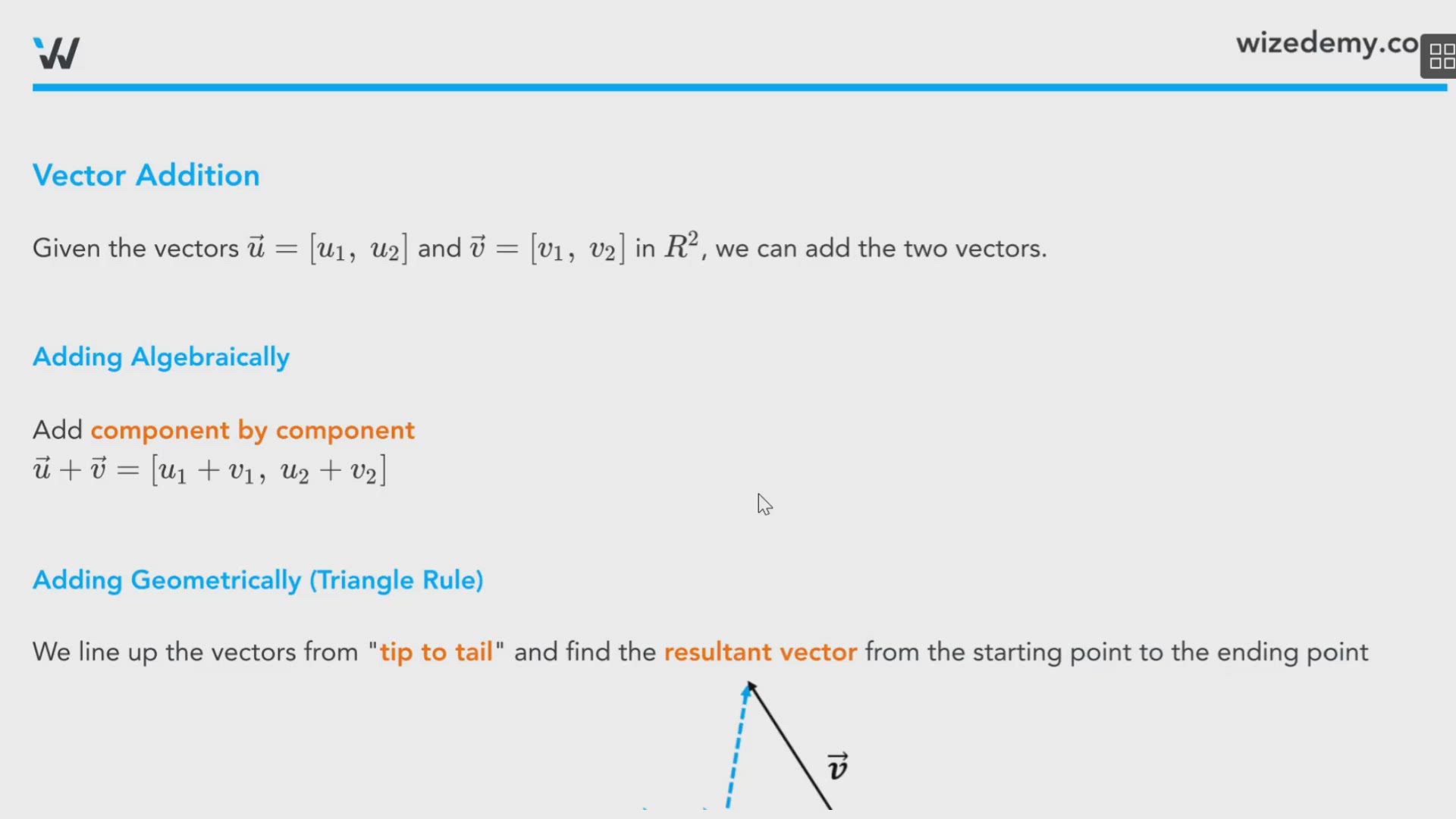
Vector Addition
Given the vectors and in , we can add the two vectors.
Adding Algebraically
Add component by component
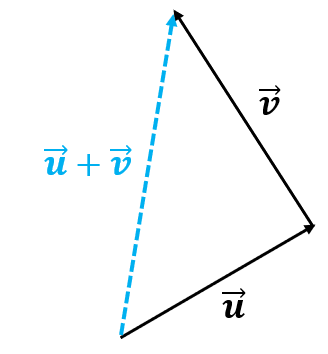
Adding Geometrically (Triangle Rule)
We line up the vectors from "tip to tail" and find the resultant vector from the starting point to the ending point
Wize Tip
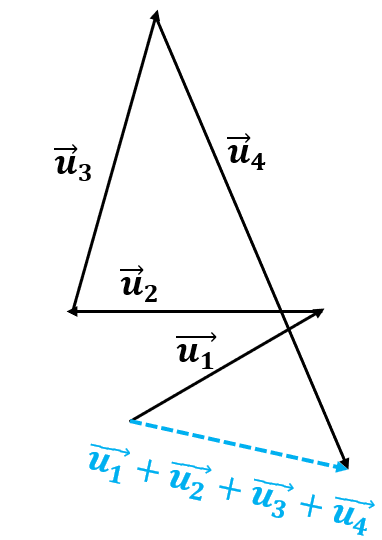
When adding multiple vectors, find the "short-cut" from the starting point to the ending point.
Example
If , , , , find .
0:00 / 0:00
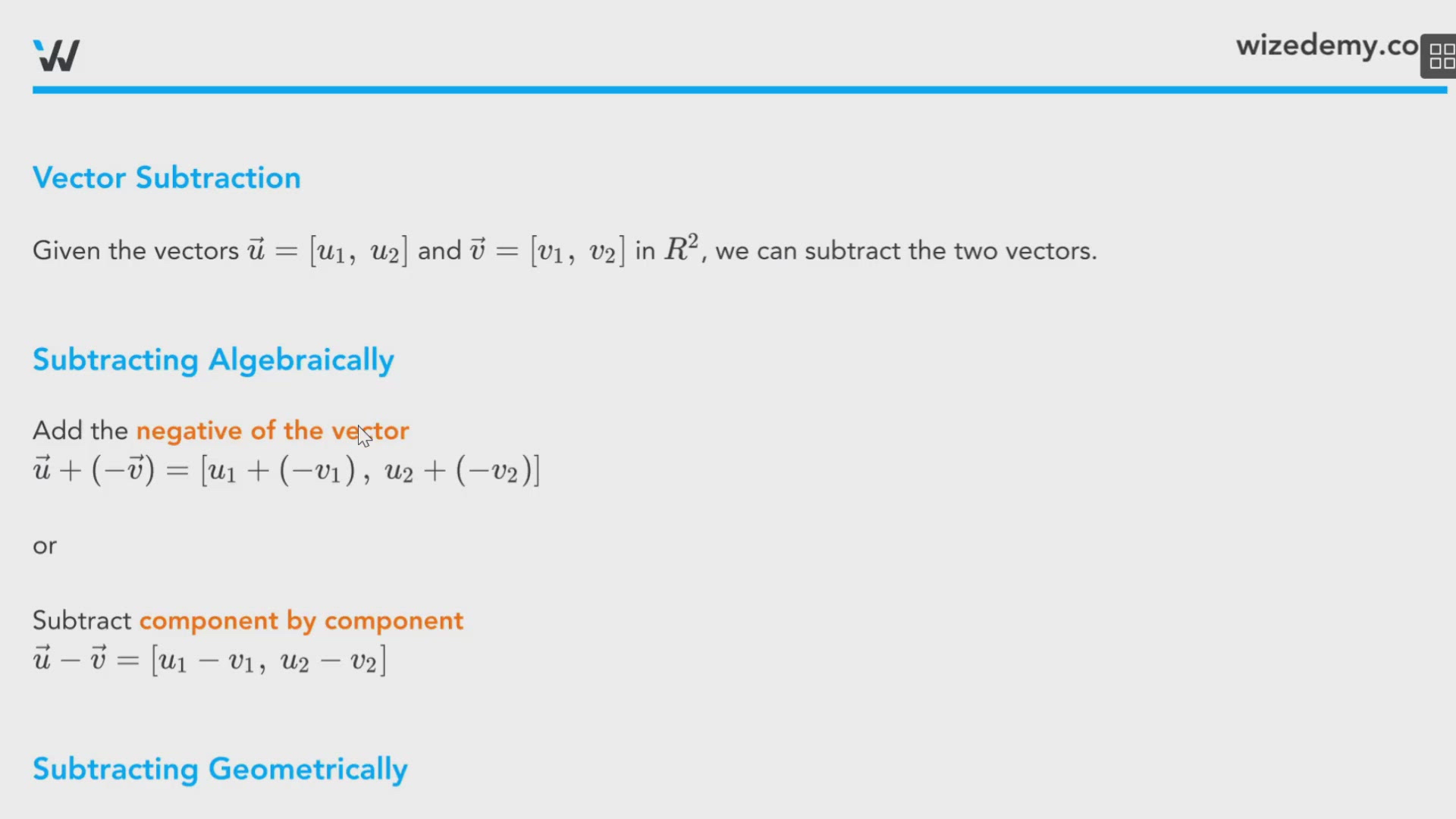
Vector Subtraction
Given the vectors and in , we can subtract the two vectors.
Subtracting Algebraically
Add the negative of the vector
or
Subtract component by component
Subtracting Geometrically
We line up the vectors from "tail to tail" and find the resultant vector from the tip of the second vector to the tip of the first vector

Wize Tip
Vector addition and subtraction are done the same way in as it is in !
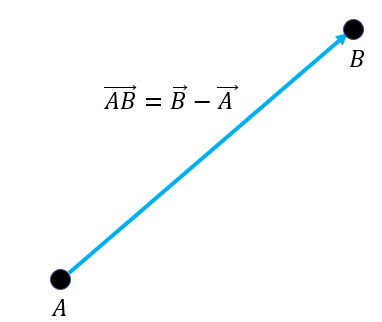
Position Vector
The position vector in (or ) that points from point A to point B is .
Practice: Vector Operations
If , , and , determine .
Practice: Position Vectors
Given the points , , and , select all of the following statements that is/are true.
0:00 / 0:00
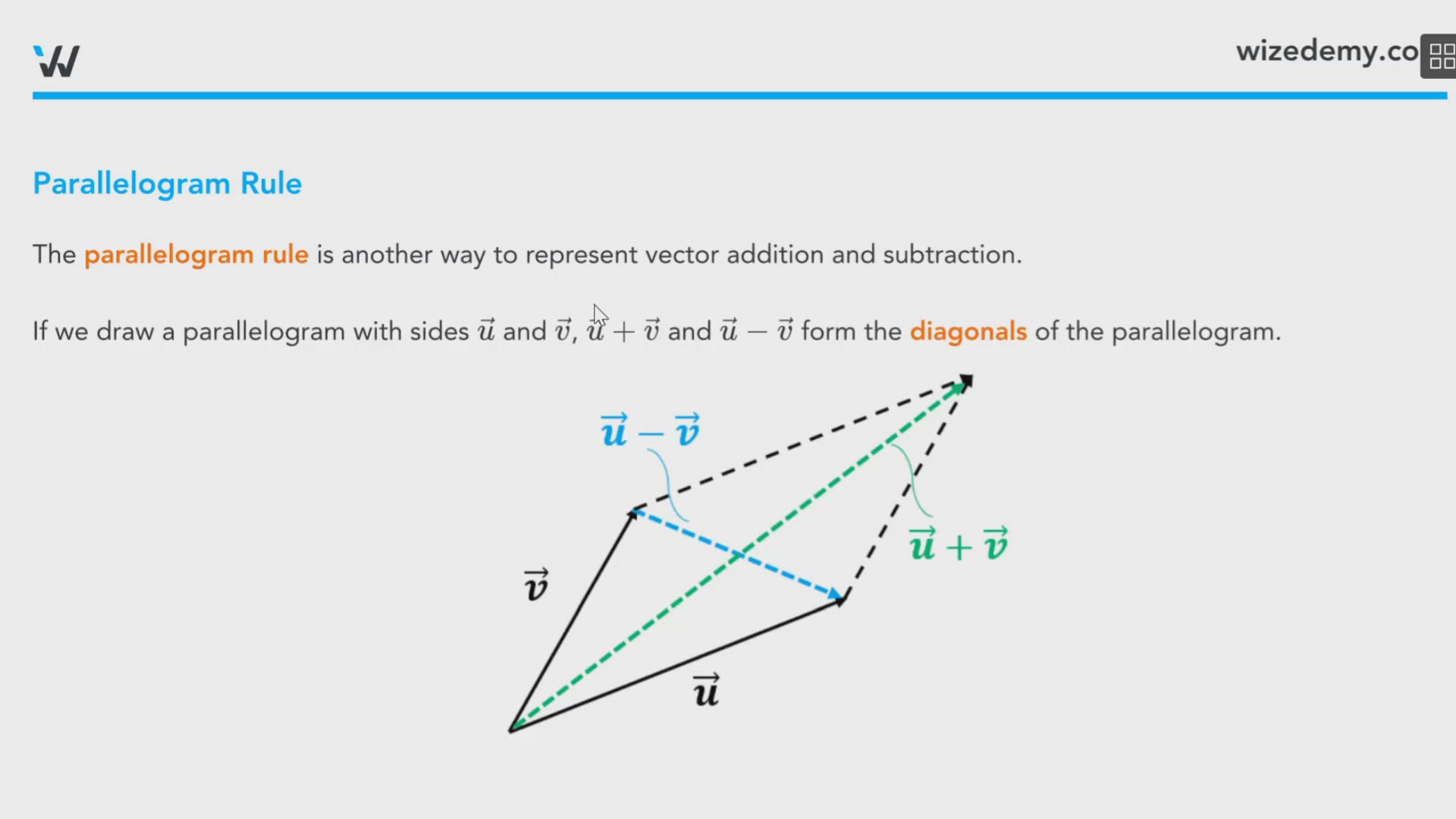
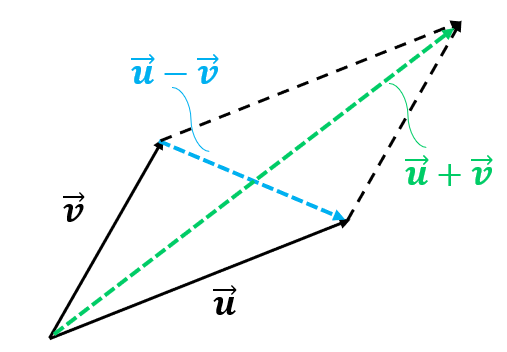
Parallelogram Rule
The parallelogram rule is another way to represent vector addition and subtraction.
If we draw a parallelogram with sides and , and form the diagonals of the parallelogram.
Finding Magnitudes
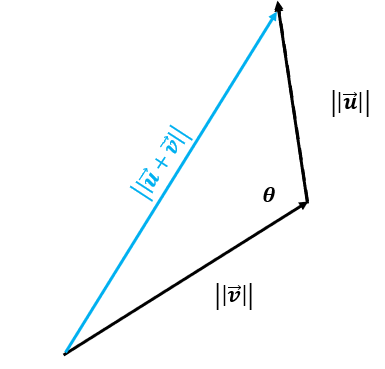
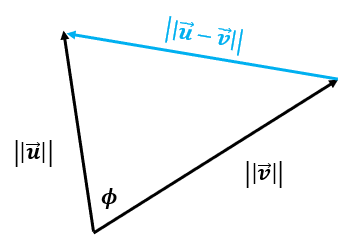
We can use the Cosine Law to calculate magnitudes:
- If we line up the vectors from tip to tail, suppose the angle between and is , then
- If we line up the vectors from tail to tail, suppose the angle between and is , then
Finding Angles
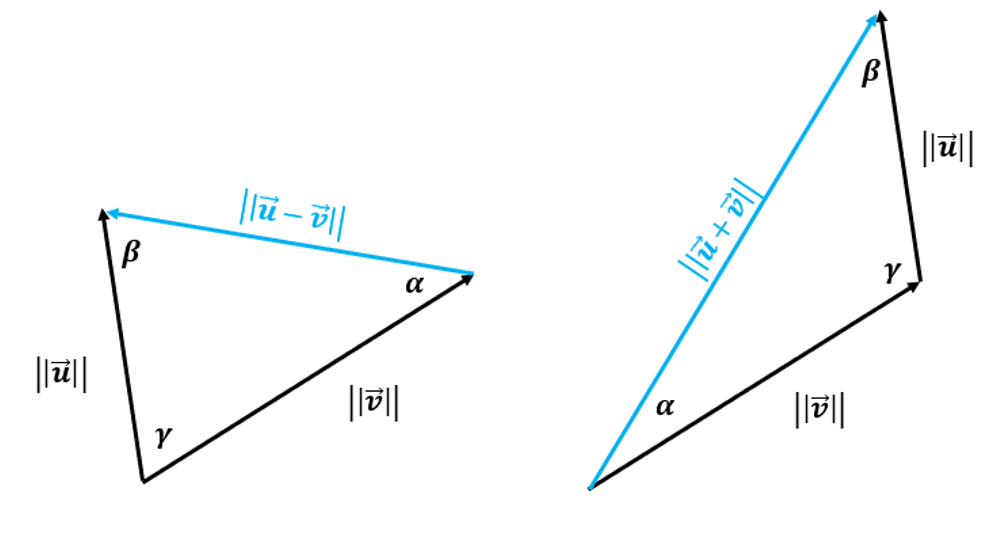
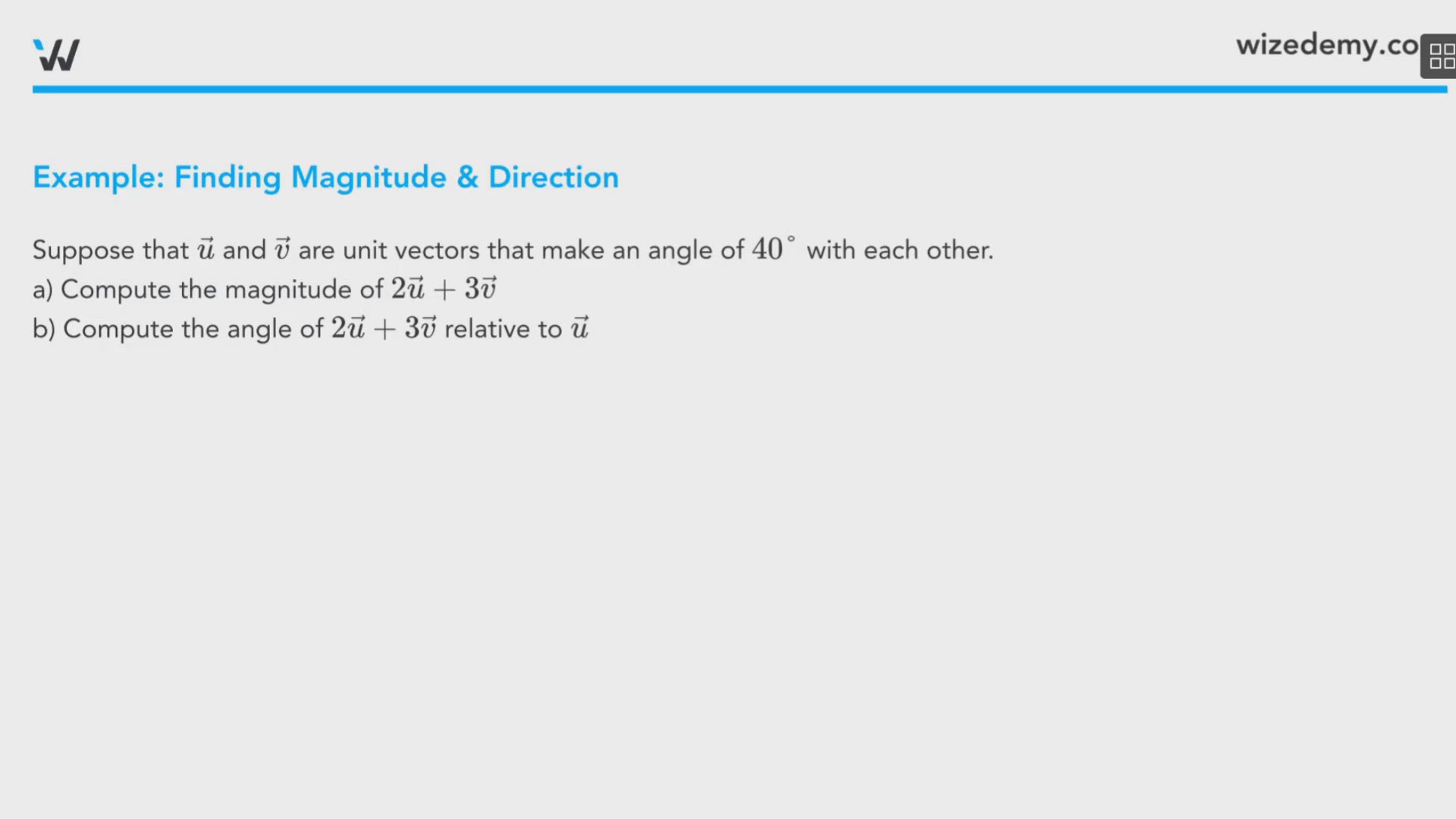
We can use the Sine Law to calculate the angles:
0:00 / 0:00
Example: Finding Magnitude & Direction
Suppose that and are unit vectors that make an angle of with each other.
a) Compute the magnitude of
b) Compute the angle of relative to
Part a)
Since and are unit vectors, their magnitudes are 1:
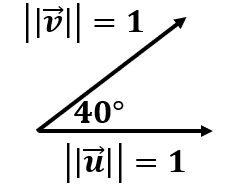
The diagram below shows . Once we line up the vectors from tip to tail, we see that the angle between the two vectors is
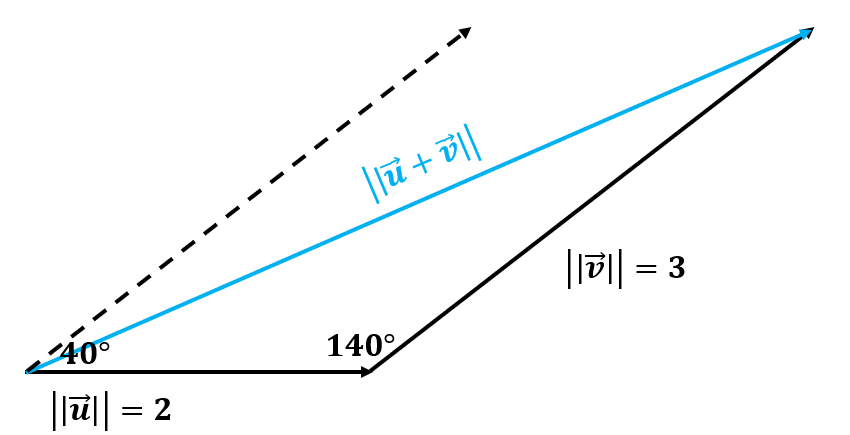
Using the Cosine law, we see that
:
Therefore, the magnitude of
Part b)
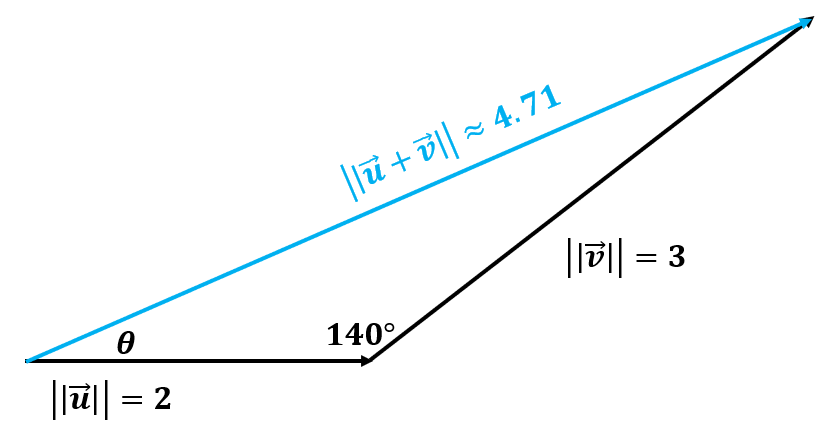
Using the Sine law, we see that
Therefore, is measured counter clockwise from
Practice: Finding Magnitudes
Suppose that , , and the angle between the two vectors when placed tail to tail is .
a) Compute
b) Computer
c) Computer
[Enter your answers as exact values, without rounding)
0:00 / 0:00
Vector Properties
Given that are vectors both in or , are scalars.
Justify the following properties.
- Commutative Property for Addition:
- Associative Property for Addition:
- Distributive Property for Addition:
- Associative Law for Scalars:
- Distrobutive Law for Scalars:
- There exists a zero vector such that:
- Magnitude Properties
Can You Answer These?
❓ Can we add a vector in and a vector in ?
No
❓ If and , what is ?
❓ When will ?
When and are parallel.