Wize High School Grade 12 Calculus Textbook > Vectors
Vector Applications
0:00 / 0:00
Vector Application Questions
In the previous section, we learned how to add and subtract vectors:
- In Cartesian form ⟶ add and subtract the vectors algebraically component by component
- In Polar form ⟶ add and subtract the vectors geometrically using the Cosine and Sine Laws
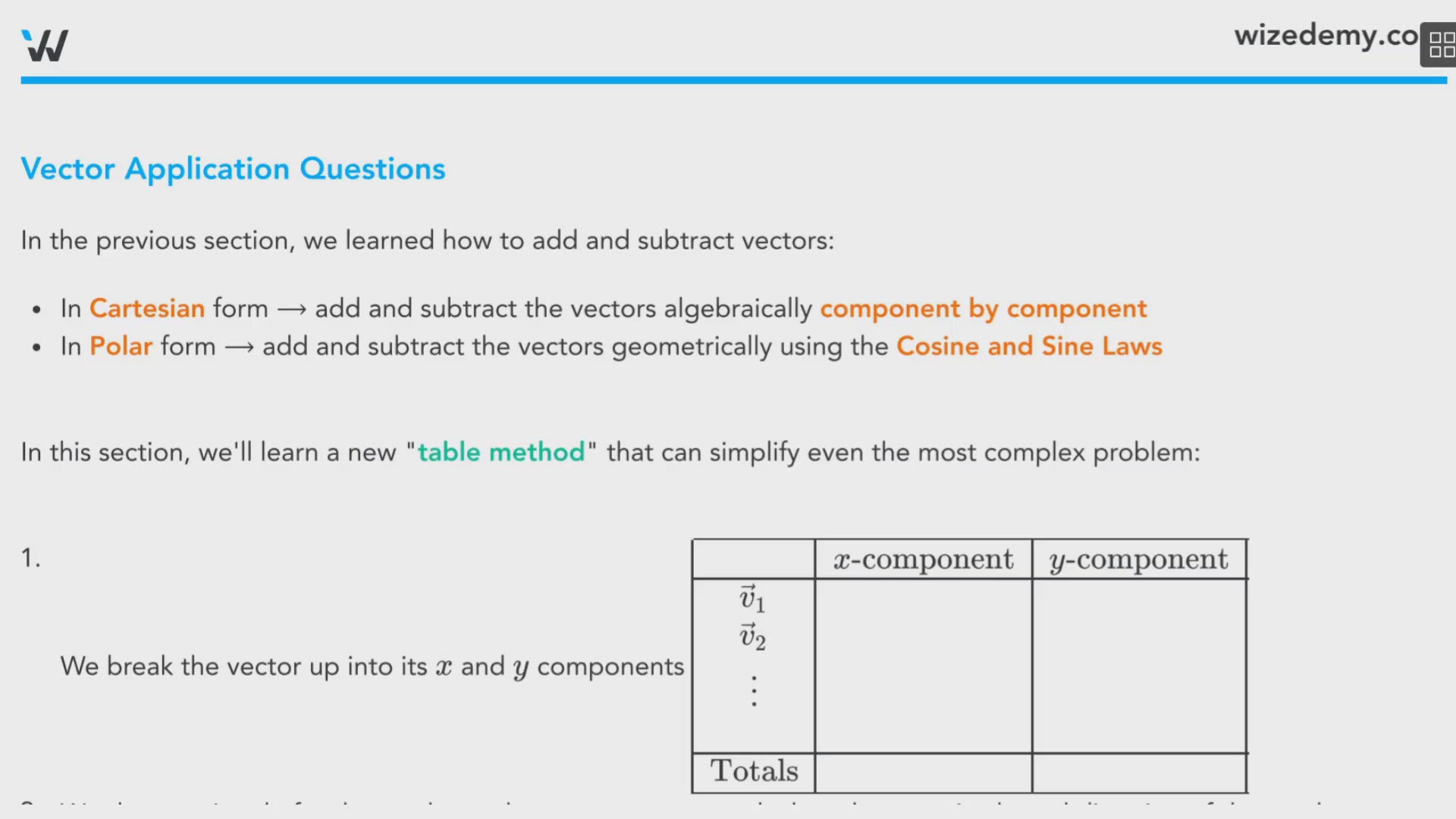
In this section, we'll learn a new "table method" that can simplify even the most complex problem:
- We break the vector up into its and components
- We draw a triangle for the total and components to calculate the magnitude and direction of the resultant vector
0:00 / 0:00
Example: Velocity
A plane on a heading of N 30° E has an air speed of 350 km/h. The wind is blowing from the south at 52 km/h. Determine the actual direction of travel of the plane and its ground speed.
The two vectors we need to add are
- [N30oE] → [60o counter clockwise from the positive x-axis]
- [from the S, meaning towards N] → [90o counter clockwise from the positive x-axis]
Break the vectors down into vector components:
Therefore, the ground speed of the plane is 395.89 km/h E 63.77o N.
Practice: Velocity
A swimmer wants to cross a river 10m wide that has a current of 2m/s downstream. Suppose that Mike Phelps wants to cross the river and can swim at 2.7m/s
What direction should Mike aim to swim along so that he ends up at the other side of the river, directly across from his starting position?
Practice: Velocity
A car travels due East at 60km/h for 1.5 hours, then it changes direction and travels NE at 50km/h for 0.5 hours, finally it changes direction one last time and travels N 10o E at 75km/h for 2 hours.
What is the distance the car travelled?
0:00 / 0:00
Example: Force
A neon store sign is suspended by two cables--cable 1 forms a 20o angle with the horizontal and has a tension of 50N, cable 2 forms a 30o angle with the horizontal and has an unknown tension of . If the store sign is perfectly still, what is the tension in cable 2? What is the force of gravity acting downwards?

When an object is still, the sum of all forces is zero
(i.e. the sum of the x vector components = 0 and the sum of the y vector components = 0)
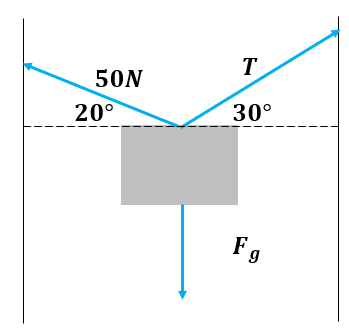
We have the two equations:
1.
2.
From equation 1:
Substitute this value for into equation 2:
Therefore, the tension in cable 2 is approximately 54.25 N and the force of gravity is approximately 44.23 N (downwards)
Practice: Force
You're helping a friend move a couch into their first year dorm room. Your friend pulls the couch at an angle of E20oN. You push the couch at an angle of E10oS. If you and your friend are both exerting a force of 50N, find the magnitude and direction of the total force exerted on the couch. (Ignore any other forces such as friction)