0:00 / 0:00

Dot Product

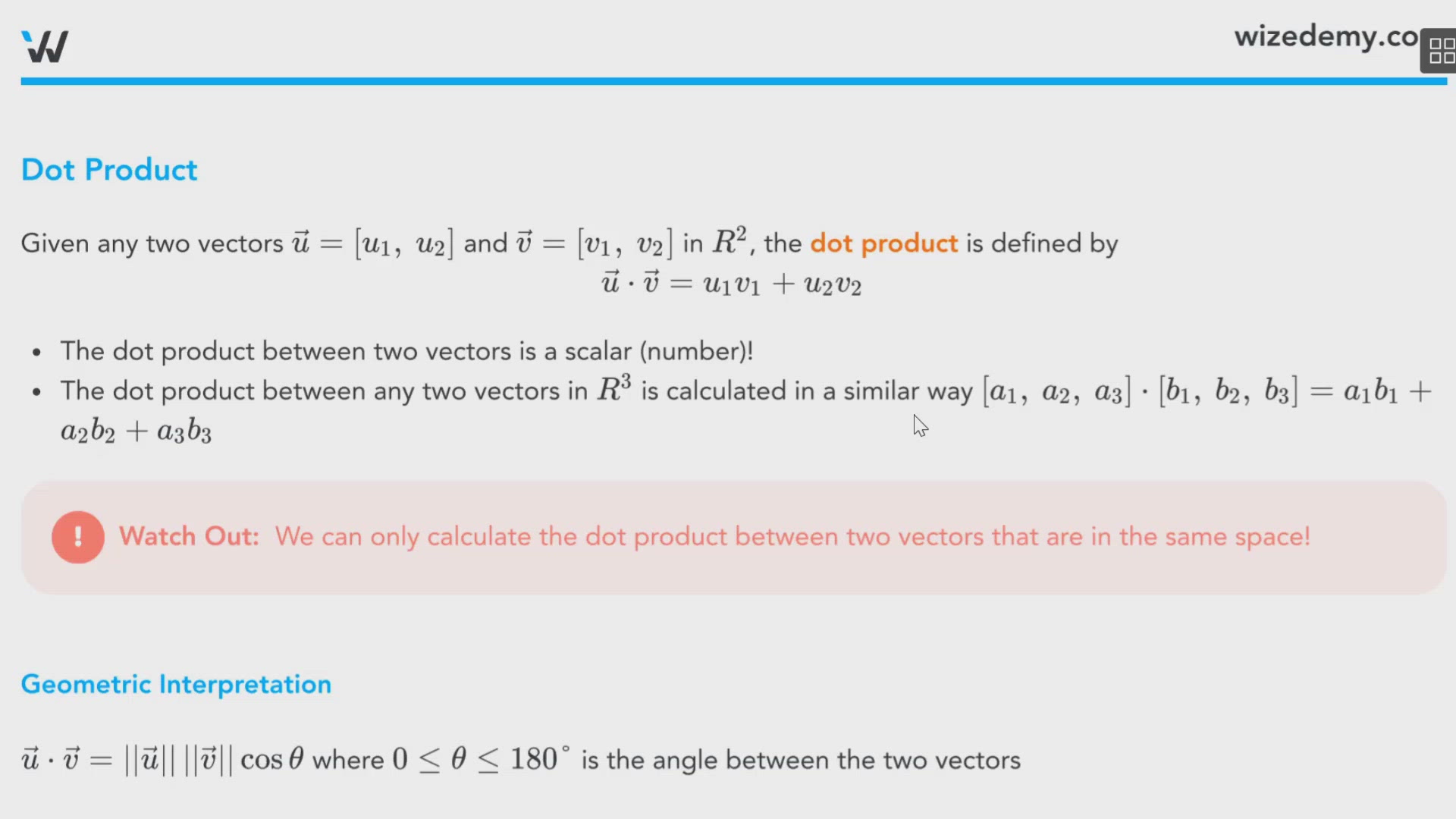
Given any two vectors u=[u1, u2]\vec{u}=\left[u_1,\ u_2\right] and v=[v1, v2]\vec{v}=\left[v_1,\ v_2\right] in R2R^2, the dot product is defined by
uv=u1v1+u2v2\vec{u}\cdot\vec{v}=u_1v_1+u_2v_2
  • The dot product between two vectors is a scalar (number)!
  • The dot product between any two vectors in R3R^3 is calculated in a similar way [a1, a2, a3][b1, b2, b3]=a1b1+a2b2+a3b3\left[a_1,\ a_2,\ a_3\right]\cdot\left[b_1,\ b_2,\ b_3\right]=a_1b_1+a_2b_2+a_3b_3
Watch Out!
We can only calculate the dot product between two vectors that are in the same space!

Geometric Interpretation

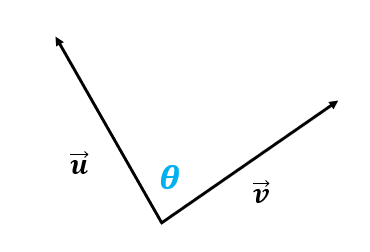
uv=uvcosθ\vec{u}\cdot\vec{v}=\left|\left|\vec{u}\right|\right|\left|\left|\vec{v}\right|\right|\cos\theta where 0θ180°0\le\theta\le180\degree is the angle between the two vectors
❓ What does it mean if the dot product between two non-zero vectors is 0?
0=u vcosθ0=\left|\left|\vec{u}\right|\right|\ \left|\left|\vec{v}\right|\right|\cos\theta
Since the two vectors are non-zero, we know that cosθ=0\cos\theta=0
So, θ=90°\theta=90\degree → The two vectors are perpendicular (a.k.a. orthogonal or normal)


Write it Down
Any two non-zero vectors u\vec{u} and v\vec{v} are orthogonal (a.k.a. perpendicular or normal) if and only if uv=0\vec{u}\cdot\vec{v}=0

0:00 / 0:00

Example: Angle Between Vectors

Find the angle between the vectors u=[1, 1]\vec{u}=\left[1,\ -1\right] and v=[5, 3]\vec{v}=\left[-5,\ 3\right].

uv=uvcosθ\vec{u}\cdot\vec{v}=\left|\left|\vec{u}\right|\right|\left|\left|\vec{v}\right|\right|\cos\theta
[1, 1][5, 3]=[1, 1][5, 3]cosθ\left[1,\ -1\right]\cdot\left[-5,\ 3\right]=\left|\left|\left[1,\ -1\right]\right|\right|\left|\left|\left[-5,\ 3\right]\right|\right|\cos\theta
8=(1)2+(1)2(5)2+(3)2cosθ-8=\sqrt{\left(1\right)^2+\left(-1\right)^2}\sqrt{\left(-5\right)^2+\left(3\right)^2}\cos\theta
8=234cosθ-8=\sqrt{2}\sqrt{34}\cos\theta
8234=cosθ-\frac{8}{\sqrt{2}\sqrt{34}}=\cos\theta
868=cosθ-\frac{8}{\sqrt{68}}=\cos\theta
8417=cosθ-\frac{8}{\sqrt{4}\sqrt{17}}=\cos\theta
8217=cosθ-\frac{8}{2\sqrt{17}}=\cos\theta
θ=cos1(417)\theta=\cos^{-1}\left(-\frac{4}{\sqrt{17}}\right)
θ165.96\theta\approx165.96

Practice: Dot Product

Find the value(s) of kk such that the vectors v=[1, k, 2]\vec{v}=\left[1,\ k,\ -2\right] and u=[2k,k1,k]\vec{u}=\left[2k,k-1,k\right] are perpendicular.
0:00 / 0:00

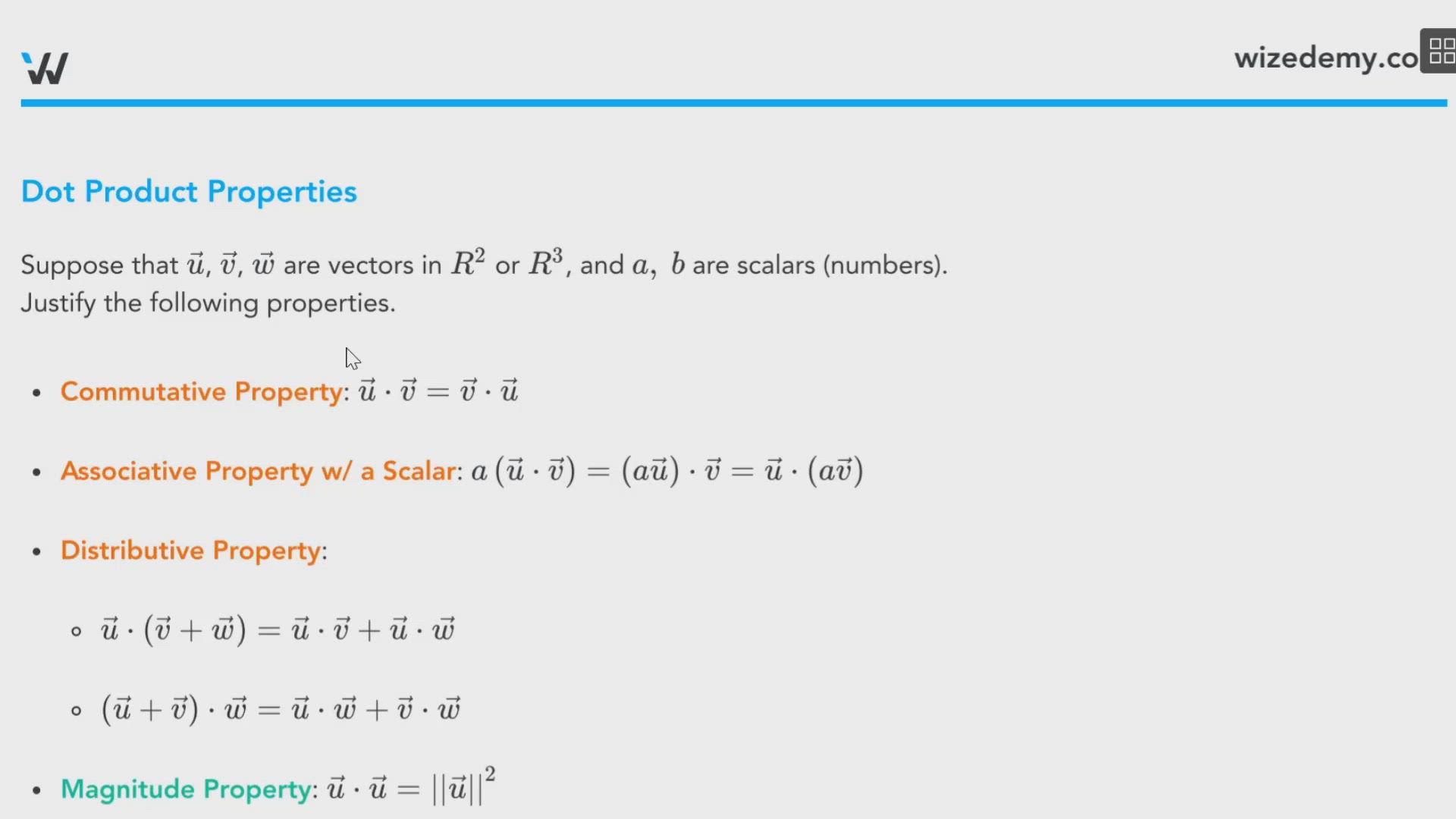
Dot Product Properties

Suppose that u\vec{u}, v\vec{v}, w\vec{w} are vectors in R2R^2 or R3R^3, and a, ba,\ b are scalars (numbers).
Justify the following properties.
  • Commutative Property: uv=vu\vec{u}\cdot\vec{v}=\vec{v}\cdot\vec{u}
  • Associative Property w/ a Scalar: a(uv)=(au)v=u(av)a\left(\vec{u}\cdot\vec{v}\right)=\left(a\vec{u}\right)\cdot\vec{v}=\vec{u}\cdot\left(a\vec{v}\right)
  • Distributive Property:
  • u(v+w)=uv+uw\vec{u}\cdot\left(\vec{v}+\vec{w}\right)=\vec{u}\cdot\vec{v}+\vec{u}\cdot\vec{w}
  • (u+v)w=uw+vw\left(\vec{u}+\vec{v}\right)\cdot\vec{w}=\vec{u}\cdot\vec{w}+\vec{v}\cdot\vec{w}
  • Magnitude Property: uu=u2\vec{u}\cdot\vec{u}=\left|\left|\vec{u}\right|\right|^2

Practice: Dot Product Properties

Suppose that u, v, w\vec{u},\ \vec{v},\ \vec{w} are vectors in R2R^2, p, q, r\vec{p},\ \vec{q},\ \vec{r} are vectors in R3R^3 and a, ba,\ b are scalars.

Which of the following are valid operations? (Select all that apply)