0:00 / 0:00

Dot Product Application: Projections

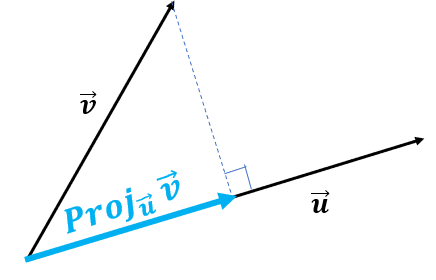
The vector projection of the vector v\bold{\color{orange}\vec{v}} onto u\bold{\color{orange}\vec{u}} is the "shadow" v\vec{v} casts on u\vec{u}.

It is calculated as Projuv=uvu2u\displaystyle \text{Proj}_{\vec u}\vec v=\frac{\vec u\cdot\vec v}{||\vec u||^2}\vec u


The length of this projection "shadow" is called the scalar projection: Projuv=uvu\displaystyle ||\text{Proj}_{\vec u}\vec v||=\frac{|\vec u\cdot\vec v|}{||\vec u||}

Example
Given the points A(1, 0, 1)A\left(1,\ 0,\ 1\right), B(0, 1, 1)B\left(0,\ 1,\ -1\right), and C(2,0,0)C\left(2,0,0\right), find ProjACAB\text{Proj}_{\overrightarrow {AC}}\overrightarrow{AB} and its length.
First we need to find the position vectors:
  • AB=(1,1,2)\overrightarrow {AB}=(-1, 1, -2)
  • AC=(1,0,1)\overrightarrow{AC}=(1,0,-1)
The vector projection is
ProjACAB\text{Proj}_{\overrightarrow{AC}}\overrightarrow{AB}
=(1,1,2)(1,0,1)(12+02+(1)2)2[1,0,1]\displaystyle =\frac{(-1,1,-2)\cdot(1,0,-1)}{(\sqrt{1^2+0^2+(-1)^2})^2}[1,0,-1]
=12[1,0,1]\displaystyle=\frac{1}{2}\left[1,0,-1\right] or [12, 0, 12]\left[\frac{1}{2},\ 0,\ -\frac{1}{2}\right]

The length of this projection (scalar projection) is
ProjACAB=(12)2+02+(12)2=12\left|\left|\text{Proj}_{\overrightarrow{AC}}\overrightarrow{AB}\right|\right|=\sqrt{\left(\frac{1}{2}\right)^2+0^2+\left(-\frac{1}{2}\right)^2}=\sqrt{\frac{1}{2}}

Or

You could just the scalar projection formula:
ProjACAB=(1, 1, 2)(1, 0, 1)12+02+(1)2=12\left|\left|\text{Proj}_{\overrightarrow{AC}}\overrightarrow{AB}\right|\right|=\frac{\left|\left(-1,\ 1,\ -2\right)\cdot\left(1,\ 0,\ -1\right)\right|}{\sqrt{1^2+0^2+\left(-1\right)^2}}=\frac{1}{\sqrt{2}}

Practice: Projection

The vertices AA, BB, and CC defines an equilateral triangle with side legnth 1.

Determine the scalar projection of any one side onto any one of the other two sides.
0:00 / 0:00

Dot Product Application: Work

Work is the energy required by a force to move an object a certain distance.

If we apply a constant force on an object, then work is calculated by:
W=FdW=\vec{F}\cdot\vec{d}
  • WW is the work measured in Nm (Newton meters) or J (joules)
  • F\vec{F} is the force exerted on the object
  • d\vec{d} is the displacement of the object due to this force

Example
Josh pulls a wagon containing a kitten a distance of 300 m with a force of 70N at 60o to the horizontal. Calculate the amount of work done.

Method 1
Use the formula Fd=Fdcosθ\vec{F}\cdot\vec{d}=\left|\left|\vec{F}\right|\right|\left|\left|\vec{d}\right|\right|\cos\theta:
W=(70)(300)cos60°=10500 Nm or 10500 JW=\left(70\right)\left(300\right)\cos60\degree=10500\ Nm\ or\ 10500\ J


Method 2
Convert the vector into Cartesian form:
F=[70cos60°, 70sin60°]=[35, 3532]\vec{F}=\left[70\cos60\degree,\ 70\sin60\degree\right]=\left[35,\ \frac{35\sqrt{3}}{2}\right]

So, W=Fd=[35, 3532][300, 0]=10500 Nm or 10500 JW=\vec{F}\cdot\vec{d}=\left[35,\ \frac{35\sqrt{3}}{2}\right]\cdot\left[300,\ 0\right]=10500\ Nm\ or\ 10500\ J
0:00 / 0:00

Example: Work

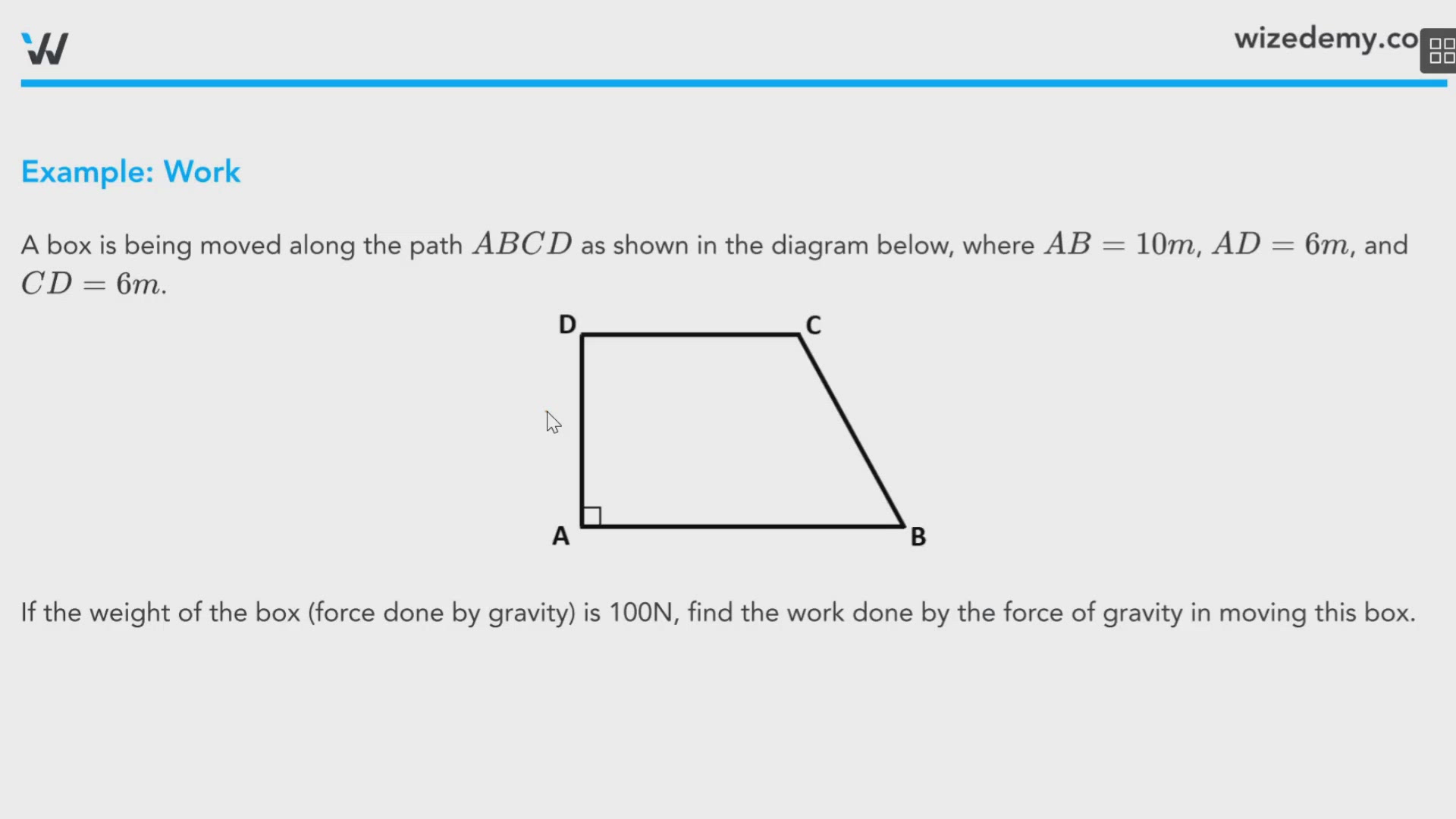
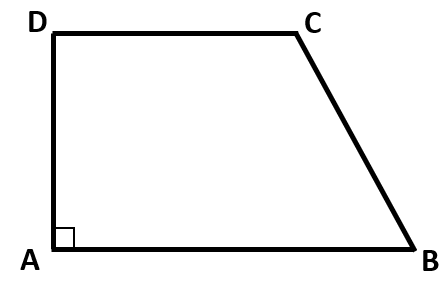
A box is being moved along the path ABCDAABCDA as shown in the diagram below, where AB=10mAB=10m, AD=6mAD=6m, and CD=6mCD=6m.

If the weight of the box (force done by gravity) is 100N, find the work done by the force of gravity in moving this box.

Observe that here are the vectors along the path:
  • AB=[10, 0]\overrightarrow{AB}=\left[10,\ 0\right]
  • BC=[4,6]\overrightarrow{BC}=\left[-4,6\right]
  • CD=[6, 0]\overrightarrow{CD}=\left[-6,\ 0\right]
  • DA=[0, 6]\overrightarrow{DA}=\left[0,\ -6\right]
The force of gravity has a downwards direction, so F=[0, 100]\vec{F}=\left[0,\ -100\right].

Method 1:
Now we need to calculate the work done by the force of gravity along each segment path W=Fd\color{orange}W=\vec{F}\cdot\vec{d}:
  • Work from A to B: W=[0, 100][10, 0]=0JW=\left[0,\ -100\right]\cdot\left[10,\ 0\right]=0J
  • Work from B to C: W=[0, 100][4, 6]=600JW=\left[0,\ -100\right]\cdot\left[-4,\ 6\right]=-600J
  • Work from C to D: W=[0, 100][6, 0]=0JW=\left[0,\ -100\right]\cdot\left[-6,\ 0\right]=0J
  • Work from D to A: W=[0, 100][0, 6]=600JW=\left[0,\ -100\right]\cdot\left[0,\ -6\right]=600J
Therefore, the work done by the force of gravity along this path is 0J+(600J)+0J+600J=0J0J+\left(-600J\right)+0J+600J=0J

Method 2:
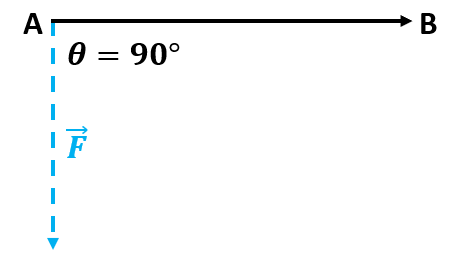
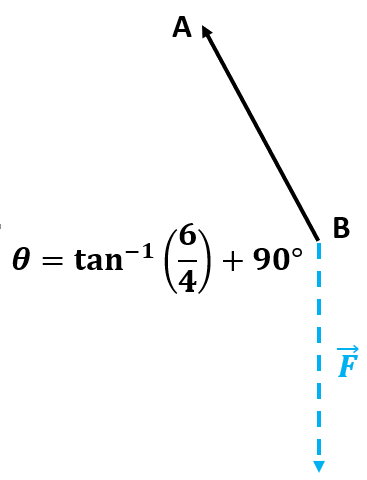
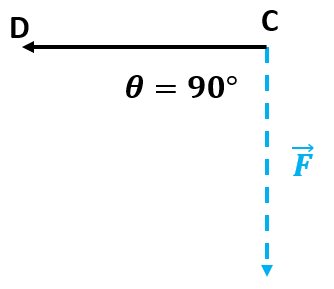
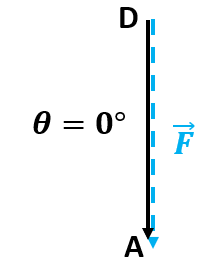
We can calculate the word done by the force of gravity along each segment of the path using the formula W=Fd=Fdcosθ\color{orange}W=\vec{F}\cdot\vec{d}=\left|\left|\vec{F}\right|\right|\left|\left|\vec{d}\right|\right|\cos\theta, where θ\theta is the angle between the vectors F\vec{F} and d\vec{d} lined up tail to tail, that is less than 180°180\degree.

*The vectors are NOT drawn to scale!
  • Work from A to B: W=(100)(10)cos(90°)=0JW=\left(100\right)\left(10\right)\cos\left(90\degree\right)=0J

  • Work from B to C: W=(100)((4)2+(6)2)cos(tan1(64)+90°)=600JW=\left(100\right)\left(\sqrt{\left(-4\right)^2+\left(6\right)^2}\right)\cos\left(\tan^{-1}\left(\frac{6}{4}\right)+90\degree\right)=-600J
  • Work from C to D: W=(100)(6)cos(90°)=0JW=\left(100\right)\left(6\right)\cos\left(90\degree\right)=0J
  • Work from D to A: W=(100)(6)cos(0°)=600JW=\left(100\right)\left(6\right)\cos\left(0\degree\right)=600J
Therefore, the word done by the force of gravity along this path is 0J+(600J)+0J+600J=0J0J+\left(-600J\right)+0J+600J=0J