0:00 / 0:00

Cross Product

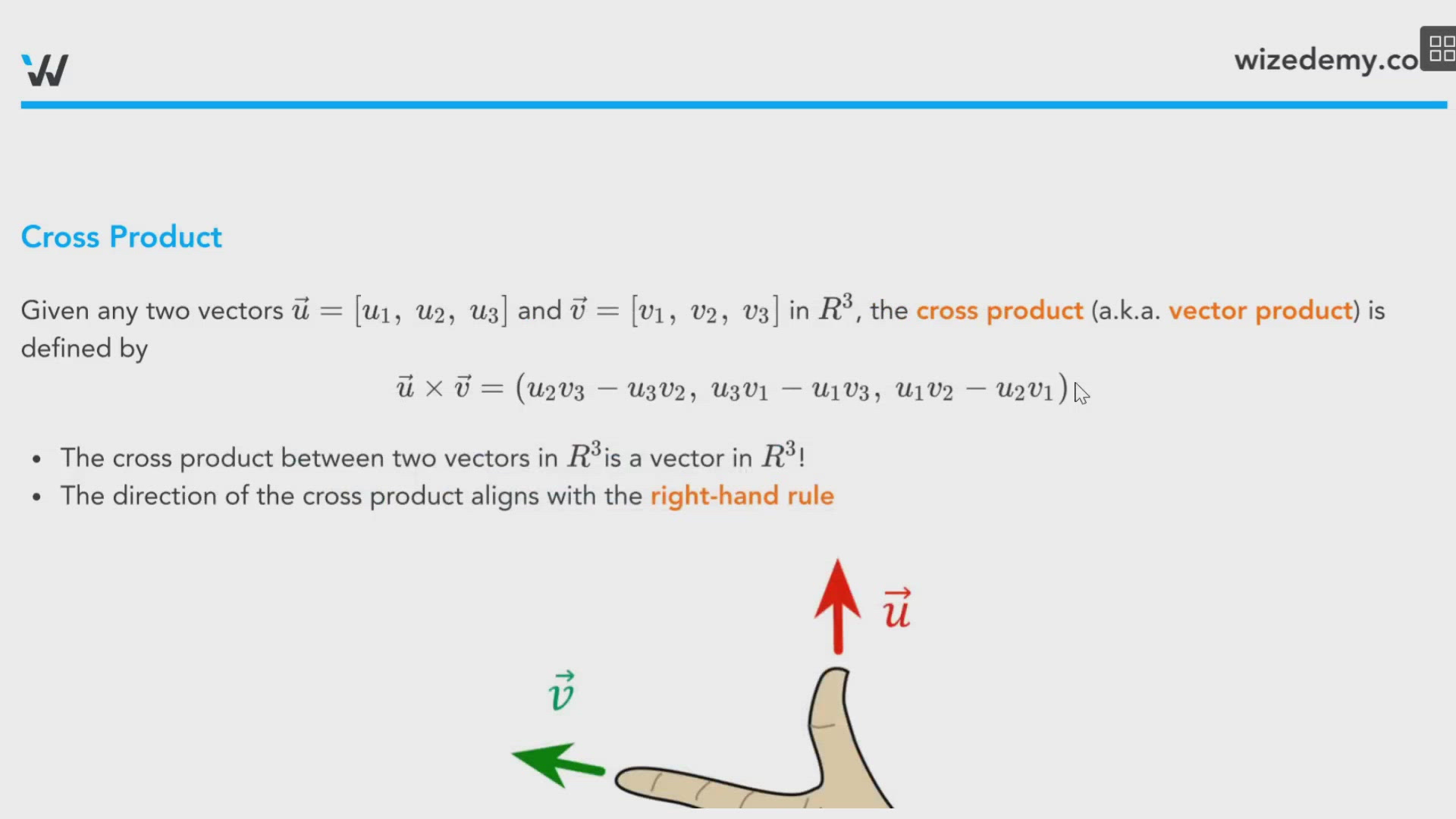
Given any two vectors u=[u1, u2, u3]\vec{u}=\left[u_1,\ u_2,\ u_3\right] and v=[v1, v2, v3]\vec{v}=\left[v_1,\ v_2,\ v_3\right] in R3R^3, the cross product (a.k.a. vector product) is defined by
u×v=(u2v3u3v2, u3v1u1v3, u1v2u2v1)\vec{u}\times\vec{v}=\left(u_2v_3-u_3v_2,\ u_3v_1-u_1v_3,\ u_1v_2-u_2v_1\right)
  • The cross product between two vectors in R3R^3is a vector in R3R^3!
  • The direction of the cross product aligns with the right-hand rule
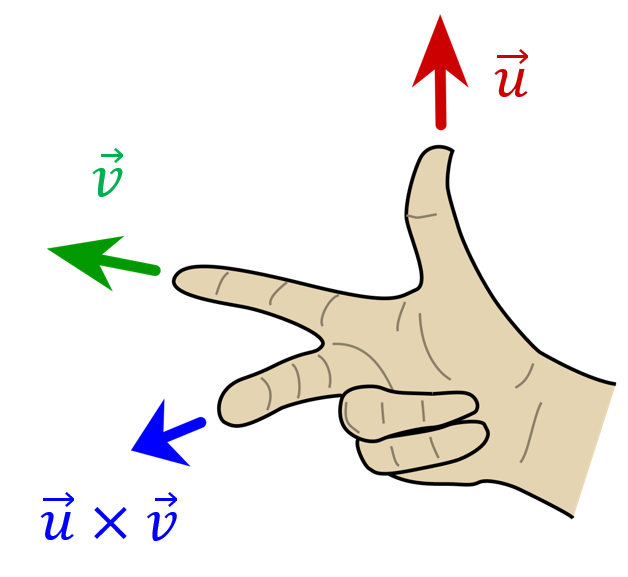

Watch Out!
We can only calculate the cross product between two vectors that are in R3R^3!

PAGE BREAK

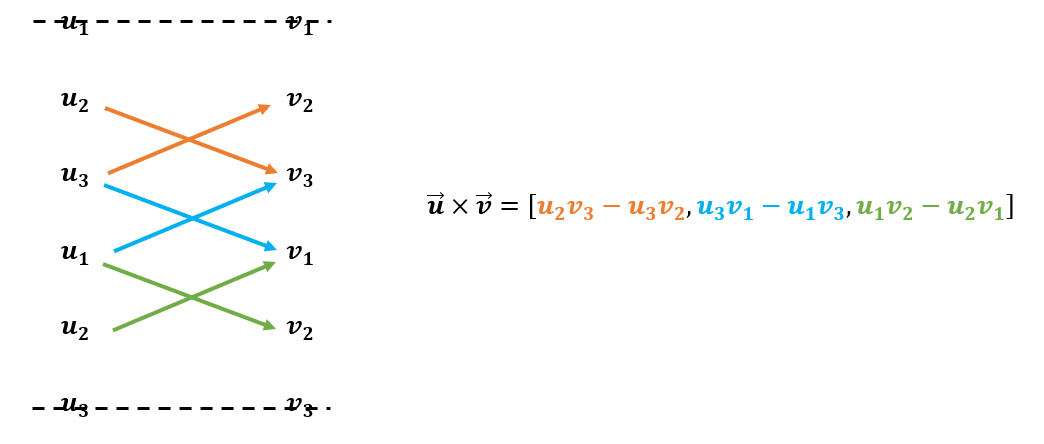
How do we Remember This?


Example
Compute [1, 0, 3]×[2, 2, 4]\left[1,\ 0,\ -3\right]\times\left[2,\ -2,\ -4\right]
=[(0)(4)(3)(2), (3)(2)(1)(4), (1)(2)(0)(2)]=\left[\color{orange}{\left(0\right)\left(-4\right)-\left(-3\right)\left(-2\right)}, \color{blue}{\ \left(-3\right)\left(2\right)-\left(1\right)\left(-4\right)}, \color{green}{\ \left(1\right)\left(-2\right)-\left(0\right)\left(2\right)}\right]
=[6, 2, 2]=\left[\color{orange}{-6},\ \color{blue}{-2},\ \color{green}{-2}\right]
PAGE BREAK

Geometric Interpretation

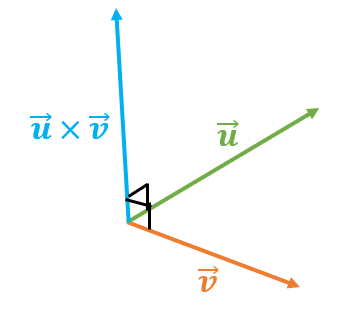
If u\vec{u} and v\vec{v} are non-zero, non-parallel vectors, then u×v\vec{u}\times\vec{v} is a vector that is orthogonal (a.k.a. perpendicular or normal) to u\vec{u} and v\vec{v}


❓ What are u(u×v)\vec{u}\cdot\left(\vec{u}\times\vec{v}\right) and v(u×v)\vec{v}\cdot\left(\vec{u}\times\vec{v}\right)?
Since the cross product produces a vector that is perpendicular to the original two vectors, we know that the dot product between u×v\vec{u}\times\vec{v} and u\vec{u} or v\vec{v} is 0.


Cross Product & Angle

u×v=uvsinθ\left|\left|\vec{u}\times\vec{v}\right|\right|=\left|\left|\vec{u}\right|\right|\left|\left|\vec{v}\right|\right|\sin\theta where 0θ180°0\le\theta\le180\degree is the angle between the two vectors

Practice: Cross Product

Consider u=[2, 3, 1]\vec{u}=\left[-2,\ 3,\ -1\right] and v=[1, 0, 1]\vec{v}=\left[1,\ 0,\ -1\right].
How many unit vectors are perpendicular to u\vec{u} and v\vec{v}?

[Hint: If w\vec{w} is a vector that is perpendicular to u\vec{u} and v\vec{v}, then any scalar multiple of w\vec{w} will be a vector perpendicular to u\vec{u} and v\vec{v}]
0:00 / 0:00

Cross Product Properties

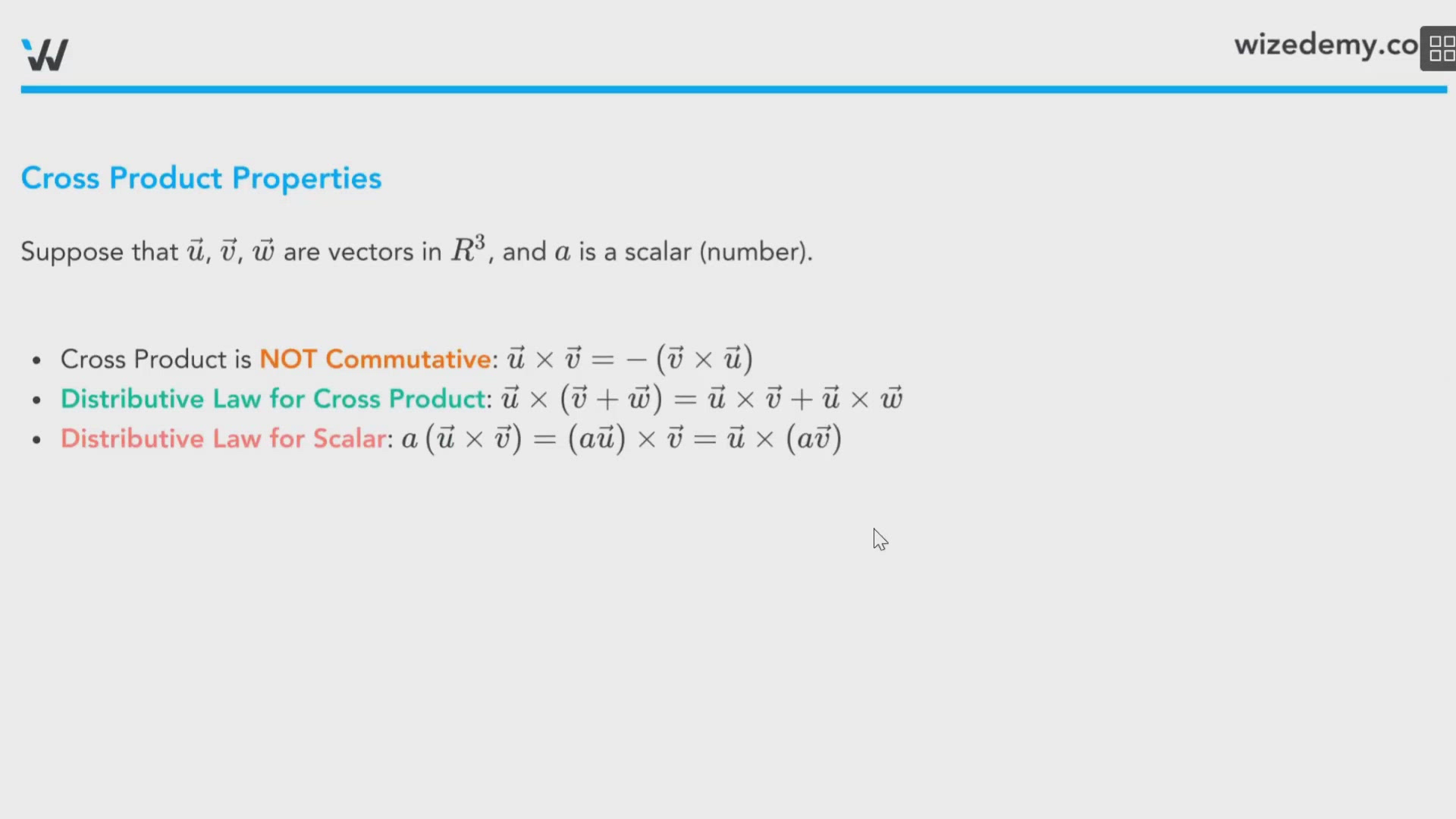
Suppose that u\vec{u}, v\vec{v}, w\vec{w} are vectors in R3R^3, and aa is a scalar (number).

  • Cross Product is NOT Commutative: u×v=(v×u)\vec{u}\times\vec{v}=-\left(\vec{v}\times\vec{u}\right)
  • Distributive Law for Cross Product: u×(v+w)=u×v+u×w\vec{u}\times\left(\vec{v}+\vec{w}\right)=\vec{u}\times\vec{v}+\vec{u}\times\vec{w}
  • Distributive Law for Scalar: a(u×v)=(au)×v=u×(av)a\left(\vec{u}\times\vec{v}\right)=\left(a\vec{u}\right)\times\vec{v}=\vec{u}\times\left(a\vec{v}\right)

Practice: Cross Product

Recall that i=[1, 0, 0]\vec{i}=\left[1,\ 0,\ 0\right], j=[0, 1, 0]\vec{j}=\left[0,\ 1,\ 0\right], and k=[0, 0, 1]\vec{k}=\left[0,\ 0,\ 1\right].
Match the following cross products with the correct result.
A.
2ik2\vec{i}-\vec{k}
B.
j\vec{j}
C.
2i2\vec{i}
D.
k\vec{k}
E.
i-\vec{i}
F.
j-\vec{j}
i×k\vec{i}\times\vec{k}
i×j\vec{i}\times\vec{j}
k×j\vec{k}\times\vec{j}
(i)×k\left(-\vec{i}\right)\times\vec{k}
k×(2j)\vec{k}\times\left(-2\vec{j}\right)

j×(2k+i)\vec{j}\times\left(2\vec{k}+\vec{i}\right)