Create a free account to get started

Unlock full course notes by signing up

  • Video lessons taught by top educators
  • Practice questions with guided solutions
  • Written review notes for reference
  • Expert answers anytime from course tutors

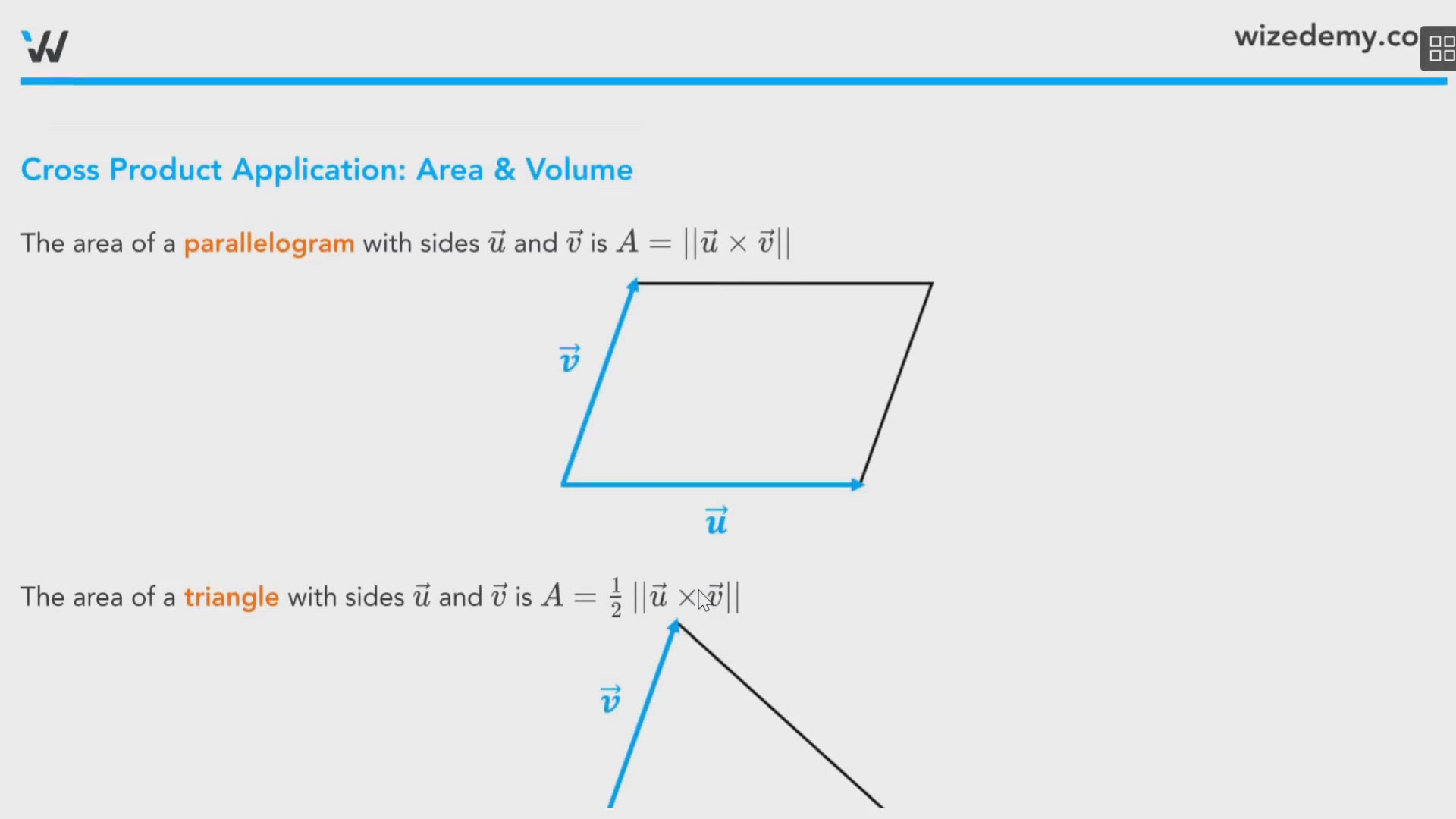
Cross Product Application: Area & Volume

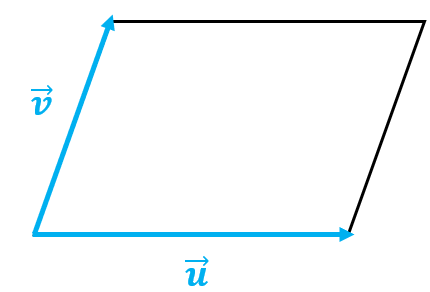
The area of a parallelogram with sides u⃗\vec{u} and v⃗\vec{v} is A=∣∣u⃗×v⃗∣∣A=\left|\left|\vec{u}\times\vec{v}\right|\right|

Image illustrating Cross Product Application: Area & Volume


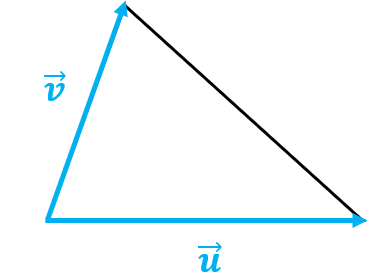
The area of a triangle with sides u⃗\vec{u} and v⃗\vec{v} is A=12∣∣u⃗×v⃗∣∣A=\frac{1}{2}\left|\left|\vec{u}\times\vec{v}\right|\right|

Image illustrating Cross Product Application: Area & Volume


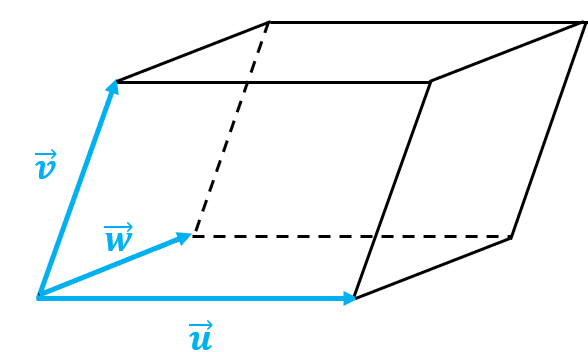
The volume of a parallelopiped with sides u⃗\vec{u}, v⃗\vec{v}, and w⃗\vec{w} is V=∣u⃗⋅(v⃗×w⃗)∣V=\left|\vec{u}\cdot\left(\vec{v}\times\vec{w}\right)\right|

Image illustrating Cross Product Application: Area & Volume


Create a free account to get started

Unlock full course notes by signing up

  • Video lessons taught by top educators
  • Practice questions with guided solutions
  • Written review notes for reference
  • Expert answers anytime from course tutors

Example: Area of a Parallelogram

Find the area of the triangle with vertices A(1, 0, 1)A\left(1,\ 0,\ 1\right), B(−1, 2, −2)B\left(-1,\ 2,\ -2\right) and C(3, 1, 1)C\left(3,\ 1,\ 1\right).


AB→=B→−A→=[−1, 2, −2]−[1, 0, 1]=[−2, 2, −3]\overrightarrow{AB}=\overrightarrow{B}-\overrightarrow{A}=\left[-1,\ 2,\ -2\right]-\left[1,\ 0,\ 1\right]=\left[-2,\ 2,\ -3\right]

AC→=C→−A→=[3, 1, 1]−[1, 0, 1]=[2, 1, 0]\overrightarrow{AC}=\overrightarrow{C}-\overrightarrow{A}=\left[3,\ 1,\ 1\right]-\left[1,\ 0,\ 1\right]=\left[2,\ 1,\ 0\right]


The area of the triangle is A=12∣∣AB→×AC→∣∣A=\frac{1}{2}\left|\left|\overrightarrow{AB}\times\overrightarrow{AC}\right|\right|

A=12∣∣[−2, 2, −3]×[2, 1, 0]∣∣\displaystyle A=\frac{1}{2}\left|\left|\left[-2,\ 2,\ -3\right]\times\left[2,\ 1,\ 0\right]\right|\right|

A=12∣∣[(2)(0)−(−3)(1), (−3)(2)−(−2)(0), (−2)(1)−(2)(2)]∣∣\displaystyle A=\frac{1}{2}\left|\left|\left[\left(2\right)\left(0\right)-\left(-3\right)\left(1\right),\ \left(-3\right)\left(2\right)-\left(-2\right)\left(0\right),\ \left(-2\right)\left(1\right)-\left(2\right)\left(2\right)\right]\right|\right|

A=12∣∣[3, −6, −6]∣∣\displaystyle A=\frac{1}{2}\left|\left|\left[3,\ -6,\ -6\right]\right|\right|

A=12(3)2+(−6)2+(−6)2\displaystyle A=\frac{1}{2}\sqrt{\left(3\right)^2+\left(-6\right)^2+\left(-6\right)^2}

A=129+36+36\displaystyle A=\frac{1}{2}\sqrt{9+36+36}

A=1281\displaystyle A=\frac{1}{2}\sqrt{81}

A=92\displaystyle A=\frac{9}{2}

Practice: Volume of a Parallelpiped

Find the volume of a parallelopiped defined by the sides u⃗=[2,3,−1]\vec{u}=[2,3,-1], v⃗=[0,1,1]\vec v=[0, 1, 1], and w⃗=[−1,−1,0]\vec w=[-1, -1, 0].

Create a free account to get started

Unlock full course notes by signing up

  • Video lessons taught by top educators
  • Practice questions with guided solutions
  • Written review notes for reference
  • Expert answers anytime from course tutors

Create a free account to get started

Unlock full course notes by signing up

  • Video lessons taught by top educators
  • Practice questions with guided solutions
  • Written review notes for reference
  • Expert answers anytime from course tutors

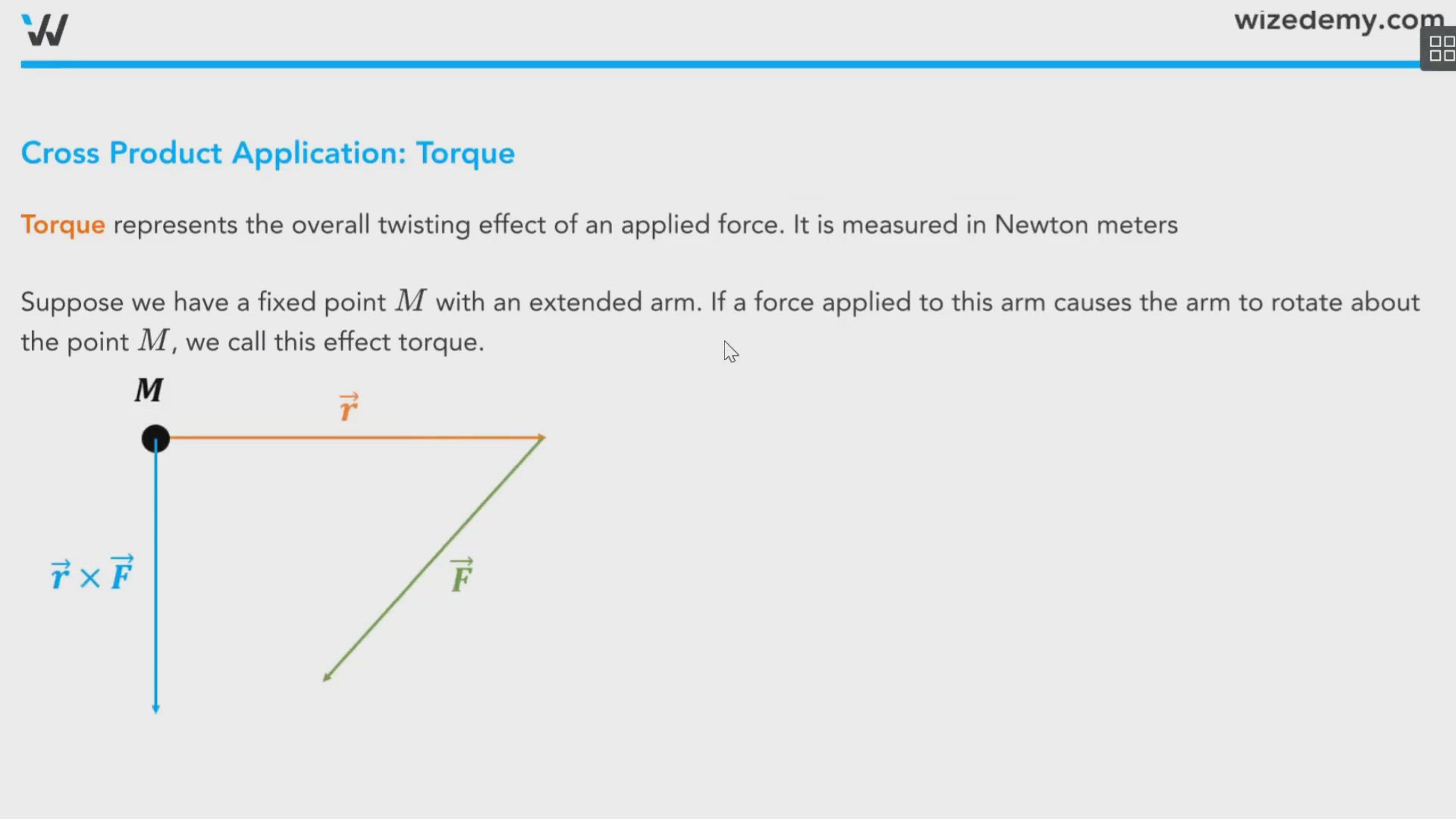
Cross Product Application: Torque

Torque represents the overall twisting effect of an applied force. It is measured in Newton meters


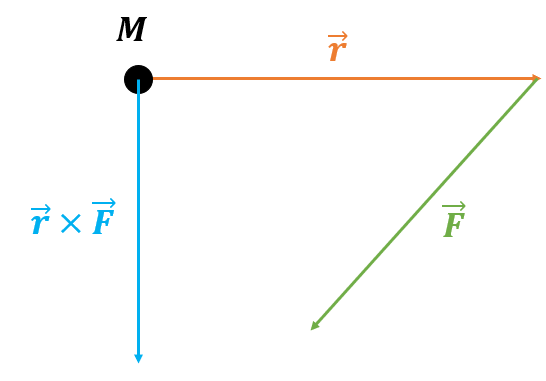
Suppose we have a fixed point MM with an extended arm. If a force applied to this arm causes the arm to rotate about the point MM, we call this effect torque.

Image illustrating Cross Product Application: Torque


τ⃗=r⃗×F⃗\vec{\tau}=\vec{r}\times\vec{F} and ∣∣τ⃗∣∣=∣∣r⃗∣∣∣∣F⃗∣∣sin⁡θ\left|\left|\vec{\tau}\right|\right|=||\vec{r}||||\vec{F}||\sin\theta

  • r⃗\vec r is the vector from the fixed point MM to the point in which the force is appled (∣r⃗∣|\vec r| is measured in m)
  • F⃗\vec F is the force that is applied (∣F⃗∣|\vec F| is measured in N)
  • θ\theta is the angle between the vectors r⃗\vec r and F⃗\vec F (0≤θ≤180°0\le\theta\le180\degree)


Example

A wrench 35cm long is used to tighten a bolt by applying a force of 30N at an angle of 60°60\degree to the end of the handle of the wrench. Find the magnitude of the torque.

∣∣τ⃗∣∣=∣∣r⃗∣∣∣∣F⃗∣∣sin⁡θ||\vec \tau||=||\vec r||||\vec F||\sin\theta

∣∣τ⃗∣∣=(0.35)(30)sin⁡(60°)||\vec \tau||=(0.35)(30)\sin(60\degree)

∣∣τ⃗∣∣=(0.35)(30)(32)||\vec \tau||=(0.35)(30)\left(\frac{\sqrt{3}}{2}\right)

∣∣τ⃗∣∣=5.2530≈9.09 Nm||\vec \tau||=5.25\sqrt {30}\approx9.09\ Nm

Create a free account to get started

Unlock full course notes by signing up

  • Video lessons taught by top educators
  • Practice questions with guided solutions
  • Written review notes for reference
  • Expert answers anytime from course tutors

Example: Torque

You and your friend are trying to push open a gate that has a single hinge on one side. The gate starts opening if you apply a force of 60N perpendicular to the gate, at a point that is 60cm away from the hinge, parallel to the ground. If your friend is only able to push the gate with a force of 40N perpendicular to the door, where should they apply the force in order to open the gate?


The same amount of torque is required to open the gate.


You

Since you apply a force of 60N perpendicular to the gate, the angle between r⃗\vec r and F⃗\vec F is 90°90\degree :

∣∣τ⃗∣∣=∣∣r⃗∣∣∣∣F⃗∣∣sin⁡(90°)||\vec \tau||=||\vec r||||\vec F||\sin(90\degree)

∣∣τ⃗∣∣=(0.60)(60)sin⁡(90°)||\vec \tau||=(0.60)(60)\sin(90\degree)

∣∣τ⃗∣∣=36||\vec \tau||=36


Your friend

∣∣τ⃗∣∣=∣∣r⃗∣∣∣∣F⃗∣∣sin⁡(90°)||\vec \tau||=||\vec r||||\vec F||\sin(90\degree)

36=∣∣r⃗∣∣(40)sin⁡(90°)36=||\vec r||(40)\sin(90\degree)

∣∣r⃗∣∣=3640||\vec{r}||=\frac{36}{40}

∣∣r⃗∣∣=0.9\left|\left|\vec{r}\right|\right|=0.9


Therefore, your friend should push the door at a distance of 90 cm away from the hinge, parallel to the ground.