0:00 / 0:00

Intro to Equations of Lines

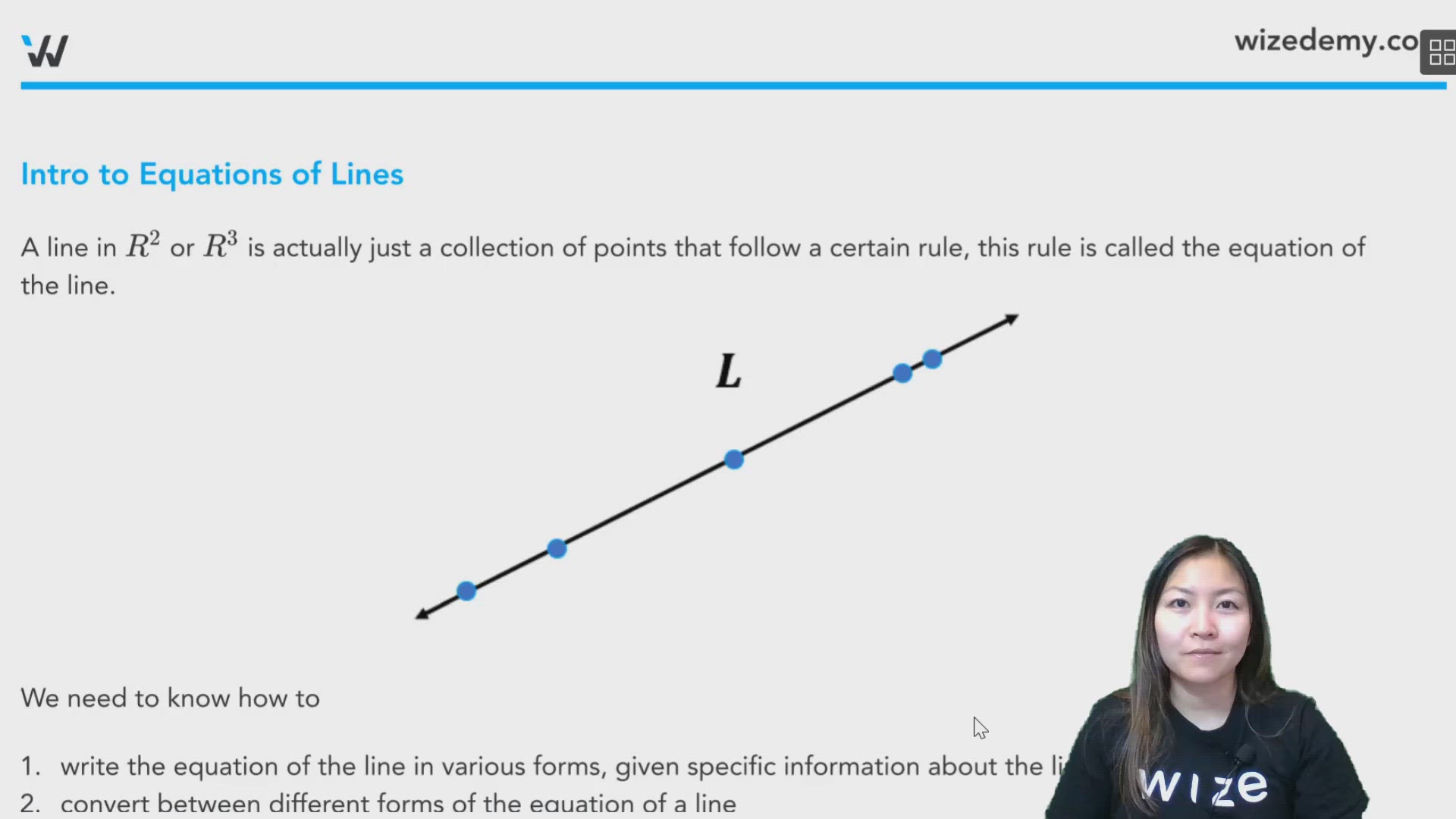
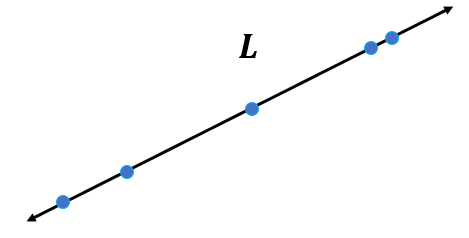
A line in R2R^2 or R3R^3 is actually just a collection of points that follow a certain rule, this rule is called the equation of the line.
We need to know how to
  1. write the equation of the line in various forms, given specific information about the line
  2. convert between different forms of the equation of a line
PAGE BREAK

Lines in R2

Slope y-intercept Equationy=mx+bVector Equationr=r0+tmParametric Equationsx=x0+mxty=y0+mytSymmetric Equationxx0mx=yy0myNormal Equation(rr0)n=0Cartesian (a.k.a. Scalar) EquationAx+By+C=0\displaystyle \begin{array}{|c|c|} \hline\\ \text{\textcolor{orange}{Slope y-intercept Equation}}&y=mx+b\\ \\\hline\\ \text{\textcolor{orange}{Vector Equation}}&\vec r=\vec {r_0}+t\vec m\\ \\\hline\\ \text{\textcolor{orange}{Parametric Equations}}&\begin{array}{c} x=x_0+m_xt\\y=y_0+m_yt\end{array}\\ \\\hline\\ \text{\textcolor{orange}{Symmetric Equation}}&\displaystyle \frac{x-x_0}{m_x}=\frac{y-y_0}{m_y}\\ \\\hline\\ \text{\textcolor{orange}{Normal Equation}}&(\vec r-\vec{r_0})\cdot\vec n=0\\ \\\hline\\ \text{\textcolor{orange}{Cartesian (a.k.a. Scalar) Equation}}&Ax+By+C=0\\ \\\hline \end{array}
PAGE BREAK

Lines in R3

Vector Equationr=r0+tmParametric Equationsx=x0+mxty=y0+mytz=z0+mztSymmetric Equationxx0mx=yy0my=zz0mz\displaystyle \begin{array}{|c|c|} \hline\\ \text{\textcolor{orange}{Vector Equation}}&\vec r=\vec {r_0}+t\vec m\\ \\\hline\\ \text{\textcolor{orange}{Parametric Equations}}&\begin{array}{c} x=x_0+m_xt\\y=y_0+m_yt\\z=z_0+m_zt\end{array}\\ \\\hline\\ \text{\textcolor{orange}{Symmetric Equation}}&\displaystyle \frac{x-x_0}{m_x}=\frac{y-y_0}{m_y}=\frac{z-z_0}{m_z}\\ \\\hline \end{array}
0:00 / 0:00

Vector, Parametric & Symmetric Equations in R2
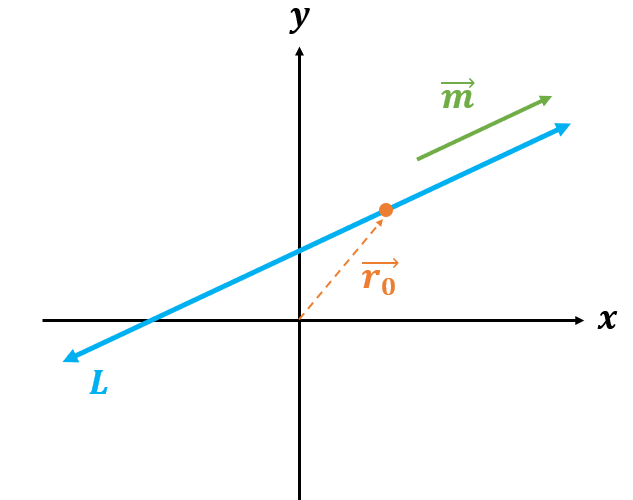
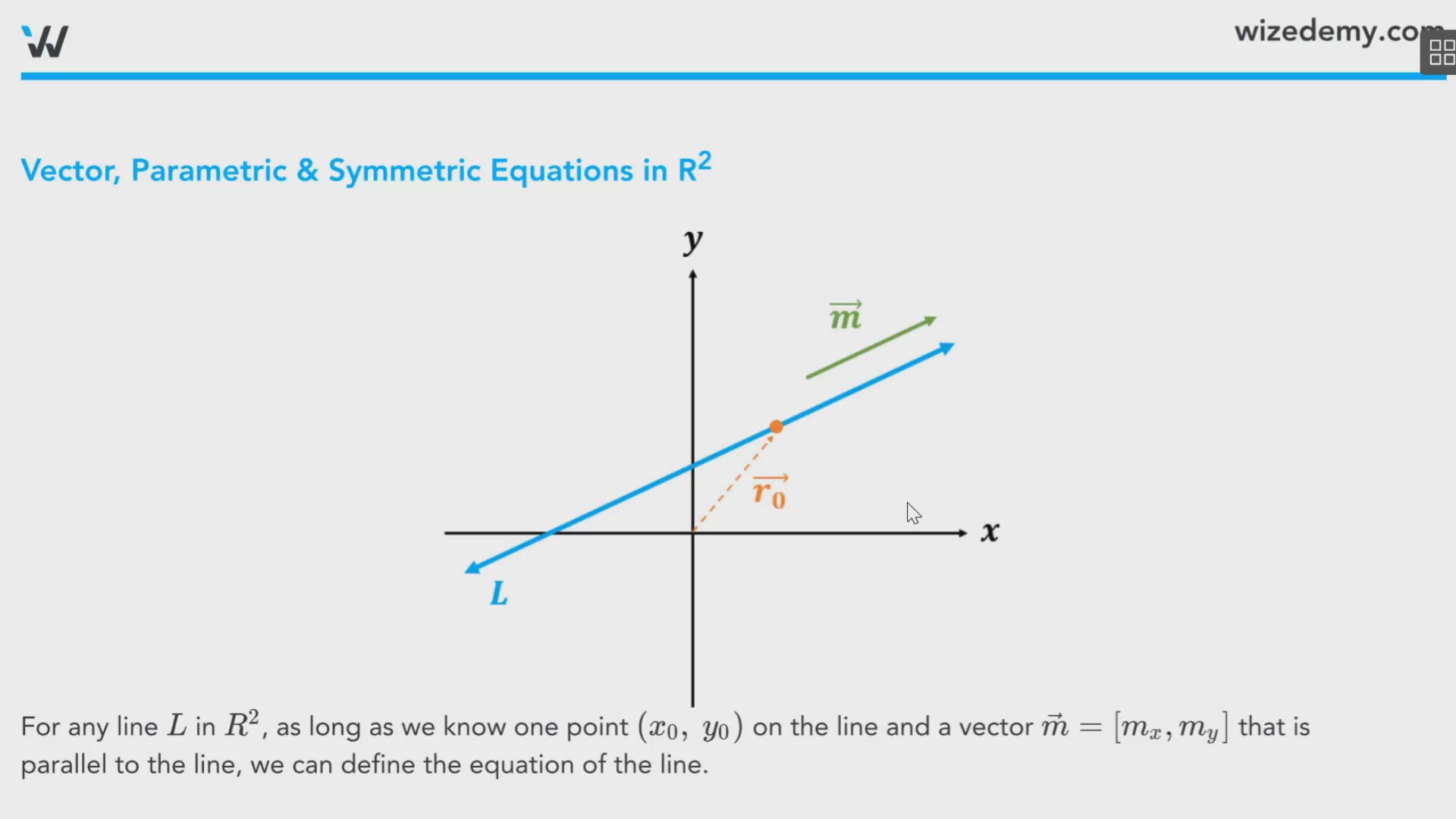
For any line LL in R2R^2, as long as we know one point (x0, y0)(x_0,\ y_0) on the line and a vector m=[mx,my]\vec m=[m_x, m_y] that is parallel to the line, we can define the equation of the line.

Slope y-intercept Equation
yy0=mymx(xx0)\boxed{y-y_0=\frac{m_y}{m_x}\left(x-x_0\right)} or y=mymxx+(y0mymxx0)\boxed{y=\frac{m_y}{m_x}x+\left(y_0-\frac{m_y}{m_x}x_0\right)}

Vector Equation
r=r0+tm\boxed{\overrightarrow r=\overrightarrow r_0+t\overrightarrow m} or [x, y]=[x0, y0]+t[mx, my]\boxed{\left[x,\ y\right]=\left[x_0,\ y_0\right]+t\left[m_x,\ m_y\right]}
  • r=[x, y]\overrightarrow{r}=[x,\ y] represents the position vector from the original to any point (x, y)(x,\ y) on the line LL
  • r0=[x0, y0]\overrightarrow{r_0}=[x_0,\ y_0] represents the position vector of a known point on the line LL
  • tt is a parameter that can take on any real number (tRt\in R)
Parametric Equations
x=x0+mxty=y0+myt\boxed{\begin{array}{c} x=x_0+m_xt\\ y=y_0+m_yt \end{array}}

Symmetric Equation
xx0mx=yy0my\boxed{\displaystyle \frac{x-x_0}{m_x}=\frac{y-y_0}{m_y}}

"Switch & Flip" Tip: If [a, b]\left[a,\ b\right] is a vector perpendicular to the line, then [b, a]\left[-b,\ a\right] and [b, a]\left[b,\ -a\right] are vectors parallel to the line.

PAGE BREAK

Vector & Parametric Equations in R3

Similar to lines in R2R^2, any Line LL in R3R^3 can be defined using a vector equation or parametric equations.

Vector Equation
r=r0+tm\boxed{\overrightarrow{r}=\overrightarrow{r_0}+t\overrightarrow{m}} or [x, y, z]=[x0, y0, z0]+t[mx, my, mz]\boxed{\left[x,\ y,\ z\right]=\left[x_0,\ y_0,\ z_0\right]+t\left[m_x,\ m_y,\ m_z\right]}

Parametric Equations
x=x0+mxty=y0+mytz=z0+mzt\boxed{\begin{array}{c} x=x_0+m_xt\\ y=y_0+m_yt\\ z=z_0+m_zt \end{array}}

Symmetric Equation
xx0mx=yy0my=zz0mz\boxed{\displaystyle \frac{x-x_0}{m_x}=\frac{y-y_0}{m_y}=\frac{z-z_0}{m_z}}
0:00 / 0:00

Example: Equations of Lines in R2

Find the vector, parametric, and symmetric equations of the following lines.

a) Given a point on the line and a parallel vector
The line passes through the point (1, 3)\left(1,\ -3\right) and is parallel to the vector [1, 2]\left[1,\ -2\right].

Position vector of the point: [1, 3]\left[1,\ -3\right]
Direction vector of the line: [1, 2]\left[1,\ -2\right] (or any scalar multiple)
Vector equation: r=[1, 3]+t[ 1, 2]\vec{r}=\left[1,\ -3\right]+t\left[\ 1,\ -2\right]
Parametric equations: x=1+ty=32t\begin{array}{l} x=1+t\\ y=-3-2t \end{array}
Symmetric equation: x11=y+32\frac{x-1}{1}=\frac{y+3}{-2}


b) Given two points on the line
The line passes through the points (1, 3)\left(1,\ -3\right) and (0, 4)\left(0,\ 4\right).

Position vector of the point: [1, 3]\left[1,\ -3\right] or [0, 4]\left[0,\ 4\right]
Direction vector of the line: [1, 3][0, 4]=[1, 7]\left[1,\ -3\right]-\left[0,\ 4\right]=\left[1,\ -7\right] (or any scalar multiple)
Vector equation: r=[1, 3]+t[ 1, 7]\vec{r}=\left[1,\ -3\right]+t\left[\ 1,\ -7\right]
Parametric equations: x=1+ty=37t\begin{array}{l} x=1+t\\ y=-3-7t \end{array}
Symmetric equation: x11=y+37\frac{x-1}{1}=\frac{y+3}{-7}


PAGE BREAK
c) Given a point on the line and a parallel line
The line passes through the point (1, 3)\left(1,\ -3\right) and is parallel to the line r=[2, 5]+t[2, 1]\vec{r}=\left[2,\ 5\right]+t\left[-2,\ 1\right].

Position vector of the point: [1, 3]\left[1,\ -3\right]
Direction vector of the line: [2, 1]\left[-2,\ 1\right] (or any scalar multiple)
Vector equation: r=[1, 3]+t[ 2, 1]\vec{r}=\left[1,\ -3\right]+t\left[\ -2,\ 1\right]
Parametric equations: x=12ty=3+t\begin{array}{l} x=1-2t\\ y=-3+t \end{array}
Symmetric equation: x12=y+31\frac{x-1}{-2}=\frac{y+3}{1}


d) Given a point on the line and a perpendicular line
The line passes through the point (1, 3)\left(1,\ -3\right) and is perpendicular to the line r=[2, 5]+t[2, 1]\vec{r}=\left[2,\ 5\right]+t\left[-2,\ 1\right].

Position vector of the point: [1, 3]\left[1,\ -3\right]
Direction vector of the line: [1, 2]\left[1,\ 2\right] (or any scalar multiple)
Vector equation: r=[1, 3]+t[ 1, 2]\vec{r}=\left[1,\ -3\right]+t\left[\ 1,\ 2\right]
Parametric equations: x=1+ty=3+2t\begin{array}{l} x=1+t\\ y=-3+2t \end{array}
Symmetric equation: x11=y+32\frac{x-1}{1}=\frac{y+3}{2}

Practice: Equation of Lines in R2

A line LL passes through the point (3, 1)\left(-3,\ -1\right) and is perpendicular to the line r=[4, 5]+t[3, 6]\vec{r}=\left[-4,\ 5\right]+t\left[3,\ -6\right].
Which of the following is a direction vector parallel to LL?

(Select all that apply)
0:00 / 0:00

Example: Converting Equations of Lines in R2

a) Convert the equation y=2x+3y=-2x+3 into a vector equation, parametric equations, and symmetric equation.

The slope is 2=21  rise=2, run=1-2=-\frac{2}{1}\ \to\ rise=-2,\ run=1. Meaning that the direction vector is m=[1, 2]\vec{m}=\left[1,\ -2\right] (or any scalar multiple).
If we let x=0x=0, we can solve for yy: y=2(0)+3=3y=-2\left(0\right)+3=3. Meaing that the position vector of one point on the line is [0, 3]\left[0,\ 3\right].
Vector equation: r=[0, 3]+[1,2]\vec{r}=\left[0,\ 3\right]+\left[1,-2\right]
Parametric equations: x=ty=32t\begin{array}{l} x=t\\ y=3-2t \end{array}
Symmetric equation: x01=y32\frac{x-0}{1}=\frac{y-3}{-2}


b) Convert the equation r=[1, 2]+t[3, 4]\vec{r}=\left[1,\ 2\right]+t\left[3,\ 4\right] into a slope y-intercept equation.

Method 1
The slope is riserun=43\frac{rise}{run}=\frac{4}{3}. Meaing that m=43m=\frac{4}{3}.
A point on the line is (x0, y0)=(1, 2)\left(x_0,\ y_0\right)=\left(1,\ 2\right).
Therefore, the slope y-intercept equation is y2=43(x1)  y=43x+23y-2=\frac{4}{3}\left(x-1\right)\ \to\ y=\frac{4}{3}x+\frac{2}{3}

Method 2
First write out the symmetric equation of the line: x13=y24\frac{x-1}{3}=\frac{y-2}{4}
Then, solve for yy:
4(x1)=3(y2)4\left(x-1\right)=3\left(y-2\right)
4x4=3y64x-4=3y-6
4x+2=3y4x+2=3y
4x+23=y\frac{4x+2}{3}=y
y=43x+23y=\frac{4}{3}x+\frac{2}{3}

Practice: Converting Equations of Lines in R2 & R3

Match the following vector equations with their identical parametric, symmetric, or slope y-intercept equations.
A.
x13=y24\displaystyle \frac{x-1}{3}=\frac{y-2}{4}
B.
x3=y42\displaystyle x-3=\frac{y-4}{2}
C.
y=2x+10y=-2x+10
D.
x=1y=2+tz=35t\begin{array}{l} x=1\\ y=2+t\\ z=3-5t \end{array}
E.
x=y12=z+53\displaystyle x=\frac{y-1}{2}=\frac{z+5}{3}
F.
x=1+4ty=2+3t\begin{array}{l} x=-1+4t\\ y=2+3t \end{array}
G.
x=1+3ty=24t\begin{array}{l} x=-1+3t\\ y=2-4t \end{array}
H.
x=3ty=4+2t\begin{array}{l} x=3-t\\ y=-4+2t \end{array}
[3, 4]+t[1, 2]\left[3,\ -4\right]+t\left[-1,\ 2\right]
[1, 2]+t[3, 4]\left[-1,\ 2\right]+t\left[3,\ -4\right]
[1, 2]+t[4, 3]\left[-1,\ 2\right]+t\left[4,\ 3\right]
[3, 4]+t[1, 2]\left[3,\ 4\right]+t\left[1,\ 2\right]
[1, 2]+t[3, 4]\left[1,\ 2\right]+t\left[3,\ 4\right]
[3, 4]+t[1, 2]\left[3,\ 4\right]+t\left[-1,\ 2\right]
[1, 2, 3]+t[0, 1, 5]\left[1,\ 2,\ 3\right]+t\left[0,\ 1,\ -5\right]
[0, 1, 5]+t[1, 2, 3][0,\ 1,\ -5]+t\left[1,\ 2,\ 3\right]
0:00 / 0:00

Example: Equations of Lines in R3

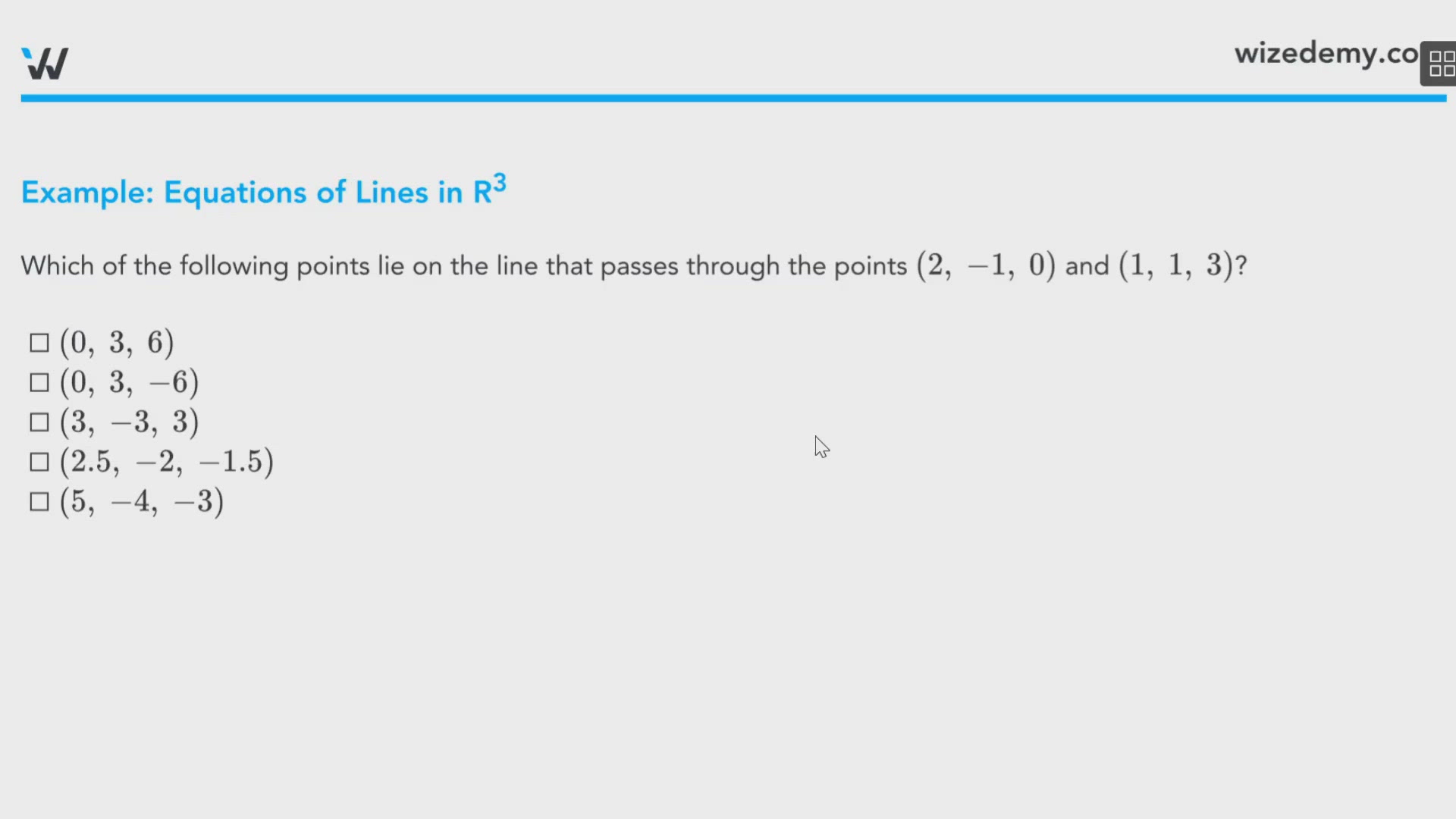
Which of the following points lie on the line that passes through the points (2, 1, 0)\left(2,\ -1,\ 0\right) and (1, 1, 3)\left(1,\ 1,\ 3\right)?

(0, 3, 6)\left(0,\ 3,\ 6\right)
(0, 3, 6)\left(0,\ 3,\ -6\right)
(3, 3, 3)\left(3,\ -3,\ 3\right)
(2.5, 2, 1.5)\left(2.5,\ -2,\ -1.5\right)
(5, 4, 3)\left(5,\ -4,\ -3\right)

The direction vector parallel to the line is [2, 1, 0][1, 1, 3]=[1, 2, 3]\left[2,\ -1,\ 0\right]-\left[1,\ 1,\ 3\right]=\left[1,\ -2,\ -3\right] (or any scalar multiple of this)

The vector equation of the line is r=[2, 1, 0]+t[1, 2, 3]\vec{r}=\left[2,\ -1,\ 0\right]+t\left[1,\ -2,\ -3\right] (you could have used the position vector of the other point as well).

So, the parametric equations of the line are x=2+ty=12tz=3t\begin{array}{l} x=2+t\\ y=-1-2t\\ z=-3t \end{array}.

Point (0, 3, 6):
0=2+t   =20=2+t\ \ \to\ =-2
3=12t  t=23=-1-2t\ \to\ t=-2
6=3t  t=26=-3t\ \to\ t=-2
Since the parameter tt is the same for each of these parametric equations, the point (0, 3, 6) is on the line.

Point (0, 3, -6):
Since the xx and yy coordinates are the same as the point above while the zz coordinate is different, we know that this point cannot be on the line. Alternatively, we can show this by solving for the parameter tt.

Point (3, -3, 3):
3=2+t  t=13=2+t\ \to\ t=1
3=12t  t=1-3=-1-2t\ \to\ t=1
3=3t  t=13=-3t\ \to\ t=-1
Since the parameter tt is not the same for all these parametric equations, the point (3, -3, 3) is not on the line.

Point (2.5, -2, -1.5):
2.5=2+t  t=0.52.5=2+t\ \to\ t=0.5
2=12t  t=0.5-2=-1-2t\ \to\ t=0.5
1.5=3t  t=0.5-1.5=-3t\ \to\ t=0.5
Since the paramter tt is the same for each of these parametric equations, the point (2.5, -2, -1.5) is on the line.

Point (5, -4, -3):
Although this point is a scalar multiple of the point directly before this one, don't let that trick you!
5=2+t  t=35=2+t\ \to\ t=3
4=12t  t=1.5-4=-1-2t\ \to\ t=1.5
Since the parameter tt is not the same for all these parametric equations, the point (5, -4, -3) is not on the line.

Alternatively
We could substitute the x, y, zx,\ y,\ z values from the given points into the symmetric equation x21=y(1)2=z03\displaystyle \frac{x-2}{1}=\frac{y-\left(-1\right)}{-2}=\frac{z-0}{-3}, if all 3 parts of the equation equal, then the given point is on the line. Otherwise, the point is not on the line.
0:00 / 0:00

Cartesian (Scalar) & Normal Equations in R2

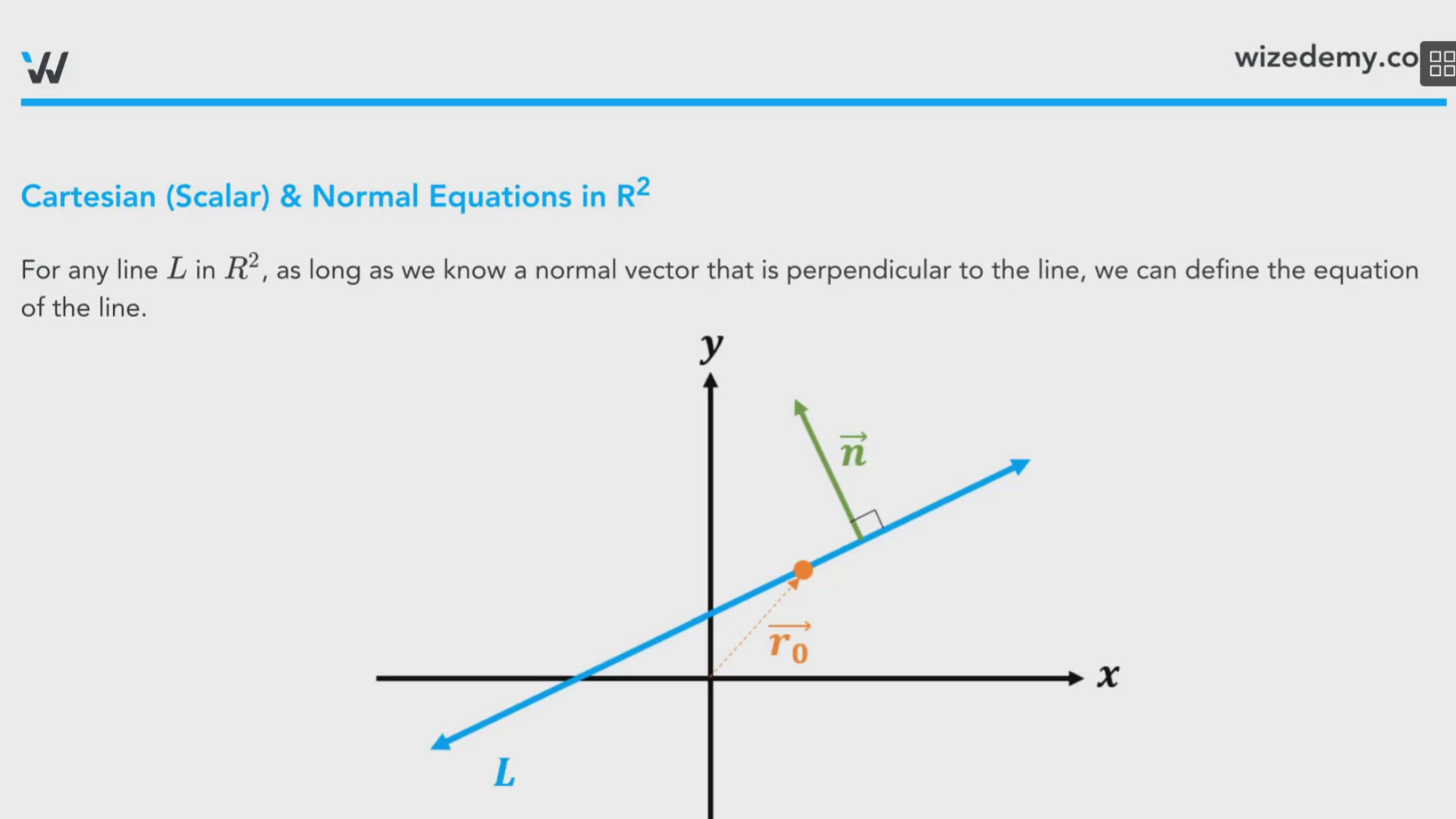
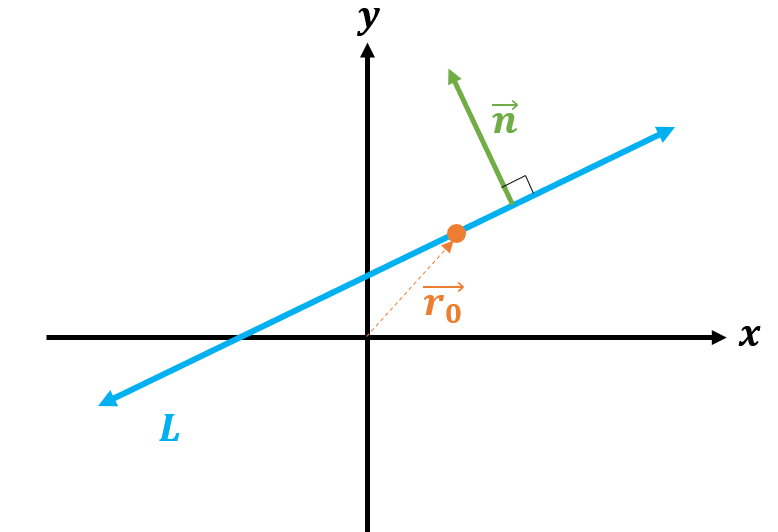
For any line LL in R2R^2, as long as we know a normal vector that is perpendicular to the line, we can define the equation of the line.
Normal Equation
(rr0)n=0\boxed{\left(\overrightarrow r-\overrightarrow{r_0}\right)\cdot\overrightarrow{n}=0}
  • r=[x, y]\overrightarrow{r}=[x,\ y] represents the position vector from the original to any point (x, y)(x,\ y) on the line LL
  • r0=[x0, y0]\overrightarrow{r_0}=[x_0,\ y_0] represents the position vector of a known point on the line LL
  • n=[A, B]\overrightarrow{n}=\left[A,\ B\right] represents the normal vector that is perpendicular to the line LL

Cartesian (a.k.a. Scalar) Equation
Ax+By+C=0\boxed{Ax+By+C=0}
  • n=[A,B]\overrightarrow{n}=[A,B] represents the normal vector that is perpendicular to the line LL
  • C=[x0, y0][A, B]C=-[x_0,\ y_0]\cdot[A,\ B] where [x0, y0][x_0,\ y_0] represents the position vector of a known point on the line LL

How About in R3?

Can we define a Normal or Cartesian Equation of a line in R3R^3?
A line in R3R^3 has more than 1 normal vector, it actually has infinitely many normal vectors. So, we cannot define a line in R3R^3 by a normal vector of the line and a known point on the line.

In fact, a normal vector and a known point defines an equation of a plane in R3R^3!
0:00 / 0:00

Example: Equations of Lines in R2

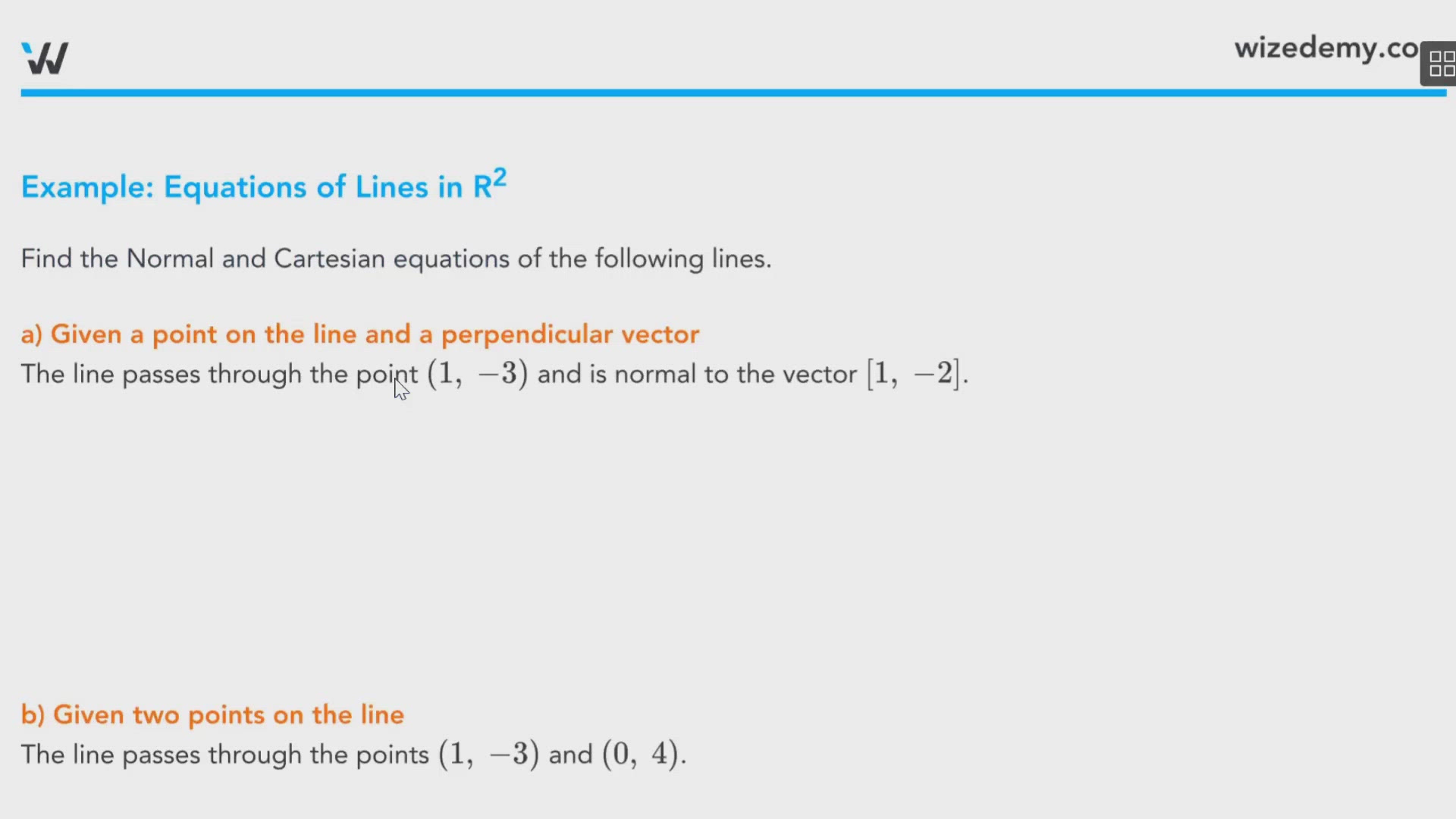
Find the Normal and Cartesian equations of the following lines.

a) Given a point on the line and a perpendicular vector
The line passes through the point (1, 3)\left(1,\ -3\right) and is normal to the vector [1, 2]\left[1,\ -2\right].

Position vector of the point: [1, 3]\left[1,\ -3\right]
Normal vector of the line: n=[1, 2]\vec{n}=\left[1,\ -2\right] (or any scalar multiple)
Normal equation: ([x, y][1, 3])[1, 2]=0\left(\left[x,\ y\right]-\left[1,\ -3\right]\right)\cdot\left[1,\ -2\right]=0
Cartesian equation: x2y[1, 3][1, 2]=0x-2y-\left[1,\ -3\right]\cdot\left[1,\ -2\right]=0 or x2y7=0x-2y-7=0


b) Given two points on the line
The line passes through the points (1, 3)\left(1,\ -3\right) and (0, 4)\left(0,\ 4\right).

Position vector of the point: [1, 3]\left[1,\ -3\right] or [0, 4]\left[0,\ 4\right]
Direction vector of the line: [1, 3][0, 4]=[1, 7]\left[1,\ -3\right]-\left[0,\ 4\right]=\left[1,\ -7\right] (or any scalar multiple)
Normal vector of the line: n=[7, 1]\vec{n}=\left[7,\ 1\right] (or any scalar multiple)
Normal equation: ([x, y][1, 3])[7, 1]=0\left(\left[x,\ y\right]-\left[1,\ -3\right]\right)\cdot\left[7,\ 1\right]=0
Cartesian equation: 7x+y[1,3][7,1]=07x+y-\left[1,-3\right]\cdot\left[7,1\right]=0 or 7x+y4=07x+y-4=0


PAGE BREAK
c) Given a point on the line and a parallel line
The line passes through the point (1, 3)\left(1,\ -3\right) and is parallel to the line r=[2, 5]+t[2, 1]\vec{r}=\left[2,\ 5\right]+t\left[-2,\ 1\right].

Position vector of the point: [1, 3]\left[1,\ -3\right]
Direction vector of the line: [2, 1]\left[-2,\ 1\right] (or any scalar multiple)
Normal vector of the line: n=[1, 2]\vec{n}=\left[1,\ 2\right] (or any scalar multiple)
Normal equation: ([x, y][1, 3])[1, 2]=0\left(\left[x,\ y\right]-\left[1,\ -3\right]\right)\cdot\left[1,\ 2\right]=0
Cartesian equation: 1x+2y[1,3][1,2]=01x+2y-\left[1,-3\right]\cdot\left[1,2\right]=0 or x+2y+5=0x+2y+5=0


d) Given a point on the line and a perpendicular line
The line passes through the point (1, 3)\left(1,\ -3\right) and is perpendicular to the line r=[2, 5]+t[2, 1]\vec{r}=\left[2,\ 5\right]+t\left[-2,\ 1\right].

Position vector of the point: [1, 3]\left[1,\ -3\right]
Normal vector of the line: n=[2, 1]\vec{n}=\left[-2,\ 1\right] (or any scalar multiple)
Normal equation: ([x, y][1, 3])[2, 1]=0\left(\left[x,\ y\right]-\left[1,\ -3\right]\right)\cdot\left[-2,\ 1\right]=0
Cartesian equation: 2x+y[1, 3][2, 1]=0-2x+y-\left[1,\ -3\right]\cdot\left[-2,\ 1\right]=0 or 2xy5=02x-y-5=0

Practice: Equations of Lines in R2

Line 1 is a line that passes through the points (1, 2)\left(1,\ -2\right) and (3, 0)\left(3,\ 0\right).
Line 2 is the line that passes through the point (5, 3)\left(5,\ 3\right) and is perpendicular to the line [1, 1]+t[1, 1]\left[-1,\ -1\right]+t\left[-1,\ 1\right].
Determine the Cartesian equations of the lines 1 and 2.

Practice: Converting Equations of Lines in R2

Select all of the equations that are identical to this slope y-intercept equation y=13x1y=-\frac{1}{3}x-1.
0:00 / 0:00

Angle Between Lines

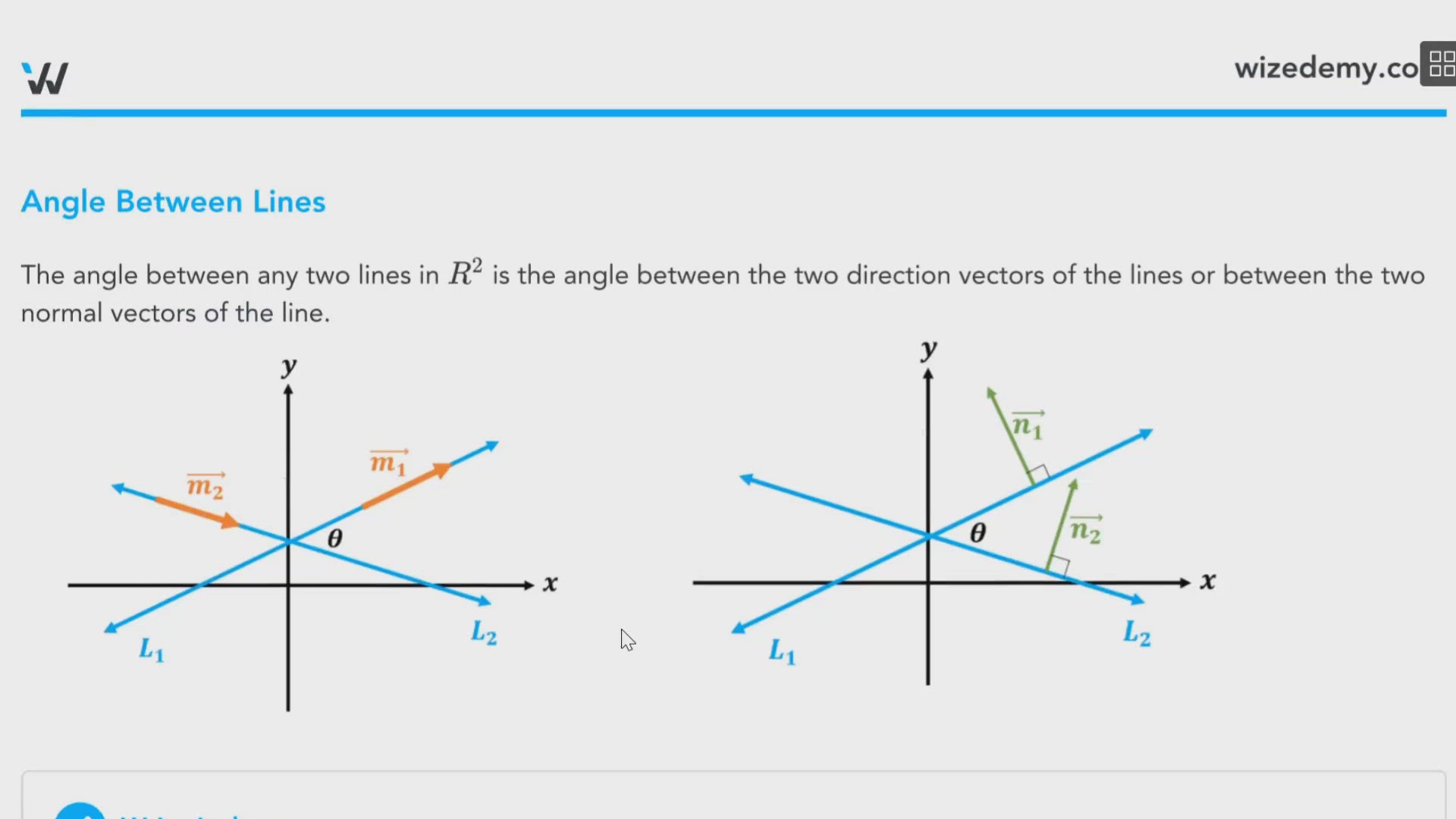
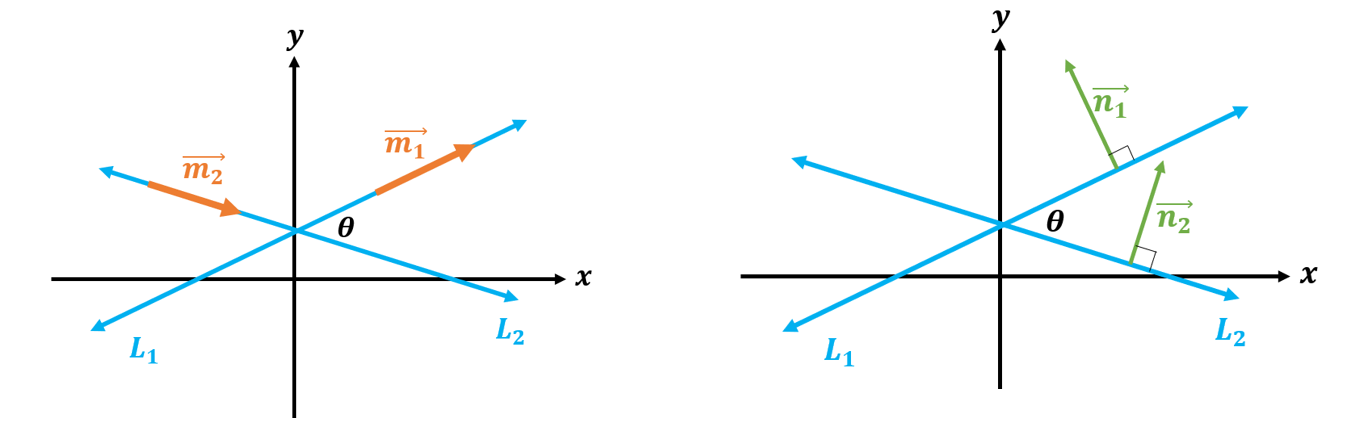
The angle between any two lines in R2R^2 is the angle between the two direction vectors of the lines or between the two normal vectors of the line.
Write it Down
The angle between any two lines in R2R^2 is calculated by:
θ=cos1(m1m2m1m2)\displaystyle \theta=\cos^{-1}\left(\frac{\vec{m_1}\cdot\vec{m_2}}{\left|\left|\vec{m_1}\right|\right|\left|\left|\vec{m_2}\right|\right|}\right) or θ=cos1(n1n2n1n2)\displaystyle \theta=\cos^{-1}\left(\frac{\vec{n_1}\cdot\vec{n_2}}{\left|\left|\vec{n_1}\right|\right|\left|\left|\vec{n_2}\right|\right|}\right)

Parallel Lines

  • m1\overrightarrow{m_1} and m2\overrightarrow{m_2} are parallel (scalar multiples)
  • n1\overrightarrow{n_1} and n2\overrightarrow{n_2} are parallel (scalar multiples)
  • m1\overrightarrow{m_1} and n2\overrightarrow{n_2} are perpendicular (dot product is 0)
  • m2\overrightarrow{m_2} and n1\overrightarrow{n_1} are perpendicular (dot product is 0)

Perpendicular Lines

  • m1\overrightarrow{m_1} and m2\overrightarrow{m_2} are perpendicular (dot product is 0)
  • n1\overrightarrow{n_1} and n2\overrightarrow{n_2} are perpendicular (dot product is 0)
  • m1\overrightarrow{m_1} and n2\overrightarrow{n_2} are parallel (scalar multiples)
  • m2\overrightarrow{m_2} and n1\overrightarrow{n_1} are parallel (scalar multiples)
PAGE BREAK
Example
Find the angle between the lines r1=[1,2]+t[1,3]\vec {r_1}=[1, 2]+t[-1, 3] and x+y3=0x+y-3=0.

Line 1:
  • Direction vector: m1=[1, 3]\vec{m_1}=[-1,\ 3]
  • Normal vector: n1=[3, 1]\vec {n_1}=[3,\ 1]
Line 2:
  • Normal vector: n2=[1, 1]\vec {n_2}=[1,\ 1]
  • Direction vector m2=[1,1]\vec {m_2}=[1, -1]
Therefore, the angle between the two lines can be calculated with either one of these formulas:
  • cos1([1, 3][1, 1] [1, 3][1, 1])=cos1(4102)=cos1(25)153.43°\cos^{-1}\left(\frac{\left[-1,\ 3\right]\cdot\left[1,\ -1\right]}{\ \left|\left|\left[-1,\ 3\right]\right|\right|\left|\left|\left[1,\ -1\right]\right|\right|}\right)=\cos^{-1}\left(\frac{-4}{\sqrt{10}\sqrt{2}}\right)=\cos^{-1}\left(-\frac{2}{\sqrt{5}}\right)\approx153.43\degree
  • cos1([3, 1][1, 1][3, 1][1, 1])=cos1(4102)=cos1(25)26.57°\cos^{-1}\left(\frac{\left[3,\ 1\right]\cdot\left[1,\ 1\right]}{\left|\left|\left[3,\ 1\right]\right|\right|\left|\left|\left[1,\ 1\right]\right|\right|}\right)=\cos^{-1}\left(\frac{4}{\sqrt{10}\sqrt{2}}\right)=\cos^{-1}\left(\frac{2}{\sqrt{5}}\right)\approx26.57\degree