0:00 / 0:00

Intro to Equations of Planes in R3

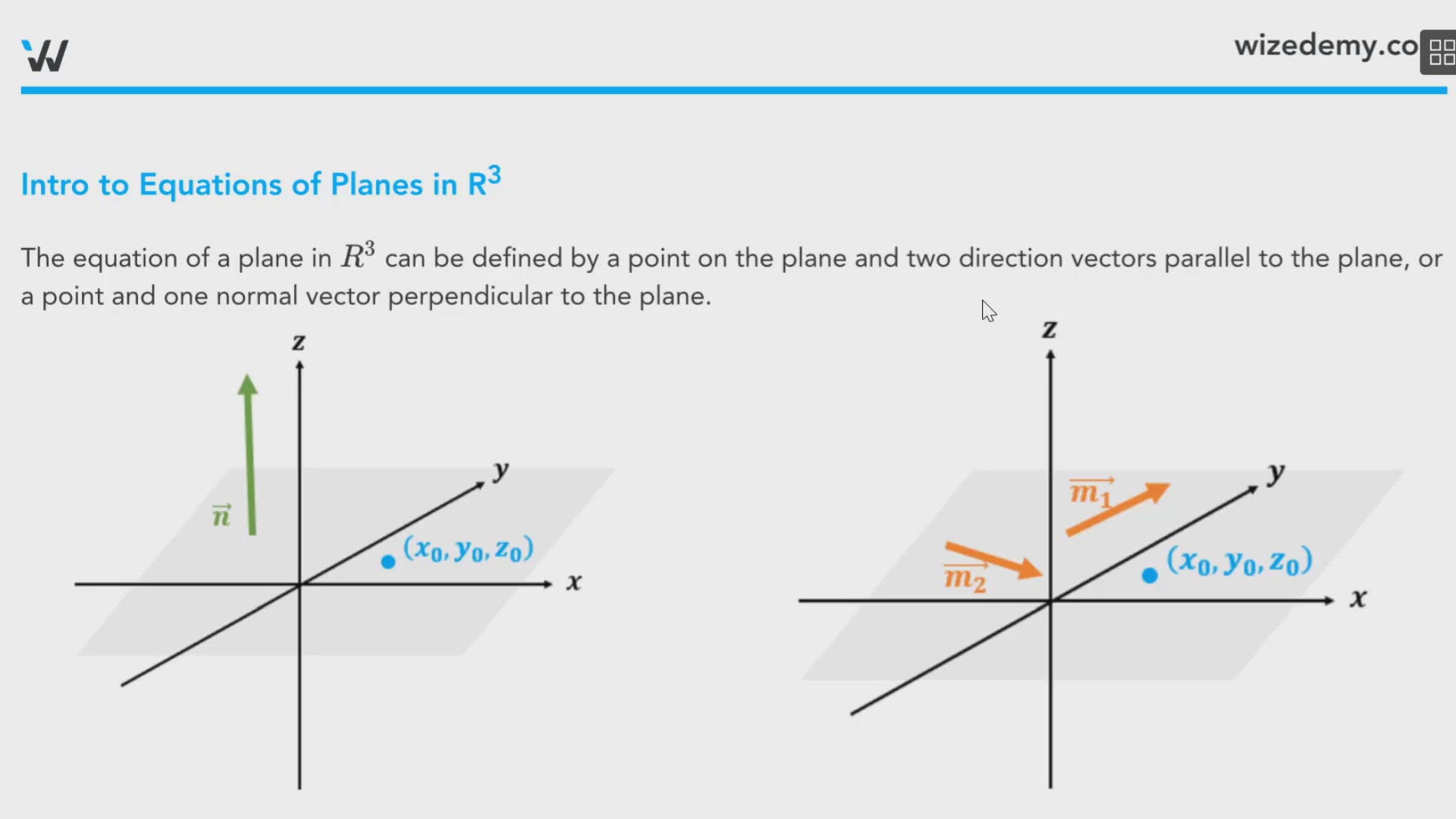
The equation of a plane in R3R^3 can be defined by a point on the plane and two direction vectors parallel to the plane, or a point and one normal vector perpendicular to the plane.

Vector Equationr=r0+tm1+sm2Parametric Equationsx=x0+m1xt+m2xsy=y0+m1yt+m2ysz=z0+m1zt+m2zsNormal Equation(rr0)n=0Cartesian (a.k.a. Scalar) EquationAx+By+Cz+D=0\displaystyle \begin{array}{|c|c|} \hline\\ \text{\textcolor{orange}{Vector Equation}}&\vec r=\vec {r_0}+t\vec {m_1}+s\vec{m_2}\\ \\\hline\\ \text{\textcolor{orange}{Parametric Equations}}&\begin{array}{c} x=x_0+m_{1x}t+m_{2x}s\\y=y_0+m_{1y}t+m_{2y}s\\z=z_0+m_{1z}t+m_{2z}s\end{array}\\ \\\hline\\ \text{\textcolor{orange}{Normal Equation}}&(\vec r-\vec{r_0})\cdot\vec n=0\\ \\\hline\\ \text{\textcolor{orange}{Cartesian (a.k.a. Scalar) Equation}}&Ax+By+Cz+D=0\\ \\\hline \end{array}

What Information is Commonly Provided?

  1. A line on the plane, and a point on the plane that is not on the line
  2. Three non-collinear points on the plane (three points that don't form a line)
  3. Two intersecting lines
  4. Two parallel and non-coincidient lines
0:00 / 0:00

Vector and Parametric Equations of Planes in R3
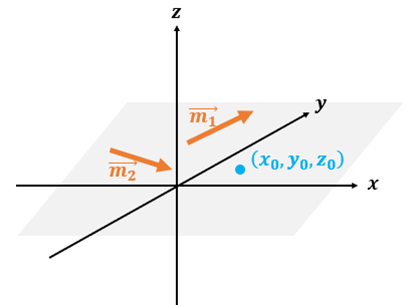


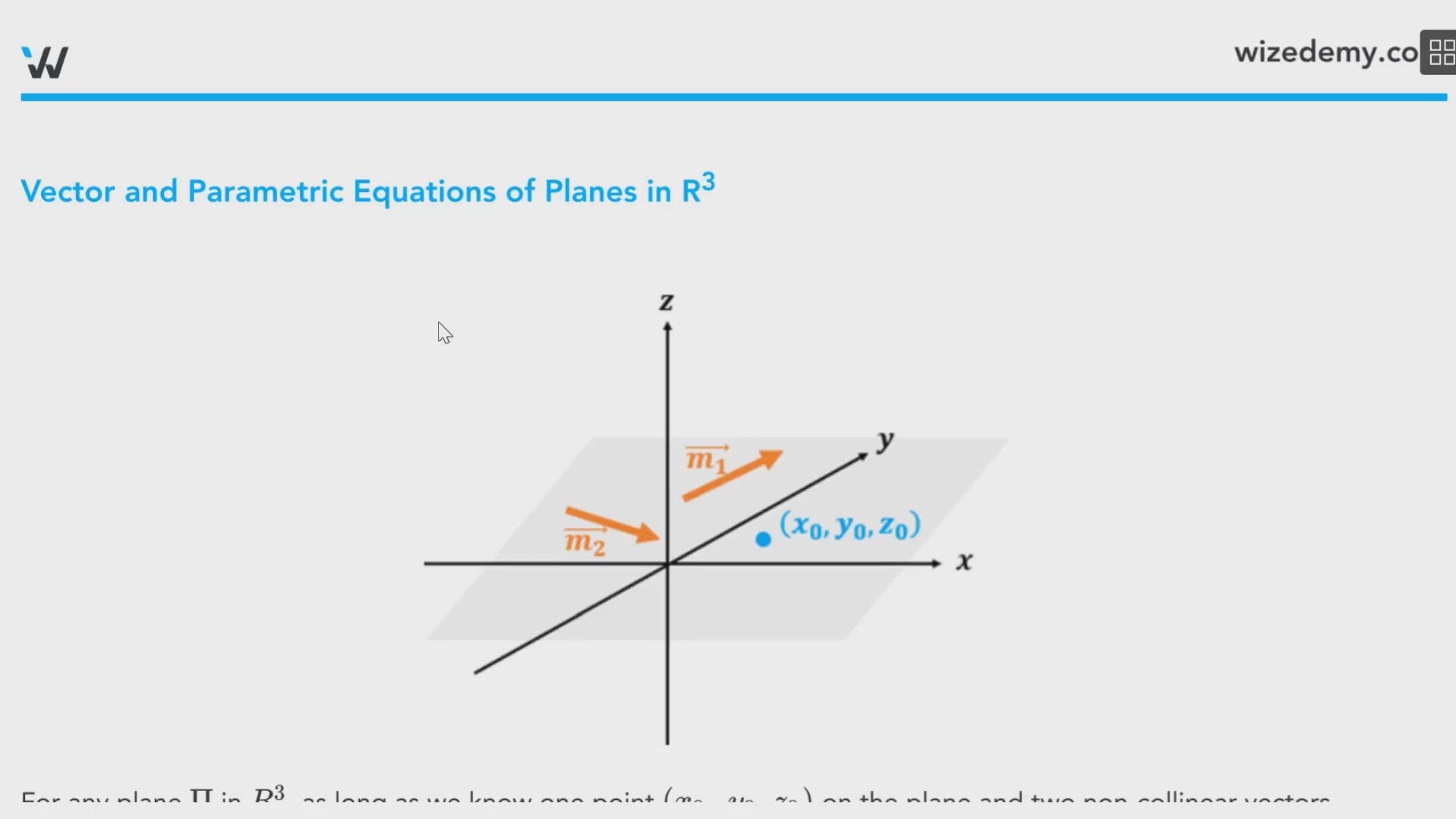
For any plane Π\Pi in R3R^3, as long as we know one point (x0, y0,z0)(x_0,\ y_0, z_0) on the plane and two non-collinear vectors m1=[m1x, m1y, m1z]\vec m_1=[m_{1x},\ m_{1y},\ m_{1z}] and m2=[m2x, m2y, m2z]\vec {m_2}=[m_{2x},\ m_{2y},\ m_{2z}] that are parallel to the plane, we can define the equation of the plane.

Vector Equation
r=r0+tm1+sm2\boxed{\overrightarrow r=\overrightarrow r_0+t\overrightarrow {m_1}+s\overrightarrow {m_2}} or [x, y, z]=[x0, y0, z0]+t[m1x, m1y, m1z]+s[m2x, m2y, m2z]\boxed{\left[x,\ y,\ z\right]=\left[x_0,\ y_0,\ z_0\right]+t\left[m_{1x},\ m_{1y},\ m_{1z}\right]+s[m_{2x},\ m_{2y},\ m_{2z}]}
  • r=[x, y, z]\overrightarrow{r}=[x,\ y,\ z] represents the position vector from the original to any point (x, y, z)(x,\ y,\ z) on the plane Π\Pi
  • r0=[x0, y0, z0]\overrightarrow{r_0}=[x_0,\ y_0,\ z_0] represents the position vector of a known point on the plane Π\Pi
  • tt and ss are parameters that can take on any real numbers (t, sRt,\ s\in R)
We can split this vector equation up into its xx, yy, and zz components.

Parametric Equations
x=x0+m1xt+m2xsy=y0+m1yt+m2ysz=z0+m1zt+m2zs\boxed{\begin{array}{c} x=x_0+m_{1x}t+m_{2x}s\\ y=y_0+m_{1y}t+m_{2y}s\\ z=z_0+m_{1z}t+m_{2z}s \end{array}}
0:00 / 0:00

Example: Equations of Planes in R3

Find the vector and parametric equations of the following planes:
a) Given a line on the plane and a point on the plane that's not on the line
The plane contains the point (1, 2, 0)\left(1,\ 2,\ 0\right) and the line [0, 1, 0]+t[1, 2, 3]\left[0,\ -1,\ 0\right]+t\left[1,\ 2,\ 3\right].

  • Position vector of a point on the plane: [1, 2, 0]\left[1,\ 2,\ 0\right]
  • Direction vector 1: m1=[1, 2, 3]\vec{m_1}=\left[1,\ 2,\ 3\right]
  • Direction vector 2: m2=[1, 2, 0][0, 1, 0]=[1, 3, 0]\vec{m_2}=\left[1,\ 2,\ 0\right]-\left[0,\ -1,\ 0\right]=\left[1,\ 3,\ 0\right]
Therefore, the vector equation of the plane is r=[1, 2, 0]+t[1, 2, 3]+s[1, 3, 0]\vec{r}=\left[1,\ 2,\ 0\right]+t\left[1,\ 2,\ 3\right]+s\left[1,\ 3,\ 0\right]

The parametric equations are x=1+t+sy=2+2t+3sz=3t\begin{array}{l} x=1+t+s\\ y=2+2t+3s\\ z=3t \end{array}.


b) Given three non-collinear points on the plane
The plane contains the points (1, 2, 3)\left(1,\ 2,\ 3\right), (2, 0, 1)\left(2,\ 0,\ 1\right), and (0, 1, 2)\left(0,\ -1,\ -2\right).

  • Position vector of a point on the plane: [1,2,3][1, 2, 3]
  • Direction vector 1: m1=[2, 0, 1][1, 2, 3]=[1, 2, 2]\vec{m_1}=\left[2,\ 0,\ 1\right]-\left[1,\ 2,\ 3\right]=\left[1,\ -2,\ -2\right]
  • Direction vector 2: m2=[2, 0 ,1][0, 1, 2]=[2, 1, 3]\vec{m_2}=\left[2,\ 0\ ,1\right]-\left[0,\ -1,\ -2\right]=\left[2,\ 1,\ 3\right]
Therefore, the vector equation of the plane is r=[1, 2, 3]+t[1, 2, 2]+s[2, 1, 3]\vec{r}=\left[1,\ 2,\ 3\right]+t\left[1,\ -2,\ -2\right]+s\left[2,\ 1,\ 3\right]

The parametric equations are x=1+t+2sy=22t+sz=32t+3s\begin{array}{l} x=1+t+2s\\ y=2-2t+s\\ z=3-2t+3s \end{array}

PAGE BREAK
c) Given two intersecting lines
The plane contains the two lines [0, 1, 0]+t[1, 2, 3]\left[0,\ -1,\ 0\right]+t\left[1,\ 2,\ 3\right] and [2, 1, 0]+s[1, 0, 0]\left[2,\ -1,\ 0\right]+s\left[1,\ 0,\ 0\right]

  • Position vector of a point on the plane: [0,1,0][0, -1, 0]
  • Direction vector 1: m1=[1, 2, 3]\vec{m_1}=\left[1,\ 2,\ 3\right]
  • Direction vector 2: m2=[1, 0, 0]\vec{m_2}=\left[1,\ 0,\ 0\right]
Therefore, the vector equation of the plane is r=[0, 1, 0]+t[1, 2, 3]+s[1, 0, 0]\vec{r}=\left[0,\ -1,\ 0\right]+t\left[1,\ 2,\ 3\right]+s\left[1,\ 0,\ 0\right]

The parametric equations are x=t+sy=1+2tz=3t\begin{array}{l} x=t+s\\ y=-1+2t\\ z=3t \end{array}

d) Given two parallel and non-coincident lines
The plane contains the two lines [1, 0, 1]+t[1, 2, 0]\left[1,\ 0,\ -1\right]+t\left[-1,\ 2,\ 0\right] and [0, 1, 1]+s[2, 4, 0]\left[0,\ 1,\ 1\right]+s\left[2,\ -4,\ 0\right]

  • Position vector of a point on the plane: [1,0,1][1, 0, -1]
  • Direction vector 1: m1=[1, 2, 0]\vec{m_1}=[-1,\ 2,\ 0]
  • Direction vector 2: m2=[1, 0, 1][0, 1, 1]=[1, 1, 2]\vec{m_2}=\left[1,\ 0,\ -1\right]-\left[0,\ 1,\ 1\right]=\left[1,\ -1,\ -2\right]
Therefore, the vector equation of the plane is r=[1, 0, 1]+t[1, 2, 0]+s[1, 1, 2]\vec{r}=\left[1,\ 0,\ -1\right]+t\left[-1,\ 2,\ 0\right]+s\left[1,\ -1,\ -2\right]

The parametric equations are x=1t+sy=2tsz=12s\begin{array}{l} x=1-t+s\\ y=2t-s\\ z=-1-2s \end{array}

Practice: Equations of Planes in R3

Find the vector equation of the plane that contains the lines [1, 0, 0]+t[4, 0, 2]\left[1,\ 0,\ 0\right]+t\left[-4,\ 0,\ 2\right] and [2, 3, 5]+s[6, 0, 3]\left[2,\ -3,\ 5\right]+s\left[6,\ 0,\ -3\right].
0:00 / 0:00

Example: Equations of Planes in R3

A plane Π\Pi is given by the vector equation r=[1, 0, 3]+t[1,1, 1]+s[3, 1, 1]\vec{r}=\left[1,\ 0,\ 3\right]+t\left[1,-1,\ 1\right]+s\left[3,\ 1,\ 1\right]

a) Find 2 different points on the plane.

To find a point on the plane, we just need to set different values for our parameters.
Let t=1, s=0t=1,\ s=0: (1, 0, 3)+(1, 1, 1)=(2, 1, 4)\left(1,\ 0,\ 3\right)+\left(1,\ -1,\ 1\right)=\left(2,\ -1,\ 4\right)
Let t=0, s=1t=0,\ s=1: (1, 0, 3)+(3, 1, 1)=(4, 1, 4)\left(1,\ 0,\ 3\right)+\left(3,\ 1,\ 1\right)=\left(4,\ 1,\ 4\right)
There are infinitely many possible such points.

b) Find a line on the plane.

For a line, we need a point and a direction vector.
  • Position vector of a point on the line: [1, 0, 3]\left[1,\ 0,\ 3\right]
  • Direction vector of the line: [1, 1, 1]\left[1,\ -1,\ 1\right]
Therefore, one line on the plane is [1, 0, 3]+t[1, 1, 1]\left[1,\ 0,\ 3\right]+t\left[1,\ -1,\ 1\right]
There are infinitely many possible such lines.

c) Check if the point (0, 1, 2)\left(0,\ -1,\ 2\right) is on the plane.

The parametric equations of the plane are:
x=1+t+3sx=1+t+3s
y=t+sy=-t+s
z=3+t+sz=3+t+s

Substituting the point (0, 1, 2)\left(0,\ -1,\ 2\right) into these equations, we get
0=1+t+3s0=1+t+3s
1=t+s-1=-t+s
2=3+t+s2=3+t+s

From equations 1: t=13st=-1-3s
Sub this into equation 2: 1=(13s)+s s=12-1=-\left(-1-3s\right)+s\ \to s=-\frac{1}{2}
Sub this back into equation 1: t=13(12)=12t=-1-3\left(-\frac{1}{2}\right)=\frac{1}{2}

Substitute t=12t=\frac{1}{2} and s=12s=-\frac{1}{2} into equation 3:
2=3+(12)+(12)  2=32=3+\left(\frac{1}{2}\right)+\left(-\frac{1}{2}\right)\ \to\ 2=3
Since we don't get left side equal right side, the point (0, 1, 2)\left(0,\ -1,\ 2\right) is NOT on the plane.
0:00 / 0:00

Cartesian (Scalar) & Normal Equations of Planes in R3
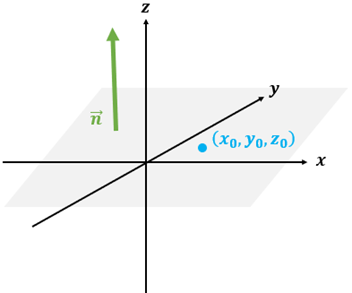

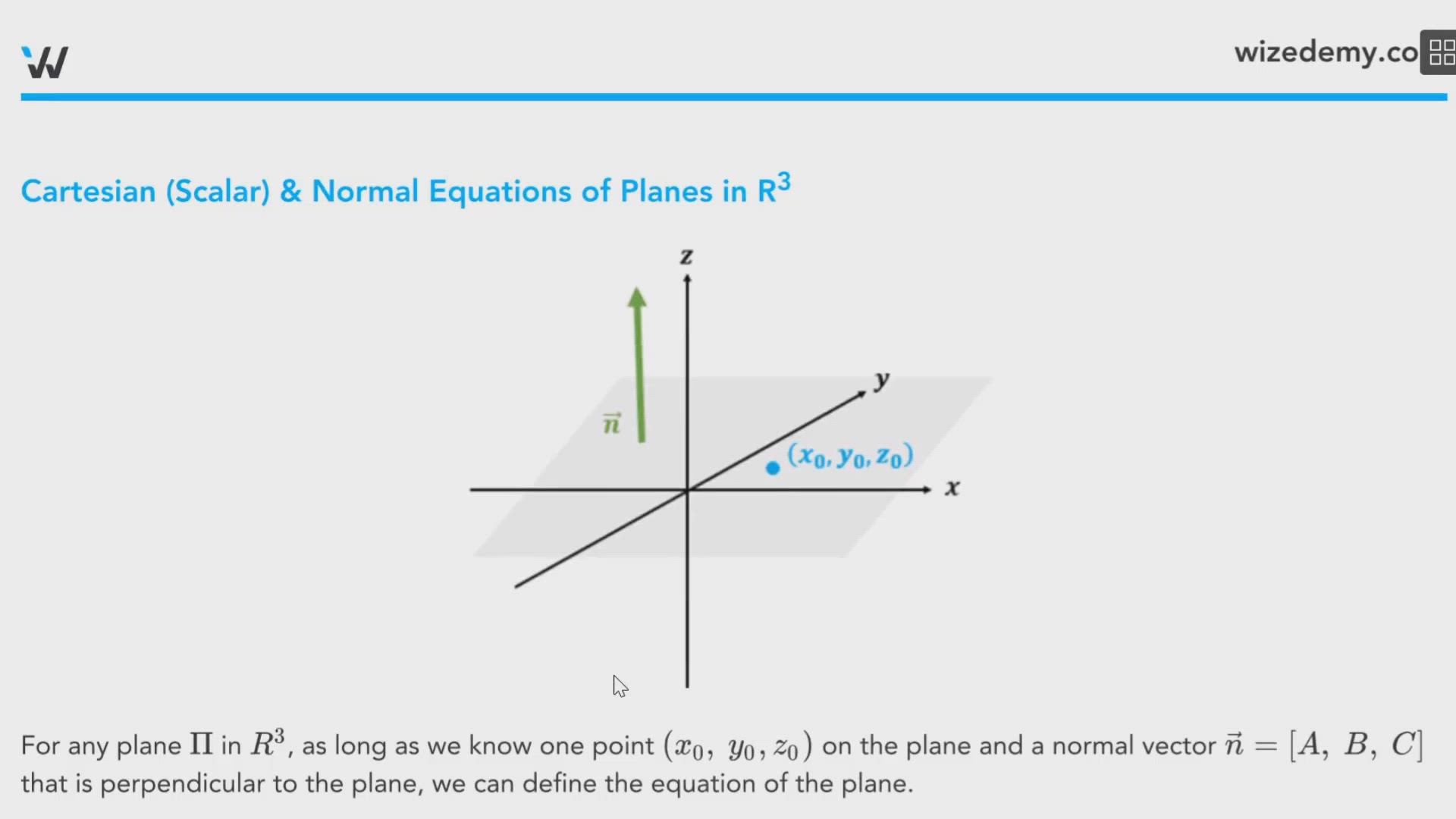
For any plane Π\Pi in R3R^3, as long as we know one point (x0, y0,z0)(x_0,\ y_0, z_0) on the plane and a normal vector n=[A, B, C]\vec n=[A,\ B,\ C] that is perpendicular to the plane, we can define the equation of the plane.

Normal Equation
(rr0)n=0\boxed{\left(\overrightarrow r-\overrightarrow{r_0}\right)\cdot\overrightarrow{n}=0}
  • r=[x, y, z]\overrightarrow{r}=[x,\ y,\ z] represents the position vector from the original to any point (x, y, z)(x,\ y,\ z) on the plane Π\Pi
  • r0=[x0, y0, z0]\overrightarrow{r_0}=[x_0,\ y_0,\ z_0] represents the position vector of a known point on the plane Π\Pi
  • n=[A, B, C]\overrightarrow{ n}=[A,\ B,\ C] represents the normal vector that is perpendicular to the plane Π\Pi

Cartesian (a.k.a. Scalar) Equation
Ax+By+Cz+D=0\boxed{Ax+By+Cz+D=0}
  • n=[A,B,C]\overrightarrow{n}=[A,B,C] represents the normal vector that is perpendicular to the plane Π\Pi
  • D=[x0, y0, z0][A, B, C]D=-[x_0,\ y_0,\ z_0]\cdot[A,\ B,\ C] where [x0, y0, z0][x_0,\ y_0,\ z_0] represents the position vector of a known point on the plane Π\Pi
0:00 / 0:00

Example: Equations of Planes in R3

Find the Normal and Cartesian equations of the following planes:

a) Given a line on the plane and a point on the plane that's not on the line
The plane contains the point (1, 2, 0)\left(1,\ 2,\ 0\right) and the line [0, 1, 0]+t[1, 2, 3]\left[0,\ -1,\ 0\right]+t\left[1,\ 2,\ 3\right].

  • Position vector of a point on the plane: [1, 2, 0]\left[1,\ 2,\ 0\right]
  • Direction vector 1: m1=[1, 2, 3]\vec{m_1}=\left[1,\ 2,\ 3\right]
  • Direction vector 2: m2=[1, 2, 0][0, 1, 0]=[1, 3, 0]\vec{m_2}=\left[1,\ 2,\ 0\right]-\left[0,\ -1,\ 0\right]=\left[1,\ 3,\ 0\right]
  • Normal vector: n=[1, 2, 3]×[1, 3, 0]=[9, 3, 1]\vec{n}=\left[1,\ 2,\ 3\right]\times\left[1,\ 3,\ 0\right]=\left[-9,\ 3,\ 1\right] → use [9, 3, 1]\left[9,\ -3,\ -1\right] (or any scalar multiple)
Therefore, the normal equation of the plane is ([x, ,y, z][1, 2, 0])[9, 3, 1]=0\left(\left[x,\ ,y,\ z\right]-\left[1,\ 2,\ 0\right]\right)\cdot\left[9,\ -3,\ -1\right]=0

The cartesian equation is 9x3yz[1, 2, 0][9, 3, 1]=09x-3y-z-\left[1,\ 2,\ 0\right]\cdot\left[9,\ -3,\ -1\right]=0 or 9x3yz3=09x-3y-z-3=0


b) Given three non-collinear points on the plane
The plane contains the points (1, 2, 3)\left(1,\ 2,\ 3\right), (2, 0, 1)\left(2,\ 0,\ 1\right), and (0, 1, 2)\left(0,\ -1,\ -2\right).

  • Position vector of a point on the plane: [1,2,3][1, 2, 3]
  • Direction vector 1: m1=[2, 0, 1][1, 2, 3]=[1, 2, 2]\vec{m_1}=\left[2,\ 0,\ 1\right]-\left[1,\ 2,\ 3\right]=\left[1,\ -2,\ -2\right]
  • Direction vector 2: m2=[2, 0 ,1][0, 1, 2]=[2, 1, 3]\vec{m_2}=\left[2,\ 0\ ,1\right]-\left[0,\ -1,\ -2\right]=\left[2,\ 1,\ 3\right]
  • Normal vector: n=[1, 2, 2]×[2, 1, 3]=[4, 7, 5]\vec{n}=\left[1,\ -2,\ -2\right]\times\left[2,\ 1,\ 3\right]=\left[-4,\ -7,\ 5\right] → use [4, 7, 5]\left[4,\ 7,\ -5\right] (or any scalar multiple)
Therefore, the normal equation of the plane is ([x, y, z][1, 2, 3])[4, 7, 5]=0\left(\left[x,\ y,\ z\right]-\left[1,\ 2,\ 3\right]\right)\cdot\left[4,\ 7,\ -5\right]=0

The cartesian equation is 4x+7y5z[1,2,3][4,7,5]=04x+7y-5z-\left[1,2,3\right]\cdot\left[4,7,-5\right]=0 or 4x+7y5z3=04x+7y-5z-3=0

PAGE BREAK
c) Given two intersecting lines
The plane contains the two lines [0, 1, 0]+t[1, 2, 3]\left[0,\ -1,\ 0\right]+t\left[1,\ 2,\ 3\right] and [2, 1, 0]+s[1, 0, 0]\left[2,\ -1,\ 0\right]+s\left[1,\ 0,\ 0\right]

  • Position vector of a point on the plane: [0,1,0][0, -1, 0]
  • Direction vector 1: m1=[1, 2, 3]\vec{m_1}=\left[1,\ 2,\ 3\right]
  • Direction vector 2: m2=[1, 0, 0]\vec{m_2}=\left[1,\ 0,\ 0\right]
  • Normal vector: n=[1,2,3]×[1,0,0]=[0, 3, 2]\vec{n}=\left[1,2,3\right]\times\left[1,0,0\right]=\left[0,\ 3,\ -2\right]
Therefore, the normal equation is ([x,y,z][0,1,0])[0, 3, 2]=0\left(\left[x,y,z\right]-\left[0,-1,0\right]\right)\cdot\left[0,\ 3,\ -2\right]=0

The cartesian equation is 3y2z[0,1,0][0,3,2]=03y-2z-\left[0,-1,0\right]\cdot\left[0,3,-2\right]=0 or 3y2z+3=03y-2z+3=0


d) Given two parallel and non-coincident lines
The plane contains the two lines [1, 0, 1]+t[1, 2, 0]\left[1,\ 0,\ -1\right]+t\left[-1,\ 2,\ 0\right] and [0, 1, 1]+s[2, 4, 0]\left[0,\ 1,\ 1\right]+s\left[2,\ -4,\ 0\right]

  • Position vector of a point on the plane: [1,0,1][1, 0, -1]
  • Direction vector 1: m1=[1, 2, 0]\vec{m_1}=[-1,\ 2,\ 0]
  • Direction vector 2: m2=[1, 0, 1][0, 1, 1]=[1, 1, 2]\vec{m_2}=\left[1,\ 0,\ -1\right]-\left[0,\ 1,\ 1\right]=\left[1,\ -1,\ -2\right]
  • Normal vector: n=[1, 2, 0]×[1, 1, 2]=[4, 2, 1]\vec{n}=\left[-1,\ 2,\ 0\right]\times\left[1,\ -1,\ -2\right]=\left[-4,\ -2,\ -1\right] → use [4, 2, 1]\left[4,\ 2,\ 1\right] (or any scalar multiple)
Therefore, the normal equation is ([x, y, z][1, 0, 1])[4, 2, 1]=0\left(\left[x,\ y,\ z\right]-\left[1,\ 0,\ -1\right]\right)\cdot\left[4,\ 2,\ 1\right]=0

The cartesian equation is 4x+2y+z[1, 0, 1][4, 2, 1]=04x+2y+z-\left[1,\ 0,\ -1\right]\cdot\left[4,\ 2,\ 1\right]=0 or 4x+2y+z3=04x+2y+z-3=0
checklist
Mark Yourself Question
  1. Grab a piece of paper and try this problem yourself.
  2. When you're done, check the "I have answered this question" box below.
  3. View the solution and report whether you got it right or wrong.

Example: Equations of Planes in R3

The Cartesian equation of a plane is 3x2y+6z12=03x-2y+6z-12=0.
a) Find three different points on this plane.

b) Find a normal vector to this plane.

c) Determine if the point (1, 2, 3)\left(1,\ 2,\ -3\right) is on this plane.

Practice: Equations of Planes in R3

The Cartesian equation of a plane is 2x+y+3z6=02x+y+3z-6=0.
Find the coordinates of the points where the plane intersects the xx-axis.

Practice: Converting Equations of Planes in R3

Which of the following are the parametric equations of the plane x+y3z=3x+y-3z=3?
0:00 / 0:00

Angle Between Planes

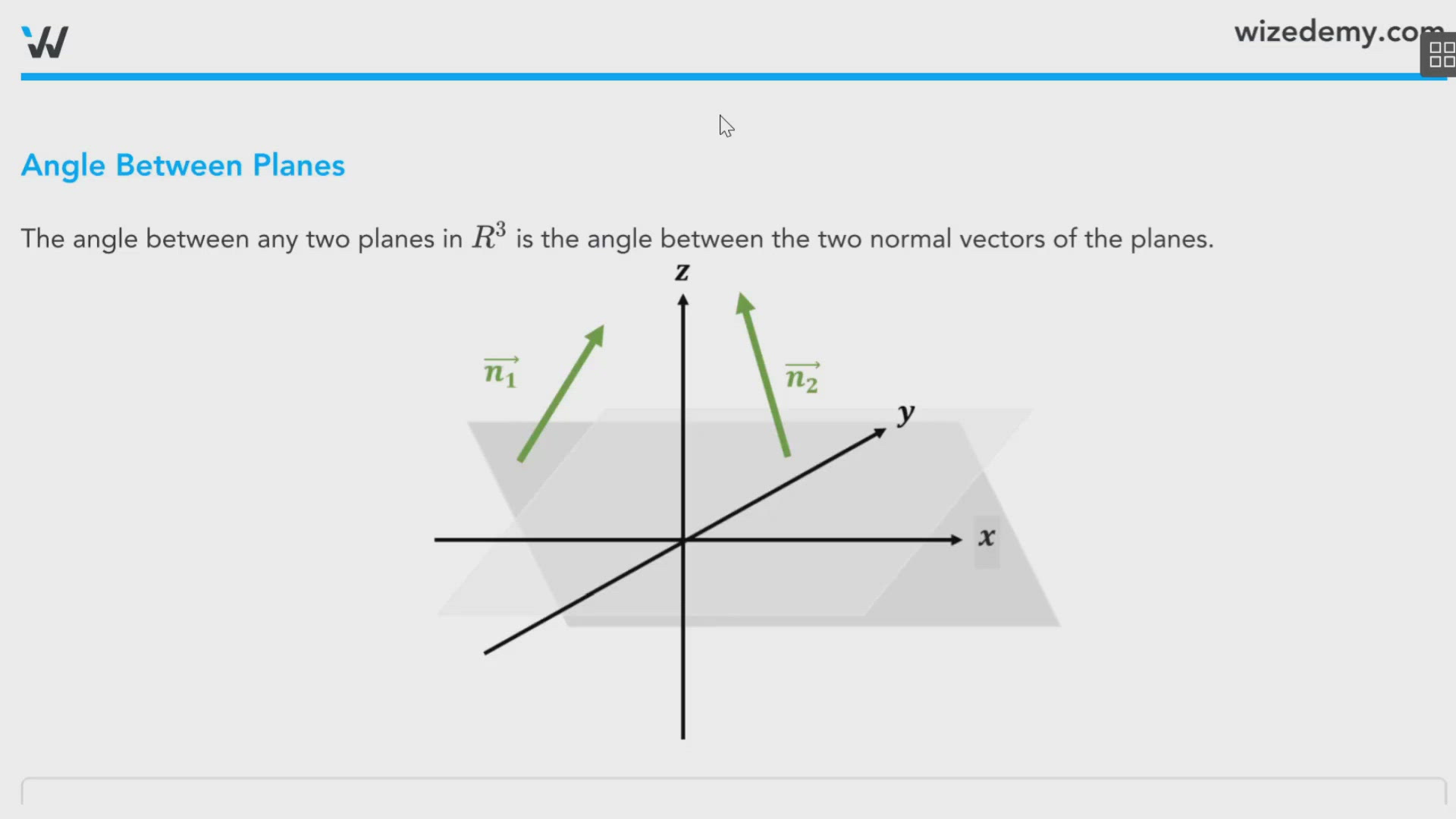
The angle between any two planes in R3R^3 is the angle between the two normal vectors of the planes.
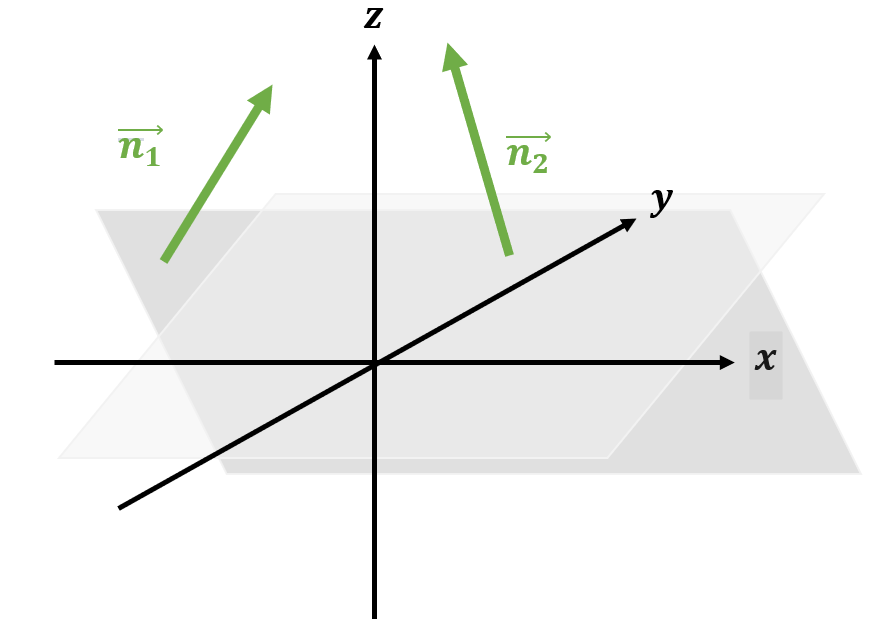
Write it Down
The angle between any two planes in R3R^3 is calculated by:
θ=cos1(n1n2n1n2)\displaystyle \theta=\cos^{-1}\left(\frac{\vec{n_1}\cdot\vec{n_2}}{\left|\left|\vec{n_1}\right|\right|\left|\left|\vec{n_2}\right|\right|}\right)

Parallel Planes

n1\vec{n_1} and n2\vec{n_2} are parallel (scalar multiples)

Perpendicular Planes

n1\vec{n_1} and n2\vec{n_2} are perpendicular (dot product is 0)


PAGE BREAK
Example
Find the angle between the planes x+y+z=0x+y+z=0 and x2y5=0x-2y-5=0.

Plane 1: n1=[1, 1, 1]\vec{n_1}=\left[1,\ 1,\ 1\right]
Plane 2: n2=[1, 2, 0]\vec{n_2}=\left[1,\ -2,\ 0\right]

Therefore, the angle between the two planes can be calculated with the formula
cos1([1, 1, 1][1, 2, 0][1, ,1, 1][1, 2, 0])=cos1(135)=cos1(115)104.96°\cos^{-1}\left(\frac{\left[1,\ 1,\ 1\right]\cdot\left[1,\ -2,\ 0\right]}{\left|\left|\left[1,\ ,1,\ 1\right]\right|\right|\left|\left|\left[1,\ -2,\ 0\right]\right|\right|}\right)=\cos^{-1}\left(\frac{-1}{\sqrt{3}\sqrt{5}}\right)=\cos^{-1}\left(-\frac{1}{\sqrt{15}}\right)\approx104.96\degree