0:00 / 0:00

The Slope of Tangent Lines

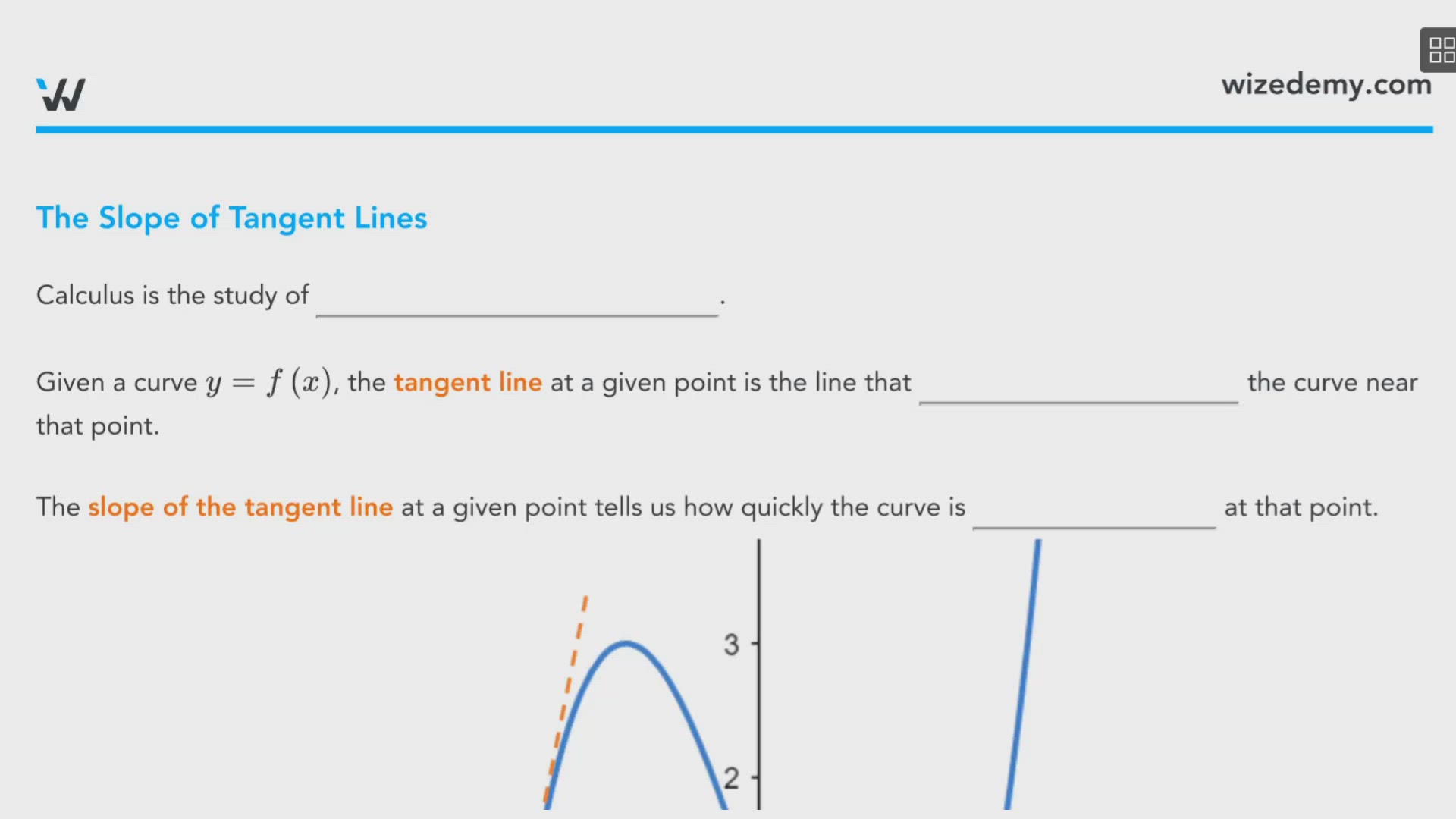
Calculus is the study of
continuous change
.

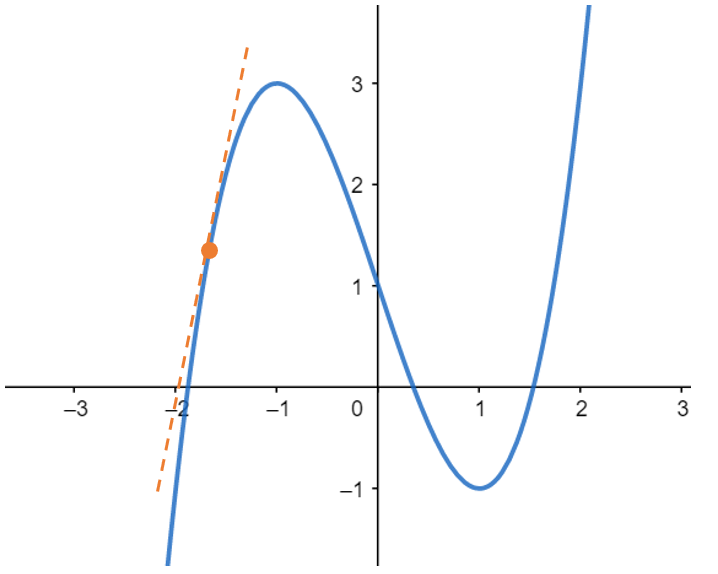
Given a curve y=f(x)y=f\left(x\right), the tangent line at a given point is the line that
most resembles
the curve near that point.

The slope of the tangent line at a given point tells us how quickly the curve is
changing
at that point.
PAGE BREAK

How do we construct a tangent line?

Given 2 points PP and QQ on the curve y=f(x)y=f\left(x\right), the
secant line
between these 2 points is the straight line that connects the two points.

As we slide point QQ closer to point P(a,b)P(a,b), the slope of the secant line will be closer to the slope of the tangent line at PP
m=f(a+h)f(a)h\boxed{\displaystyle m=\frac{f\left(a+h\right)-f\left(a\right)}{h}}
Write it Down
The slope of the tangent line to a curve at a point PP is the slope of the secant line between the point PP and a point that is
arbitrarily close to P

limh0f(a+h)f(a)h\displaystyle \lim_{h\to0}\frac{f\left(a+h\right)-f\left(a\right)}{h}


Wize Tip
To evaluate the limit, we need to simplify the expression enough so that when we substitute h0h\to 0 into the expression, we get something that makes sense (i.e. a finite number or \infty)

PAGE BREAK
Example
Given the curve f(x)=x2+1f\left(x\right)=x^2+1,
a) find the slope of the secant line between the points x=0x=0 and x=1x=1
b) find the slope of the secant line between the points x=0x=0 and x=0.5x=0.5
c) find the slope of the secant line between the points x=0x=0 and x=0.1x=0.1
d) find the slope of the secant line between the points x=0x=0 and x=0.01x=0.01
e) find the slope of the secant line between the points x=0x=0 and x=0.001x=0.001
f) use your findings from a) - e) to estimate the slope of the tangent line at the point x=0x=0

a) m=f(1)f(0)10=(12+1)(02+1)1=11=1\displaystyle m=\frac{f\left(1\right)-f\left(0\right)}{1-0}=\frac{\left(1^2+1\right)-\left(0^2+1\right)}{1}=\frac{1}{1}=1

b) m=f(0.5)f(0)0.50=(0.52+1)(02+1)0.5=0.250.5=0.5\displaystyle m=\frac{f\left(0.5\right)-f\left(0\right)}{0.5-0}=\frac{\left(0.5^2+1\right)-\left(0^2+1\right)}{0.5}=\frac{0.25}{0.5}=0.5

c) m=f(0.1)f(0)0.10=(0.12+1)(02+1)0.1=0.010.1=0.1\displaystyle m=\frac{f\left(0.1\right)-f\left(0\right)}{0.1-0}=\frac{\left(0.1^2+1\right)-\left(0^2+1\right)}{0.1}=\frac{0.01}{0.1}=0.1

d) m=f(0.01)f(0)0.010=(0.012+1)(02+1)0.01=0.00010.01=0.01\displaystyle m=\frac{f\left(0.01\right)-f\left(0\right)}{0.01-0}=\frac{\left(0.01^2+1\right)-\left(0^2+1\right)}{0.01}=\frac{0.0001}{0.01}=0.01

e) m=f(0.001)f(0)0.0010=(0.0012+1)(021)0.001=0.0000010.001=0.001\displaystyle m=\frac{f\left(0.001\right)-f\left(0\right)}{0.001-0}=\frac{\left(0.001^2+1\right)-\left(0^2-1\right)}{0.001}=\frac{0.000001}{0.001}=0.001

f) As the second point gets closer and closer to x=0x=0, the slope of the secant line gets smaller and smaller and approaches 0. Therefore, the slope of the tangent line at the point x=0x=0 is 0.
0:00 / 0:00

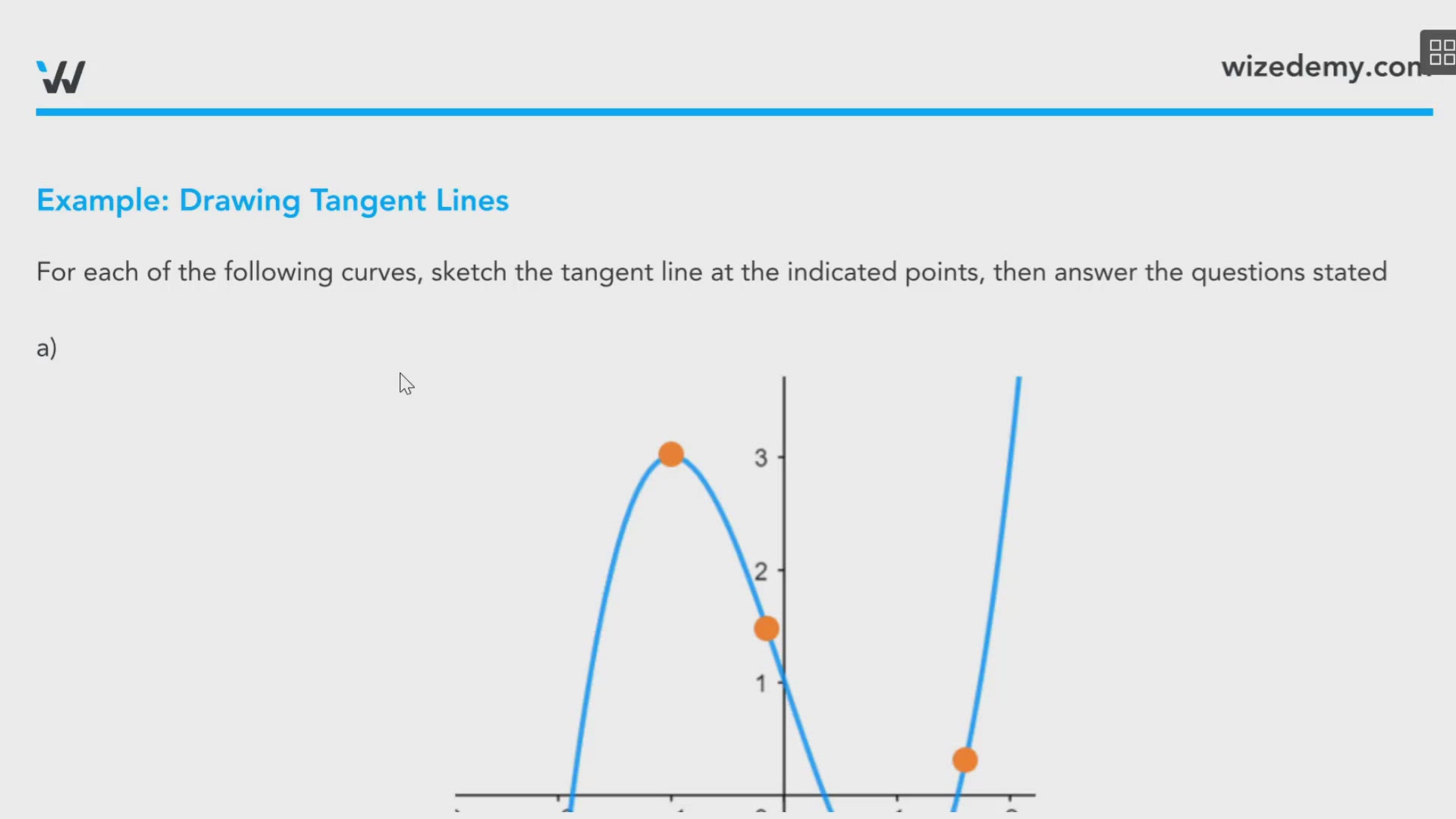
Example: Drawing Tangent Lines

For each of the following curves, sketch the tangent line at the indicated points, then answer the questions stated

a)
i) How many tangent lines to this curve have a slope of 0?
2 points (the points where the curve has a turning point

PAGE BREAK
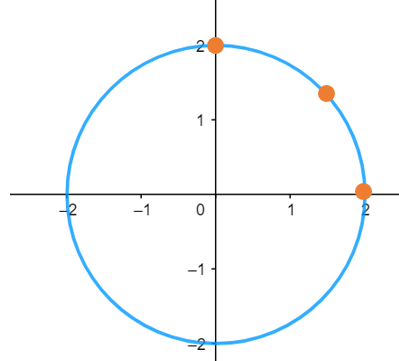
b)

i) How many tangent lines to this curve have a slope of 0?
2 points (at the top and bottom of the circle

ii) How many tangent lines to this curve have an infinite slope?
2 points (at the left and right-most points of the circle


PAGE BREAK
c)
i) What can we conclude about the slope of the tangent line of a straight line?
The slope of the tangent line on a point that is on a straight line is the same as the slope of the straight line

ii) What is the slope of the tangent line at the turning point (a.k.a. cusp) of the absolute value function?
The slope is not defined because we can draw many different tangent lines at that point.
0:00 / 0:00

Example: Calculating Slopes of Tangents

Determine the slope of the tangent to the following curves at the indicated point.
a) f(x)=x2xf(x)=x^2-x at the point x=0x=0
m=limh0 f(0+h)f(0)h\displaystyle m=\lim_{h\to0}\ \frac{f\left(0+h\right)-f\left(0\right)}{h}
m=limh0 ((0+h)2(0+h))(020)h\displaystyle m=\lim_{h\to0}\ \frac{\left(\left(0+h\right)^2-\left(0+h\right)\right)-\left(0^2-0\right)}{h}
m=limh0 (h2h)0h\displaystyle m=\lim_{h\to0}\ \frac{\left(h^2-h\right)-0}{h}
m=limh0 h2hh\displaystyle m=\lim_{h\to0}\ \frac{h^2-h}{h}

If we "substittue" the value h0h\to0, we get 00\frac{0}{0} , which doesn't make sense. Let's simplify this expression further:
m=limh0 h(h1)h\displaystyle m=\lim_{h\to0}\ \frac{h\left(h-1\right)}{h}
m=limh0 h1\displaystyle m=\lim_{h\to0}\ h-1
m=01m=0-1
m=1m=-1
PAGE BREAK
b) f(x)=x1f\left(x\right)=\sqrt{x-1} at the point x=2x=2
m=limh0 f(2+h)f(2)h\displaystyle m=\lim_{h\to0}\ \frac{f\left(2+h\right)-f\left(2\right)}{h}
m=limh0 (2+h)121h\displaystyle m=\lim_{h\to0}\ \frac{\sqrt{\left(2+h\right)-1}-\sqrt{2-1}}{h}
m=limh0 1+h1h\displaystyle m=\lim_{h\to0}\ \frac{\sqrt{1+h}-1}{h}

If we "substitute" the value h0h\to0, we get 00\frac{0}{0}, which doesn't make sense. Let's simplify this expression further:
m=limh0 1+h1h×1+h+11+h+1\displaystyle m=\lim_{h\to0}\ \frac{\sqrt{1+h}-1}{h}\times\frac{\sqrt{1+h}+1}{\sqrt{1+h}+1}
m=limh0 1+h1h(1+h+1)\displaystyle m=\lim_{h\to0}\ \frac{1+h-1}{h\left(\sqrt{1+h}+1\right)}
m=limh0 hh(1+h+1)\displaystyle m=\lim_{h\to0}\ \frac{h}{h\left(\sqrt{1+h}+1\right)}
m=limh0 11+h+1\displaystyle m=\lim_{h\to0}\ \frac{1}{\sqrt{1+h}+1}
m=11+0+1\displaystyle m=\frac{1}{\sqrt{1+0}+1}
m=12\displaystyle m=\frac{1}{2}
PAGE BREAK
c) f(x)=2xf\left(x\right)=\frac{2}{x} at the point x=1x=1
m=limh0 f(1+h)f(1)h\displaystyle m=\lim_{h\to0}\ \frac{f\left(1+h\right)-f\left(1\right)}{h}
m=limh0 21+h21h\displaystyle m=\lim_{h\to0}\ \frac{\frac{2}{1+h}-\frac{2}{1}}{h}
m=limh0 21+h2h\displaystyle m=\lim_{h\to0}\ \frac{\frac{2}{1+h}-2}{h}

If we "substitute" the value h0h\to 0, we get 00\frac{0}{0} which doesn't make sense. Let's simplify this expression further:
m=limh0 [22(1+h)1+h]h\displaystyle m=\lim_{h\to0}\ \frac{\left[\frac{2-2\left(1+h\right)}{1+h}\right]}{h}
m=limh0 [222h1+h]h\displaystyle m=\lim_{h\to0}\ \frac{\left[\frac{2-2-2h}{1+h}\right]}{h}
m=limh0 [2h1+h]h\displaystyle m=\lim_{h\to0}\ \frac{\left[\frac{-2h}{1+h}\right]}{h}
m=limh0 21+h\displaystyle m=\lim_{h\to0}\ \frac{-2}{1+h}
m=21+0\displaystyle m=-\frac{2}{1+0}
m=2m=-2

Practice: Calculating Slopes of Tangents

Caluclate the slope of the tangent line to the following curves at the indicated point.
y=4x1y=\sqrt{4x-1} at x=1x=1
0:00 / 0:00

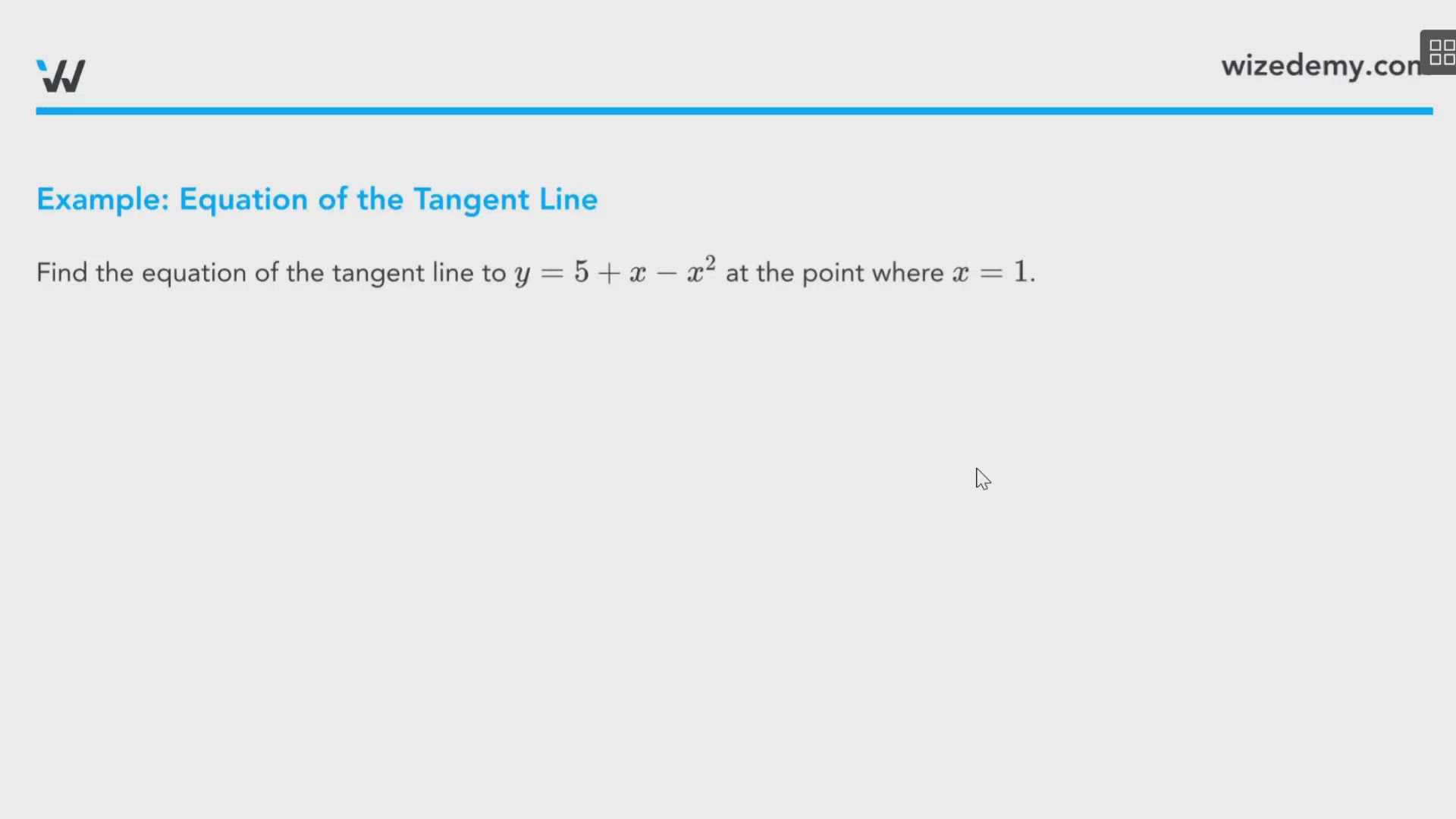
Example: Equation of the Tangent Line

Find the equation of the tangent line to y=5+xx2y=5+x-x^2 at the point where x=1x=1.

At x=1x=1, y=5+112=5y=5+1-1^2=5.
So we are looking for the equation of the tangent line at the point (x0, y0)=(1, 5)\left(x_0,\ y_0\right)=\left(1,\ 5\right).

The slope of the line is
m=limh0 f(1+h)f(1)h\displaystyle m=\lim_{h\to0}\ \frac{f\left(1+h\right)-f\left(1\right)}{h}
m=limh0 [5+(1+h)(1+h)2][5+112]h\displaystyle m=\lim_{h\to0}\ \frac{\left[5+\left(1+h\right)-\left(1+h\right)^2\right]-\left[5+1-1^2\right]}{h}
m=limh0 [5hh2][5]h\displaystyle m=\lim_{h\to0}\ \frac{\left[5-h-h^2\right]-\left[5\right]}{h}
m=limh0 hh2h\displaystyle m=\lim_{h\to0}\ \frac{-h-h^2}{h}
m=limh0 h(1h)h\displaystyle m=\lim_{h\to0}\ \frac{h\left(-1-h\right)}{h}
m=limh01h\displaystyle m=\lim_{h\to0}-1-h
m=1m=-1

Therefore, the equation of the tangent line at this particular point is:
y5=1(x1)y-5=-1(x-1)
y=x+6y=-x+6

Practice: Equation of the Tangent Lines

Find the equation of the tangent line to the curve y=23x+1y=2-\sqrt{3x+1} at the point x=0x=0.
0:00 / 0:00

Example: Slope of Tangent Line

Find the point(s) (if any) on the curve f(x)=1+3xf\left(x\right)=1+\frac{3}{x} where the tangent line is perpendicular to the line 3yx=33y-x=3.

1. Find the slope of the given line
Rearranging the given line, we get y=13x+1y=\frac{1}{3}x+1, so the slope is 13\frac{1}{3}

2. Take the negative reciprocal of this slope --> this is the slope of the line that is perpendicular to the given line
The tangent line perpendicular to this line will have slope 31 or 3-\frac{3}{1}\ or\ -3

3. Use the slope of tangent formula to find the slope of the tangent line to the curve at the point x=ax=a
Using the formula, we can calculate the slope of the tangent line at the point x=ax=a:
m=limh0 f(a+h)f(a)h\displaystyle m=\lim_{h\to0}\ \frac{f\left(a+h\right)-f\left(a\right)}{h}
m=limh0 [1+3a+h][1+3a]h\displaystyle m=\lim_{h\to0}\ \frac{\left[1+\frac{3}{a+h}\right]-\left[1+\frac{3}{a}\right]}{h}

4. Simplify the limit expression as much as possible, then evaluate the limit
m=limh0 [a+h+3a+h][a+3a]h\displaystyle m=\lim_{h\to0}\ \frac{\left[\frac{a+h+3}{a+h}\right]-\left[\frac{a+3}{a}\right]}{h}
m=limh0 [(a+h+3)a(a+3)(a+h)(a+h)a]h\displaystyle m=\lim_{h\to0}\ \frac{\left[\frac{\left(a+h+3\right)a-\left(a+3\right)\left(a+h\right)}{\left(a+h\right)a}\right]}{h}
m=limh0 [a2+ah+3aa2ah3a3h(a+h)a]h\displaystyle m=\lim_{h\to0}\ \frac{\left[\frac{a^2+ah+3a-a^2-ah-3a-3h}{\left(a+h\right)a}\right]}{h}
m=limh0 [3h(a+h)a]h\displaystyle m=\lim_{h\to0}\ \frac{\left[\frac{-3h}{\left(a+h\right)a}\right]}{h}
m=limh0 3(a+h)a\displaystyle m=\lim_{h\to0}\ \frac{-3}{\left(a+h\right)a}
m=3(a+0)a\displaystyle m=-\frac{3}{\left(a+0\right)a}
m=3a2\displaystyle m=-\frac{3}{a^2}

5. Set the limit found in step 4 to the slope value you found in step 2
We need this slope to equal 3-3:
3=3a2\displaystyle -3=-\frac{3}{a^2}

6. Solve for the value aa
a2=1a^2=1
a=±1a=\pm1

7. Find the corresponding yy values
  • x=1  y=1+31=4x=1\ \to\ y=1+\frac{3}{1}=4 the point is (1, 4)\left(1,\ 4\right)
  • x=1  y=1+31=2x=-1\ \to\ y=1+\frac{3}{-1}=-2 the point is (1, 2)\left(-1,\ -2\right)
Therefore, the points on the curve where the tangent line is perpendicular to the line 3yx=33y-x=3 are (1, 4)\left(1,\ 4\right) and (1, 2)\left(-1,\ -2\right)

Practice: Slope of Tangent Line

Find the point on the curve y=2x2xy=2x^2-x where the tangent line is horizontal.