0:00 / 0:00

Rate of Change

A lot of real world relationships can be described by functions of the form y=f(x)y=f\left(x\right), where
  • xx is the independent variable
  • y or fy\ or\ f is the dependent variable that changes with the independent variable
How quickly the dependent variable changes when there is a change in the independent variable is called the
rate of change

Average Rate of Change

The average rate of change between x=ax=a and x=bx=b is the slope of the secant line of the curve between the points x=ax=a and x=bx=b

Average Rate of Change=f(b)f(a)ba or ΔyΔx=y2y1x2x1\displaystyle \boxed{\text{Average Rate of Change}=\frac{f\left(b\right)-f\left(a\right)}{b-a}}\ \text{or}\ \frac{\Delta y}{\Delta x}=\frac{y_2-y_1}{x_2-x_1}

Instantaneous Rate of Change

The instantaneous rate of change at a point x=ax=a is the slope of the tangent line of the curve at the point x=ax=a
Instantaneous Rate of Change=limh0 f(a+h)f(a)h\displaystyle \boxed{\text{Instantaneous Rate of Change}=\lim_{h\to0}\ \frac{f\left(a+h\right)-f\left(a\right)}{h}}

Common Rates of Change Questions

  • Velocity: the speed with a direction → this is the rate of change of the position relative to the initial position
  • Cost, revenue, & profit: Profit=RevenueCost\text{Profit}=\text{Revenue}-\text{Cost}
  • Volume & Surface Area: The rate of change of volume is surface area
0:00 / 0:00

Example: Velocity

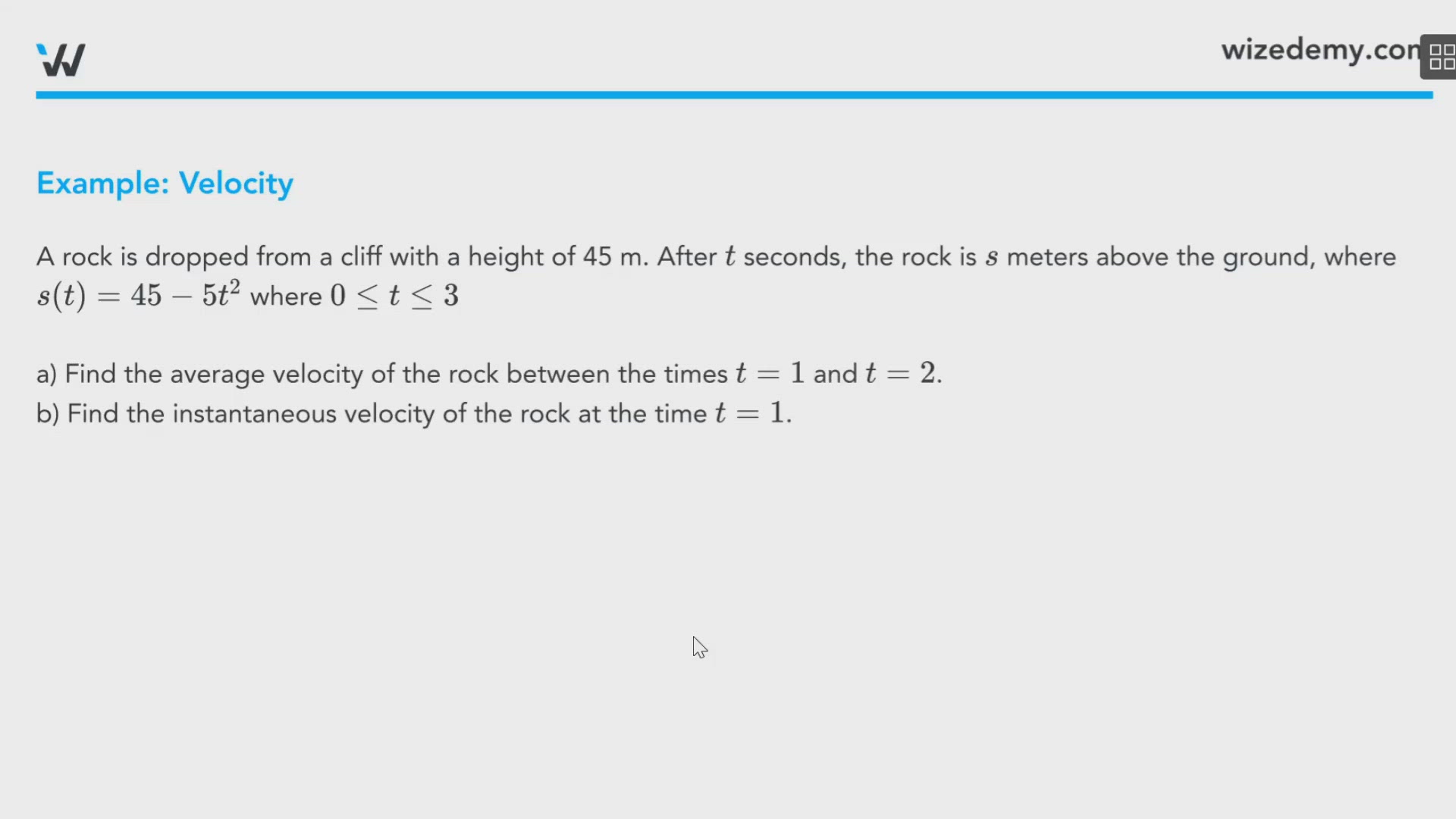
A rock is dropped from a cliff with a height of 45 m. After tt seconds, the rock is ss meters above the ground, where s(t)=455t2s(t)=45-5t^2 where 0t30\le t\le3

a) Find the average velocity of the rock between the times t=1t=1 and t=2t=2.
b) Find the instantaneous velocity of the rock at the time t=1t=1.

a)
Since velocity is the rate of change of position, the average velocity is the average rate of change of position.
Avg Velocity=s(2)s(1)21\displaystyle\text{Avg Velocity}=\frac{s\left(2\right)-s\left(1\right)}{2-1}
Avg Velocity=(455(2)2)(455(1)2)21\displaystyle\text{Avg Velocity}=\frac{\left(45-5\left(2\right)^2\right)-\left(45-5\left(1\right)^2\right)}{2-1}
Avg Velocity=(4520)(40)1\displaystyle\text{Avg Velocity}=\frac{\left(45-20\right)-\left(40\right)}{1}
Avg Velocity=15\text{Avg Velocity}=-15
Therefore, the average velocity between t=1t=1 and t=2t=2 is 15-15 m/s

b)
The instantaneous velocity of the rock is the instantaneous rate of change of the position.
Instantaneous Rate of Change=limh0 s(1+h)s(1)h\displaystyle \text{Instantaneous Rate of Change}=\lim_{h\to0}\ \frac{s\left(1+h\right)-s\left(1\right)}{h}
Instantaneous Rate of Change=limh0 [455(1+h)2][455(1)]h\displaystyle \text{Instantaneous Rate of Change}=\lim_{h\to0}\ \frac{\left[45-5\left(1+h\right)^2\right]-\left[45-5\left(1\right)\right]}{h}
Instantaneous Rate of Change=limh0 [4010h5h2][40]h\displaystyle \text{Instantaneous Rate of Change}=\lim_{h\to0}\ \frac{\left[40-10h-5h^2\right]-\left[40\right]}{h}
Instantaneous Rate of Change=limh0 [10h5h2]h\displaystyle \text{Instantaneous Rate of Change}=\lim_{h\to0}\ \frac{\left[-10h-5h^2\right]}{h}
Instantaneous Rate of Change=limh0 h(105h)h\displaystyle \text{Instantaneous Rate of Change}=\lim_{h\to0}\ \frac{h\left(-10-5h\right)}{h}
Instantaneous Rate of Change=limh0 (105h)\displaystyle \text{Instantaneous Rate of Change}=\lim_{h\to0}\ \left(-10-5h\right)
Instantaneous Rate of Change=10\text{Instantaneous Rate of Change}=-10
Therefore, the instantaneous velocity of the rock at the time t=1st=1s is 10-10m/s

Practice: Rate of Change of Revenue

The revnue of a local theater is given by R(t)=640+120t10t2R\left(t\right)=640+120t-10t^2 where tt is the number of months from January (for example, t=1t=1 corresponds to the revenue in January, t=4t=4 corresponds to the revenue if April, etc.)

a) Find the theather's revenue in June.
b) How fast is the revenue increasing or decreasing in June? (i.e. find the instantaneous rate of change at t=6t=6
0:00 / 0:00

Example: Rate of Change of Medicine

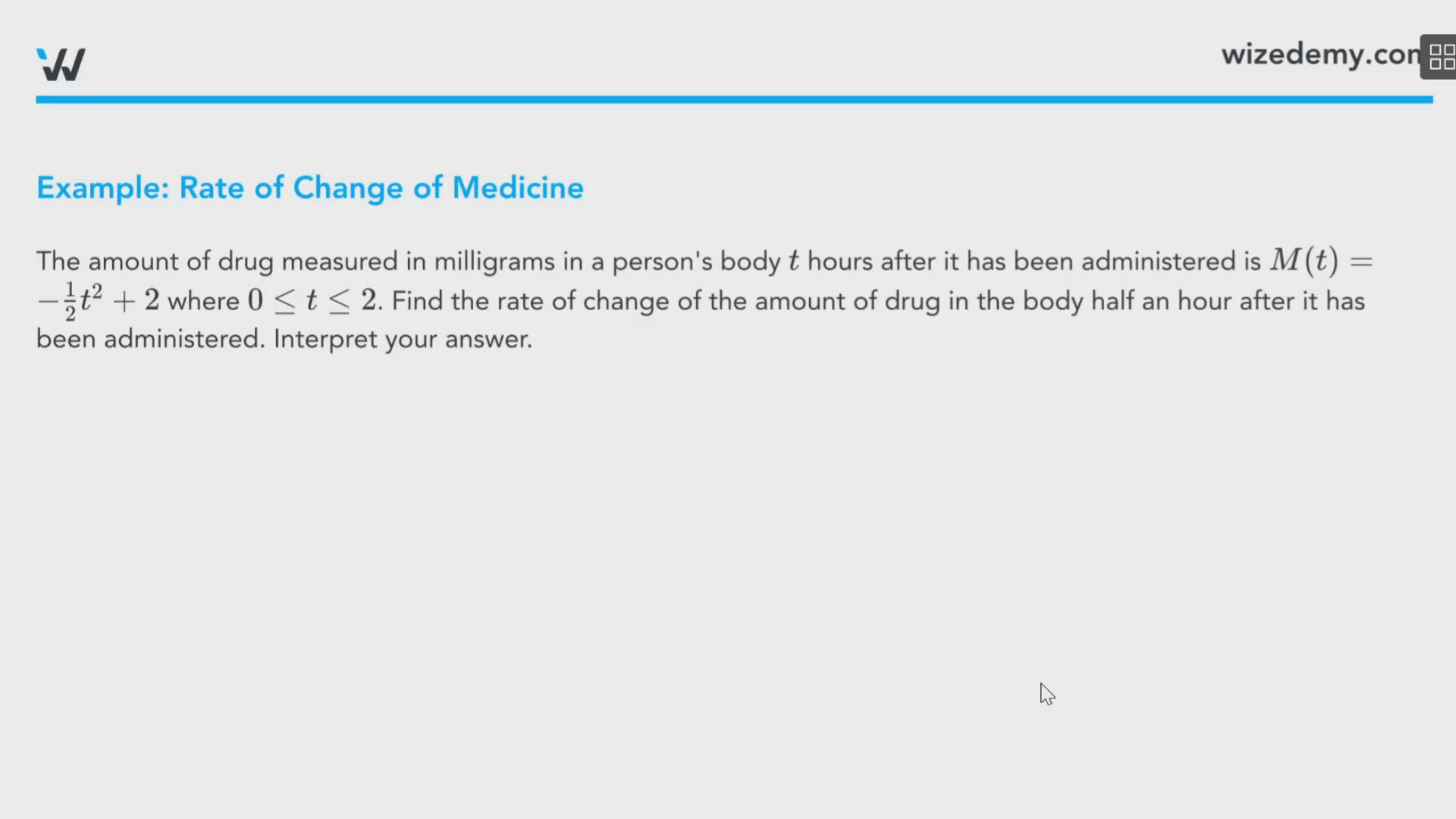
The amount of drug measured in milligrams in a person's body tt hours after it has been administered is M(t)=12t2+2M(t)=-\frac{1}{2}t^2+2 where 0t20\le t\le2. Find the rate of change of the amount of drug in the body half an hour after it has been administered. Interpret your answer.

The rate of change after half an hour is the slope of the tangent line at the point t=12t=\frac{1}{2}:
m=limh0 M(12+h)M(12)h\displaystyle m=\lim_{h\to0}\ \frac{M\left(\frac{1}{2}+h\right)-M\left(\frac{1}{2}\right)}{h}
m=limh0 [12(12+h)2+2][12(12)2+2]h\displaystyle m=\lim_{h\to0}\ \frac{\left[-\frac{1}{2}\left(\frac{1}{2}+h\right)^2+2\right]-\left[-\frac{1}{2}\left(\frac{1}{2}\right)^2+2\right]}{h}
m=limh0 [12(14+h+h2)+2][158]h\displaystyle m=\lim_{h\to0}\ \frac{\left[-\frac{1}{2}\left(\frac{1}{4}+h+h^2\right)+2\right]-\left[\frac{15}{8}\right]}{h}
m=limh0 [1812h12h2+2][158]h\displaystyle m=\lim_{h\to0}\ \frac{\left[-\frac{1}{8}-\frac{1}{2}h-\frac{1}{2}h^2+2\right]-\left[\frac{15}{8}\right]}{h}
m=limh0 [12h12h2]h\displaystyle m=\lim_{h\to0}\ \frac{\left[-\frac{1}{2}h-\frac{1}{2}h^2\right]}{h}
m=limh0 h(1212h)h\displaystyle m=\lim_{h\to0}\ \frac{h\left(-\frac{1}{2}-\frac{1}{2}h\right)}{h}
m=limh0 1212h\displaystyle m=\lim_{h\to0}\ -\frac{1}{2}-\frac{1}{2}h
m=12\displaystyle m=-\frac{1}{2}

Therefore, the rate of change of the amount of drug in the body half an hour after it's been administered is 12-\frac{1}{2} mg/hr.

This rate of change is negative because the amount of drug in the body is decreasing at this time.

The profit of a company measured in dollars is modelled by the function P(x)=400xx2P(x)=400x-x^2, where xx is the amount of product sold in a week.
a) Find the profit if 10 products are sold in a week.
b) Find the rate of change of the profit if 100 products are sold per week.

Practice: Rate of Change of Volume & Surface Area

Determine the instantaneous rate of change of the following volumes.
Find the instantaneous rate of change of the volume of a sphere.