0:00 / 0:00

Definition of Limits

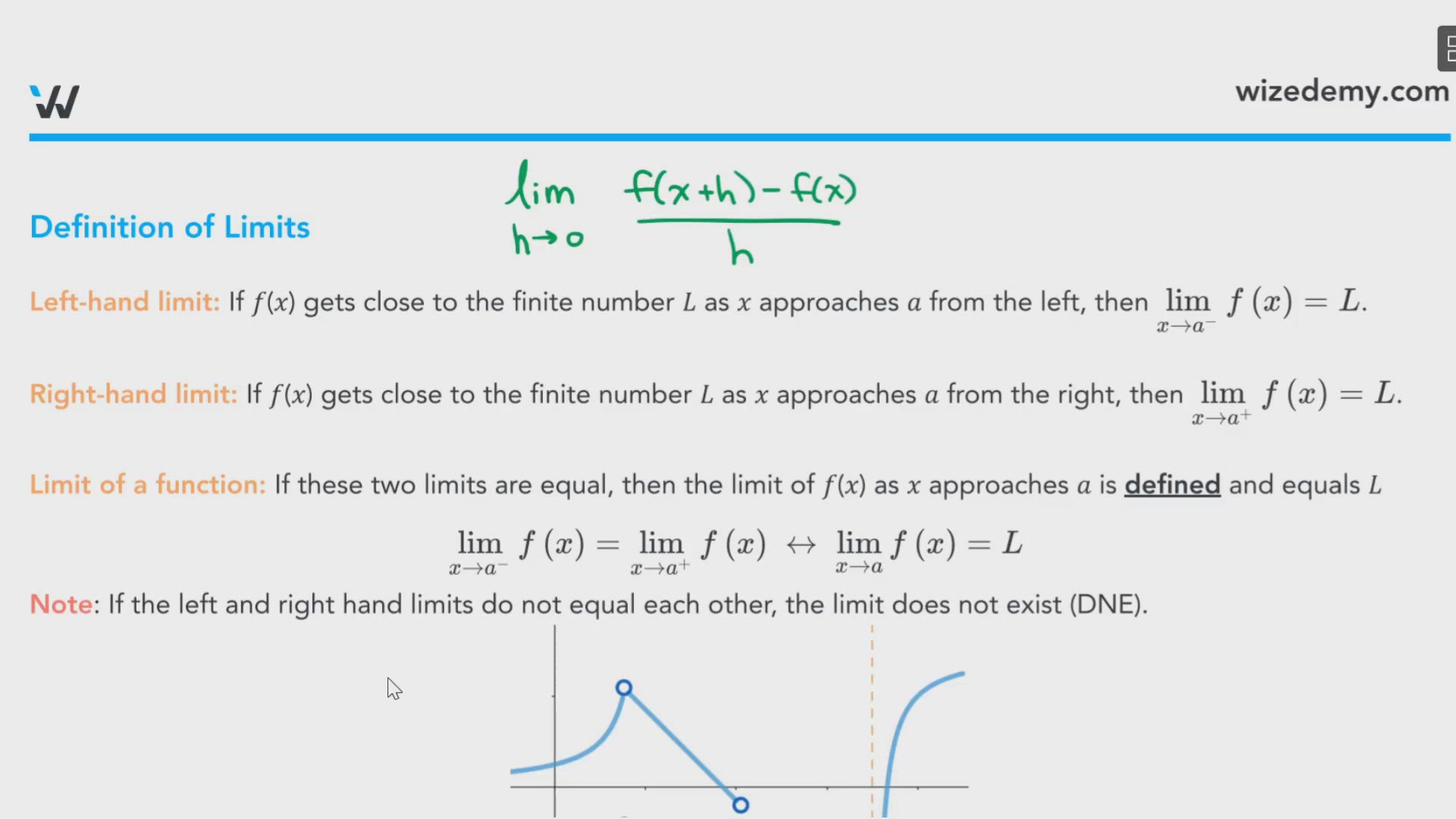
Left-hand limit: If 𝑓(𝑥) gets close to the finite number 𝐿 as 𝑥 approaches 𝑎 from the left, then limxaf(x)=L\displaystyle\lim_{x\to a^-}f\left(x\right)=L.

Right-hand limit: If 𝑓(𝑥) gets close to the finite number 𝐿 as 𝑥 approaches 𝑎 from the right, then limxa+f(x)=L\displaystyle\lim_{x\to a^+}f\left(x\right)=L.

Limit of a function: If these two limits are equal, then the limit of 𝑓(𝑥) as 𝑥 approaches 𝑎 is defined and equals 𝐿
limxaf(x)=limxa+f(x)  limxaf(x)=L\displaystyle\lim_{x\to a^-}f\left(x\right)=\lim_{x\to a^+}f\left(x\right)\ \leftrightarrow\ \lim_{x\to a}f\left(x\right)=L
Note: If the left and right hand limits do not equal each other, the limit does not exist (DNE).
Watch Out!
𝑓(𝑥) does not have to equal 𝐿, it doesn't even have to be defined at 𝑥 = 𝑎, just at values really close to 𝑎.

PAGE BREAK
Example
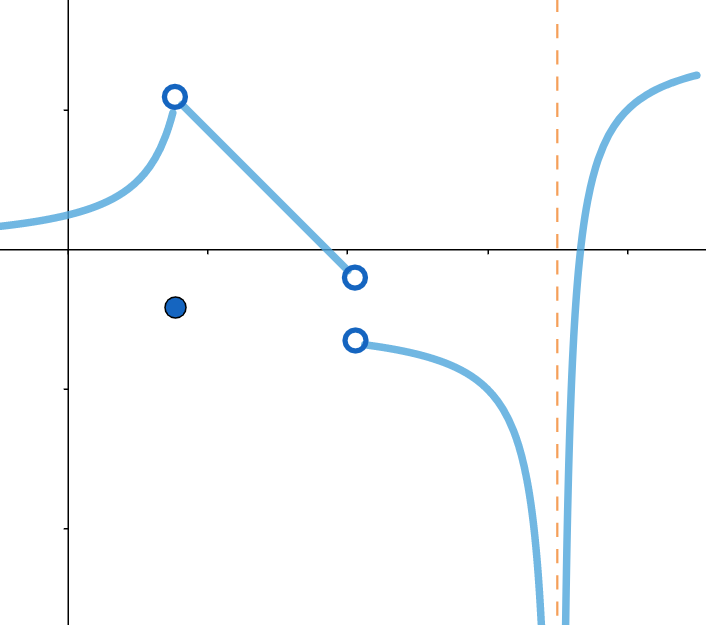
The following is the graph of the function f(x)f\left(x\right)
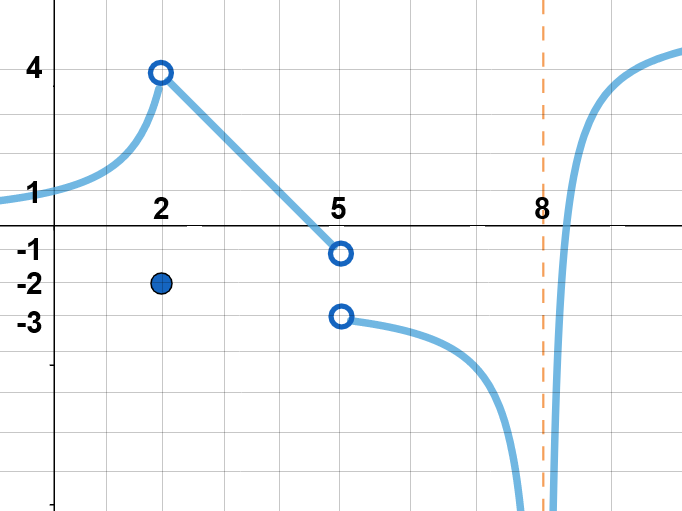
Determine the following limits:

a. limx0f(x)=\displaystyle \lim_{x\to0}f\left(x\right)=
1
Because the left and right hand limits both approach 1.

b. i)limx2f(x)=\displaystyle \lim_{x\to2^-}f\left(x\right)=
4
ii) limx2+f(x)=\displaystyle \lim_{x\to2^+}f\left(x\right)=
4
iii) limx2f(x)=\displaystyle \lim_{x\to2}f\left(x\right)=
4
The left and right hand limits both approach 4, so even though the function value f(4)=2f\left(4\right)=-2, the limit actually equals 4

c. i) limx5f(x)=\displaystyle \lim_{x\to5^-}f\left(x\right)=
-1
ii) limx5+f(x)=\displaystyle \lim_{x\to5^+}f\left(x\right)=
-3
iii) limx5f(x)=\displaystyle \lim_{x\to5}f\left(x\right)=
DNE
Since the left hand limit approaches -1 and the right hand limit approaches -3, the limit does not exist because the values don't match up.

d. i) limx8f(x)=\displaystyle \lim_{x\to8^-}f\left(x\right)=
-∞ (DNE)
ii) limx8+f(x)=\displaystyle \lim_{x\to8^+}f\left(x\right)=
-∞ (DNE)
iii) limx8f(x)=\displaystyle \lim_{x\to8}f\left(x\right)=
-∞ (DNE)
Since the left and right hand limits don't approach a single numerical value, it does not exist.
0:00 / 0:00

Example: Limits From Graphs

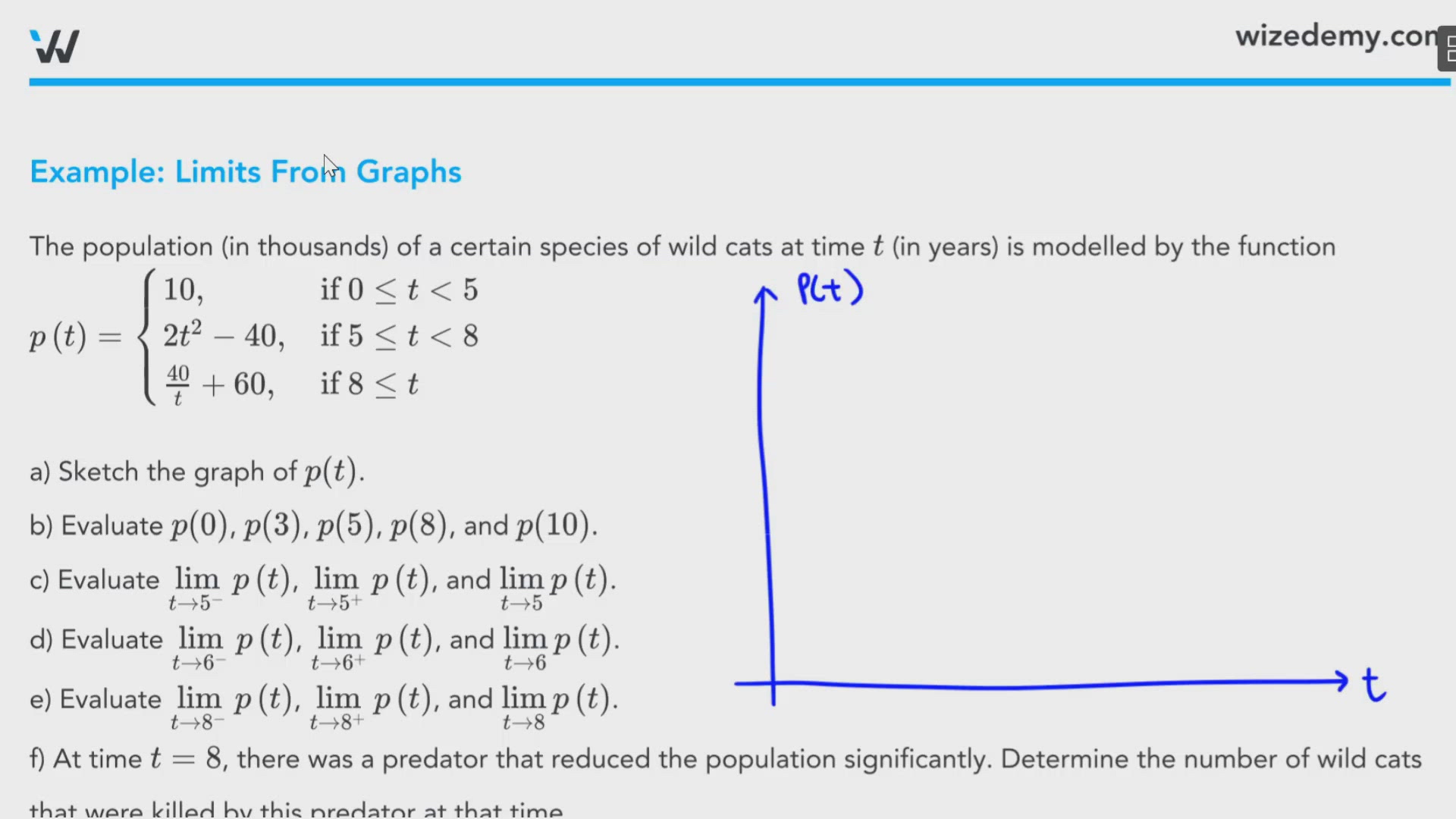
The population (in thousands) of a certain species of wild cats at time tt (in years) is modelled by the function
p(t)={10,if 0t<52t240,if 5t<840t+60,if 8tp\left(t\right)=\begin{cases} 10,&\text{if }0\le t<5\\ 2t^2-40,&\text{if }5\le t<8\\ \frac{40}{t}+60,&\text{if }8\le t \end{cases}

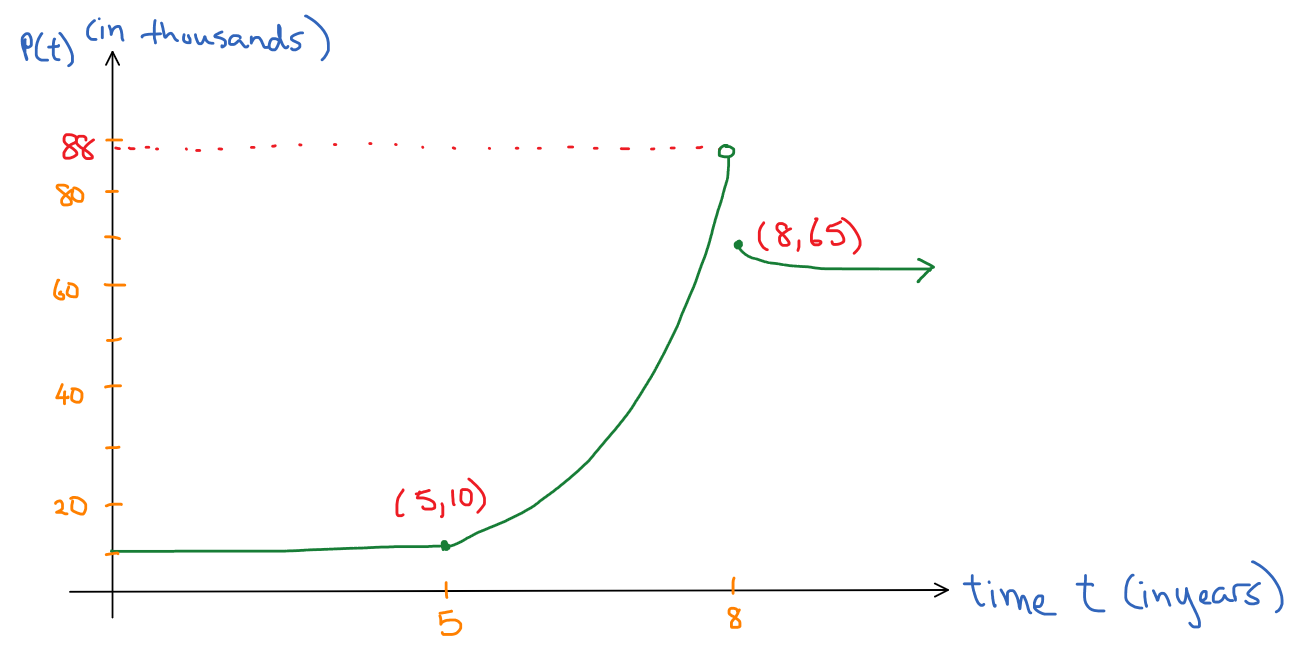
a) Sketch the graph of p(t)p(t).
b) Evaluate p(0)p(0), p(3)p(3), p(5)p(5), p(8)p(8), and p(10)p(10).
c) Evaluate limt5p(t)\displaystyle \lim_{t\to5^-}p\left(t\right), limt5+p(t)\displaystyle \lim_{t\to5^+}p\left(t\right), and limt5p(t)\displaystyle \lim_{t\to5}p\left(t\right).
d) Evaluate limt6p(t)\displaystyle \lim_{t\to6^-}p\left(t\right), limt6+p(t)\displaystyle \lim_{t\to6^+}p\left(t\right), and limt6p(t)\displaystyle \lim_{t\to6}p\left(t\right).
e) Evaluate limt8p(t)\displaystyle \lim_{t\to8^-}p\left(t\right), limt8+p(t)\displaystyle \lim_{t\to8^+}p\left(t\right), and limt8p(t)\displaystyle \lim_{t\to8}p\left(t\right).
f) At time t=8t=8, there was a predator that reduced the population significantly. Determine the number of wild cats that were killed by this predator at that time.
Part a)
Part b)
p(0)=10p\left(0\right)=10
p(3)=10p\left(3\right)=10
p(5)=2(5)240=10p\left(5\right)=2\left(5\right)^2-40=10
p(8)=408+60=65p\left(8\right)=\frac{40}{8}+60=65
p(10)=4010+60=64p\left(10\right)=\frac{40}{10}+60=64

Part c)
limt5p(t)=limt510=10\displaystyle \lim_{t\to5^-}p\left(t\right)=\displaystyle \lim_{t\to5^-}10=10
limt5+p(t)=limt5+2t240=10\displaystyle \lim_{t\to5^+}p\left(t\right)=\displaystyle \lim_{t\to5^+}2t^2-40=10
limt5p(t)=10\displaystyle \lim_{t\to5}p\left(t\right)=10

Part d)
limt6p(t)=limt62t240=32\displaystyle \lim_{t\to6^-}p\left(t\right)=\displaystyle \lim_{t\to6^-}2t^2-40=32
limt6+p(t)=limt6+2t240=32\displaystyle \lim_{t\to6^+}p\left(t\right)=\displaystyle \lim_{t\to6^+}2t^2-40=32
limt6p(t)=32\displaystyle \lim_{t\to6}p\left(t\right)=32

Part e)
limt8p(t)=limt82t240=88\displaystyle \lim_{t\to8^-}p\left(t\right)=\displaystyle \lim_{t\to8^-}2t^2-40=88
limt8+p(t)=limt8+40t+60=65\displaystyle \lim_{t\to8^+}p\left(t\right)=\displaystyle \lim_{t\to8^+}\frac{40}{t}+60=65
limt8p(t)=DNE\displaystyle \lim_{t\to8}p\left(t\right)=DNE

Part f)
Since limt8p(t)=88\displaystyle \lim_{t\to8^-}p\left(t\right)=88, we know that right before the predator killed a portion of the wild cats, there were 88 thousand wild cats.

Sincelimt8+p(t)=65\displaystyle \lim_{t\to8^+}p\left(t\right)=65, we know that after the predator attack, there were only 65 thousand wild cats.

Therefore, the predator killed 23 thousand wild cats at the beginning of year 8.


*BONUS*
Q: What is the population of this species of wild cats as time goes on? (i.e. 100 years from now, 10000 years from now, etc.)
A: As tt\to\infty, the population will follow the function 40t+60\frac{40}{t}+60. So, as tt gets really large, 40t\frac{40}{t} gets really small, until it's practically 0. So the population in the long run as time goes on will approach 60,000 wild cats.
0:00 / 0:00

Limits Properties

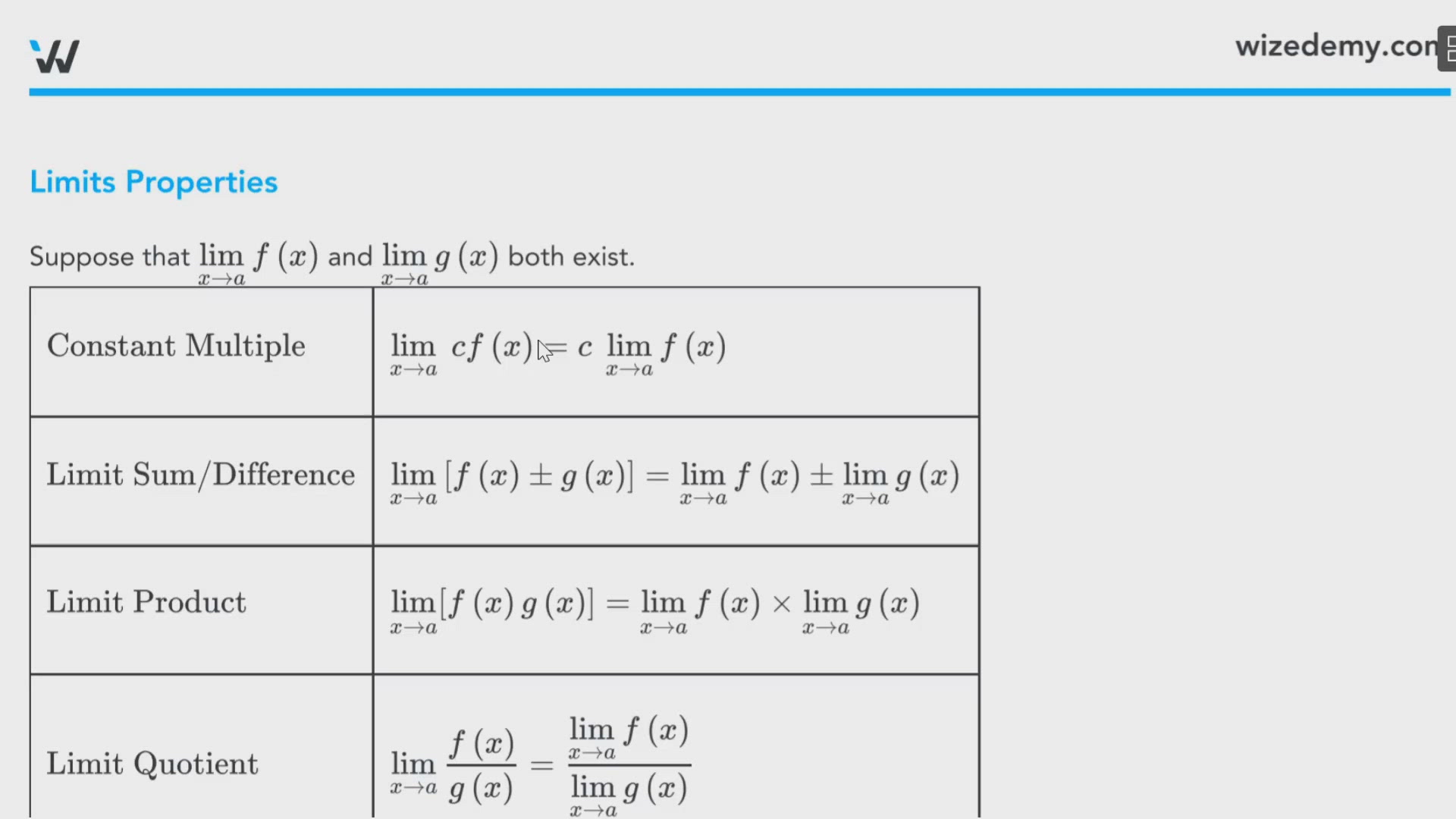
Suppose that limxaf(x)\displaystyle\lim_{x\to a}f\left(x\right) and limxag(x)\displaystyle\lim_{x\to a}g\left(x\right) both exist.
Constant Multiplelimxa cf(x)=c limxaf(x)Limit Sum/Differencelimxa[f(x)±g(x)]=limxaf(x)±limxag(x)Limit Productlimxa[f(x)g(x)]=limxaf(x)×limxag(x)Limit Quotientlimxaf(x)g(x)=limxaf(x)limxag(x)Limit Powerlimxa[f(x)]n=[limxaf(x)]n\begin{array}{|l|l|} \hline\\ \text{Constant Multiple}&\displaystyle\lim_{x\to a}\ cf\left(x\right)=c\ \lim_{x\to a}f\left(x\right)\\\\ \hline\\ \text{Limit Sum/Difference}&\displaystyle\lim_{x\to a}\left[f\left(x\right)\pm g\left(x\right)\right]=\lim_{x\to a}f\left(x\right)\pm\lim_{x\to a}g\left(x\right)\\\\ \hline\\ \text{Limit Product}&\displaystyle\lim_{x\to a}[f\left(x\right)g\left(x\right)]=\lim_{x\to a}f\left(x\right)\times\lim_{x\to a}g\left(x\right)\\\\ \hline\\ \text{Limit Quotient}&\displaystyle\lim_{x\to a}\frac{f\left(x\right)}{g\left(x\right)}= \frac{\displaystyle\lim_{x\to a}f\left(x\right)}{\displaystyle\lim_{x\to a}g\left(x\right)}\\\\ \hline\\ \text{Limit Power}&\displaystyle\lim_{x\to a}\left[f\left(x\right)\right]^n=\left[\lim_{x\to a}f\left(x\right)\right]^n\\\\ \hline \end{array}

PAGE BREAK

Direct Substitution

For any real number aa:
  • limxak=k\displaystyle \lim_{x\to a}k=k for any constant kk
  • limxax=a\displaystyle \lim_{x\to a}x=a
Meaning: Substitute the value that xx approaches directly into the expression → if you get a number, that's the limit!

Wize Tip
ALWAYS TRY DIRECTION SUBSTITUTION FIRST!

Watch Out!
If you end up with 0\sqrt 0, check the left and right-hand limit to make sure the limit exists

Watch Out!
If you end up with 00\frac{0}{0}, this is called an indeterminate form → have to manipulate the expression algebraically to evaluate the limit.

Other indeterminate forms (some of these will be covered in later chapters, some will not be covered in this course):
, 0×, , 1, 0, 00\frac{\infty}{\infty},\ 0\times\infty,\ \infty-\infty,\ 1^{\infty},\ \infty^0,\ 0^0

0:00 / 0:00

Example: Evaluating Limits

Evaluate the following limits:
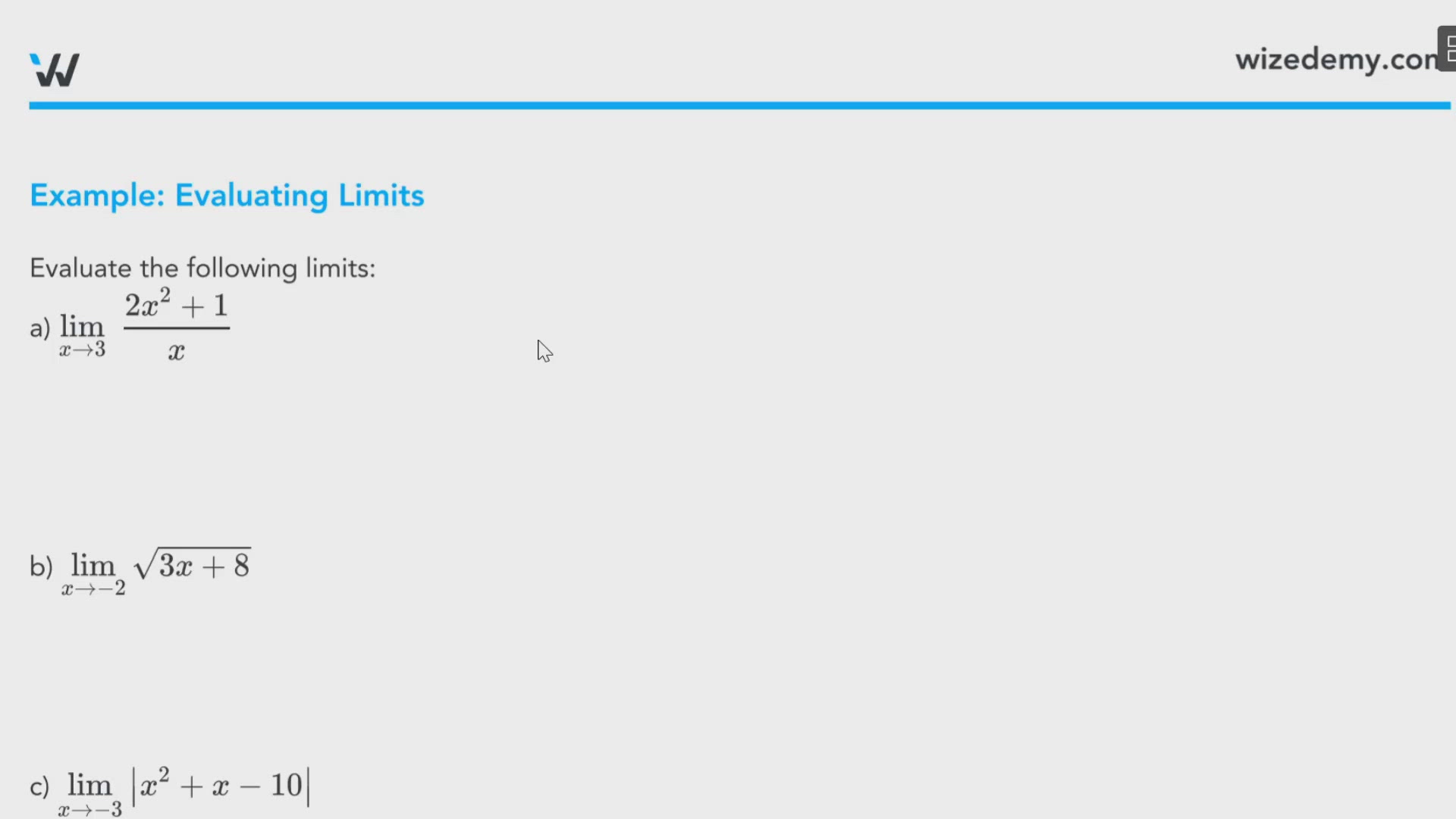
a) limx3 2x2+1x\displaystyle \lim_{x\to3}\ \frac{2x^2+1}{x}

limx3 2x2+1x=2(3)2+13=193\displaystyle \lim_{x\to3}\ \frac{2x^2+1}{x}=\frac{2\left(3\right)^2+1}{3}=\frac{19}{3}

b) limx23x+8\displaystyle \lim_{x\to-2}\sqrt{3x+8}

limx23x+8=3(2)+8=2\displaystyle \lim_{x\to-2}\sqrt{3x+8}=\sqrt{3(-2)+8}=\sqrt {2}

c) limx3x2+x10\displaystyle \lim_{x\to-3}\left|x^2+x-10\right|

limx3x2+x10=(3)2+(3)10=4=4\displaystyle \lim_{x\to-3}\left|x^2+x-10\right|=|(-3)^2+(-3)-10|=|-4|=4

d) limx1x1\displaystyle \lim_{x\to1}\sqrt{x-1} (*tricky*)

If we do a direct substitution, we get limx1x1=11=0\displaystyle \lim_{x\to1}\sqrt{x-1}=\sqrt {1-1}=\sqrt 0
We know that 0\sqrt 0 is defined, however,  number\sqrt {-\text{ number}} is not defined.
Let's examine both left and right hand limits:
  • limx1+x1=1+1=0+=0\displaystyle \lim_{x\to1^+}\sqrt{x-1}=\sqrt{1^+-1}=\sqrt{0^+}=0 (this is the square root of a very small positive value)
  • limx1x1=11=0=DNE\displaystyle \lim_{x\to1^-}\sqrt{x-1}=\sqrt{1^--1}=\sqrt{0^-}=DNE (this is the square root of a very small negative value)
Therefore, the limit does not exist.


PAGE BREAK
e) f(x)={x,x<02x21,x0f\left(x\right)= \begin{cases} |x|,&x<0\\ 2x^2-1,&x\ge0 \end{cases}
i) limx1f(x)\displaystyle \lim_{x\to-1}f\left(x\right)

limx1f(x)=limx1x=1=1\displaystyle \lim_{x\to-1}f\left(x\right)=\lim_{x\to-1}|x|=|-1|=1

ii) limx1f(x)\displaystyle \lim_{x\to1}f\left(x\right)

limx1f(x)=limx12x21=2(1)21=1\displaystyle \lim_{x\to1}f\left(x\right)=\lim_{x\to-1}2x^2-1=2(1)^2-1=1

iii) limx0f(x)\displaystyle \lim_{x\to0}f\left(x\right)

Since the function switches at the point x=0x=0, we need to examine the left and right hand limits:
  • limx0f(x)=limx0x=0=0\displaystyle \lim_{x\to0^-}f\left(x\right)=\lim_{x\to0^-}\left|x\right|=\left|0^-\right|=0
  • limx0+f(x)=limx0+2x21=2(0+)21=1\displaystyle \lim_{x\to0^+}f\left(x\right)=\lim_{x\to0^+}2x^2-1=2\left(0^+\right)^2-1=-1

Practice: Evaluating Limits

Evaluate the limit limx3 x210x+2x\displaystyle \lim_{x\to3}\ \frac{\left|x^2-10\right|-x+2}{x}

Practice: Evaluating Limits

Given the following function, evaluate the limits below.
f(x)={3x+5if  x<110if  x=19x2if  1<x212x3if  x>2f\left(x\right)= \begin{cases} -3x+5 & \text{if } \ x<-1 \\ -10 & \text{if }\ x=-1\\ 9-x^2 & \text{if }\ -1< x\le2\\ 1-|2x-3| & \text{if } \ x>2 \end{cases}

Enter DNE if the limit does not exist.
0:00 / 0:00

Example: Evaluating Limits

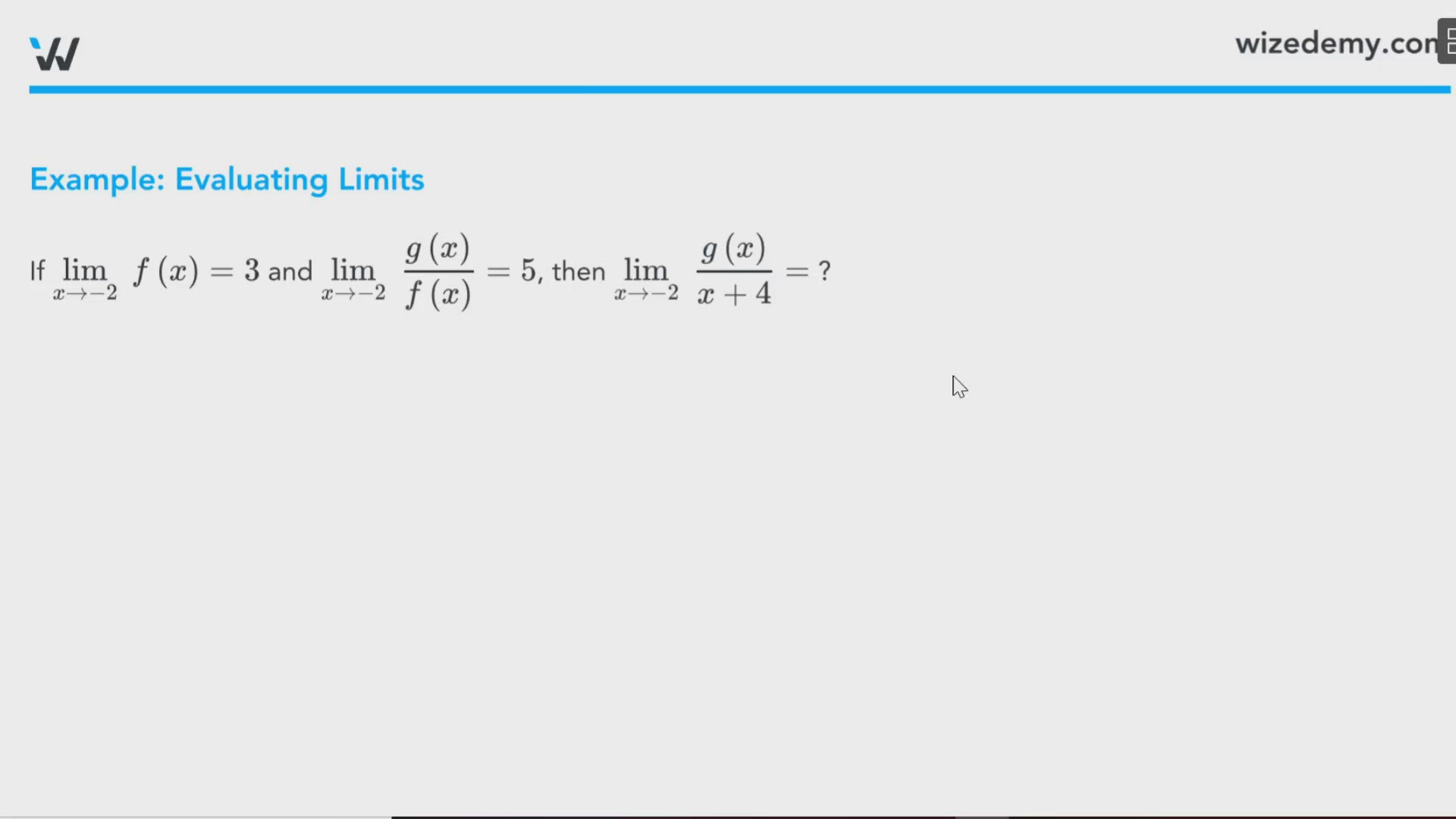
If limx2 f(x)=3\displaystyle\lim_{x\to-2}\ f\left(x\right)=3 and limx2 g(x)f(x)=5\displaystyle\lim_{x\to-2}\ \frac{g\left(x\right)}{f\left(x\right)}=5, then limx2 g(x)x+4= \displaystyle\lim_{x\to-2}\ \frac{g\left(x\right)}{x+4}=\ ?

Using what we know, we need to create the expression g(x)x+4\frac{g\left(x\right)}{x+4}:
f(x)g(x)f(x)1x+4=g(x)x+4f\left(x\right)\cdot\frac{g\left(x\right)}{f\left(x\right)}\cdot\frac{1}{x+4}=\frac{g\left(x\right)}{x+4}

So, we know that
limx2 g(x)x+4\displaystyle\lim_{x\to-2}\ \frac{g\left(x\right)}{x+4}
= limx2 [f(x)g(x)f(x)1x+4]\displaystyle=\ \lim_{x\to-2}\ \left[f(x)\cdot\frac{g(x)}{f(x)}\cdot\frac{1}{x+4}\right]
=limx2[f(x)]limx2[g(x)f(x)]limx2[1x+4]=\displaystyle\lim_{x\to-2}\left[f\left(x\right)\right]\cdot\lim_{x\to-2}\left[\frac{g\left(x\right)}{f\left(x\right)}\right]\cdot\lim_{x\to-2}\left[\frac{1}{x+4}\right]
=351(2)+4=3\cdot5\cdot\frac{1}{\left(-2\right)+4}
=152=\frac{15}{2}

Practice: Evaluating Limits

If limx1f(x)=2\displaystyle \lim_{x\to1}f\left(x\right)=-2, evaluate the limit limx1 2f(x)+5[f(x)]3+x\displaystyle \lim_{x\to1}\ \frac{\sqrt{2f\left(x\right)+5}}{\left[f\left(x\right)\right]^3+x}.
0:00 / 0:00
This concept will be revisited in the Curve Sketching chapter.

Infinite Limits

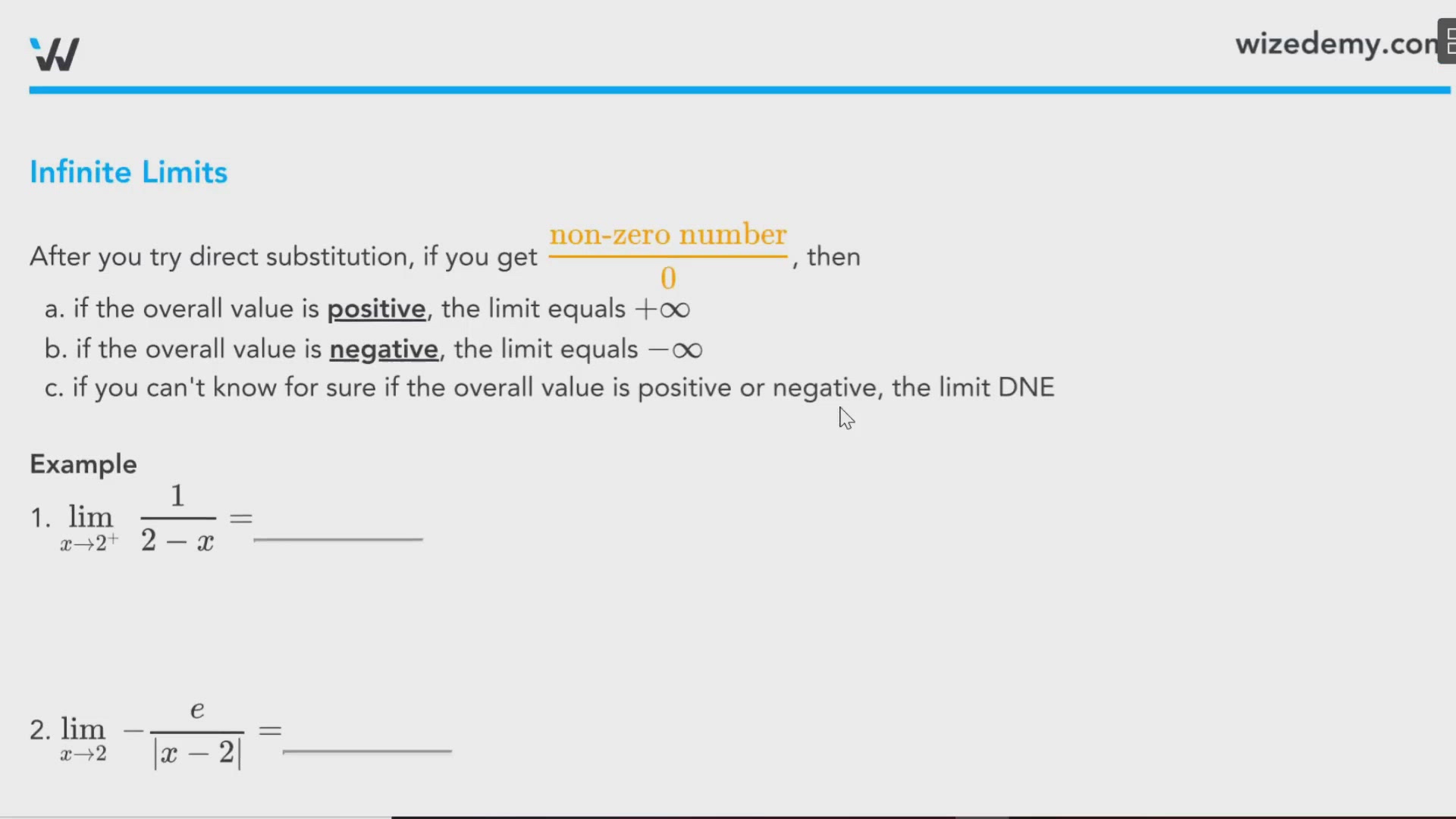
After you try direct substitution, if you get non-zero number0\displaystyle \orange{\frac{\text{non-zero number}}{0}}, then
a. if the overall value is positive, the limit equals ++\infty
b. if the overall value is negative, the limit equals -\infty
c. if you can't know for sure if the overall value is positive or negative, the limit DNE

Example
1. limx2+ 12x=\displaystyle\lim_{x\to2^+}\ \frac{1}{2-x}=
-∞ (DNE)
Direct sub gives us 10\frac{1}{0}. If we substitute 2+2^+ into the expression, the denominator will be slightly negative. Since the numerator is positive 1, the overall value will be negative. Therefore, the limit is -\infty (DNE)

2. limx2 ex2=\displaystyle\lim_{x\to2}\ -\frac{e}{|x-2|}=
-∞ (DNE)
Direct sub gives us e0-\frac{e}{0}. It doesn't matter if we substitute 22^- or 2+2^+ into the expression, the deonominator will be positive, and the overall value will be negative. Therefore, the limit is -\infty (DNE)

3. limxπ 1πx=\displaystyle\lim_{x\to\pi}\ \frac{1}{\pi-x}=
DNE
Direct sub gives us cosπ0=10\frac{\cos\pi}{0}=-\frac{1}{0}. If we substitute π\pi^- into the expression, the denominator will be slightly positive, and the overall value will be negative. If we substitute π+\pi^+ into the expression, the denominator will be slightly negative, and the overall value will be positive. Therefore, the limit DNE.

Did You Know?

If limxaf(x)=±\displaystyle\lim_{x\to a}f\left(x\right)=\pm\infty, then f(x)f\left(x\right) has a vertical asymptote at x=ax=a.
0:00 / 0:00
This concept will be revisited in the Curve Sketching chapter.

Limits at Infinity & Horizontal Asymptotes

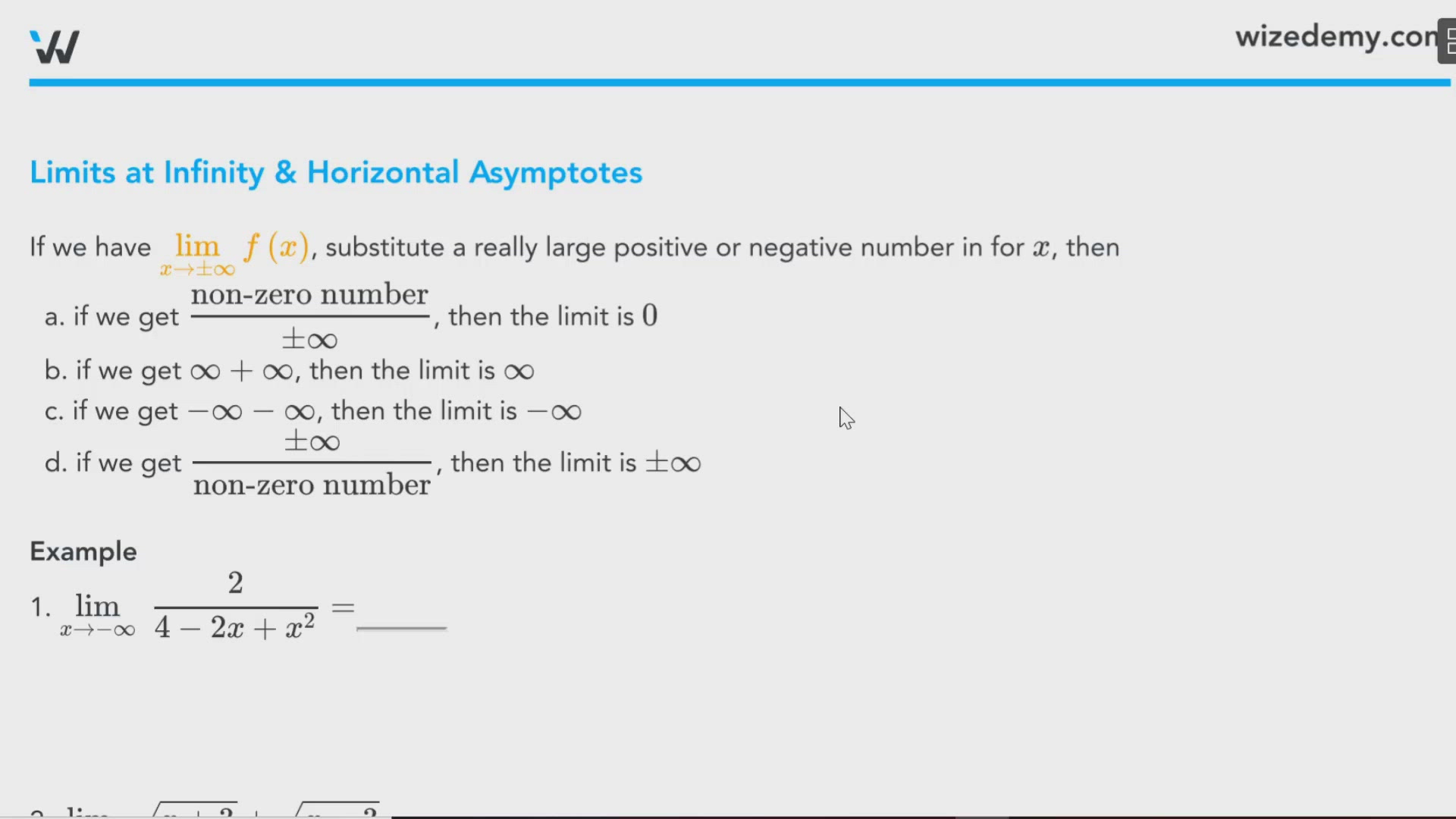
If we have limx±f(x)\orange{\displaystyle\lim_{x\to\pm\infty}f\left(x\right)}, substitute a really large positive or negative number in for xx, then
a. if we get non-zero number±\displaystyle \frac{\text{non-zero number}}{\pm\infty}, then the limit is 00
b. if we get +\infty+\infty, then the limit is \infty
c. if we get -\infty-\infty, then the limit is -\infty
d. if we get ±non-zero number\displaystyle \frac{\pm\infty}{\text{non-zero number}}, then the limit is ±\pm\infty

Example
1. limx 242x+x2=\displaystyle \lim_{x\to-\infty}\ \frac{2}{4-2x+x^2}=
0
Direct sub gives us 242()+()2=24++=2=0\frac{2}{4-2\left(-\infty\right)+\left(-\infty\right)^2}=\frac{2}{4+\infty+\infty}=\frac{2}{\infty}=0


2. limx x+3+x3=\displaystyle \lim_{x\to\infty}\ \sqrt{x+3}+\sqrt{x-3}=
∞ (DNE)
Direct sub gives us +3+3=+=\sqrt{\infty+3}+\sqrt{\infty-3}=\infty+\infty=\infty (DNE)

Did You Know?

If limxf(x)=a\displaystyle\lim_{x\to \infty }f\left(x\right)=a or limxf(x)=a\displaystyle\lim_{x\to -\infty }f\left(x\right)=a, then f(x)f\left(x\right) has a horizontal asymptote at y=ay=a.

Watch Out!
If you get the result \infty-\infty or ±±\frac{\pm\infty}{\pm\infty}, we don't actually know what happens!

We will learn how to evaluate these types of limits in later chapters