
0:00 / 0:00
Vertical Asymptotes
The graph of has a vertical asymptote at if the left-hand and/or right-hand limit as is or
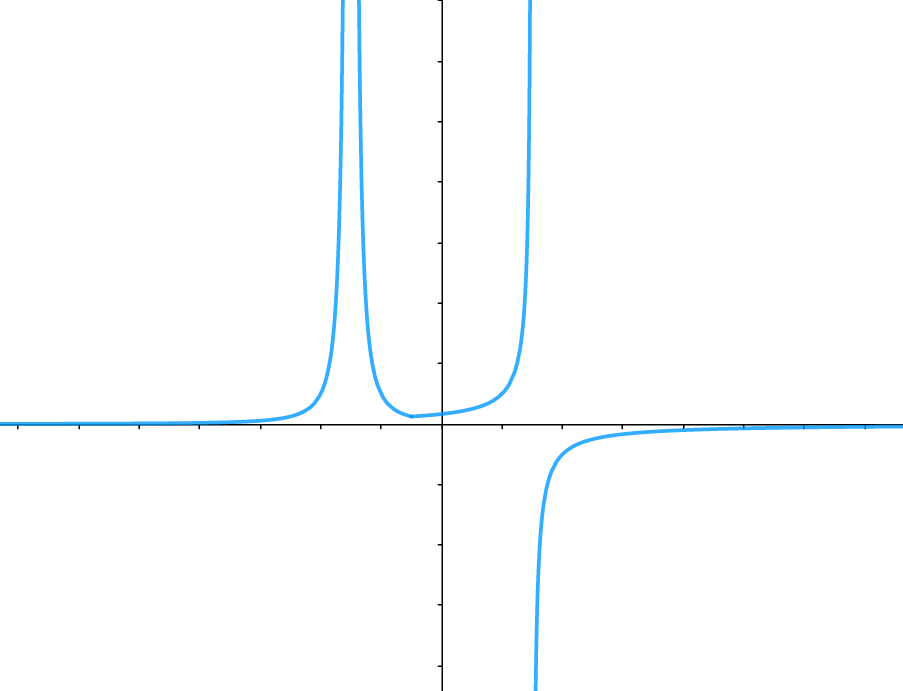
Wize Tip
Vertical asymptotes are usually denoted by a dotted vertical line on the graph.
How do we find vertical asymptotes?
Determine any point(s) where the graph is undefined.
Wize Tip
*If we are given a rational function , we want to check when the denominator equals 0.
Set up the following table to more easily determine the left and right-hand limits

0:00 / 0:00
Example: Vertical Asymptotes
Find the vertical asymptote(s), if any, of the following functions.
a)
This is a rational function, which is undefined (discontinuous) when the denominator equals 0:
Therefore, this graph has vertical asymptotes at and .
b)
This is a rational function, which is undefined (discontinuous) when the denominator equals 0:
Therefore, this graph has vertical asymptotes at only (it has a point discontinuity at ).
c)
Rewrite:
This is a rational functions, which is undefined (discontinuous) when the denominator equals 0:
Therefore, this graph has vertical asymptotes at , , and .
Practice: Vertical Asymptotes
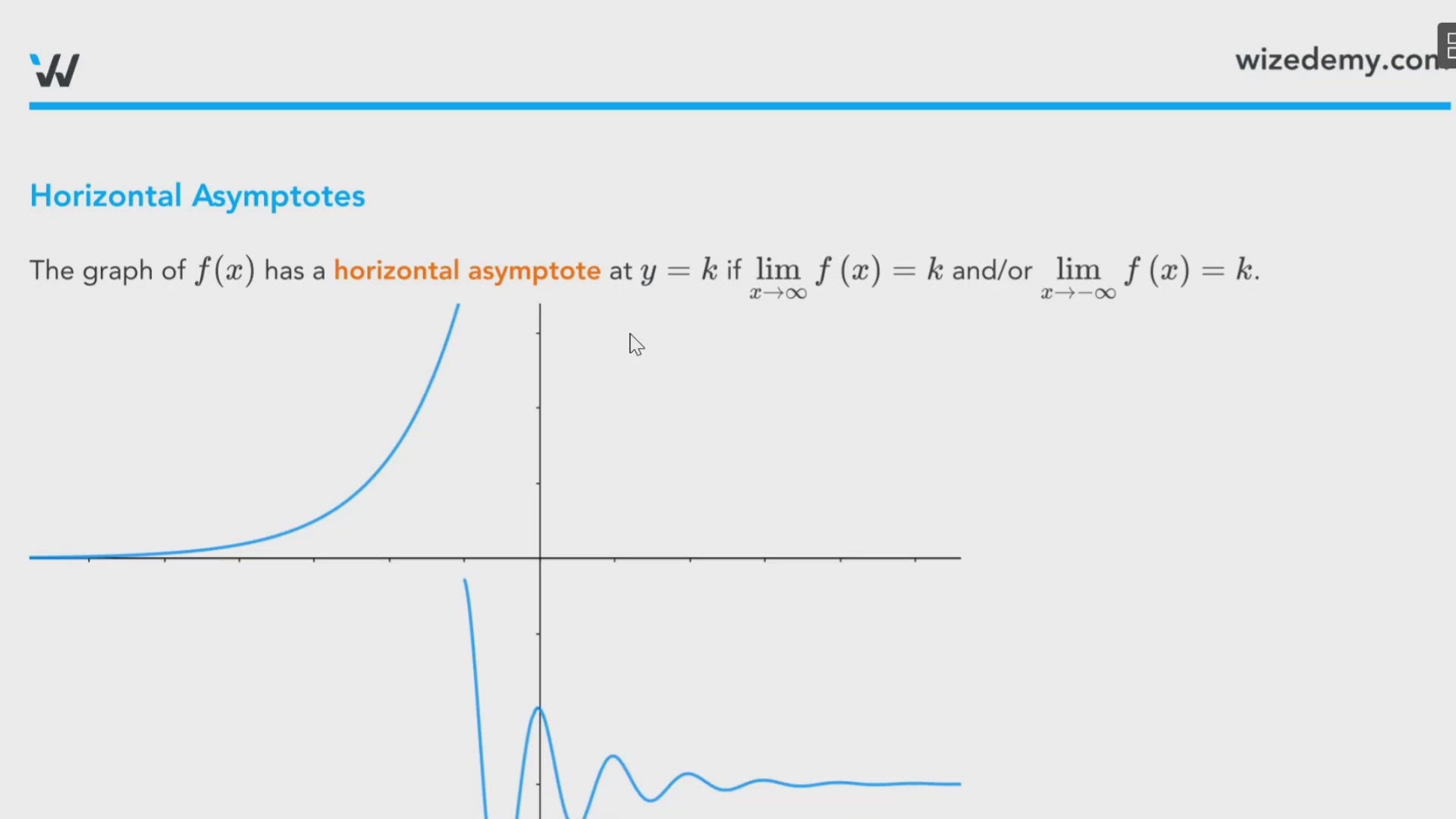
Find the vertical asymptote(s), if any, of .
[Select all that apply]
0:00 / 0:00
Horizontal Asymptotes
The graph of has a horizontal asymptote at if and/or .
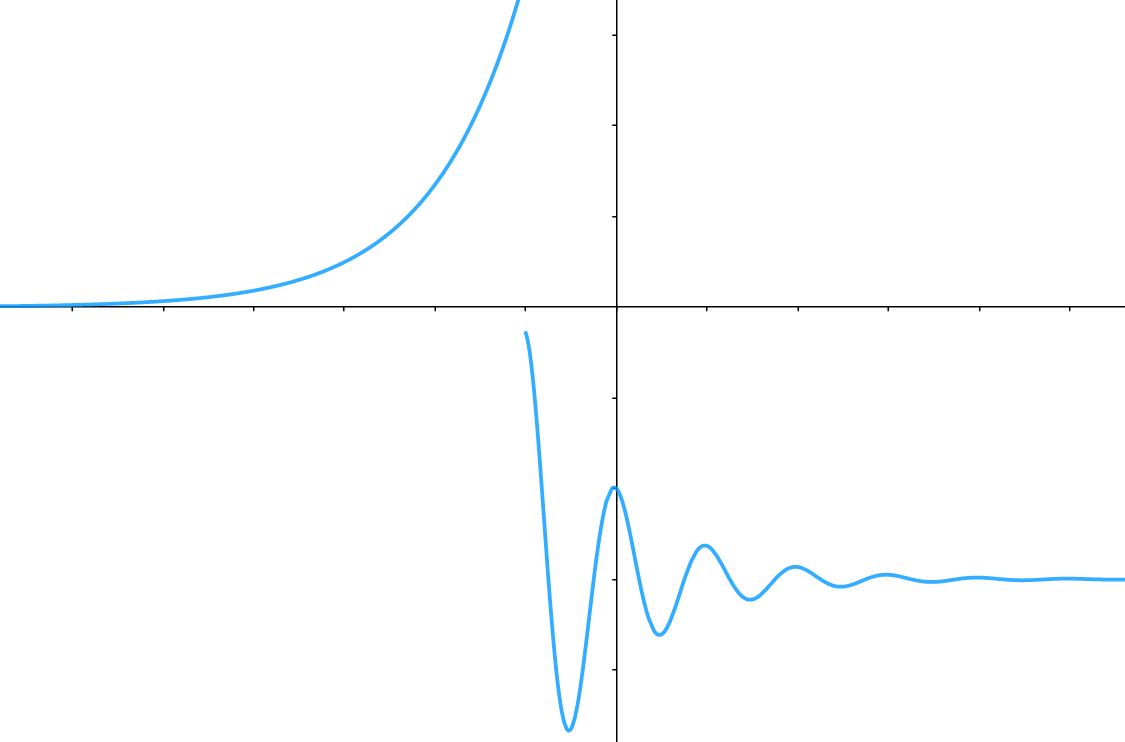
Wize Tip
Horizontal asymptotes are usually denoted by a dotted horizontal line on the graph.
How do we find horizontal asymptotes?
Determine and .
For rational functions :
- We divide all terms by the highest degree term and then evaluate the limit
- We also want to determine if the graph is approaching the horizontal asymptote from above or below
Write it Down
Short-cut for rational functions :
1. If degree of numerator < degree of denominator:
is the horizontal asymptote
2. If degree of numerator = degree of denominator:
Divide the coefficients of the highest degree terms from the numerator and denominator to get the horizontal asymptote
3. If degree of numerator > degree of denominator:
There is no horizontal asymptote

0:00 / 0:00
Example: Horizontal Asymptotes
Find the horizontal asymptote(s), if any, of the following functions.
a)
Limit as :
Limit as :
Same as above →
Therefore, the graph has a horizontal asymptote at .
Behaviour near the horizontal asymptote:
(below the horizontal asymptote)
(above the horizontal asymptote)
Short-cut:
The degree of the numerator is 1, the degree of the denominator is 2.
Since degree of numerator < degree of denominator, the graph has one horizontal asymptote .
b)
Limit as :
Limit as :
Same as above →
Therefore, the graph has a horizontal asymptote at .
Behaviour near the horizontal asymptote:
(above the horizontal asymptote)
(above the horizontal asymptote)
Short-cut:
The degree of the numerator is 3, the degree of the denominator is 3.
Since degree of numerator = degree of denominator, the graph has one horizontal asymptote .
c)
Limit as :
Limit as :
Same as above →
Therefore, the graph doesn't have any horizontal asymptotes.
Short-cut:
The degree of the numerator is 2, the degree of the denominator is 1.
Since degree of numerator > degree of denominator, the graph doesn't have any horizontal asymptotes.
Practice: Horizontal Asymptotes
Find the horizontal asymptote(s), if any, of the following functions
Practice: Vertical & Horizontal Asymptotes
Given the function , answer the following questions.
Determine the one vertical asymptote of the graph .
0:00 / 0:00
Oblique (Slant) Asymptote
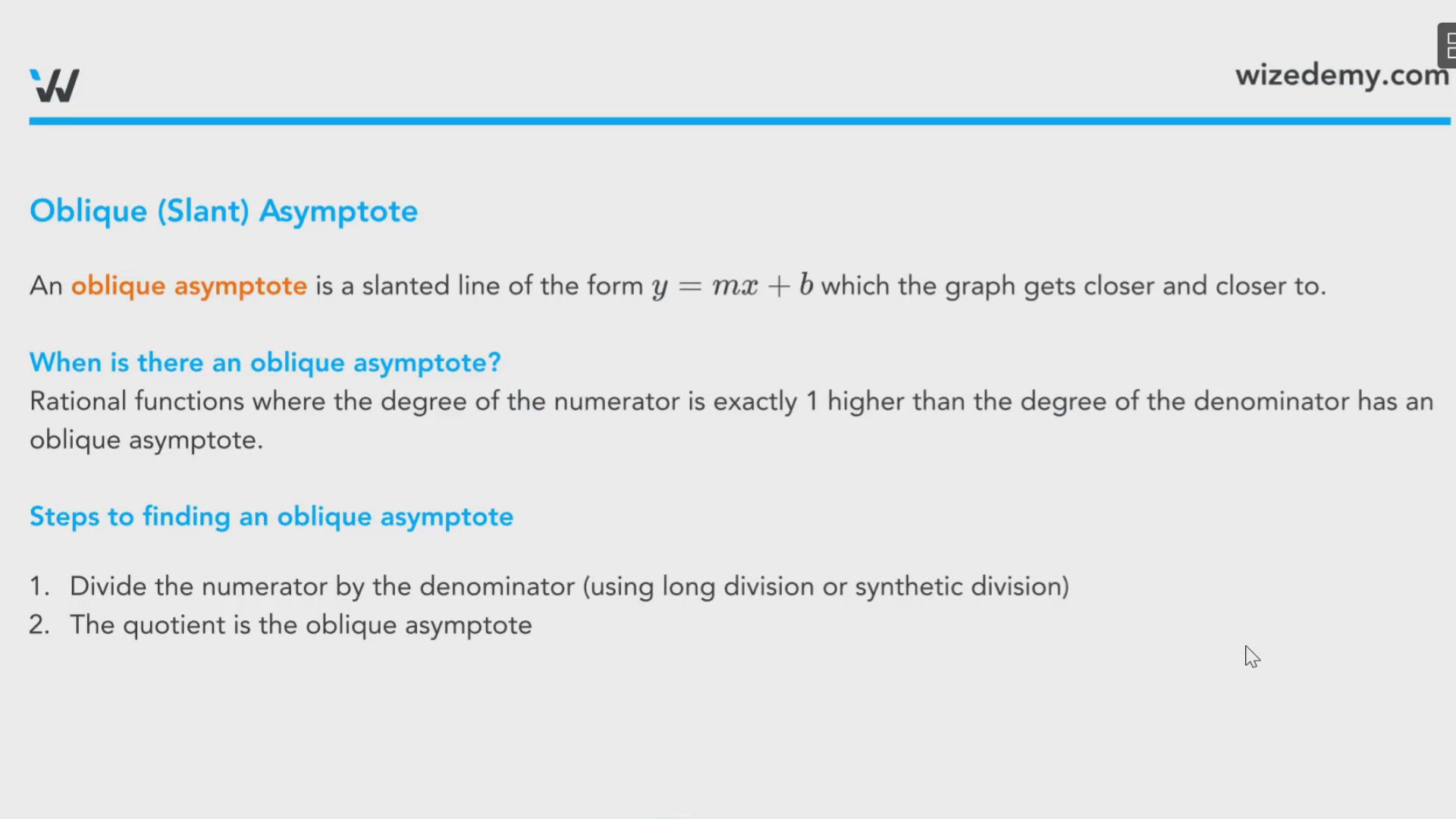
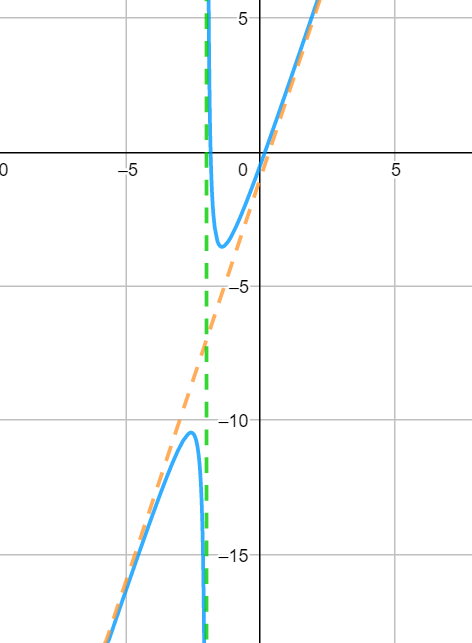
An oblique asymptote is a slanted line of the form which the graph gets closer and closer to.
When is there an oblique asymptote?
Rational functions where the degree of the numerator is exactly 1 higher than the degree of the denominator has an oblique asymptote.
Steps to finding an oblique asymptote
- Divide the numerator by the denominator (using long division or synthetic division)
- The quotient is the oblique asymptote
Example
Find all asymptotes of the graph .
Vertical asymptote
The function is undefined when the denominator equals 0:
There, the function has a vertical asymptote at .
Oblique asymptote
Since the degree of the numerator is exactly one higher than the denominator, there is an oblique asymptote.
So, .
As , , meaning that the function gets really close to .
Therefore, the oblique asymptote is
Horizontal asymptote
Therefore, there is no horizontal asymptote.
Practice: Asymptotes
Given the following functions, determine which ones have vertical, horizontal, and oblique asymptote(s).
Which function(s) has at least one vertical asymptote?
0:00 / 0:00
Example: Asymptotes
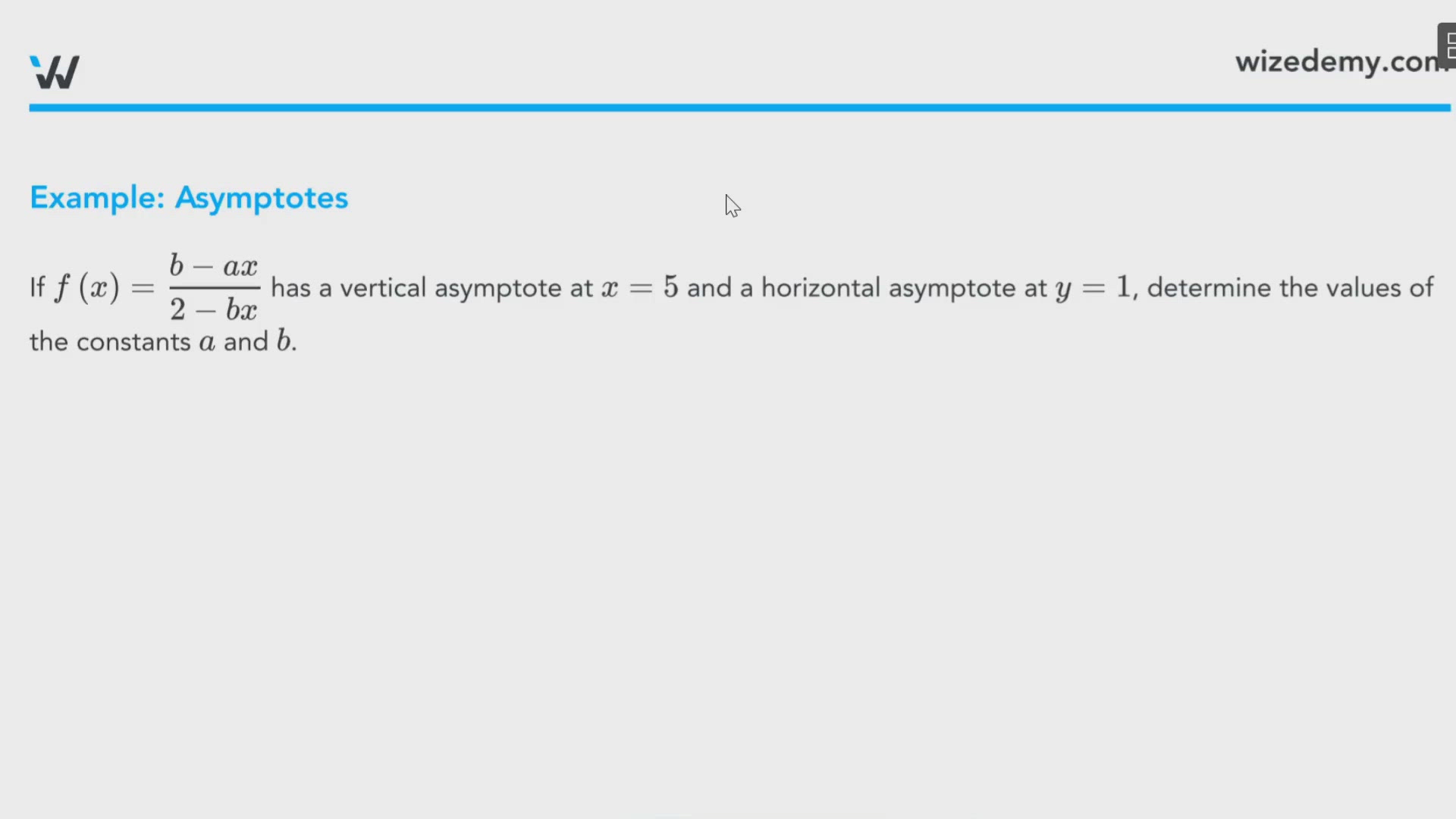
If has a vertical asymptote at and a horizontal asymptote at , determine the values of the constants and .
Vertical asymptote
The function is undefined when the denominator equals 0 and when :
Horizontal asymptote
Since we have a rational function where the degree of the numerator and denominator is the same, we can find the horizontal asymptote by dividing the coefficient fo the numerator and denominator:
Now, we set and :
Therefore, and .