0:00 / 0:00

Inflection Points & Concavity

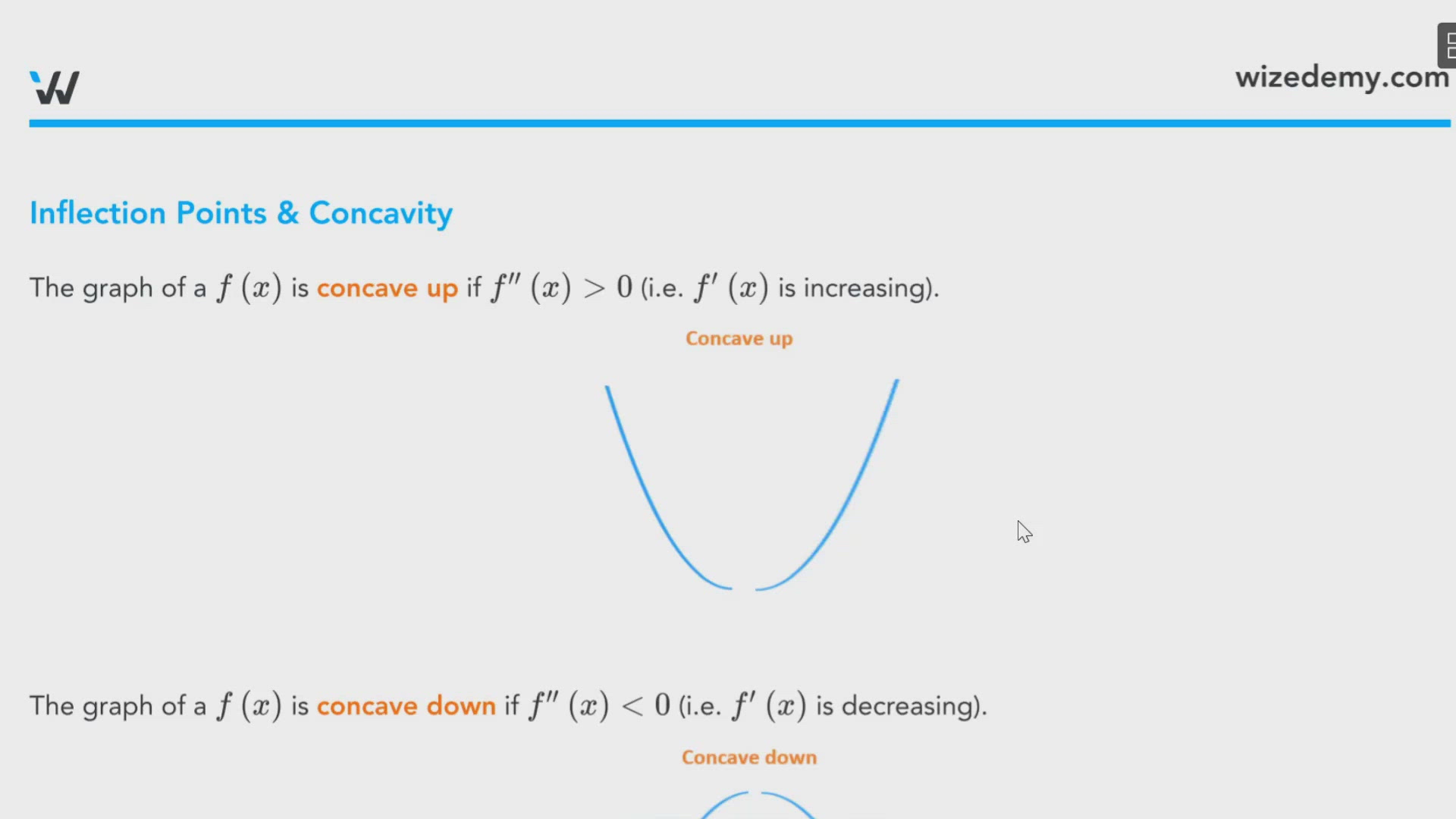
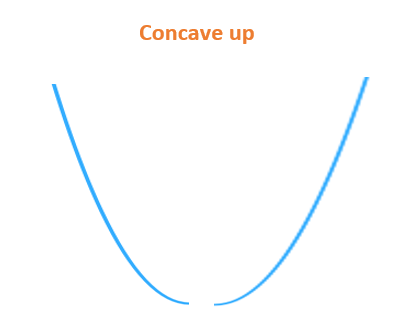
The graph of a f(x)f\left(x\right) is concave up if f(x)>0f''\left(x\right)>0 (i.e. f(x)f'\left(x\right) is increasing).


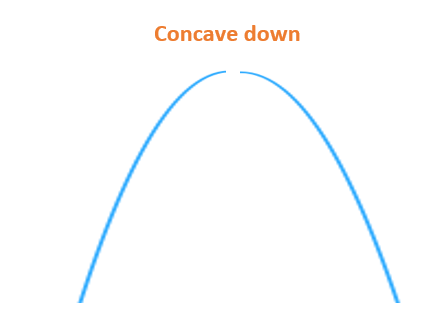
The graph of a f(x)f\left(x\right) is concave down if f(x)<0f''\left(x\right)<0 (i.e. f(x)f'\left(x\right) is decreasing).

The graph f(x)f\left(x\right) has an inflection point at (c, f(c))\left(c,\ f\left(c\right)\right) if f(c)=0f''\left(c\right)=0 or f(c)f''\left(c\right) is undefined.
*The graph may change concavity at this inflection point.


PAGE BREAK
Example
Determine any inflection points in the graph of f(x)=2x3+3x21f\left(x\right)=2x^3+3x^2-1 , and when the graph is concave up or concave down.

Find the second derivative:
f(x)=6x2+6xf'\left(x\right)=6x^2+6x
f(x)=12x+6f''\left(x\right)=12x+6

Any point(s) of inflection occurs when the second derivative equals 0 or is undefined:
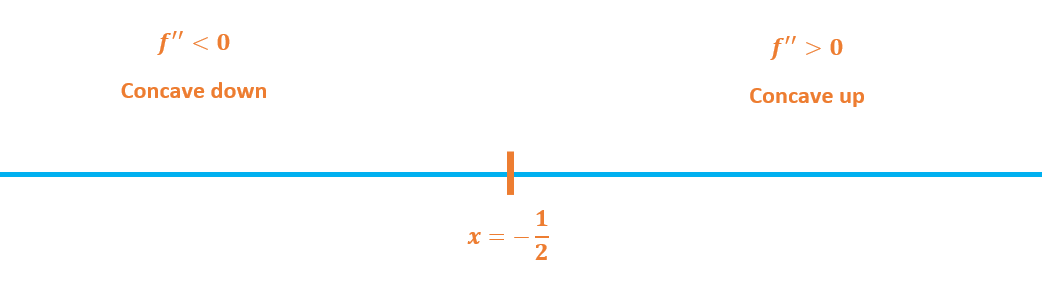
f=0=12x+6  x=12f''=0=12x+6\ \to\ x=-\frac{1}{2}

Therefore, the graph has an inflection point at x=12x=-\frac{1}{2}, it is concave down on the interval x<12x<-\frac{1}{2} and concave up on the interval x>12x>-\frac{1}{2}

Practice: Inflection Points & Concavity

Determine any inflection point(s) and intervals of concave up or down for the graph of f(x)=3x3f\left(x\right)=3\sqrt[3]{x}.
0:00 / 0:00

Second Derivative Test

Recall (First derivative test)
Suppose that x=ax=a is a critical point (a.k.a. turning point), then
  • x=ax=a is a local max if the function is increasing to the left of x=ax=a (i.e. f(x)>0f'\left(x\right)>0) and it is decreasing to the right of x=ax=a (i.e. f(x)<0f'\left(x\right)<0)
  • x=ax=a is a local min if the function is decreasing to the left of x=ax=a (i.e. f(x)<0f'\left(x\right)<0) and it is decreasing to the right of x=ax=a (i.e. f(x)>0f'\left(x\right)>0)

We can classify critical points as local max or local min points by using the second derivative instead of the first derivative.


PAGE BREAK
How to use the Second Derivative Test?
1. Find the critical points (solve f(x)=0f'\left(x\right)=0)
2. Find the second derivative f(x)f''\left(x\right)
3. Evaluate ff'' at x=ax=a
Value of fConclusionf(a)=0 or undefinedx=a is an inflection pointf(a)<0x=a is a local maxf(a)>0x=a is a local min\begin{array}{|c|c|} \hline \text{Value of }f''&\text{Conclusion}\\ \hline f''(a)=0\text{ or undefined}&x=a\text{ is an inflection point}\\ \hline f''(a)<0&x=a\text{ is a local max}\\ \hline f''(a)>0 & x=a\text{ is a local min}\\ \hline \end{array}

Example
Find an classify all critical points of the graph f(x)=x33x+1f\left(x\right)=x^3-3x+1

1. Find all critical points.
f(x)=3x23f'\left(x\right)=3x^2-3
0=3x230=3x^2-3
0=3(x1)(x+1)0=3\left(x-1\right)\left(x+1\right)
x=1 or 1x=1\ or\ -1

2. Find the second derivative.
f(x)=6xf''\left(x\right)=6x

3. Evaluate f(a)f''\left(a\right).
  • f(1)=6(1)>0f''\left(1\right)=6\left(1\right)>0, so x=1x=1 corresponds to a local min
  • f(1)=6(1)<0f''\left(-1\right)=6\left(-1\right)<0, so x=1x=-1 corresponds to a local max
Therefore, the graph has 2 critical points -- (1, 1)\left(1,\ -1\right) is a local min and (1, 3)\left(-1,\ 3\right) is a local max.

Given the function f(x)=1x2+1f\left(x\right)=\frac{1}{x^2+1}, answer the following questions.
The graph of this function has one critical point, find the coordinates of this critical point.
0:00 / 0:00

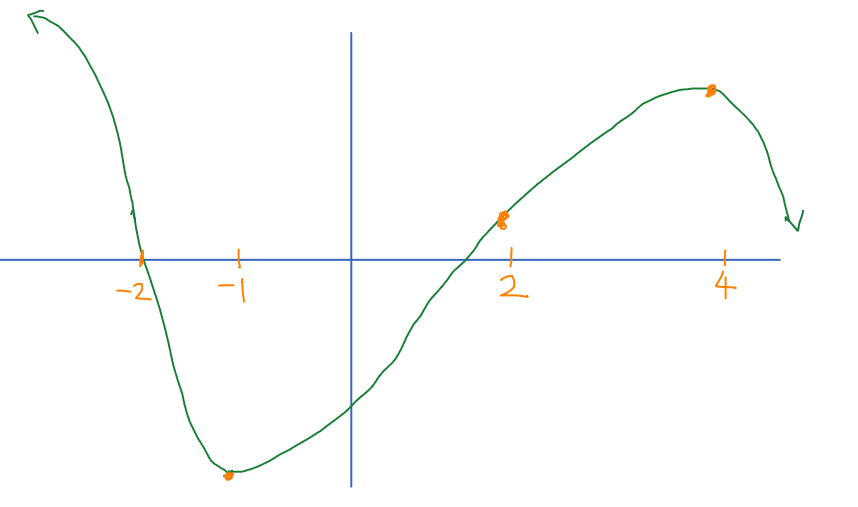
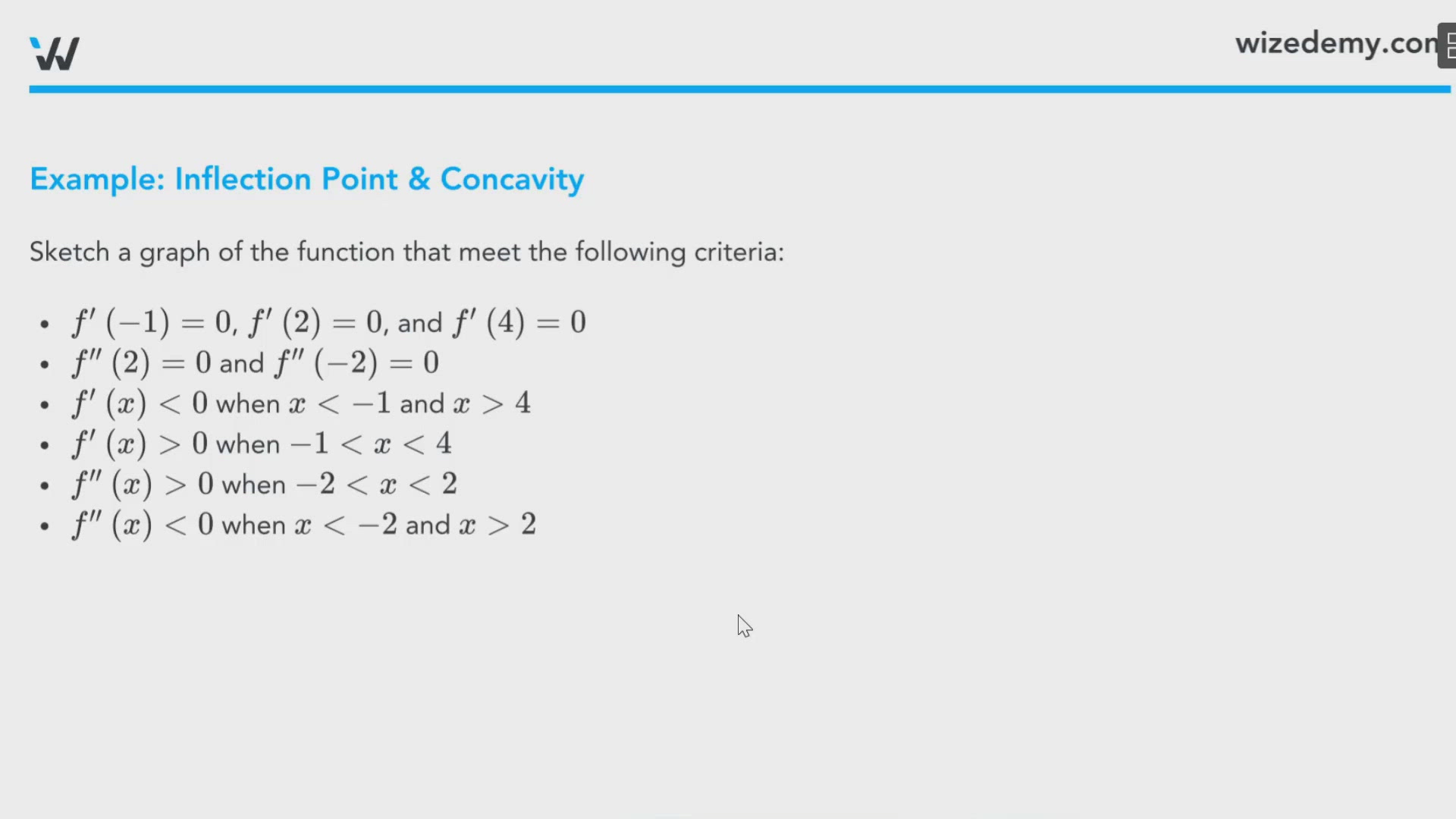
Example: Inflection Point & Concavity

Sketch a graph of the function that meet the following criteria:
  • f(1)=0f'\left(-1\right)=0, f(2)=0f'\left(2\right)=0, and f(4)=0f'\left(4\right)=0
  • f(2)=0f''\left(2\right)=0 and f(2)=0f''\left(-2\right)=0
  • f(x)<0f'\left(x\right)<0 when x<1x<-1 and x>4x>4
  • f(x)>0f'\left(x\right)>0 when 1<x<4-1<x<4
  • f(x)>0f''\left(x\right)>0 when 2<x<2-2<x<2
  • f(x)<0f''\left(x\right)<0 when x<2x<-2 and x>2x>2

0:00 / 0:00

Example: Inflection Point & Extrema

The function f(x)=ax3+bx2+cx+df\left(x\right)=ax^3+bx^2+cx+d has a local maximum at (2, 1)\left(-2,\ 1\right), local minimum at (1, 0)\left(-1,\ 0\right)
and an inflection point x=32x=-\frac{3}{2}.

Points on the graph
Since (2,1)\left(-2,1\right) and (1, 0)\left(-1,\ 0\right) are points on the graph, we can substitute the coordinates into the function:
  • 1=a(2)3+b(2)2+c(2)+d  1=8a+4b2c+d1=a\left(-2\right)^3+b\left(-2\right)^2+c\left(-2\right)+d\ \to\ \boxed{1=-8a+4b-2c+d} (equation 1)
  • 0=a(1)3+b(1)2+c(1)=d  0=a+bc+d0=a\left(-1\right)^3+b\left(-1\right)^2+c\left(-1\right)=d\ \to\ \boxed{0=-a+b-c+d} (equation 2)
Local extrema
Find the first derivative:
f(x)=3ax2+2bx+cf'\left(x\right)=3ax^2+2bx+c

Since x=2x=-2 and x=1x=-1 correspond to local extream, they result in f=0f'=0:
  • 0=3a(2)2+2b(2)+c  0=12a4b+c0=3a(-2)^2+2b(-2)+c\ \to\ \boxed{0=12a-4b+c} (equation 3)
  • 0=3a(1)2+2b(1)+c  0=3a2b+c0=3a(-1)^2+2b(-1)+c\ \to\ \boxed{0=3a-2b+c} (equation 4)
Inflection point
Since there's an inflection point at x=32x=-\frac{3}{2}, f(32)=0f''\left(-\frac{3}{2}\right)=0:
f(x)=6ax+2bf''\left(x\right)=6ax+2b
0=6a(32)+2b0=6a\left(-\frac{3}{2}\right)+2b
0=9a+2b\boxed{0=-9a+2b} (equation 5)

From equations 3: c=12a+4bc=-12a+4b
Substitute this into equation 2 and equation 1:
  • equation 2: 0=a+b(12a+4b)+d  0=11a3b+d0=-a+b-(-12a+4b)+d\ \to\ \boxed{0=11a-3b+d}
  • equation 1: 1=8a+4b2(12a+4b)+d  1=16a4b+d1=-8a+4b-2(-12a+4b)+d\ \to\ \boxed{1=16a-4b+d}
Combine the new equation 1 and 2:
1=5ab1=5a-b
b=5a1b=5a-1

Sub this into the equation 5:
0=9a+2(5a1)0=-9a+2(5a-1)
0=a20=a-2
a=2\boxed{a=2}

Use this to solve for the other coefficient values:
  • b=5(2)1  b=9b=5(2)-1\ \to\ \boxed{b=9}
  • c=12(2)+4(9)  c=12c=-12(2)+4(9)\ \to\ \boxed{c=12}
  • 0=11(2)3(9)+d  d=50=11(2)-3(9)+d\ \to\ \boxed{d=5}
Therefore, a=2,b=9,c=12,d=5a=2, b=9, c=12, d=5 and the function is f(x)=2x3+9x2+12x+5f(x)=2x^3+9x^2+12x+5.