0:00 / 0:00

Algorithm for Curve Sketching

1. Determine the domain and any discontinuities
  • Infinite discontinuity: Denominator = 0
  • Jump discontinuity: Usually piecewise functions
  • Point discontinuity: When a factor in the numerator "cancels" with a factor in the denominator
2. Determine the intercepts (Let x=0x=0, then y=0y=0)

3. Find any asymptotes & the function's behaviour near these asymptotes
  • Vertical asymptote x=ax=a: when the denominator of a rational function equals 0
  • Horizontal asymptote y=ky=k: limx±f(x)=k\displaystyle \lim_{x\to\pm\infty}f\left(x\right)=k
  • Oblique asymptote: the numerator's degree is 1 greater than the denominator's degree
4. Find the critical points (Solve f(x)=0f'(x)=0 or f(x)f'(x) undefined)

5. Determine intervals of increasing & decreasing
  • When f(x)>0f'(x)>0, the function is increasing
  • When f(x)<0f'(x)<0, the function is decreasing
6. Find the inflection points (Solve f(x)=0f''(x)=0 or f(x)f''(x) undefined)

7. Determine intervals of concave up & concave down
  • When f(x)<0f''(x)<0, the function is concave down
  • When f(x)>0f''(x)>0, the function is concave up
8. Classify the critical points as local max, local min, or neither
  • Use the first derivative test:
  • When f>0f'>0 to the left of x=ax=a and f<0f'<0 to the right of x=ax=a → local max
  • When f<0f'<0 to the left of x=ax=a and f>0f'>0 to the right of x=ax=a → local min
  • Use the second derivative test:
  • When f(a)<0f''(a)<0x=ax=a is a local max
  • When f(a)>0f''(a)>0x=ax=a is a local min
0:00 / 0:00

Example: Curve Sketching

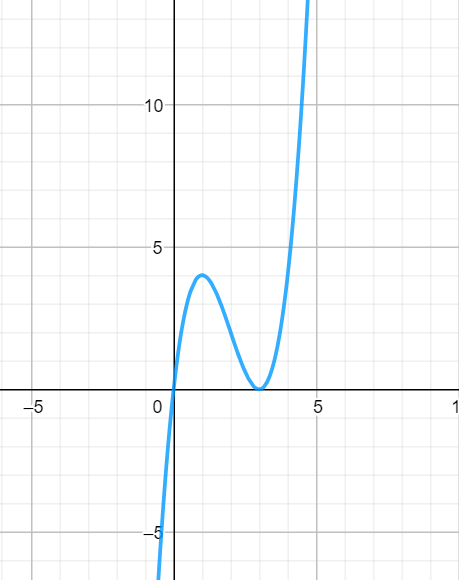
Sketch the graph of f(x)=x36x2+9xf(x)=x^3-6x^2+9x.

1. Domain and discontinuities
This is a polynomial, so it's continuous everywhere.

2. Intercepts
  • Let x=0x=0: f(0)=036(0)2+9(0)=0f(0)=0^3-6\left(0\right)^2+9\left(0\right)=0
  • Let y=0y=0: 0=x36x2+9x0=x^3-6x^2+9x0=x(x3)(x3)0=x\left(x-3\right)\left(x-3\right)
So, the y-intercept is (0, 0)\left(0,\ 0\right), and the x-intercepts are (0, 0)\left(0,\ 0\right) and (3, 0)\left(3,\ 0\right).

3. Asymptotes
  • Vertical asymptote: None
  • Horizontal asymptote: None
  • Oblique asmptote: None
4. Critical points
f(x)=3x212x+9f'\left(x\right)=3x^2-12x+9
f(x)=3(x24x+3)f'\left(x\right)=3\left(x^2-4x+3\right)
f(x)=3(x3)(x1)f'\left(x\right)=3\left(x-3\right)\left(x-1\right)
0=3(x3)(x1)0=3\left(x-3\right)\left(x-1\right)
x=3, 1x=3,\ 1

5. Intervals of increasing & decreasing

6. Inflection points
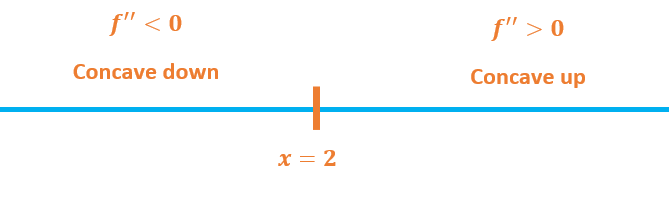
f(x)=6x12f''\left(x\right)=6x-12
0=6x120=6x-12
x=2x=2

7. Intervals of concave up and concave down

8. Classify critical points
Use first derivative test:
  • x=1x=1: increasing on the left, decreasing on the right → local max
  • x=3x=3: decreasing on the left, increasing on the right → local min
Use second derivative test:
  • x=1x=1: f(1)=6(1)12<0f''\left(1\right)=6\left(1\right)-12<0 → local max
  • x=3x=3: f(3)=6(3)12>0f''\left(3\right)=6\left(3\right)-12>0 → local min


Practice: Curve Sketching (Polynomial)

Follow these steps to graph the function f(x)=(x1)2(2x+7)f\left(x\right)=\left(x-1\right)^2\left(2x+7\right).
Which of the following is the domain of this function?
0:00 / 0:00

Example: Curve Sketching

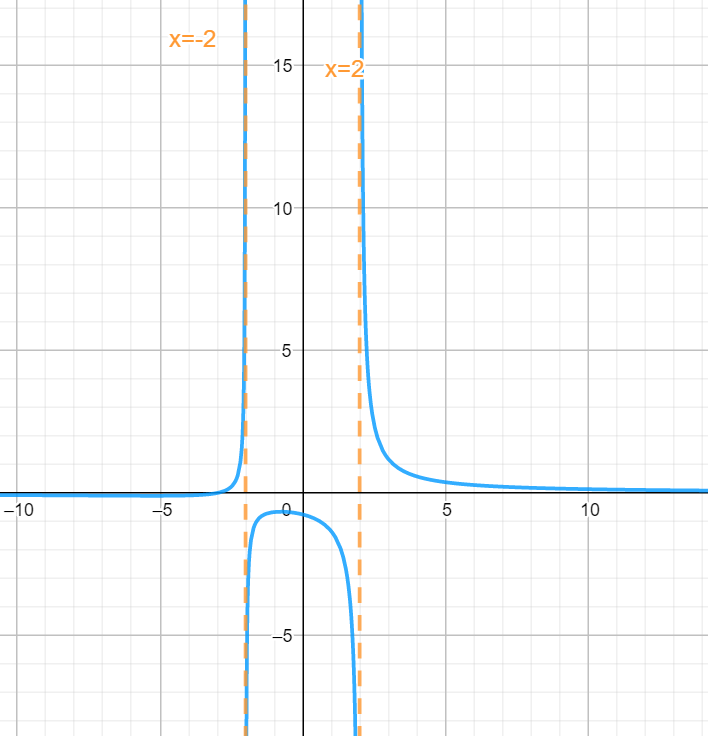
Sketch the graph of g(x)=x+3x24g(x)=\frac{x+3}{x^2-4}.

1. Domain and discontinuities
This is a rational function, so it's discontinuous when the denominator equal 0:
x=2, x=2x=-2,\ x=2

2. Intercepts
  • Let x=0x=0: g(0)=0+3(024)=34g(0)=\frac{0+3}{\left(0^2-4\right)}=-\frac{3}{4}
  • Let y=0y=0: 0=x+3x24  x=30=\frac{x+3}{x^2-4}\ \to\ x=-3
So, the y-intercept is (0, 34)\left(0,\ -\frac{3}{4}\right), and the x-intercept is (3, 0)\left(-3,\ 0\right).

3. Asymptotes
  • Vertical asymptote: x=2x=-2 and x=2x=-2
  • x2g(x)10+g(x)+x2+g(x)10g(x)x2g(x)50g(x)x2+g(x)50+g(x)+\begin{array}{|c|c|c|} \hline x\to-2^-&g(x)\to\frac{1}{0^+}&g(x)\to+\infty\\ \hline x\to-2^+&g(x)\to\frac{1}{0^-}&g(x)\to-\infty\\ \hline x\to2^-&g(x)\to\frac{5}{0^-}&g(x)\to-\infty\\ \hline x\to2^+&g(x)\to\frac{5}{0^+}&g(x)\to+\infty\\ \hline \end{array}
  • Horizontal asymptote: y=0y=0
  • As xx\to\infty: g(1000)=1003999996>0g(1000)=\frac{1003}{999996}>0 (above the H.A.)
  • As xx\to-\infty: g(1000)=997999996<0g(-1000)=\frac{-997}{999996}<0 (below the H.A.)
  • Oblique asmptote: None
4. Critical points
f(x)=(1)(x24)(x+3)(2x)[x24]2f'\left(x\right)=\frac{\left(1\right)\left(x^2-4\right)-\left(x+3\right)\left(2x\right)}{\left[x^2-4\right]^2}
f(x)=x26x4(x24)2f'\left(x\right)=\frac{-x^2-6x-4}{\left(x^2-4\right)^2}
0=x26x4(x24)20=\frac{-x^2-6x-4}{\left(x^2-4\right)^2}
0=x2+6x+40=x^2+6x+4
x=6±624(1)(4)2(1)x=\frac{-6\pm\sqrt{6^2-4\left(1\right)\left(4\right)}}{2\left(1\right)}
x=6±202x=\frac{-6\pm\sqrt{20}}{2}
x=6±252x=\frac{-6\pm2\sqrt{5}}{2}
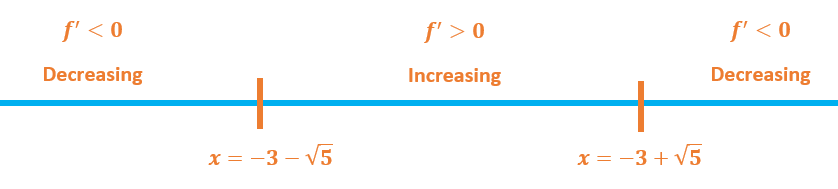
x=3±5x=-3\pm\sqrt{5}

5. Intervals of increasing & decreasing
6. Inflection points
f(x)=(2x6)(x24)2(x26x4)[2(x24)×2x][(x24)2]2f''\left(x\right)=\frac{\left(-2x-6\right)\left(x^2-4\right)^2-\left(-x^2-6x-4\right)\left[2\left(x^2-4\right)\times2x\right]}{\left[\left(x^2-4\right)^2\right]^2}
f(x)=(2x6)(x24)24x(x26x4)(x24)(x24)4f''\left(x\right)=\frac{\left(-2x-6\right)\left(x^2-4\right)^2-4x\left(-x^2-6x-4\right)\left(x^2-4\right)}{\left(x^2-4\right)^4}
f(x)=(2x6)(x24)4x(x26x4)(x24)3f''\left(x\right)=\frac{\left(-2x-6\right)\left(x^2-4\right)-4x\left(-x^2-6x-4\right)}{\left(x^2-4\right)^3}
f(x)=2x3+8x6x2+24+4x3+24x2+16x(x24)3f''\left(x\right)=\frac{-2x^3+8x-6x^2+24+4x^3+24x^2+16x}{\left(x^2-4\right)^3}
f(x)=2x3+18x2+24x+24(x24)3f''\left(x\right)=\frac{2x^3+18x^2+24x+24}{\left(x^2-4\right)^3}
0=2x3+18x2+24x+24(x24)30=\frac{2x^3+18x^2+24x+24}{\left(x^2-4\right)^3}
It's hard to solve this equation without using technology. Inflection point analysis is inconclusive.

7. Intervals of concave up and concave down
Concavity analysis is inconclusive since we are not able to solve for f=0f''=0

8. Classify critical points
Use first derivative test:
  • x=35x=-3-\sqrt{5}: decreasing on the left, increasing on the right → local min
  • x=3+5x=-3+\sqrt{5}: increasing on the left, decreasing on the right → local max

Practice: Curve Sketching (Rational Function)

Following these steps to sketch the graph of f(x)=x2+5x+4x4\displaystyle f\left(x\right)=\frac{x^2+5x+4}{x-4}.
State the domain of the function.