0:00 / 0:00

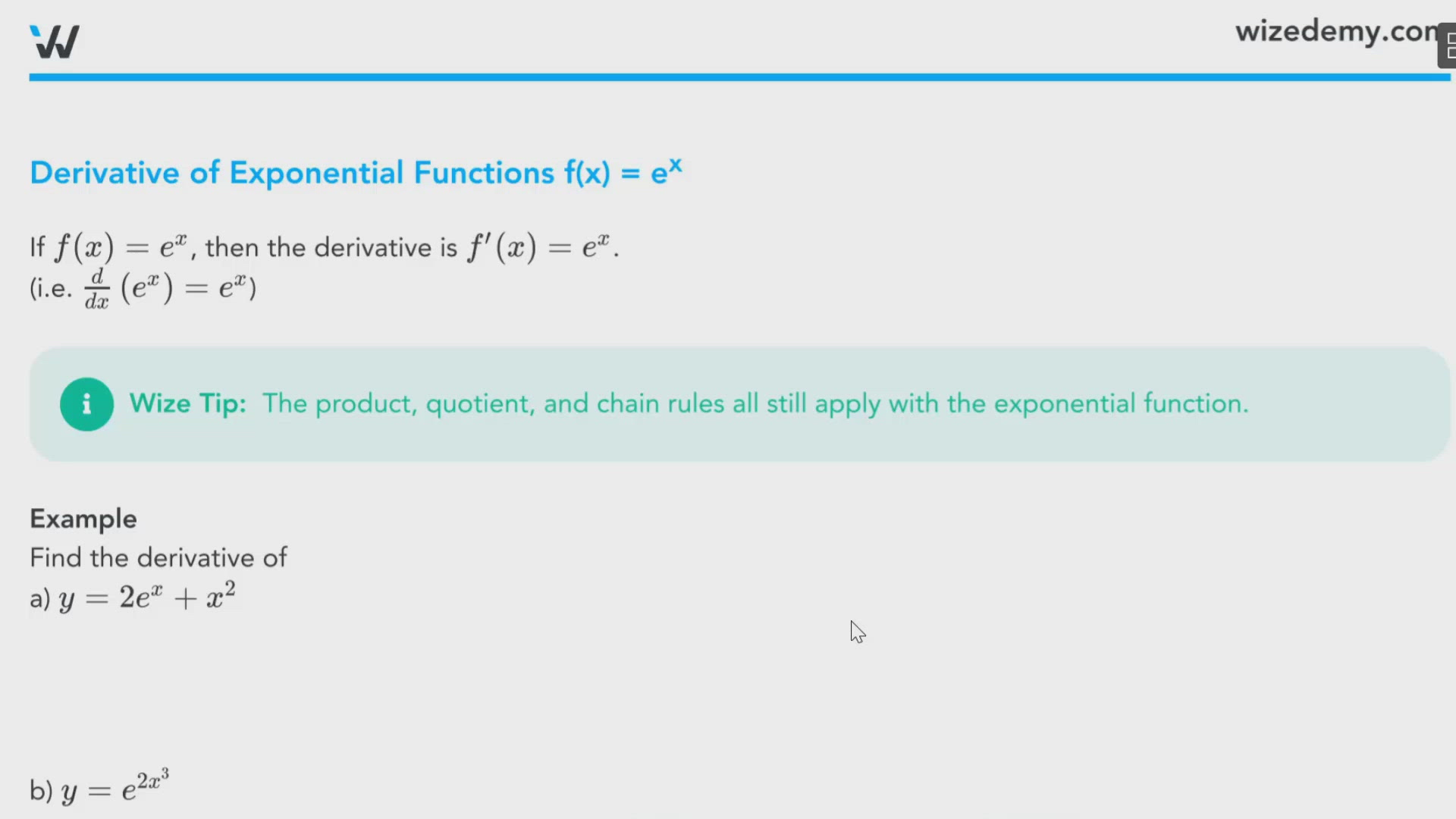
Derivative of Exponential Functions f(x) = ex

If f(x)=exf(x)=e^x, then the derivative is f(x)=exf'(x)=e^x.
(i.e. ddx(ex)=ex\frac{d}{dx}\left(e^x\right)=e^x)

Wize Tip
The product, quotient, and chain rules all still apply with the exponential function.

Example
Find the derivative of
a) y=2ex+x2y=2e^x+x^2
y=2ex+2xy'=2e^x+2x


b) y=e2x3y=e^{2x^3}
y=e2x3×(6x2)y'=e^{2x^3}\times\left(6x^2\right)
y=6x2 e2x3y'=6x^2\ e^{2x^3}


c) y=(x2x)e2x+1y=\left(x^2-x\right)e^{2x+1}
y=(2x1)e2x+1+(x2x)[e2x+1×2]y'=\left(2x-1\right)e^{2x+1}+\left(x^2-x\right)\left[e^{2x+1}\times2\right]
y=(2x1)e2x+1+2(x2x)(e2x+1)y'=\left(2x-1\right)e^{2x+1}+2\left(x^2-x\right)\left(e^{2x+1}\right)
y=e2x+1[(2x1)+2(x2x)]y'=e^{2x+1}\left[\left(2x-1\right)+2\left(x^2-x\right)\right]
y=e2x+1[2x1+2x22x]y'=e^{2x+1}\left[2x-1+2x^2-2x\right]
y=e2x+1[2x21]y'=e^{2x+1}\left[2x^2-1\right]


d) y=e2y=e^2
e2e^2 is just a constant.
y=0y'=0

Practice: Derivative of Exponential Functions

Find the rate of change of the function f(x)=(xex)(2x2)e3xf\left(x\right)=\left(x-e^x\right)\left(2x^2\right)-e^3x at x=ln2x=\ln2.
0:00 / 0:00

Example: Derivative of Exponential Functions

Determine an expression for the nth derivative of y=e2xy=e^{2x}.

First derivative:
y=e2x×2=2e2xy'=e^{2x}\times2=2e^{2x}

Second derivative:
y=2e2x×2=22e2xy''=2e^{2x}\times2=2^2e^{2x}

Third derivative:
y=22e2x×2=23e2xy'''=2^2e^{2x}\times2=2^3e^{2x}
...

The nth derivative:
y(n)=2ne2xy^{\left(n\right)}=2^ne^{2x}

Practice: Derivative of Exponential Functions

Find the equation of the tangent line to the curve y=xexy=\sqrt{xe^{\sqrt{x}}} at the point x=1x=1.
0:00 / 0:00

Example: Derivative of Exponential Functions

The number of bacteria in a petri dish is modelled by A(t)=500(et10+100t+1)A\left(t\right)=500\left(e^{-\frac{t}{10}}+\frac{100}{t+1}\right), where tt is measured in hours.
a) Find the initial number of bacteria in the petri dish.
b) How fast is the number of bacteria changing at time t=20t=20?
c) Determine the largest number of bacteria on the interval 10t5010\le t\le50.

a) A(0)=500(e010+1000+1)=500(1+100)=50500A\left(0\right)=500\left(e^{-\frac{0}{10}}+\frac{100}{0+1}\right)=500\left(1+100\right)=50500
Therefore, there are initially 50500 bacteria in the petri dish initially.

b) To find the rate of change, we need to find the derivative.
Rewrite: A(t)=500(e110t+100(t+1)1)A'\left(t\right)=500\left(e^{-\frac{1}{10}t}+100\left(t+1\right)^{-1}\right)
A(t)=500(e110t×110+100×[1(t+1)2×1])A'\left(t\right)=500\left(e^{-\frac{1}{10}t}\times-\frac{1}{10}+100\times\left[-1\left(t+1\right)^{-2}\times1\right]\right)
A(t)=500(110e110t100(t+1)2)A'\left(t\right)=500\left(-\frac{1}{10}e^{-\frac{1}{10}t}-\frac{100}{\left(t+1\right)^2}\right)
A(20)=500(110e110×20100(20+1)2)A'\left(20\right)=500\left(-\frac{1}{10}e^{-\frac{1}{10}\times20}-\frac{100}{\left(20+1\right)^2}\right)
A(20)=500(110e2100212)A'\left(20\right)=500\left(-\frac{1}{10}e^{-2}-\frac{100}{21^2}\right)
A(20)=50e250000212A'\left(20\right)=-\frac{50}{e^2}-\frac{50000}{21^2}

c) To find the largest number of bacteria on that interval, we need to find the absolute maximum.
A(t)=500(110et10+100(t+1)2)A'\left(t\right)=-500\left(\frac{1}{10e^{\frac{t}{10}}}+\frac{100}{\left(t+1\right)^2}\right)
Observe that the derivative never equals 0, so the absolute maximum occurs at one of the end points.
  • A(10)=500(e1010+10010+1)=500(e1+10011)4729.4A\left(10\right)=500\left(e^{-\frac{10}{10}}+\frac{100}{10+1}\right)=500\left(e^{-1}+\frac{100}{11}\right)\approx4729.4
  • A(50)=500(e5010+10050+1)=500(e5+10051)983.8A\left(50\right)=500\left(e^{-\frac{50}{10}}+\frac{100}{50+1}\right)=500\left(e^{-5}+\frac{100}{51}\right)\approx983.8
Therefore, the largest number of bacteria on this interval is approximately 984 at t=50t=50
0:00 / 0:00

Example: Derivative of Exponential Functions & Differential Equations

Wize Concept
Differential equations are equations that involve yy and its derivatives y, y,y',\ y'', etc.

Determine the value of the constant bb such that y=aebxy=ae^{bx} satisfies the differential equation 2d2ydx24dydx30y=02\frac{d^2y}{dx^2}-4\frac{dy}{dx}-30y=0.

y=aebxy=ae^{bx}
dydx=aebx×b=abebx\frac{dy}{dx}=ae^{bx}\times b=abe^{bx}
d2ydx2=abebx×b=ab2ebx\frac{d^2y}{dx^2}=abe^{bx}\times b=ab^2e^{bx}

Sub these into the equation:
2(ab2ebx)4(abebx)30(aebx)=02\left(ab^2e^{bx}\right)-4\left(abe^{bx}\right)-30\left(ae^{bx}\right)=0
2ab2ebx4abebx30aebx=02ab^2e^{bx}-4abe^{bx}-30ae^{bx}=0
2aebx(b22b15)=02ae^{bx}\left(b^2-2b-15\right)=0
2aebx(b5)(b+3)=02ae^{bx}\left(b-5\right)\left(b+3\right)=0
b=5b=5 and b=3b=-3