0:00 / 0:00

Derivative of Exponential Functions f(x) = bx

If f(x)=bxf(x)=b^x, then the derivative is f(x)=bx×lnbf'(x)=b^x\times\ln b.
(i.e. ddx(bx)=bx×lnb\frac{d}{dx}\left(b^x\right)=b^x\times\ln b)

Wize Tip
The product, quotient, and chain rules all still apply with the exponential function.

Example
Find the derivative of
a) y=2(4x)+x2y=2\left(4^x\right)+x^2
y=2(4x×ln4)+2xy'=2\left(4^x\times\ln4\right)+2x


b) y=42x3y=4^{2x^3}
y=42x3×ln4×(6x2)y'=4^{2x^3}\times\ln4\times\left(6x^2\right)
y=6(ln4)x2 e2x3y'=6\left(\ln4\right)x^2\ e^{2x^3}


c) y=(x2x)42x+1y=\left(x^2-x\right)4^{2x+1}
y=(2x1)42x+1+(x2x)[42x+1×ln4×2]y'=\left(2x-1\right)4^{2x+1}+\left(x^2-x\right)\left[4^{2x+1}\times\ln4\times2\right]
y=(2x1)e2x+1+2ln4(x2x)(e2x+1)y'=\left(2x-1\right)e^{2x+1}+2\ln4\left(x^2-x\right)\left(e^{2x+1}\right)
y=e2x+1[(2x1)+2ln4(x2x)]y'=e^{2x+1}\left[\left(2x-1\right)+2\ln4\left(x^2-x\right)\right]


d) y=4ey=4^e
4e4^e is just a constant.
y=0y'=0

Practice: Derivative of Exponential Functions

Find the derivative of the following functions at the given point.
f(x)=x2xf(x)=x2^x, at x=0x=0

Practice: Derivative of Exponential Functions

Find the equation of the tangent line to the curve y=13xy=\frac{1}{3^x} at x=0x=0.
0:00 / 0:00

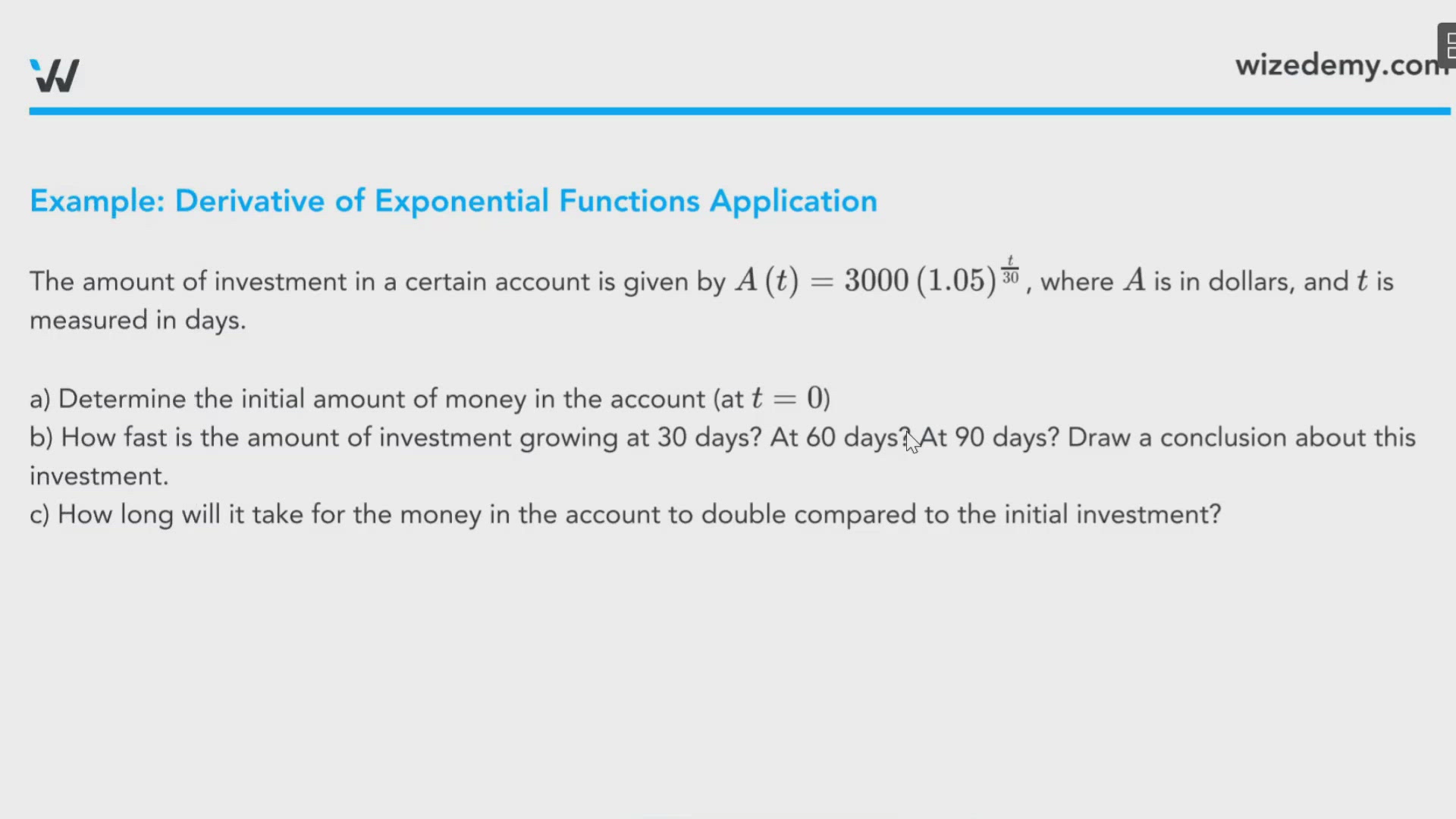
Example: Derivative of Exponential Functions Application

The amount of investment in a certain account is given by A(t)=3000(1.05)t30A\left(t\right)=3000\left(1.05\right)^{\frac{t}{30}}, where AA is in dollars, and tt is measured in days.

a) Determine the initial amount of money in the account (at t=0t=0)
b) How fast is the amount of investment growing at 30 days? At 60 days? At 90 days? Draw a conclusion about this investment.
c) How long will it take for the money in the account to double compared to the initial investment?

a) at t=0\orange{t=0}:
A(0)=3000(1.05)030=3000(1)=3000A\left(0\right)=3000\left(1.05\right)^{\frac{0}{30}}=3000\left(1\right)=3000
Therefore, the initial amount of investment in the account is $1000

b) To find the rate of change, we need to find the derivative:
A(t)=3000(1.05)t30×ln(1.05)×130=100(1.05)t30×ln(1.05)A'\left(t\right)=3000\left(1.05\right)^{\frac{t}{30}}\times\ln\left(1.05\right)\times\frac{1}{30}=100\left(1.05\right)^{\frac{t}{30}}\times\ln\left(1.05\right)

At 30 days:
A(30)=100(1.05)3030×ln(1.05)=105×ln(1.05)5.12A'\left(30\right)=100\left(1.05\right)^{\frac{30}{30}}\times\ln\left(1.05\right)=105\times\ln\left(1.05\right)\approx5.12
So, at 30 days, the investment is growing at a rate of approximately $5.12 per day.

At 60 days:
A(60)=100(1.05)6030×ln(1.05)5.38A'\left(60\right)=100\left(1.05\right)^{\frac{60}{30}}\times\ln\left(1.05\right)\approx5.38
So, at 60 days, the investment is growing at a rate of approximately $5.38 per day.

At 90 days:
A(90)=100(1.05)9030×ln(1.05)5.65A'\left(90\right)=100\left(1.05\right)^{\frac{90}{30}}\times\ln\left(1.05\right)\approx5.65
So, at 90 days, the investment is growing at a rate of approximately $5.65 per day.

Therefore, the investment is growing faster and faster with time.

c) A(0)=3000\orange{A\left(0\right)=3000}, so we want to find how long it takes for the amount to double to $6000.
6000=3000(1.05)t306000=3000\left(1.05\right)^{\frac{t}{30}}
2=1.05t302=1.05^{\frac{t}{30}}

Option 1: Guess and check
t=10t=10: 1.0510301.021.05^{\frac{10}{30}}\approx1.02
t=100t=100: 1.05100301.181.05^{\frac{100}{30}}\approx1.18
t=500t=500: 1.05500302.261.05^{\frac{500}{30}}\approx2.26
t=400t=400: 1.05400301.921.05^{\frac{400}{30}}\approx1.92
t=450t=450: 1.05450302.081.05^{\frac{450}{30}}\approx2.08
t=425t=425: 1.05425301.9961.05^{\frac{425}{30}}\approx1.996
t=426t=426: 1.05426301.9991.05^{\frac{426}{30}}\approx1.999
t=427t=427: 1.05427302.0031.05^{\frac{427}{30}}\approx2.003

Option 2: Use log
log1.052=t30\log_{1.05}2=\frac{t}{30}
30×log1.052=t30\times\log_{1.05}2=t
426.2t426.2\approx t

Therefore, it will take approximately 427 days for the initial investment to double.

Practice: Derivative of Exponential Functions Application

The amount of a certain radioactive substance is modelled by A(t)=2000(2)tA\left(t\right)=2000\left(2\right)^{-t}, where AA is measured in micrograms and tt is measured in years.

The half-life of the substance is the amount of time it takes for the substance to decay to half the amount.
Determine the initial amount of substance at t=0t=0.