0:00 / 0:00

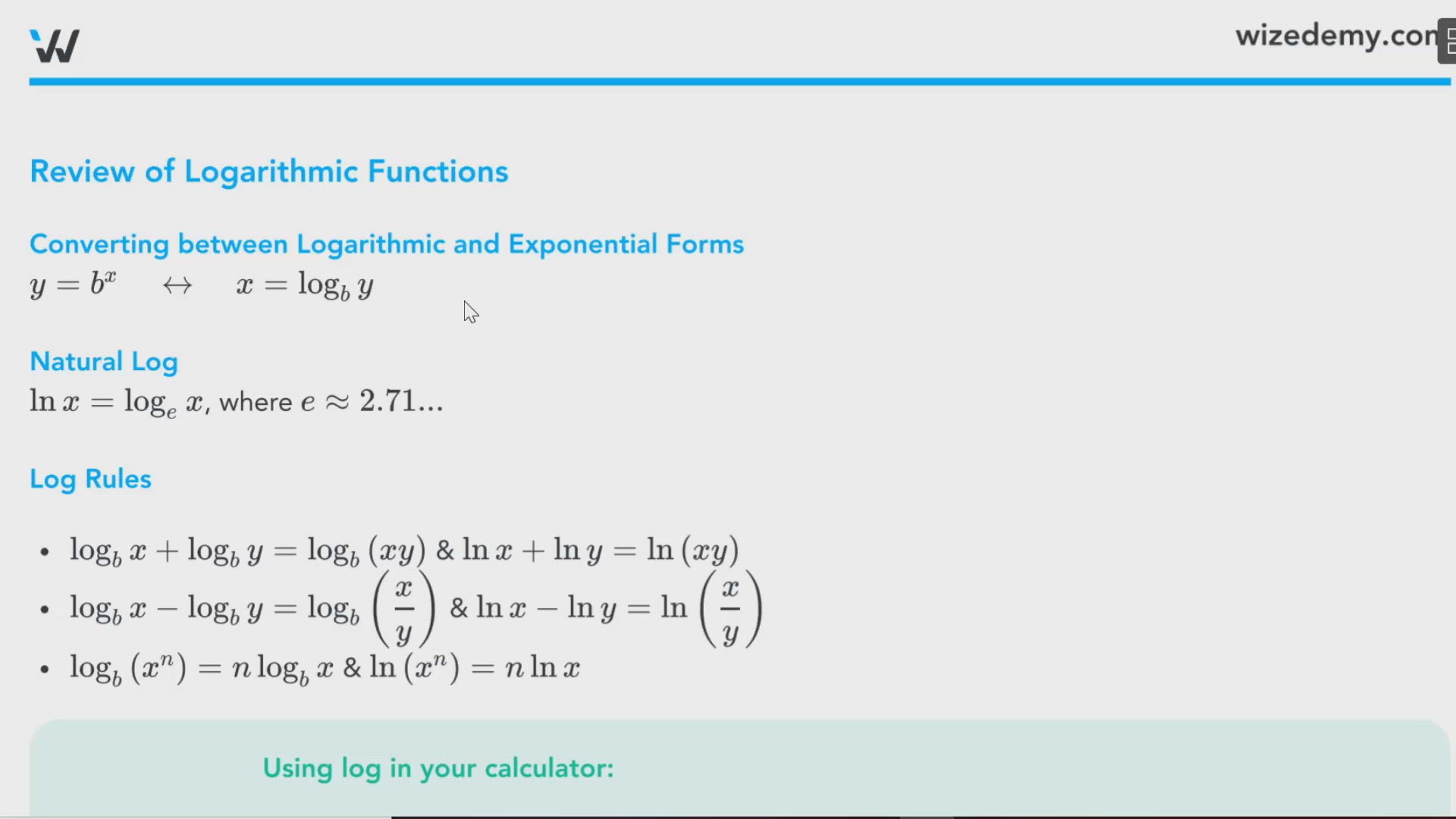
Review of Logarithmic Functions

Converting between Logarithmic and Exponential Forms
y=bx        x=logbyy=b^x\ \ \ \ \leftrightarrow\ \ \ \ x=\log_by

Natural Log
lnx=logex\ln x=\log_ex, where e2.71...e\approx2.71...

Log Rules
  • logbx+logby=logb(xy)\displaystyle \log_bx+\log_by=\log_b\left(xy\right) & lnx+lny=ln(xy)\ln x+\ln y=\ln\left(xy\right)
  • logbxlogby=logb(xy)\displaystyle \log_bx-\log_by=\log_b\left(\frac{x}{y}\right) & lnxlny=ln(xy)\displaystyle \ln x-\ln y=\ln\left(\frac{x}{y}\right)
  • logb(xn)=nlogbx\log_b\left(x^n\right)=n\log_bx & ln(xn)=nlnx\ln\left(x^n\right)=n\ln x
Wize Tip
Using log in your calculator:
  • Most calculators have the log\log button, this represents log10\log_{10}
  • If we want to calculate logbx\log_bx for base b10b\ne10, we can use the formula log10xlog10b  or  lnxlnb\displaystyle \frac{\log_{10}x}{\log_{10}b}\ \ or\ \ \frac{\ln x}{\ln b}

Practice: Logarithmic Functions

Use the graph of the logarithmic function to evaluate the following limits.
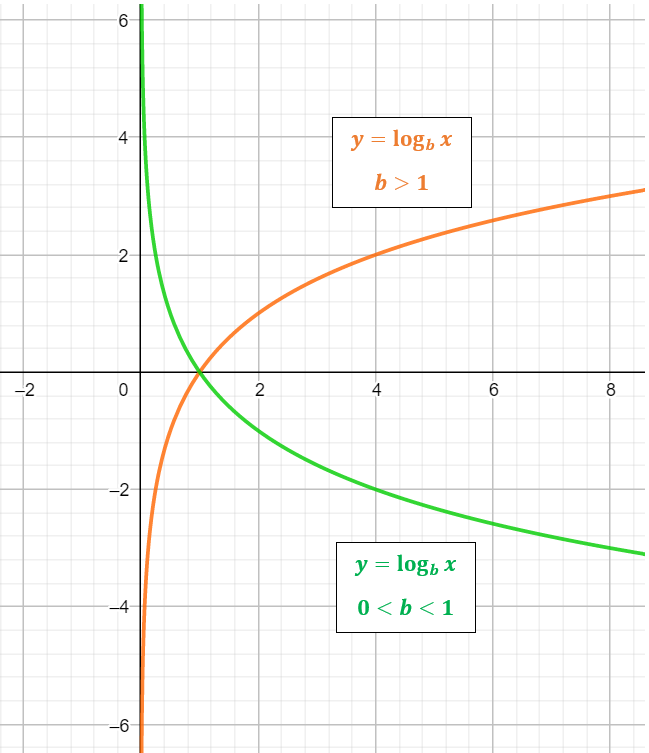
Enter the \infty or -\infty symbols when needed instead of DNE.
0:00 / 0:00

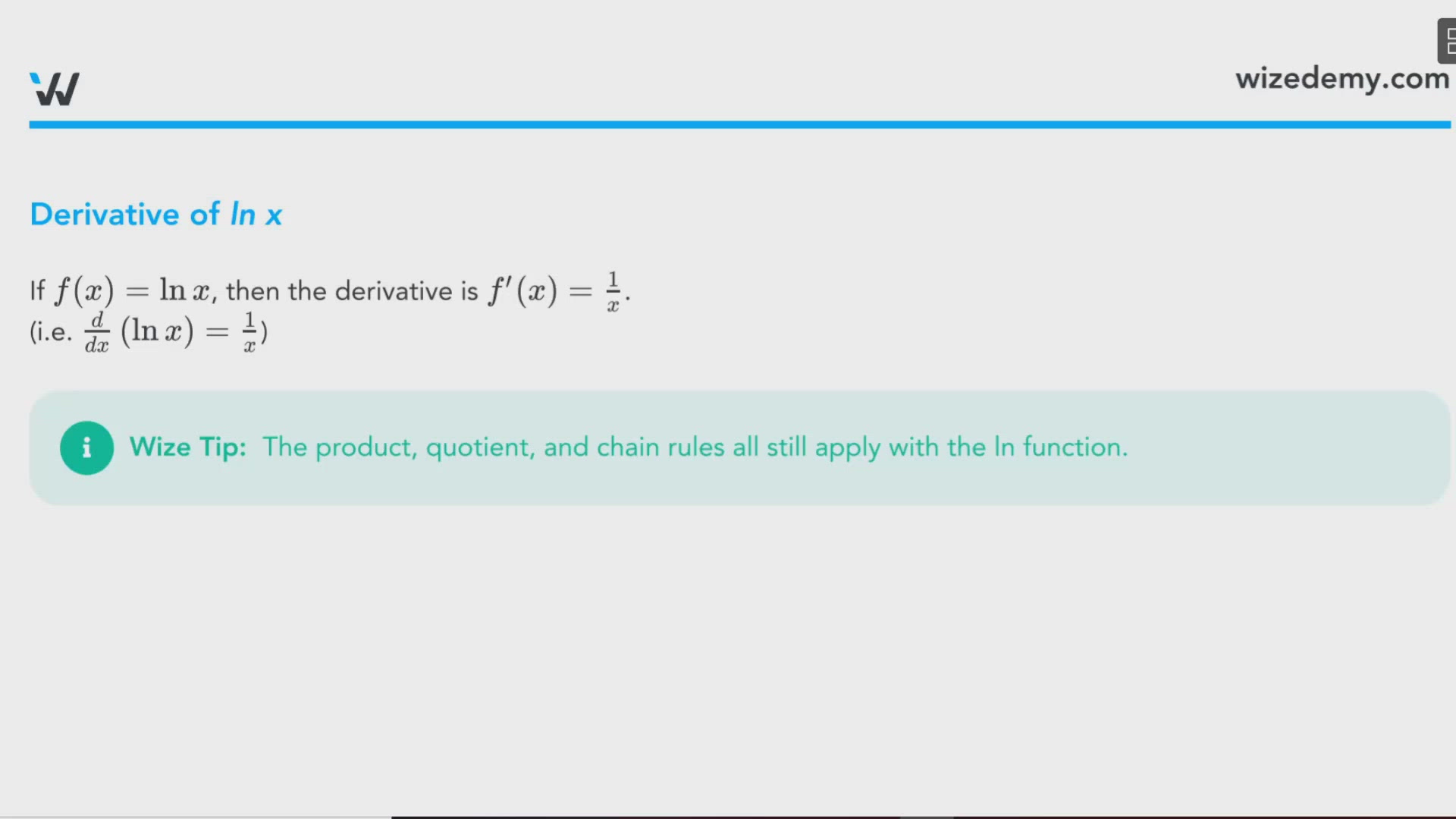
Derivative of ln x

If f(x)=lnxf(x)=\ln x, then the derivative is f(x)=1xf'(x)=\frac{1}{x}.
(i.e. ddx(lnx)=1x\frac{d}{dx}\left(\ln x\right)=\frac{1}{x})

Wize Tip
The product, quotient, and chain rules all still apply with the ln function.


PAGE BREAK
Example
Find the derivative of the following:
a) y=(3xx2)lnxy=\left(3x-x^2\right)\ln x
We need to use product rule:
y=Derivative of the first×Second+First×Derivative of the secondy'=\orange{\text{Derivative of the first}}\times\text{Second}+\text{First}\times\green{\text{Derivative of the second}}
y=(3xx2)(lnx)+(3xx2)(lnx)y'=\orange{\left(3x-x^2\right)'}\left(\ln x\right)+\left(3x-x^2\right)\green{\left(\ln x\right)'}
y=(32x)(lnx)+(3xx2)(1x)\displaystyle y'=\orange{\left(3-2x\right)}\left(\ln x\right)+\left(3x-x^2\right)\green{\left(\frac{1}{x}\right)}
y=(32x)(lnx)+(3x)y'=\left(3-2x\right)\left(\ln x\right)+\left(3-x\right)

b) y=lnxex\displaystyle y=\frac{\ln x}{e^x}
We need to use quotient rule:
y=Derivative of the first×SecondFirst×Derivative of the secondSecond2\displaystyle y'=\frac{\orange{\text{Derivative of the first}}\times \text{Second}-\text{First}\times\green{\text{Derivative of the second}}}{\text{Second}^2}
y=(lnx)(ex)(lnx)(ex)(ex)2\displaystyle y'=\frac{\orange{\left(\ln x\right)'}\left(e^x\right)-\left(\ln x\right)\green{\left(e^x\right)'}}{\left(e^x\right)^2}
y=(1x)(ex)(lnx)(ex)(ex)2\displaystyle y'=\frac{\orange{\left(\frac{1}{x}\right)}\left(e^x\right)-\left(\ln x\right)\green{\left(e^x\right)}}{\left(e^x\right)^2}
y=1x(lnx)ex\displaystyle y'=\frac{\frac{1}{x}-\left(\ln x\right)}{e^x}


PAGE BREAK
c) y=ln(2ex)y=\ln\left(2-e^x\right)
We need to use chain rule:
y=Derivative of the ouside×Derivative of the insidey'=\orange{\text{Derivative of the ouside}}\times\green{\text{Derivative of the inside}}
y=(ln...)×(2ex)y'=\orange{\left(\ln...\right)'}\times\green{\left(2-e^x\right)'}
y=12ex×(ex)\displaystyle y'=\orange{\frac{1}{2-e^x}}\times\green{\left(-e^x\right)}
y=ex2ex\displaystyle y'=-\frac{e^x}{2-e^x}

d) y=ln(x21+x)\displaystyle y=\ln\left(\frac{x^2}{1+x}\right)
We need to use chain rule, then quotient rule.
Chain rule:
y=Derivative of the outside×Derivative of the insidey'=\orange{\text{Derivative of the outside}}\times\green{\text{Derivative of the inside}}
y=(ln...)×(x21+x)\displaystyle y'=\orange{\left(\ln...\right)'}\times\green{\left(\frac{x^2}{1+x}\right)'}
Quotient rule for the derivative of the inside:
y=(1x21+x)×((x2)(1+x)(x2)(1+x)(1+x)2)\displaystyle y'=\orange{\left(\frac{1}{\frac{x^2}{1+x}}\right)}\times\green{\left(\frac{\purple{\left(x^2\right)'}\left(1+x\right)-\left(x^2\right)\blue{\left(1+x\right)'}}{\left(1+x\right)^2}\right)}
y=(1+xx2)×((2x)(1+x)(x2)(1)(x+1)2)\displaystyle y'=\orange{\left(\frac{1+x}{x^2}\right)}\times\green{\left(\frac{\purple{(2x)}\left(1+x\right)-\left(x^2\right)\blue{\left(1\right)}}{\left(x+1\right)^2}\right)}
y=(1+xx2)×(2x+x2(x+1)2)\displaystyle y'=\left(\frac{1+x}{x^2}\right)\times\left(\frac{2x+x^2}{\left(x+1\right)^2}\right)
y=(1x)×(2+x(x+1))\displaystyle y'=\left(\frac{1}{x}\right)\times\left(\frac{2+x}{\left(x+1\right)}\right)
y=2x+1x(x+1)\displaystyle y'=\frac{2x+1}{x\left(x+1\right)}
0:00 / 0:00

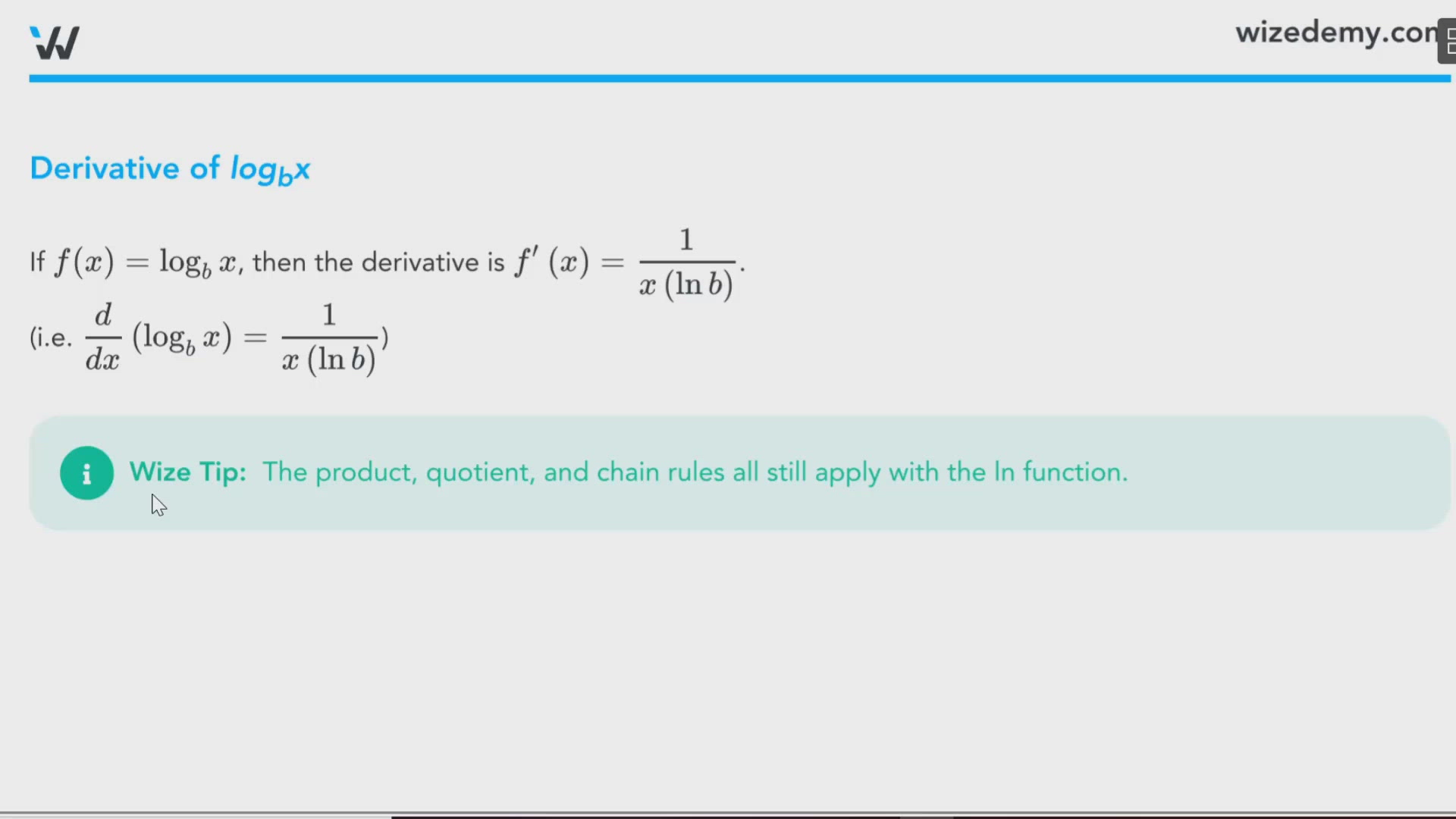
Derivative of logbx

If f(x)=logbxf(x)=\log_bx, then the derivative is f(x)=1x(lnb)\displaystyle f'\left(x\right)=\frac{1}{x\left(\ln b\right)}.
(i.e. ddx(logbx)=1x(lnb)\displaystyle \frac{d}{dx}\left(\log_bx\right)=\frac{1}{x\left(\ln b\right)})

Wize Tip
The product, quotient, and chain rules all still apply with the log function.


PAGE BREAK
Example
Find the derivatives of the following functions.
a) y=(3xx2)log2xy=\left(3x-x^2\right)\log_2x
We need to use product rule:
y=Derivative of the first×Second+First×Derivative of the secondy'=\orange{\text{Derivative of the first}}\times\text{Second}+\text{First}\times\green{\text{Derivative of the second}}
y=(3xx2)(log2x)+(3xx2)(log2x)y'=\orange{\left(3x-x^2\right)'}\left(\log_2x\right)+\left(3x-x^2\right)\green{\left(\log_2 x\right)'}
y=(32x)(log2x)+(3xx2)(1x(ln2))\displaystyle y'=\orange{\left(3-2x\right)}\left(\log_2 x\right)+\left(3x-x^2\right)\green{\left(\frac{1}{x(\ln2)}\right)}
y=(32x)(log2x)+(3x)ln2y'=\left(3-2x\right)\left(\log_2x\right)+\frac{\left(3-x\right)}{\ln2}

b) y=log2xex\displaystyle y=\frac{\log_2 x}{e^x}
We need to use quotient rule:
y=Derivative of the first×SecondFirst×Derivative of the secondSecond2\displaystyle y'=\frac{\orange{\text{Derivative of the first}}\times \text{Second}-\text{First}\times\green{\text{Derivative of the second}}}{\text{Second}^2}
y=(log2x)(ex)(log2x)(ex)(ex)2\displaystyle y'=\frac{\orange{\left(\log_2 x\right)'}\left(e^x\right)-\left(\log_2 x\right)\green{\left(e^x\right)'}}{\left(e^x\right)^2}
y=(1x(ln2))(ex)(log2x)(ex)(ex)2\displaystyle y'=\frac{\orange{\left(\frac{1}{x(\ln2)}\right)}\left(e^x\right)-\left(\log_2 x\right)\green{\left(e^x\right)}}{\left(e^x\right)^2}
y=1x(ln2)(log2x)ex\displaystyle y'=\frac{\frac{1}{x(\ln2)}-\left(\log_2 x\right)}{e^x}


PAGE BREAK
c) y=log2(2ex)y=\log_2\left(2-e^x\right)
We need to use chain rule:
y=Derivative of the ouside×Derivative of the insidey'=\orange{\text{Derivative of the ouside}}\times\green{\text{Derivative of the inside}}
y=(log2...)×(2ex)y'=\orange{\left(\log_2...\right)'}\times\green{\left(2-e^x\right)'}
y=1(2ex)(ln2)×(ex)\displaystyle y'=\orange{\frac{1}{(2-e^x)(\ln2)}}\times\green{\left(-e^x\right)}
y=ex(2ex)(ln2)\displaystyle y'=-\frac{e^x}{(2-e^x)(\ln2)}

d) y=log2(x21+x)\displaystyle y=\log_2\left(\frac{x^2}{1+x}\right)
We need to use chain rule, then quotient rule.
Chain rule:
y=Derivative of the outside×Derivative of the insidey'=\orange{\text{Derivative of the outside}}\times\green{\text{Derivative of the inside}}
y=(log2...)×(x21+x)\displaystyle y'=\orange{\left(\log_2...\right)'}\times\green{\left(\frac{x^2}{1+x}\right)'}
Quotient rule for the derivative of the inside:
y=(1x21+x(ln2))×((x2)(1+x)(x2)(1+x)(1+x)2)\displaystyle y'=\orange{\left(\frac{1}{\frac{x^2}{1+x}(\ln2)}\right)}\times\green{\left(\frac{\purple{\left(x^2\right)'}\left(1+x\right)-\left(x^2\right)\blue{\left(1+x\right)'}}{\left(1+x\right)^2}\right)}
y=(1+xx2(ln2))×((2x)(1+x)(x2)(1)(x+1)2)\displaystyle y'=\orange{\left(\frac{1+x}{x^2(\ln2)}\right)}\times\green{\left(\frac{\purple{(2x)}\left(1+x\right)-\left(x^2\right)\blue{\left(1\right)}}{\left(x+1\right)^2}\right)}
y=(1+xx2(ln2))×(2x+x2(x+1)2)\displaystyle y'=\left(\frac{1+x}{x^2(\ln2)}\right)\times\left(\frac{2x+x^2}{\left(x+1\right)^2}\right)
y=(1x(ln2))×(2+x(x+1))\displaystyle y'=\left(\frac{1}{x(\ln2)}\right)\times\left(\frac{2+x}{\left(x+1\right)}\right)
y=2+xx(ln2)(x+1)\displaystyle y'=\frac{2+x}{x(\ln2)\left(x+1\right)}