Wize Grade 11 Mathematics Textbook > Polynomials Factoring and Graphs
Basic Factoring Techniques
0:00 / 0:00
Factoring Polynomials
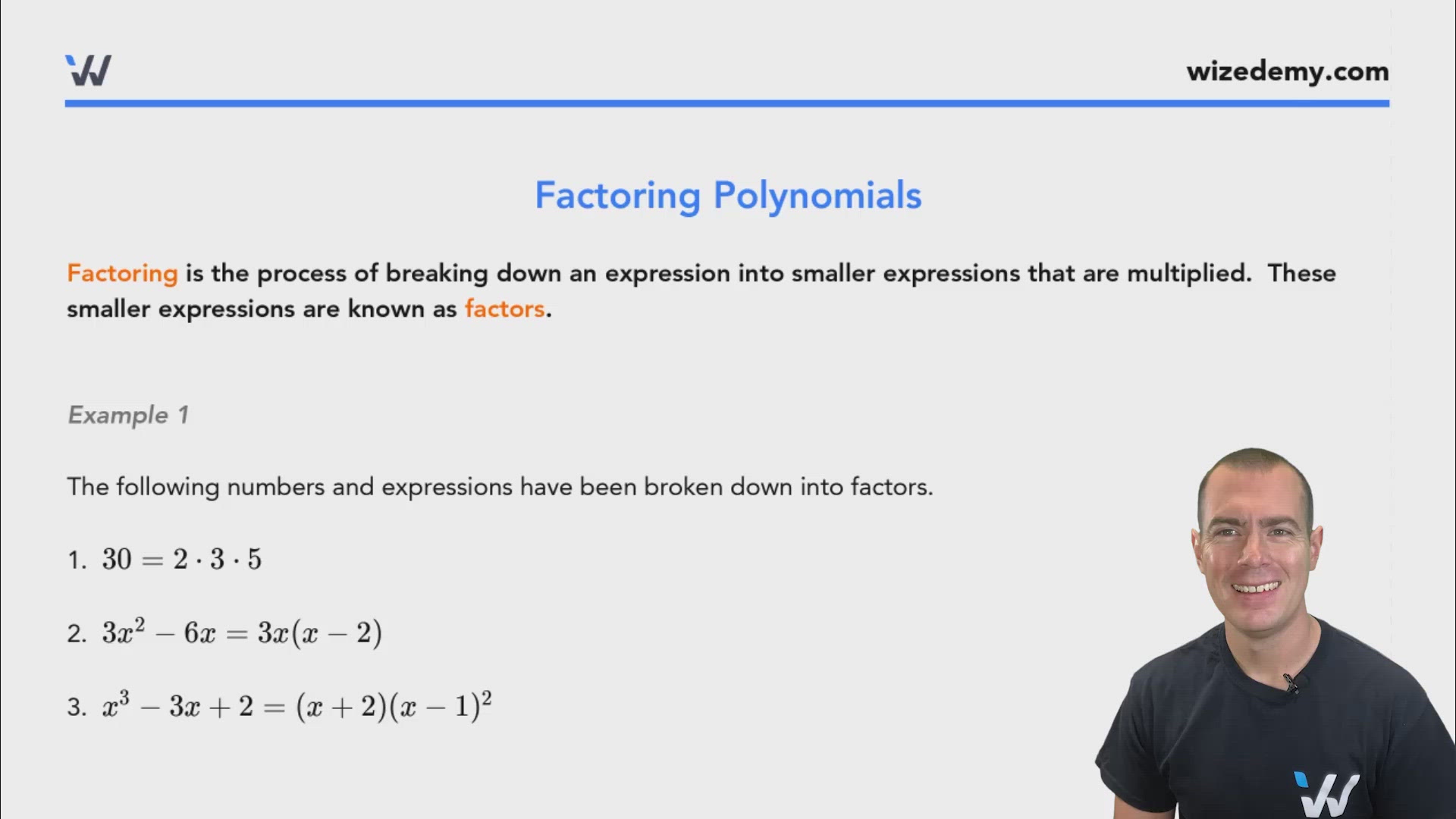
Factoring is the process of breaking down an expression into smaller expressions that are multiplied. These smaller expressions are known as factors.
Example 1
The following numbers and expressions have been broken down into factors.
1.
2.
3.
Greatest Common Factor
The greatest common factor of a polynomial is the largest term that can divide into all of the terms of a polynomial.
Example 2
Write the expression in a factored form by factoring out the greatest common factor.
1.
2.
Watch Out!
Don't let the name fool you! The degree of the greatest common term must less than or equal to the degree of any term in the polynomial. This will ensure that it can divide into original terms properly.
Factor by Grouping
Some polynomials do not have a greatest common factor, but instead have smaller groups of terms that share a common factor.
In these instances we can group these terms and then find the greatest common factor of the groups.
Example 3
Group terms that have a greatest common factor, and then factor those groups.
1.
2.

0:00 / 0:00
Factoring Trinomials
There are several methods that can help us factor trinomials, such as
- Guess and check
- AC method
- Recognizing Special forms
A trinomial is usually factored into two binomials. Factoring can be a difficult process that takes practice to master fully.
Example 1
The following trinomials have been factored
1.
2.
Wize Tip
No matter what method you use, always start by factoring out the greatest common term.
Guess and Check
In the guess and check method for trinomials we work to recreate the binomials that were originally multiplied together.
- Make an educated guess on the possible terms
- Check to see if they multiply to form the correct polynomial
- Make adjustments to the terms if it doesn't work and try again
Example 2
Factor the following trinomial
Possible numbers for the first terms include and .
Possible numbers for the last terms include and .
The outside and inside terms must combine to give us a .
Trying different combinations we arrive at the following:
AC Method
The AC method is a process works by
- Multiplying the first and last coefficients of a trinomial, often called "A" and "C"
- Finding two numbers that multiply to give us this result, but add to the middle term "B"
- The middle term is split into the two number found
- Factor by grouping is used to factor the now four terms
Example 3
Factor the following trinomial
- There are many possibilities for numbers that multiply to The pair that also adds to would be and .
- Splitting the middle term:
Watch Out!
Some trinomials can not be factored. We call these prime.
Using a methodical approach can help you better identify if a trinomial is truly prime.

0:00 / 0:00
Example: Factoring Polynomials

There are two servers at a large data center.
These servers keep track of customer information for a movie subscription website.
New files are created when customers sign up, and files are deleted when customers cancel their subscription.
A programmer at the center can model how many customers a server might gain or lose for the week using the following functions.
Here is the first week of the year, or simply week 1, and and represent the number of new customers expected for the week on server A and B.
1. Combine these polynomials to create one function that models the total expected subscriptions per week.
For total new subscriptions we can add the two functions together:
2. Factor this polynomial using any technique
This factors into:
3. When does this new function for total subscribers equal zero? Interpret what this means in the context of the problem.
The function will be equal to zero if any of its factors are equal to zero. This happens when
This means during week 1, 3, and 6 the servers are not expected to gain or lose any new customers.
Practice: Factoring Trinomials
What is the greatest common factor of the polynomial
Practice: Factoring Trinomials
Use any method to factor the following trinomials.
Don't forget to first factor out any greatest common factors.
1.
2.
3.
Practice: Factoring Trinomials
Factor the following polynomial