Solving Radical Equations

To solve an equation involving a radical we want to
- Isolate the radical on one side of the equal sign
- Raise both sides of the equation to a power that matches the index
- Simplify and solve as normal
- Check solutions in the original equation
Example 1
Solve the following equations
1.
2.
Example: Solving Radical Equations
Mia was working on building a fence around a triangular portion of their garden.
If she has exactly 12 meters of fencing, how the missing sides of the garden?
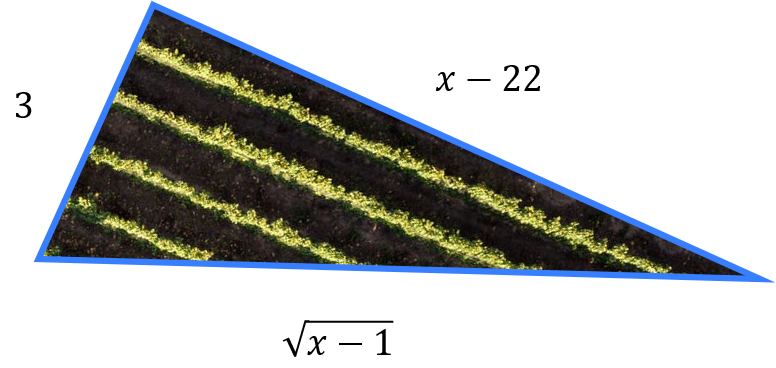
First we want to set up an equations that represents the fencing Mia used
To find the missing sides we have to solve this equation for .
So we have that or .
If then the sides of the triangle will be 3, 4, and 5 meters.
The agrees with the fact that Mia has 12 meters of fencing.
If then the sides of the triangle will be 3, 15, 6 meters.
The would mean Mia had 24 meters of fencing, which does not agree with the given information.