Radical Functions
One of our basic functions is the square root function, it comes from the family of radical functions.
Radical functions contain radicals and are important for modeling a variety of situations.
Example 1
The following are examples of radical functions
Domain and Range
For radical functions the index has an impact on the values that are in the domain and range of the function.
If the index is:
Even
Then the radicand must be positive. The radical will only output values like zero or greater.
As a result there will often be restrictions in our domain and range.
Odd
The radicand can be positive or negative. It will produce values that are both positive and negative.
As a result there are often no restrictions in our domain.
Example 2
Write the domain and range of the following
1.
The radicand will be positive when
- domain is
- range is
2.
The index is odd so we have that
- domain is
- range is

Distance Formula
One common application of radical function comes from modeling the distance between two points and
The distance formula is given by
Example 3
Find the distance between the points (2, 3) and (x, 5)
This formula represents all the possible distances between the point
and the horizontal line
Example: Radical Functions
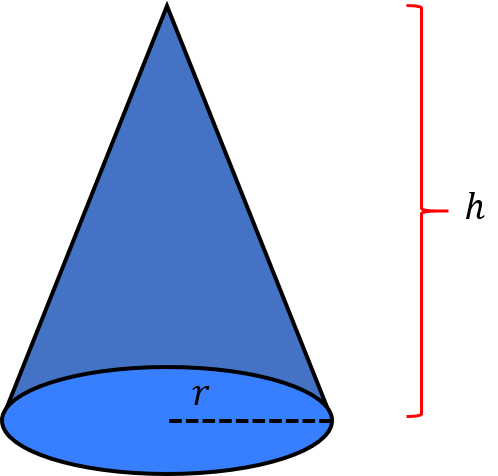
The surface area of a cone is given by the formula
Where and are the radius of the base of the cone, and the height of the cone respectively.
The solid rocket boosters on the space shuttle form the shape of a cone.
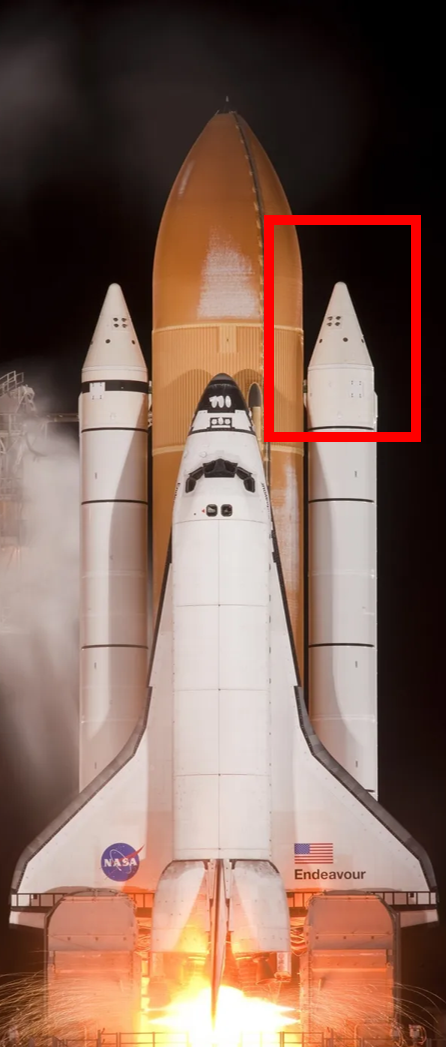
1. If the diameter of the solid rocket boosters are about 3.7 meters. Create a function that describes the amount of metal needed for the surface of the cone as a function of the height.
2. What is the domain of this function?
Although the equation has which ensures that the radicand will never be negative, since it represents height we can only consider non-negative values.
Domain

Mark Yourself Question
- Grab a piece of paper and try this problem yourself.
- When you're done, check the "I have answered this question" box below.
- View the solution and report whether you got it right or wrong.
Mark Yourself Question
- Grab a piece of paper and try this problem yourself.
- When you're done, check the "I have answered this question" box below.
- View the solution and report whether you got it right or wrong.
Mark Yourself Question
- Grab a piece of paper and try this problem yourself.
- When you're done, check the "I have answered this question" box below.
- View the solution and report whether you got it right or wrong.