Wize Grade 11 Mathematics Textbook > Polynomials Factoring and Graphs
Graphs of Polynomials
Basic Graphs of Polynomials

Basic Graphs
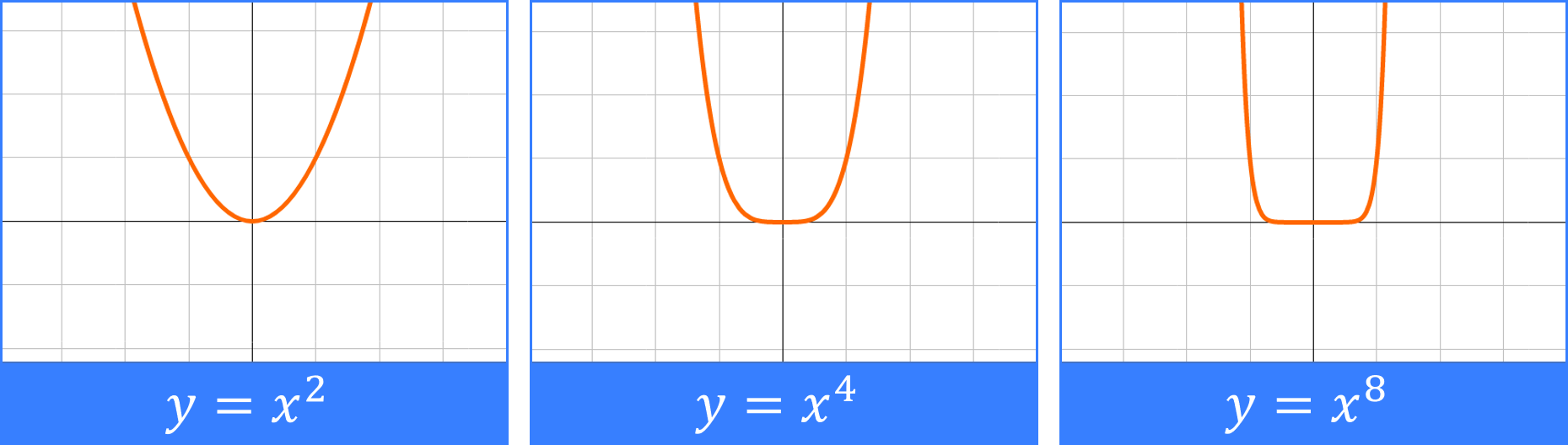
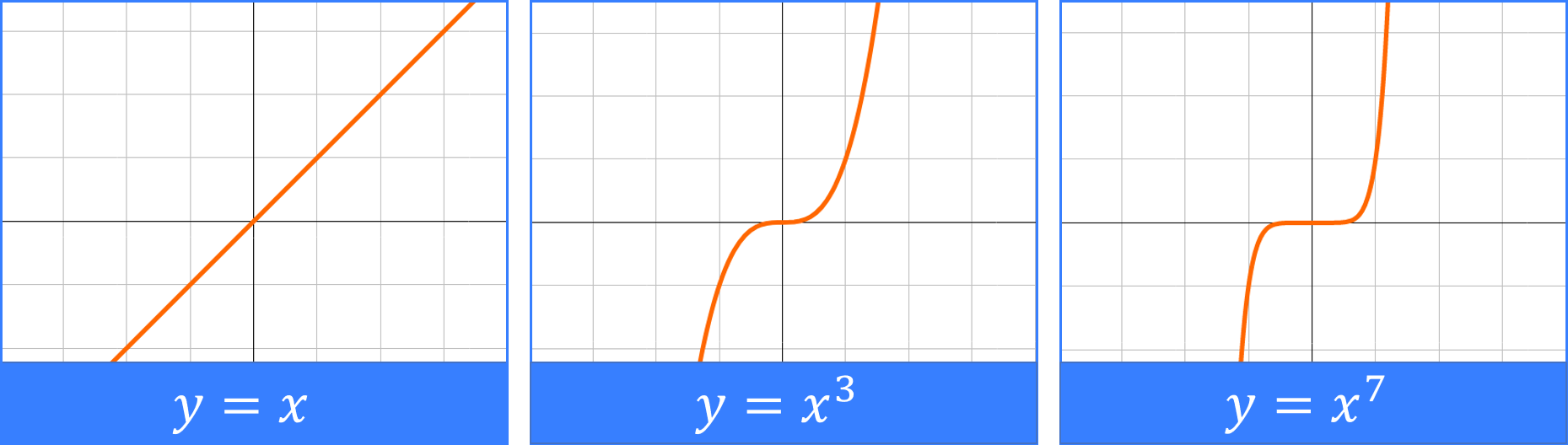
We can learn a lot about the graph of polynomials from looking at basic polynomials.
If the degree is
- Even - the graph is similar to a quadratic or u-shape
- Odd - the graph is similar to a cubic or side ways s-shape
Example 1
Use arrows to describe the end behavior of the following basic polynomials.
1.
The end behavior is
2.
The end behavior is
3.
The end behavior is
Domain and Range
All polynomials have a domain that includes all real numbers. If the degree is
- Odd - the range will again include all real numbers
- Even - there may will be some restrictions to the if the degree is even.
Example 2
Determine the domain and range of the following basic polynomials
1.
- Domain: All real numbers
- Range: All real numbers
2.
- Domain: All real numbers
- Range:
End Behavior and Zeros

End Behavior
The end behavior of a polynomial describes the functions values as x gets large in the positive and negative direction.
The end behavior can be determined by leading term.
Degree
- Odd: End behavior will be in opposite directions
- Even: End behavior will be in the same direction
Leading Coefficient
- Positive: Similar to basic polynomial with same degree
- Negative: Similar to basic polynomial with the same degree, and reflected over x-axis
Example 1
Use arrows to describe the end behavior of the following polynomial functions.
1.
The leading term is so the degree is odd and the leading coefficient is positive.
End behavior
2.
The leading term is so the degree is even and the leading coefficient is negative.
End behavior
3.
The leading term is so the degree is odd and the leading coefficient is negative.
End behavior
Wize Tip
To remember end behavior think of the basic polynomial graphs of , , and .
Zeros
The zeros of a function are the values of x that make the function equal to zero. These can been seen on the graph as places where the function touches the x-axis.
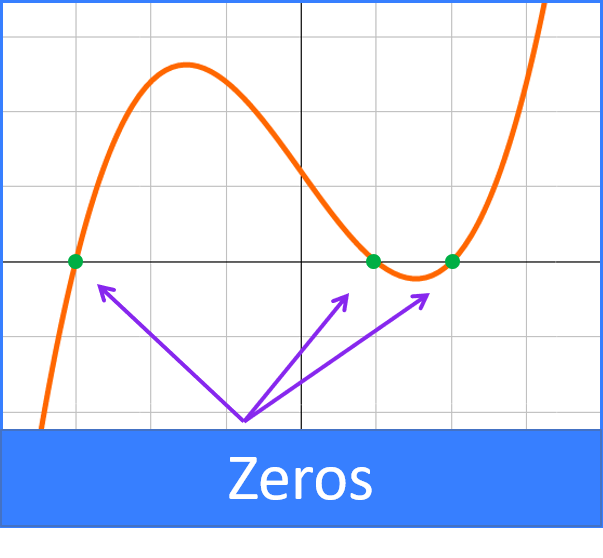
We can read the zeros of a polynomial by looking at the factors of the polynomial.
The exponent on a factor can give us the local behavior of the polynomial near the zero.
- Even power: Graph touches at the zero
- Odd: Graph go through the zero
Example 2
Determine the zeros of the following polynomials
1.
In this form we can see the factors of the polynomial. From the factor theorem we know that the zeros are at
.
2.
In this form we can see the factors of the polynomial. From the factor theorem we know that the zeros are at
Graphing
We can sketch a graph of a polynomial by knowing both its end behavior and zeros. How we write the polynomial will help us find this information quickly.
- Expanded form - all the terms have been multiplied out.
- Factored form - the polynomial is factored
With this information we can graph a polynomial
- Graph End Behavior - Use expanded form to identity the leading term and highest degree
- Graph Zeros - Use factored form to mark out the zeros on the x-axis
- Connect the information with a smooth curve
Example 3
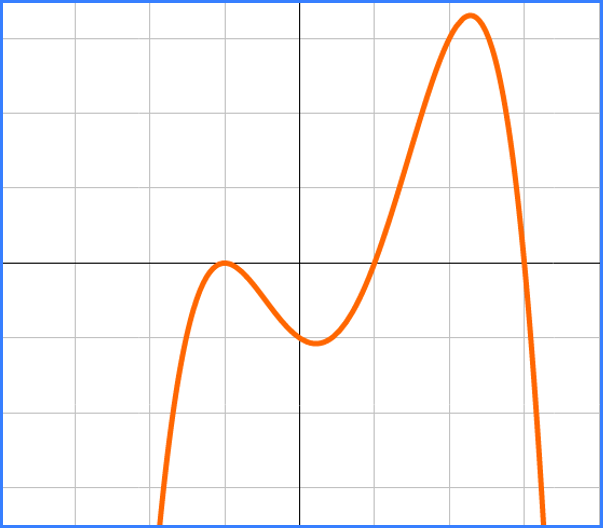
Sketch a graph of the polynomial
- The zeros are at
- The graph will touch at and go through at
- The leading term is so the end behavior will be
This gives us a sketch of the graph:
Example: Graphs of Polynomials

The design of a roller coaster can be modeled using the shape of a polynomial.
Suppose the following graph represents the track of a given roller coaster
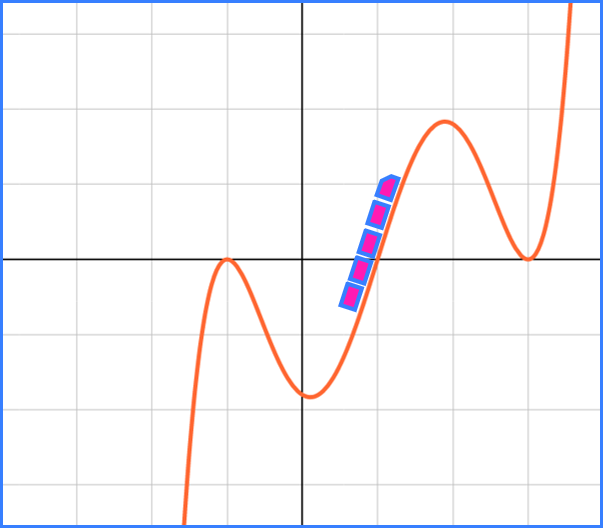
1. Describe the end behavior of this graph.
The end behavior is
2. What are the values and behaviors of the zeros.
The zeros are at
- touches
- goes through
- touches
3. Find the equation of the polynomial that models the coaster if
From the previous part we know the polynomial must be of the form
Putting in information when we have
So the polynomial function is
Practice: Graphs of Polynomials
Match each polynomial expression with the arrows that represent their end behavior.
A.
B.
C.
D.
Practice: Graphs of Polynomials
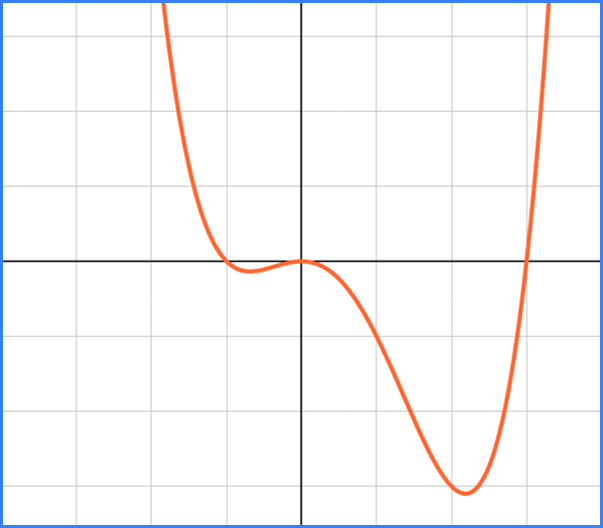
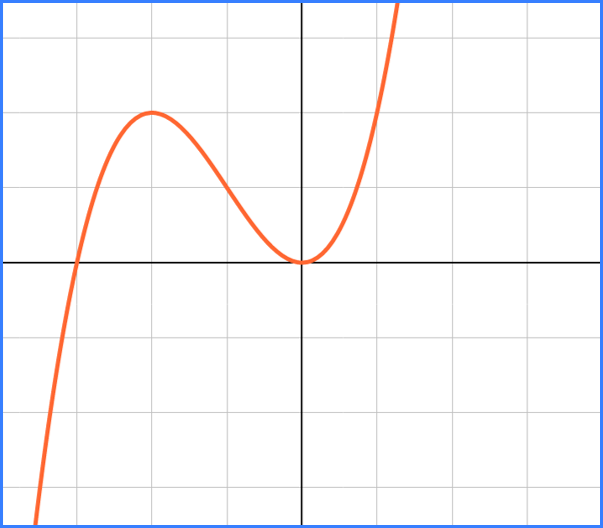
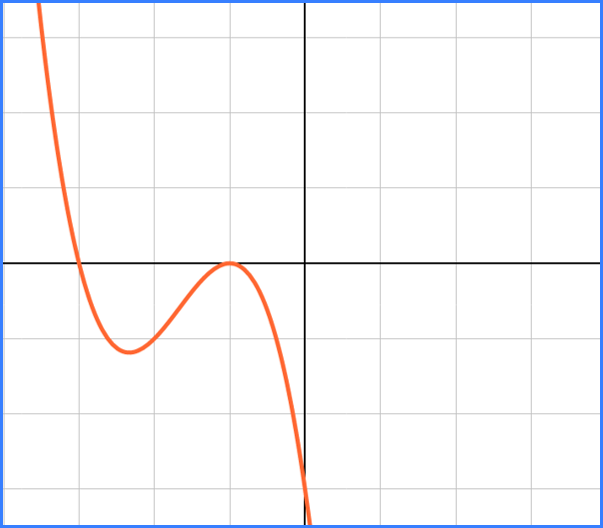
Match each polynomial with a sketch of its graph.
A.
B.
C.
Practice: Graphs of Polynomials
Graph a sketch of the given polynomial