0:00 / 0:00

Graphs of Reciprocal Trigonometric Functions

The Cosecant Function

y=1sin⁡θ=csc⁡θy=\displaystyle\frac{1}{\sin\theta}=\csc{\theta}


Maximums(3π2±2πn,−1),  n∈WMinimums(π2±2πn,1),  n∈WVertical Asymptotesθ=0±πn,  n∈WPeriod2πDomain{θ∈R∣ θ≠0±nπ,  n∈W}Rangey≤−1  &  y≥1\begin{array}{|c|c|}\hline\\ \textbf{Maximums}&\Bigg(\displaystyle\frac{3\pi}{2}\pm2\pi{}n,-1\Bigg),~~n\in\mathbb{W}\\\\\hline\\ \textbf{Minimums}&\Bigg(\displaystyle\frac{\pi}{2}\pm2\pi{}n,1\Bigg),~~n\in\mathbb{W}\\\\\hline\\ \textbf{Vertical Asymptotes}&\theta=0\pm{}\pi{}n,~~n\in\mathbb{W}\\\\\hline\\ \textbf{Period}&2\pi\\\\\hline\\ \textbf{Domain}&\{\theta\in\mathbb{R}|~\theta\neq{}0\pm{}n\pi,~~n\in\mathbb{W}\}\\\\\hline\\ \textbf{Range}&y\leq{}-1~~\&~~y\geq{}1\\\\\hline \end{array}

PAGE BREAK

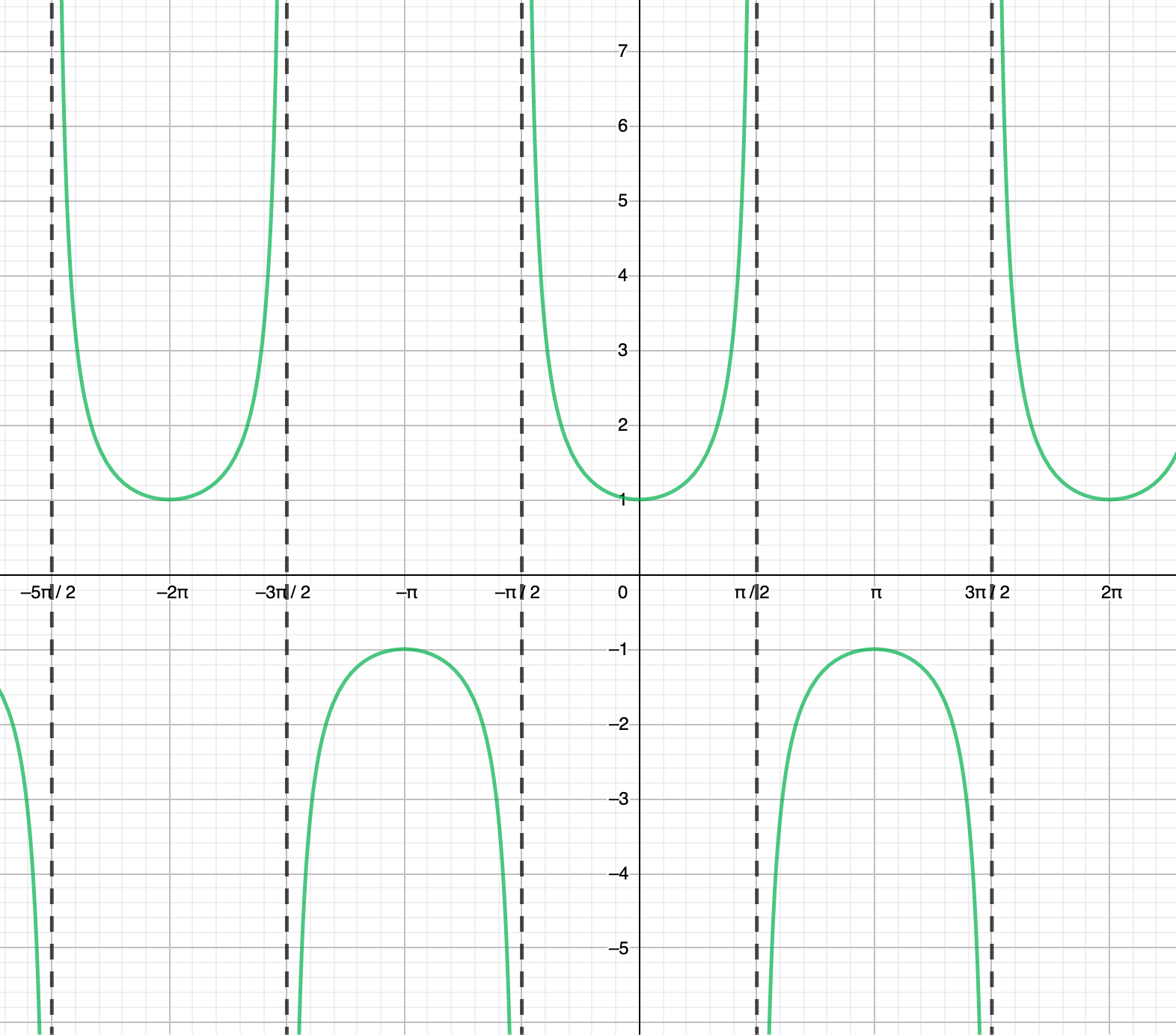
The Secant Function

y=1cos⁡θ=sec⁡θy=\displaystyle\frac{1}{\cos\theta}=\sec{\theta}

Maximums(π±2πn,−1),  n∈WMinimums(0±2πn,1),  n∈WVertical Asymptotesθ=π2±πn,  n∈WPeriod2πDomain{θ∈R∣ θ≠π2±nπ,  n∈W}Rangey≤−1  &  y≥1\begin{array}{|c|c|}\hline\\ \textbf{Maximums}&(\pi\pm2\pi{}n,-1),~~n\in\mathbb{W}\\\\\hline\\ \textbf{Minimums}&(0\pm2\pi{}n,1),~~n\in\mathbb{W}\\\\\hline\\ \textbf{Vertical Asymptotes}&\theta=\displaystyle\frac{\pi}{2}\pm{}\pi{}n,~~n\in\mathbb{W}\\\\\hline\\ \textbf{Period}&2\pi\\\\\hline\\ \textbf{Domain}&\{\theta\in\mathbb{R}|~\theta\neq{}\displaystyle\frac{\pi}{2}\pm{}n\pi,~~n\in\mathbb{W}\}\\\\\hline\\ \textbf{Range}&y\leq{}-1~~\&~~y\geq{}1\\\\\hline \end{array}


Wize Tip
Maximums on cos⁡θ, sin⁡θ\colorThree{\cos{\theta},~\sin{\theta}} turn into minimums on sec⁡θ, csc⁡θ\colorThree{\sec{\theta},~\csc{\theta}}.
Minimums on cos⁡θ, sin⁡θ\colorThree{\cos{\theta},~\sin{\theta}} turn into maximums on sec⁡θ, csc⁡θ\colorThree{\sec{\theta},~\csc{\theta}}.
X-intercepts on cos⁡θ, sin⁡θ\colorThree{\cos{\theta},~\sin{\theta}} turn into vertical asymptotes on sec⁡θ, csc⁡θ\colorThree{\sec{\theta},~\csc{\theta}}.

PAGE BREAK

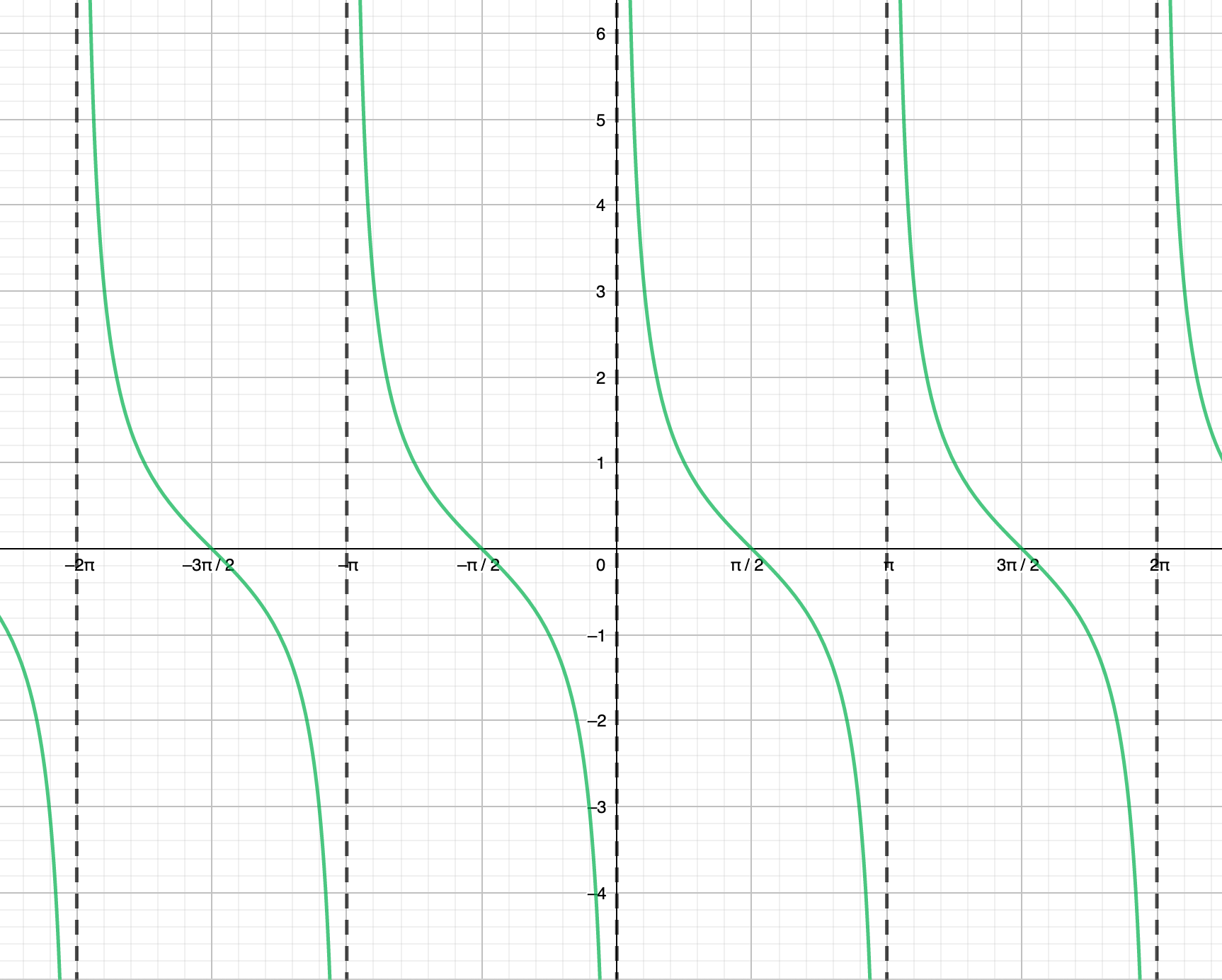
The Cotangent Function

y=1tan⁡θ=cot⁡θy=\displaystyle\frac{1}{\tan\theta}=\cot{\theta}

Vertical Asymptotesθ=0±πn,  n∈WX-intercepts(π2±πn,0),  n∈WPeriodπDomain{θ∈R∣ θ≠0±nπ,  n∈W}Range−∞<y<∞\begin{array}{|c|c|}\hline\\ \textbf{Vertical Asymptotes}&\theta=0\pm{}\pi{}n,~~n\in\mathbb{W}\\\\\hline\\ \textbf{X-intercepts}&(\displaystyle\frac{\pi}{2}\pm{}\pi{}n,0),~~n\in\mathbb{W}\\\\\hline\\ \textbf{Period}&\pi\\\\\hline\\ \textbf{Domain}&\{\theta\in\mathbb{R}|~\theta\neq{}0\pm{}n\pi,~~n\in\mathbb{W}\}\\\\\hline\\ \textbf{Range}&-\infin<y<\infin\\\\\hline \end{array}

Wize Tip
X-intercepts on tan⁡θ\colorThree{\tan{\theta}} turn into vertical asymptotes on cot⁡θ\colorThree{\cot{\theta}}.
Vertical asymptotes on tan⁡θ\colorThree{\tan{\theta}} turn into x-intercepts on cot⁡θ\colorThree{\cot{\theta}}.

0:00 / 0:00

Example: Graphs of Reciprocal Trigonometric Functions

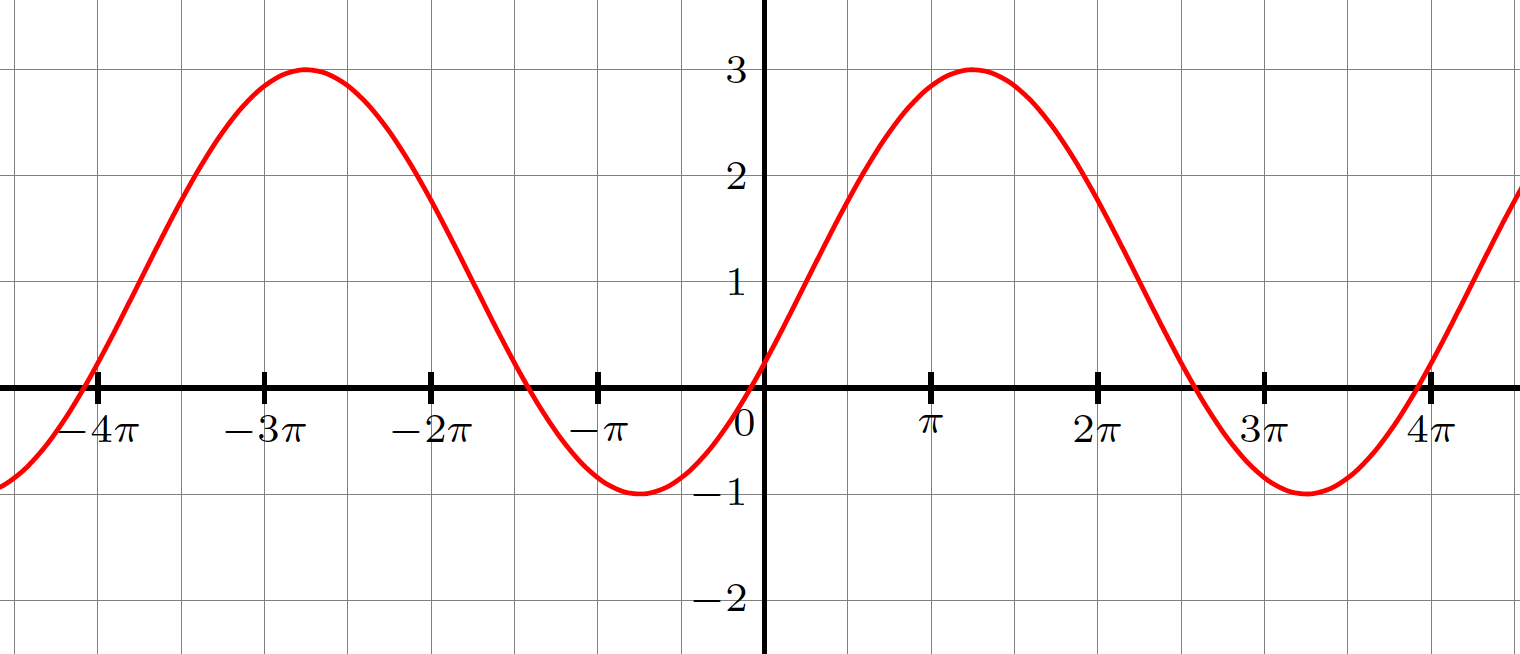
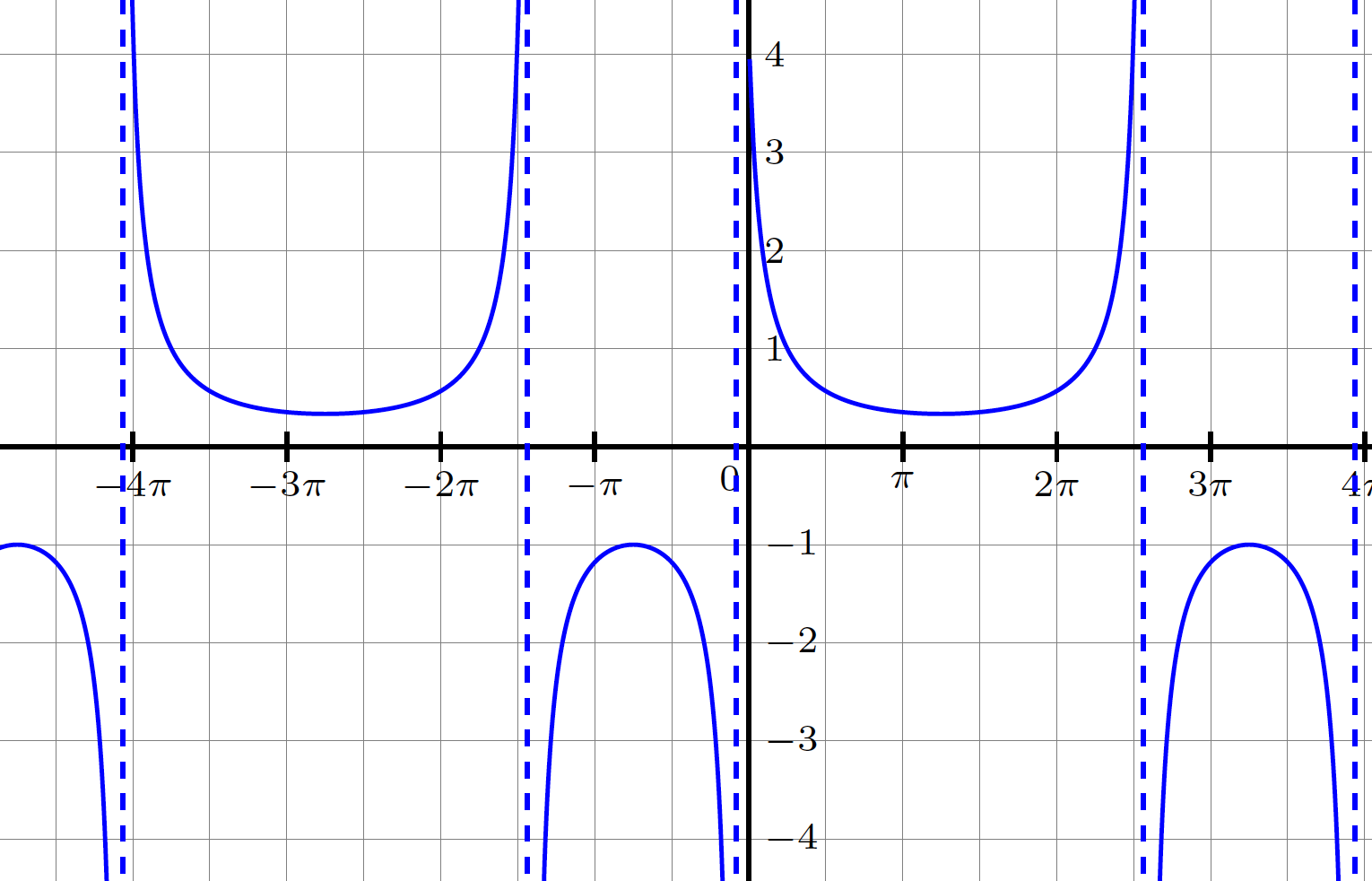
Graph y=2csc⁡(12(θ−π4))+1y=2\csc{\Bigg(\displaystyle\frac{1}{2}\Big(\theta-\displaystyle\frac{\pi}{4}\Big)\Bigg)+1}.


First, graph the function y=2sin⁡(12(θ−π4))+1y=2\sin{\Bigg(\displaystyle\frac{1}{2}\Big(\theta-\displaystyle\frac{\pi}{4}\Big)\Bigg)+1}.

Turn all x-intercepts into vertical asymptotes.

Turn all maximums into minimums.
Turn all minimums into maximums.
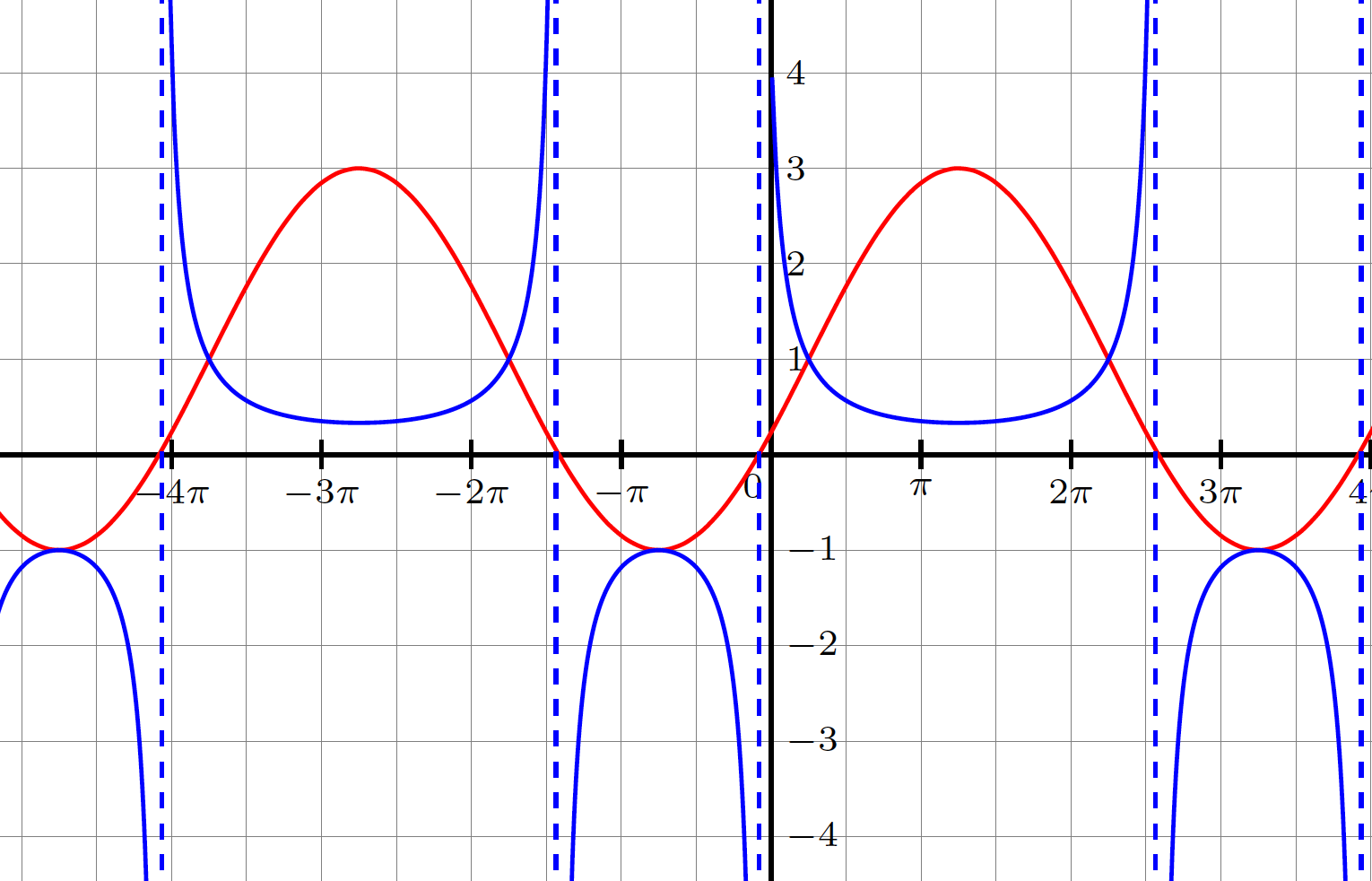


Erase y=2sin⁡(12(θ−π4))+1\color{red}y=2\sin{\Bigg(\displaystyle\frac{1}{2}\Big(\theta-\displaystyle\frac{\pi}{4}\Big)\Bigg)+1}
0:00 / 0:00

Example: Graphs of Reciprocal Trigonometric Functions


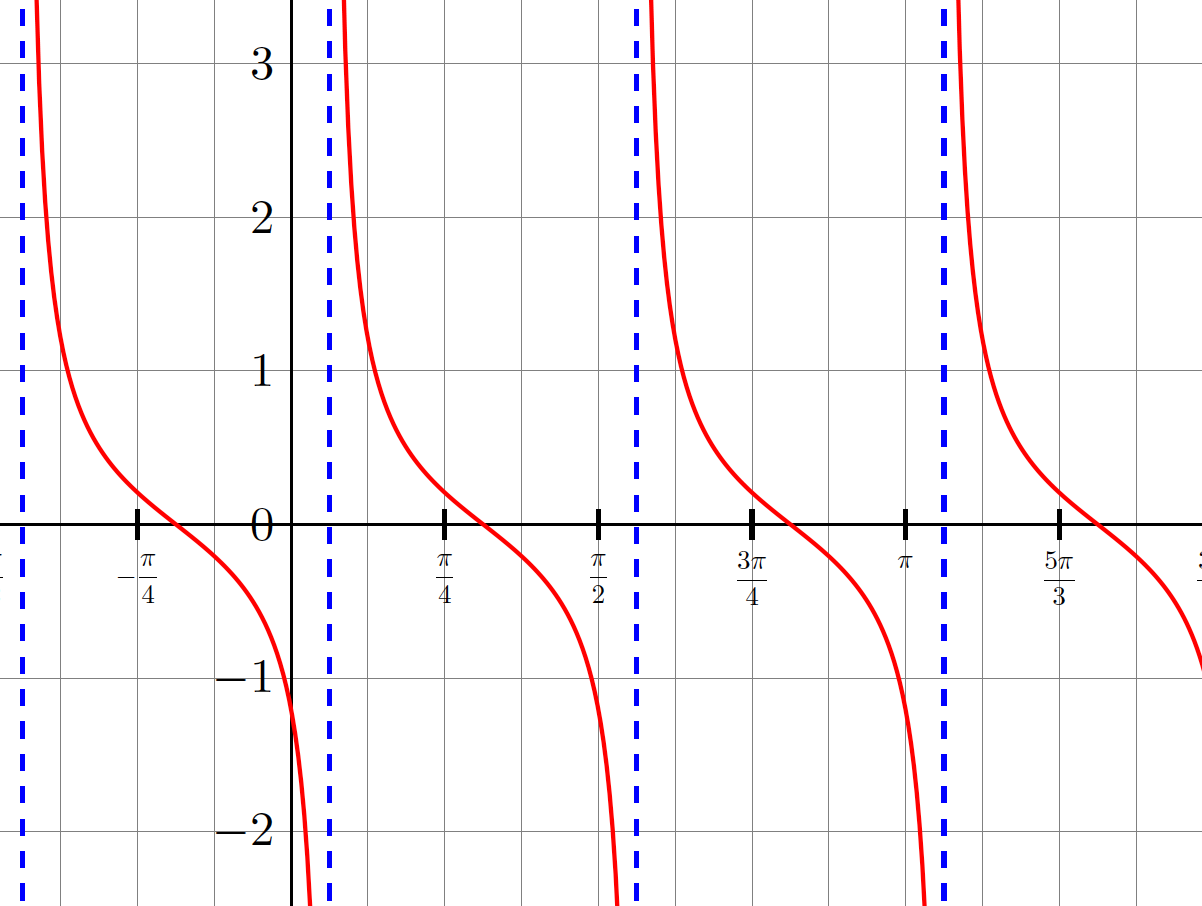
Graph y=2cot⁡(2(θ−π16))y=2\cot{\Bigg(2\Big(\theta-\displaystyle\frac{\pi}{16}\Big)\Bigg)}.


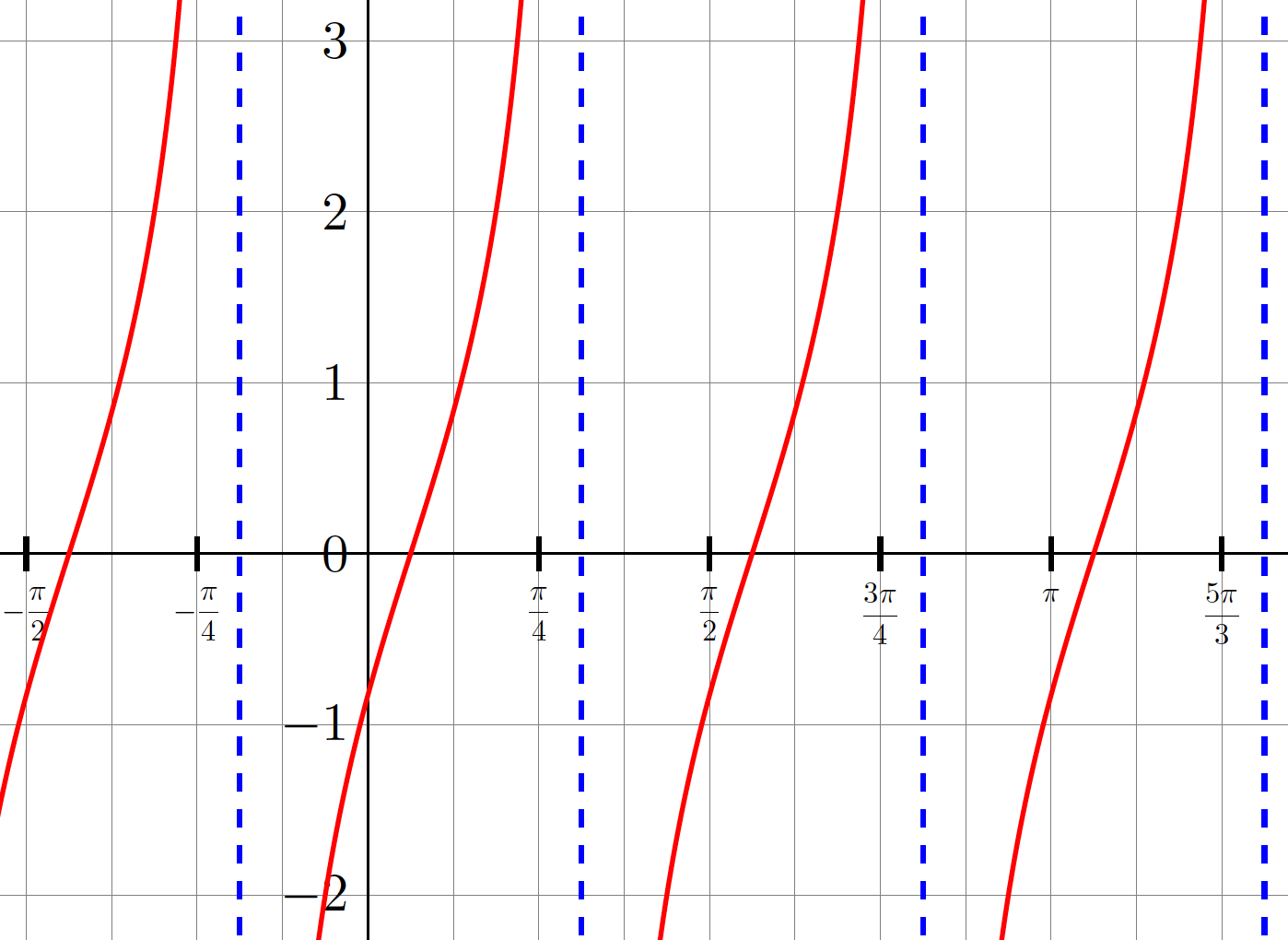
First, graph y=2tan⁡(2(θ−π16))y=2\tan{\Bigg(2\Big(\theta-\displaystyle\frac{\pi}{16}\Big)\Bigg)}.


Turn x-intercepts into vertical asymptotes.
Turn vertical asymptotes in x-intercepts.
Practice: Graphs of Reciprocal Trigonometric Functions


Find the vertical asymptotes of y=3sec⁡(3(θ−π18))+1y=3\sec\Bigg(3\Big(\theta-\displaystyle\frac{\pi}{18}\Big)\Bigg)+1.


Sketch a graph of the function y=2csc⁡(θ2−π2)y=2\csc\Bigg(\displaystyle\frac{\theta}{2}-\displaystyle\frac{\pi}{2}\Bigg).

Practice: Graphs of Reciprocal Trigonometric Functions

If the point (1,2)(1,2) is on the graph of y=3cos⁡2θ+1y=3\cos{2\theta}+1, then what point must be on the graph y=sec⁡θy=\sec{\theta}?


Extra Practice