Wize High School Grade 12 Pre-Calculus Textbook > Rates of Change
Rates of Change of Exponential Functions
Popular Courses
Grade 12 Advanced Functions
Ontario High School
Grade 12 Pre-Calculus/Functions
Canada High School
MATH 22
Pennsylvania State University
MAC 1140
University of Florida
MAC 1105
Florida State University
MAT 012
University of California - Davis
MTH 103A
Michigan State University
MAC 1147
University of Florida
MATH 140
San Diego State University
MAC 1140C
University of Central Florida
MA 15800
Purdue University
MATH 102
California State University - Northridge
M 305G
The University of Texas at Austin
MATH 1019
University of Cincinnati
MATH 1022
Temple University
MATH 1021
University of Cincinnati
MA 107
North Carolina State University
MATH 1021
Temple University
MATH-141
San Diego State University
0:00 / 0:00
Rates of Change of Exponential Functions
The rate of change of an exponential function can be solved used both algebraic and graphical methods.
Example
The population growth of a Vancouver, BC is roughly 1.16% annually. If the current population in Vancouver is approximately 2.5 million people, how fast is the population increasing 10 years from now?
Let model the above situation and is in millions. Then,
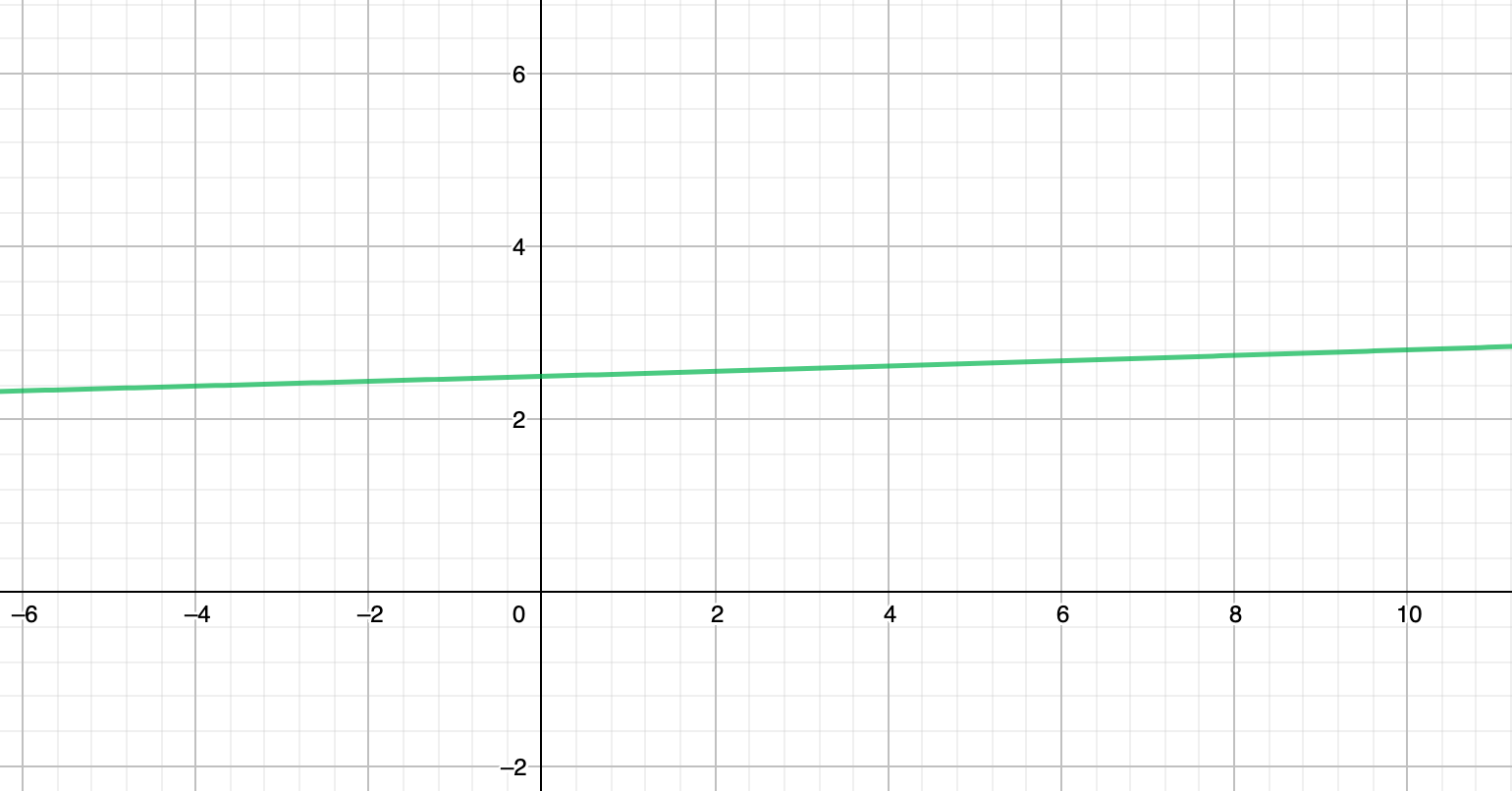
is a rough sketch of .
We are looking for the instantaneous rate of change when
Then, in a graphing calculator, we can find the IRC using the tangent line:
The tangent line is approximately .
This means that the population of Vancouver, BC will increase at a rate of 0.02589 million people/year 10 years from now.
0:00 / 0:00
Example: Rates of Change of Exponential Functions
A radioactive substance has a half-life of 2.25 seconds and a mass of 150mg.
- What is the instantaneous rate of change of the substance when seconds.
- If the half-life changed to seconds, what would the instantaneous rate of change be when seconds.
Algebraic Solution
1. Let's find a function to describe this situation.
Then, when seconds, then instantaneous rate of change is:
2.
Graphical Solution
1. We are looking for the instantaneous rate of change (IRC) when .
Then, in a graphing calculator, we can find the IRC using the tangent line:
The tangent line is approximately .
Therefore, the IRC is approximately
2. We are looking for the instantaneous rate of change (IRC) when .
Then, in a graphing calculator, we can find the IRC using the tangent line:
The tangent line is approximately .
Therefore, the IRC is approximately
Practice: Rates of Change of Exponential Functions
Jake decides to invest $4000 compounded monthly at an interest rate of .
Practice: Rates of Change of Exponential Functions
The population of a town in BC is decreasing annually. The town had a size of people in the year 2010.
Practice: Rates of Change of Exponential Functions
If the instantaneous rate of change for the function is , what is ? Let .