Wize High School Grade 12 Pre-Calculus Textbook > Rates of Change
Rates of Change of Trigonometric Functions
Popular Courses
Grade 12 Advanced Functions
Ontario High School
Grade 12 Pre-Calculus/Functions
Canada High School
MATH 22
Pennsylvania State University
MAC 1140
University of Florida
MAC 1105
Florida State University
MAT 012
University of California - Davis
MTH 103A
Michigan State University
MAC 1147
University of Florida
MATH 140
San Diego State University
MAC 1140C
University of Central Florida
MA 15800
Purdue University
MATH 102
California State University - Northridge
M 305G
The University of Texas at Austin
MATH 1019
University of Cincinnati
MATH 1022
Temple University
MATH 1021
University of Cincinnati
MA 107
North Carolina State University
MATH 1021
Temple University
MATH-141
San Diego State University
0:00 / 0:00
Rates of Change of Trigonometric Functions
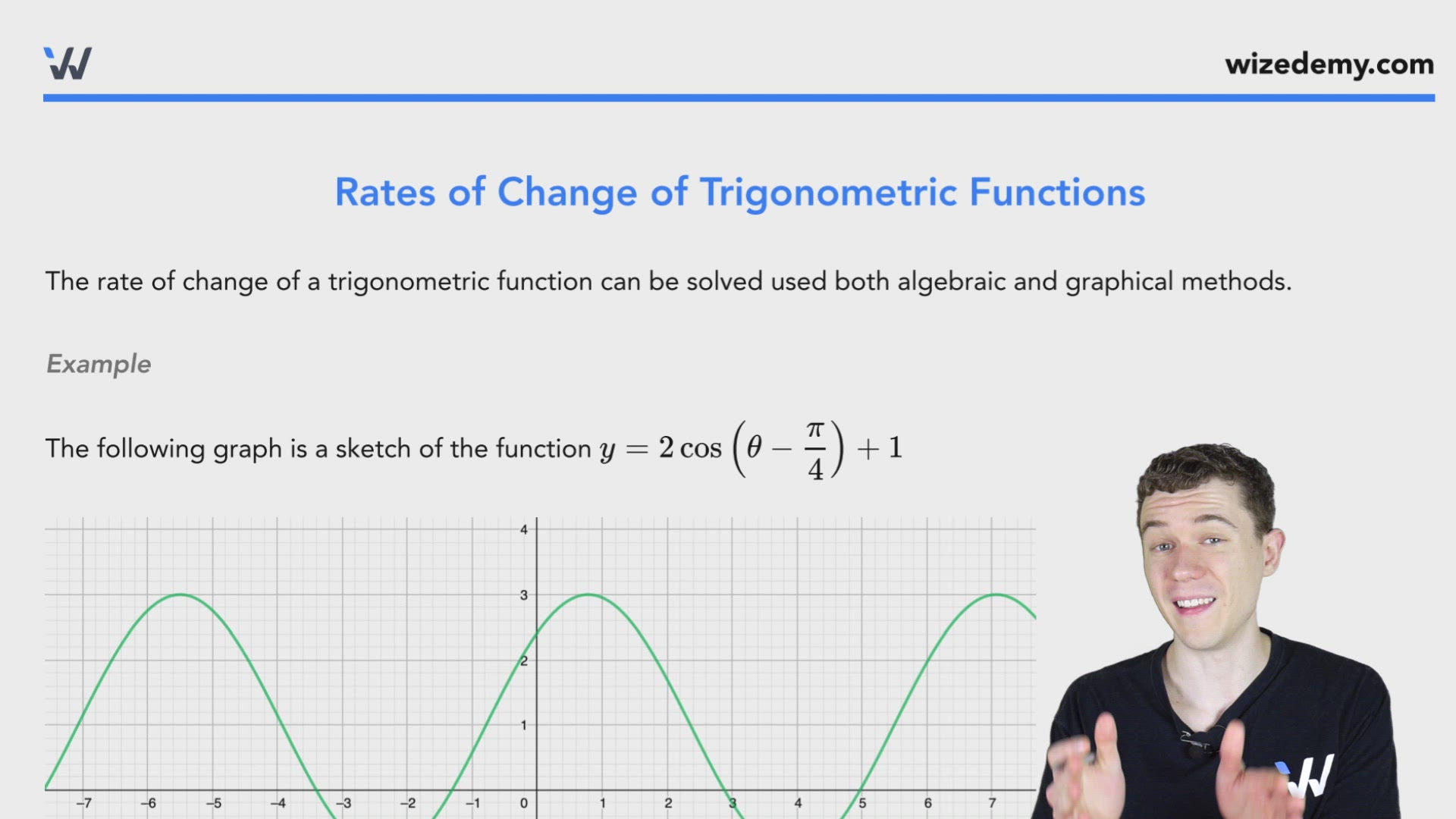
The rate of change of a trigonometric function can be solved used both algebraic and graphical methods.
Example
The following graph is a sketch of the function

The average rate of change between the interval is:
0:00 / 0:00
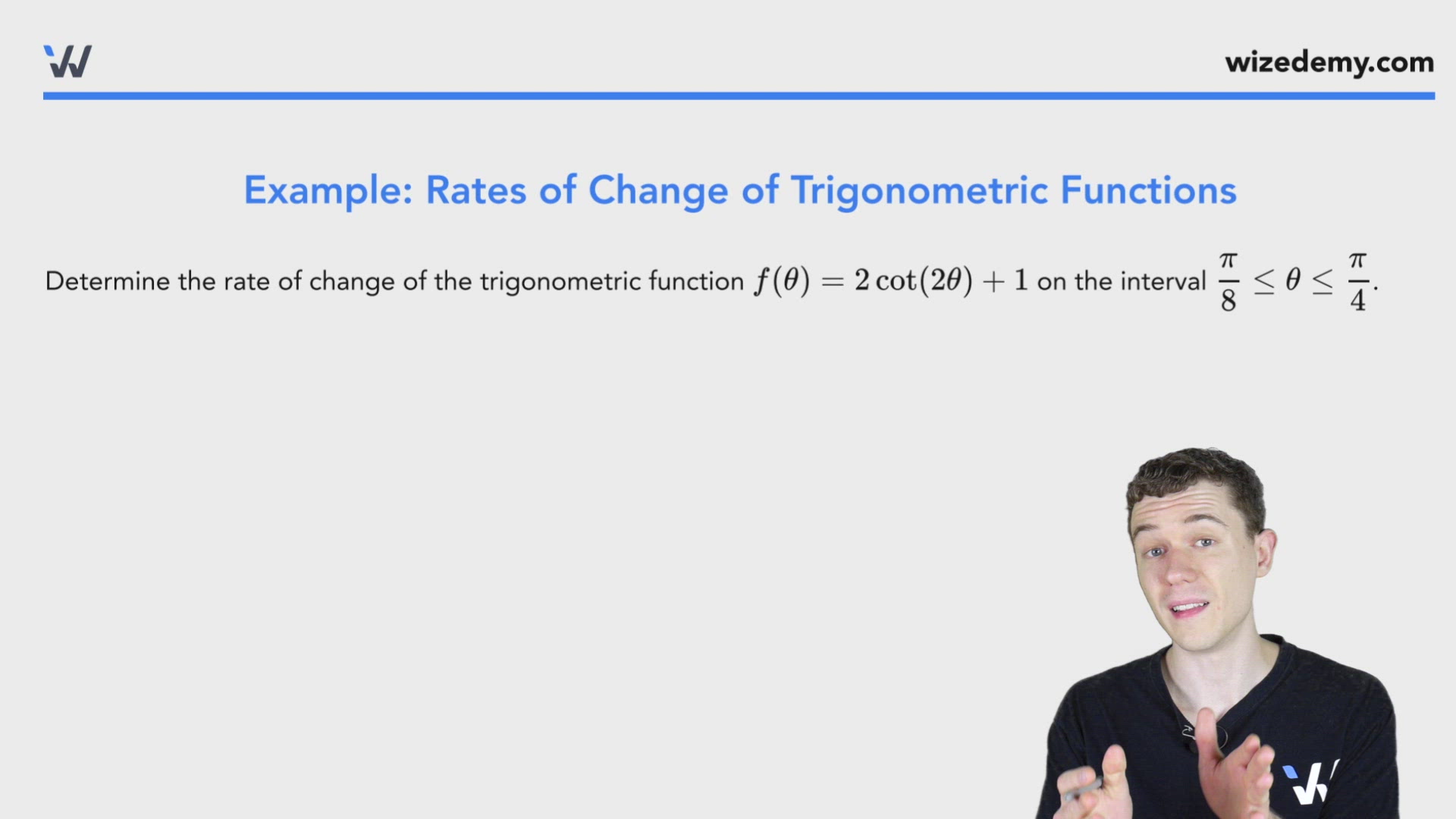
Example: Rates of Change of Trigonometric Functions
Determine the rate of change of the trigonometric function on the interval .
Practice: Rates of Change of Trigonometric Functions
Determine the average rate of change of the function on the interval .
Practice: Rates of Change of Trigonometric Functions
Alex, Rosa, and Diego were out jet-skiing when they noticed the weather started to turn. They turned their jet-skis around and docked at their harbor. The jet-skis will rise and fall with the waves of the water and represents the displacement of the jet-skis from the dock in meters.
Practice: Rates of Change of Trigonometric Functions
Let .
Practice: Rates of Change of Trigonometric Functions
Estimate the instantaneous rate of change of the function for the following values of Use .