Wize High School Grade 12 Pre-Calculus Textbook > Rates of Change
Rates of Change of Polynomials
Popular Courses
Grade 12 Advanced Functions
Ontario High School
Grade 12 Pre-Calculus/Functions
Canada High School
MATH 22
Pennsylvania State University
MAC 1140
University of Florida
MATH 41
Pennsylvania State University
MAC 1105
Florida State University
MAT 012
University of California - Davis
MTH 103A
Michigan State University
MAC 1147
University of Florida
MATH 140
San Diego State University
MAC 1140C
University of Central Florida
MA 15800
Purdue University
MATH 102
California State University - Northridge
M 305G
The University of Texas at Austin
MATH 1019
University of Cincinnati
MATH 1022
Temple University
MATH 1021
University of Cincinnati
MA 107
North Carolina State University
MATH 1021
Temple University
MATH-141
San Diego State University

0:00 / 0:00
Rates of Change of Polynomials
The rate of change of a polynomial , where and , can be solved used both algebraic and graphical methods.
Example
Let .
The instantaneous rate of change of at is:
Graphical Solution
Graph using a graphing calculator.
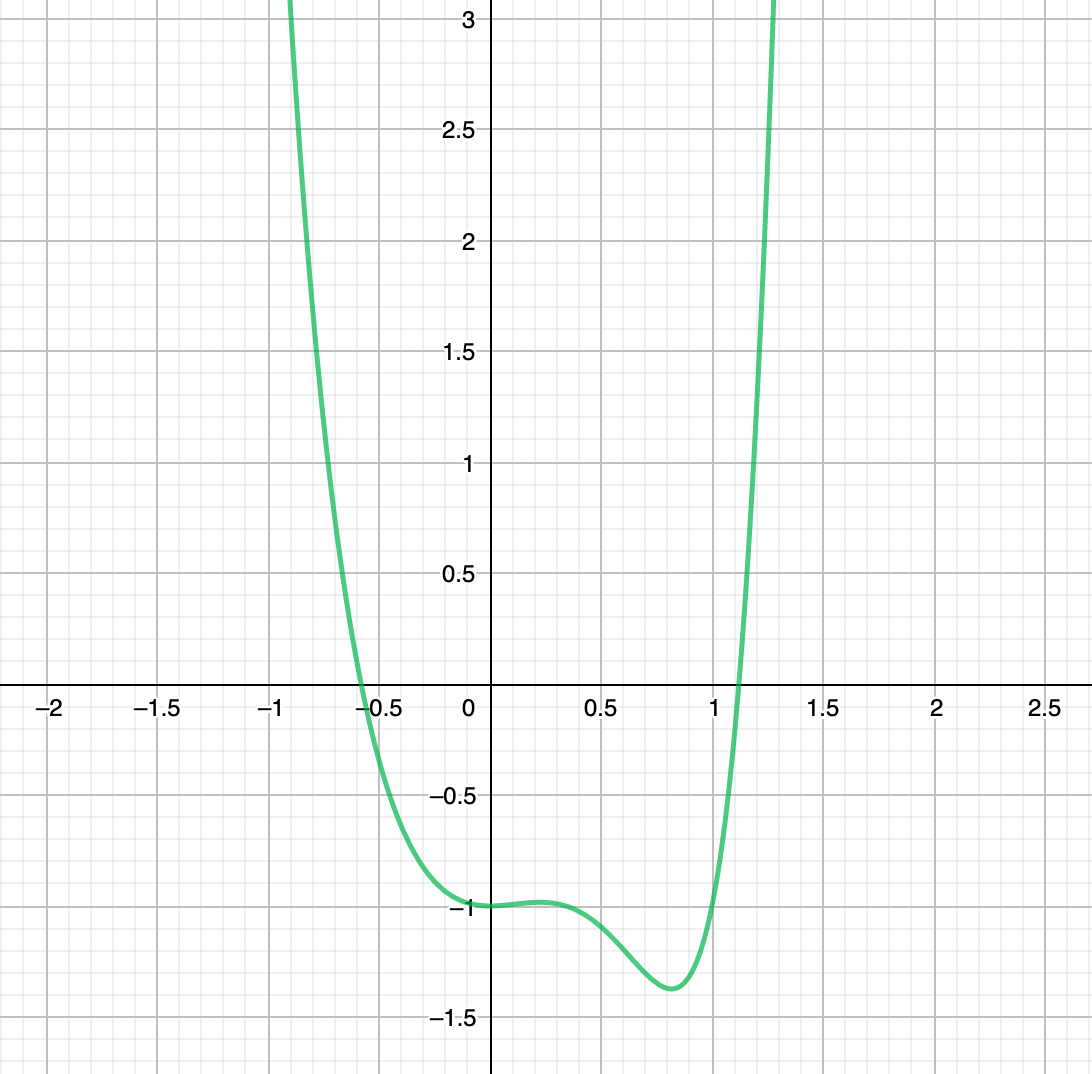
Sketch the tangent line by pressing
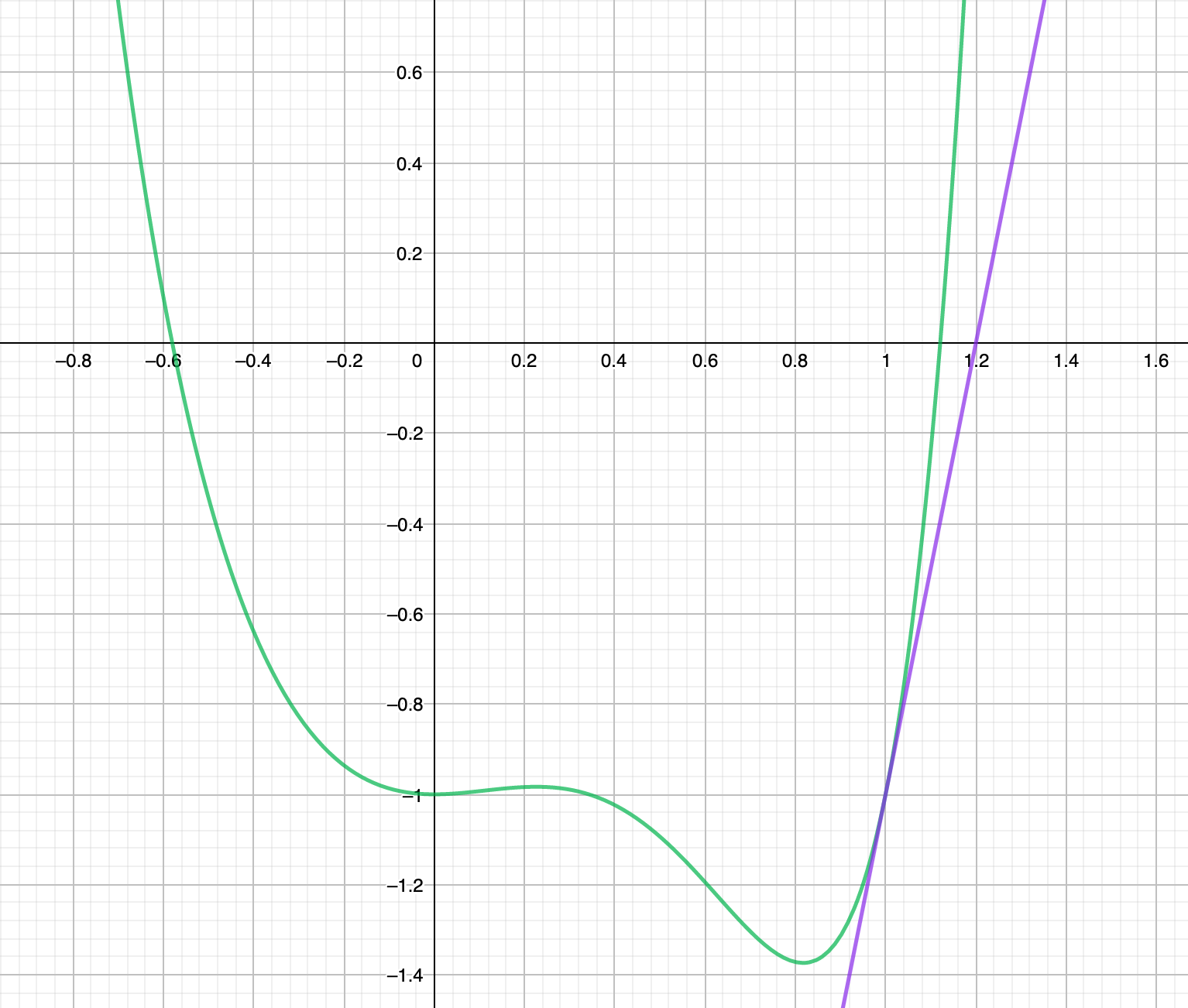
The equation of the tangent line is .
The rate of change is the slope of the tangent line. Therefore, the instantaneous rate of change of at is .
Algebraic Solution
Using the difference quotient and choosing a very small value for and , we can estimate for the instantaneous values:

0:00 / 0:00
Example: Rates of Change of Polynomials
Let .
- Determine the average rate of change for each interval:
- Estimate the instantaneous rate of change when .
1.
i.
ii.
iii.
2.
Practice: Rates of Change of Polynomials
Let be a continuous polynomial function over the interval Determine the following:
Practice: Rates of Change of Polynomials
Let .
Practice: Rates of Change of Polynomials
Let .
Estimate the tangent lines at the point to the nearest hundredth.
(Use )