Popular Courses
MCAT
General Course
Intro to Physics
University Study Guides
PHYSICS 1D03
McMaster University
AP Physics C: Mechanics Exam Prep Course
AP Exam Prep
Physics
General Course
PHYS 211
University of Calgary
PCS 211
Toronto Metropolitan University
PHYS 204
Concordia University
PHYS*1300
University of Guelph
Intro to Physics
University Study Guides
PHYS*1080
University of Guelph
PHY 1321
University of Ottawa
PHYS 131
McGill University
APSC 111
Queen's University
PHYS 111
University of Waterloo
PCS 120
Toronto Metropolitan University
PHYS 110
University of Victoria
LE/PHYS 1800 3.00
York University
PHY131H1
University of Toronto
PHY 1331
University of Ottawa

0:00 / 0:00
Inclined Surfaces
- Sliding down an inclined plane is another example of motion with constant acceleration.
- Source of the motion is still gravity of earth but only part of it is affecting the sliding of the object
- To find the acceleration of an object over an inclined surface, one should first find the acceleration using the second law of Newton
Wize Tip
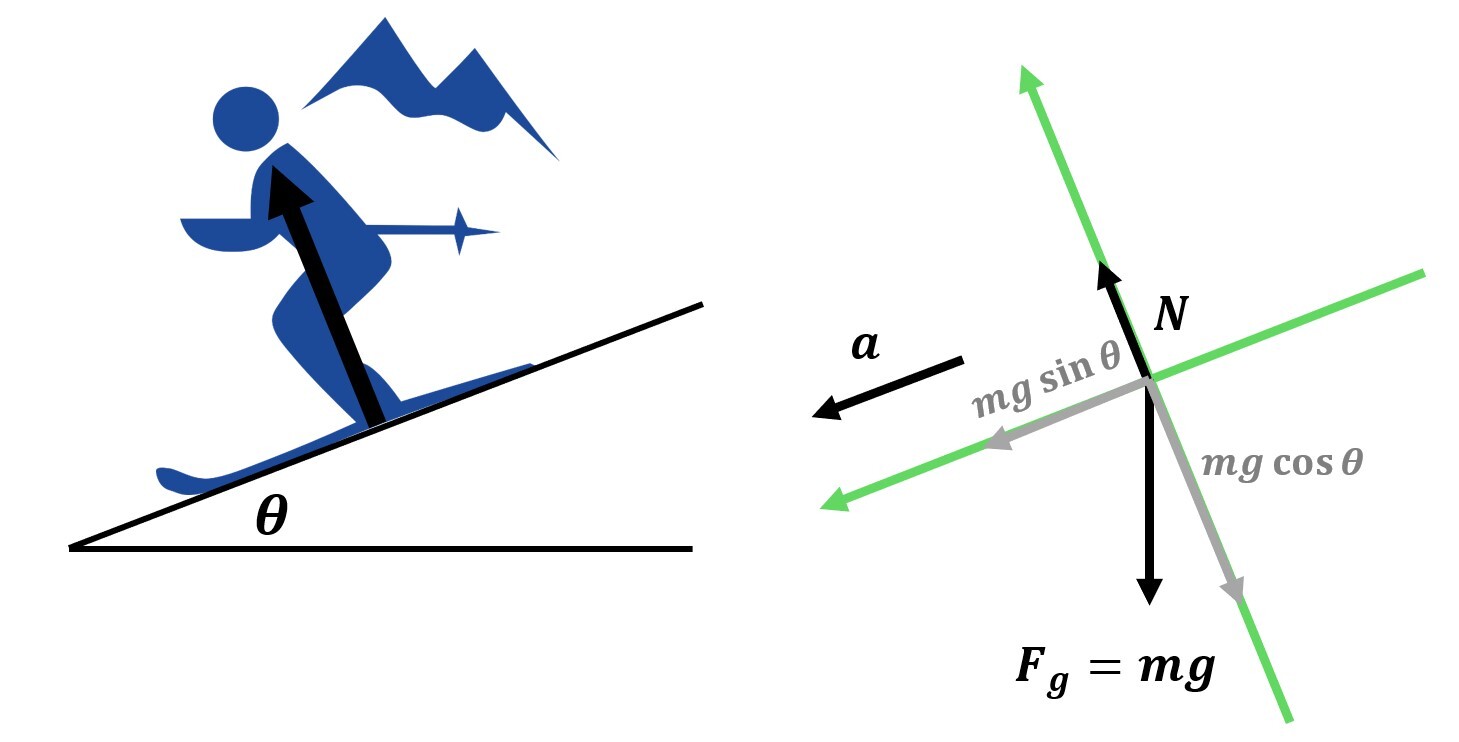
For inclined surfaces, it is easier to choose the coordinates such that x-axis is parallel to the surface and y-axis is perpendicular to the surface.
Example: Free-body diagram below is drawn for a skier of mass m gliding down a slope at angle θ. We have assumed the snow is frictionless.
Wize Tip
Since the sliding object remains in contact with the plane, there is no acceleration in the y-axis (if we define our axes along the plane).
- If the only force acting on the object is gravity, the acceleration of the sliding object along the direction of the inclined surface is:
- where is the gravitational acceleration of earth
- is the angle between the inclined plane and the horizontal surface.
- If friction is present, it always opposes movement (and therefore the force of gravity in this case)

0:00 / 0:00
Example: Finding Minimum Angle of Sliding
If the coefficient of static friction between the block and the ramp is , find the minimum angle at which the block will slide down the slope.

Solution:
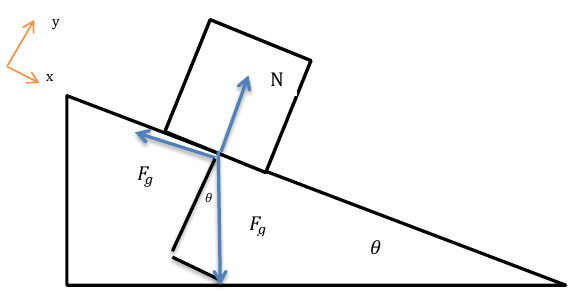
First let's look at the free body diagram:
Equations of Motion
Need to decompose into the and coordinates and
Since we are looking for the moment at which box starts to move, we are talking about threshold of motion for which static friction is maximum and equal to
From the second equation above,
Substituting in the first equation above:
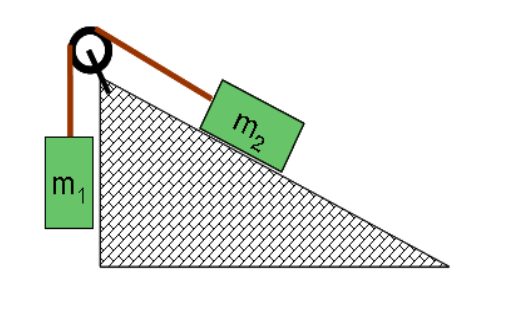
Two blocks are connected via a pulley as shown below on a 45-degree inclined surface. The static and kinetic coefficient of friction between the and the surface are 0.45 and 0.25. The system is moving with constant speed such that is going down. What is ?