Wize University Physics Textbook (Master) > Circular Motion
Centripetal Acceleration and Centripetal Force
Popular Courses
Intro to Physics
University Study Guides
PHYSICS 1D03
McMaster University
AP Physics C: Mechanics Exam Prep Course
AP Exam Prep
Physics
General Course
PHYS 115
Queen's University
PHYS 101
McGill University
PCS 211
Toronto Metropolitan University
PHYS 204
Concordia University
PHYS*1300
University of Guelph
Intro to Physics
University Study Guides
PHYS*1080
University of Guelph
PHY 1321
University of Ottawa
PHYS 131
McGill University
PHYS 102A
University of Victoria
PHYS 111
University of Waterloo
PCS 120
Toronto Metropolitan University
LE/PHYS 1800 3.00
York University
PHYS-1400
University of Windsor
PHYS-1400
University of Windsor
PHY131H1
University of Toronto

0:00 / 0:00
Centripetal Acceleration and Centripetal Force
In circular motions, there is a centripetal acceleration (pointed toward centre of circle) changing the direction of velocity. If there's acceleration, there must be a force! We call this a centripetal force.
Wize Concept
This force is not a separate force. The centripetal force is the name we give to whatever force is already there and resulting in circular motion. For example, it could be friction, an applied force, gravity, or tension. It could also be a component of any of these forces.
For an object of mass moving at speed of around a circular path of radius :
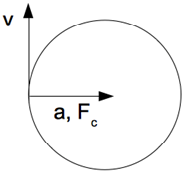
The magnitude of this centripetal acceleration is given by:
Thus using the second law of Newton, the centripetal force has magnitude of:
Watch Out!
Note that both centripetal acceleration and centripetal force are pointing toward the center of the circular path.
Tips for solving uniform circular motion problems:
- Draw a clearly labeled free body diagram.
- Calculate the net force
- Set the net force equal to the centripetal force equation (net force = centripetal force here)
- Solve for the unknown!
Examples:
Mass on a string
- The centripetal force here is provided by the tension
- If the string is swung horizontally, the tension will be equal to the centripetal force.
- If the string is held at an angle, the centripetal force will be the component of tension in towards the center of the circle.
Vertical Circular Motion
- Remember, the centripetal force is the net force towards the centre of the circle.
- Often here, it will be the sum of the force of gravity and another force acting on the object (ie. tension or a normal force).
- Choose the direction towards the centre of the circle to be positive.
- This means that the signs of forces will depend on where the object is located in the circle!
- Make sure you read the question carefully and set up the free body diagram accordingly.
0:00 / 0:00
Example: Circular Paths with a Different Radius
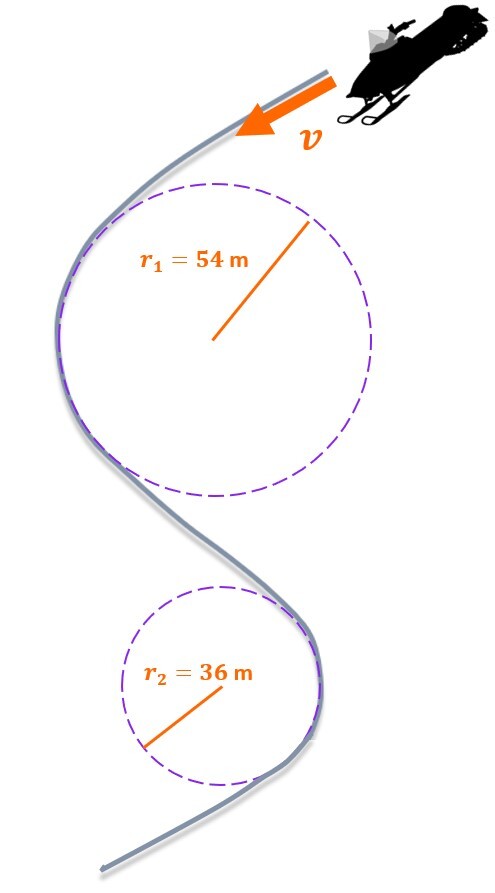
A bobsled track consists of two turns with radii 54 and 36 meter as shown in the picture. If bobsled turns with constant speed what is ratio of centripetal force , acting on the bobsled while turning around the two turns?
A) 1.9 B) 1.2 C) 0.66 D) 1.5
Solution:
A box of mass 2.50 kg is attached to a string and whirled in a vertical circle of radius 1.0 m. At the exact top of the path, the tension in the string is 3 times the ball’s weight.
What is the ball’s speed at this point?
A 20-g marble is free to slide on a frictionless wire loop with radius of 15 cm. The loop starts to rotate about its vertical axis until the bead slides up to θ=60∘ as shown below. What is the angular velocity of the loop at this moment?
