Wize University Physics Textbook (Master) > Circular Motion

Centripetal Acceleration and Centripetal Force

Create a free account to get started

Unlock full course notes by signing up

  • Video lessons taught by top educators
  • Practice questions with guided solutions
  • Written review notes for reference
  • Expert answers anytime from course tutors

Centripetal Acceleration and Centripetal Force


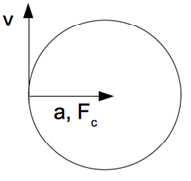
In circular motions, there is a centripetal acceleration (pointed toward centre of circle) changing the direction of velocity. If there's acceleration, there must be a force! We call this a centripetal force.


For an object of mass mm moving at speed of vvaround a circular path of radius rr:


Image illustrating Centripetal force

The magnitude of this centripetal acceleration is given by:


ac=v2r\boxed{a_c=\frac{v^2}{r}}


Thus using the second law of Newton, the centripetal force has magnitude of:


Fc=mac=mv2r\boxed{F_c=ma_c=\frac{mv^2}{r}}


Tips for solving uniform circular motion problems:

  • Draw a clearly labeled free body diagram.
  • Calculate the net force
  • Set the net force equal to the centripetal force equation (net force = centripetal force here)
  • Solve for the unknown!


Examples:


Mass on a string

  • The centripetal force here is provided by the tension
  • If the string is swung horizontally, the tension will be equal to the centripetal force.
  • If the string is held at an angle, the centripetal force will be the component of tension in towards the center of the circle.


Vertical Circular Motion

  • Remember, the centripetal force is the net force towards the centre of the circle.
  • Often here, it will be the sum of the force of gravity and another force acting on the object (ie. tension or a normal force).
  • Choose the direction towards the centre of the circle to be positive.
  • This means that the signs of forces will depend on where the object is located in the circle!
  • Make sure you read the question carefully and set up the free body diagram accordingly.


Create a free account to get started

Unlock full course notes by signing up

  • Video lessons taught by top educators
  • Practice questions with guided solutions
  • Written review notes for reference
  • Expert answers anytime from course tutors

Example: Circular Paths with a Different Radius


A bobsled track consists of two turns with radii 54 and 36 meter as shown in the picture. If bobsled turns with constant speed v,v, what is ratio of centripetal force f2/f1f_2/f_1, acting on the bobsled while turning around the two turns?


A) 1.9 B) 1.2 C) 0.66 D) 1.5
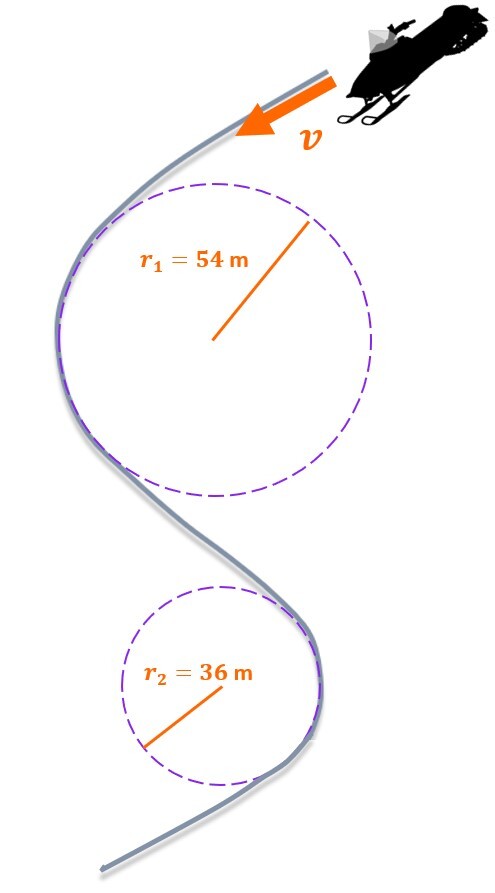


Image illustrating Example: Circular Motion with Changing Radii


Solution:


Fc1=mv2r1 and  Fc2=mv2r2 ⇒  Fc2Fc1 =r1r2=1.5F_{c1}=\frac{mv^2}{r_1}\ and\ \ F_{c2}=\frac{mv^2}{r_2}\ \Rightarrow\ \ \frac{F_{c2}}{F_{c1}}\ =\frac{r_1}{r_2}=1.5


A box of mass 2.50 kg is attached to a string and whirled in a vertical circle of radius 1.0 m. At the exact top of the path, the tension in the string is 3 times the ball’s weight.


What is the ball’s speed at this point?

Choose an answer

Create a free account to get started

Unlock full course notes by signing up

  • Video lessons taught by top educators
  • Practice questions with guided solutions
  • Written review notes for reference
  • Expert answers anytime from course tutors

A 20-g marble is free to slide on a frictionless wire loop with radius of 15 cm. The loop starts to rotate about its vertical axis until the bead slides up to θ=60∘ as shown below. What is the angular velocity of the loop at this moment?


Illustration for practice question: Circular motion: Rotating Marble


Choose an answer

Create a free account to get started

Unlock full course notes by signing up

  • Video lessons taught by top educators
  • Practice questions with guided solutions
  • Written review notes for reference
  • Expert answers anytime from course tutors

Extra Practice