Create a free account to get started

Unlock full course notes by signing up

  • Video lessons taught by top educators
  • Practice questions with guided solutions
  • Written review notes for reference
  • Expert answers anytime from course tutors

Electric Field


Every electric charge creates an electric field. The electric field is a useful concept to understand how other charges will behave at any point in space, without having to use Coulomb's Law over and over again.

  • Electric field is a vector (has both magnitude and direction) and is represented in equations by the symbol EE. It is measured in units of force per unit charge, or Newtons per Coulomb, NC\frac{N}{C}.
  • The electric force that a charged particle will experience in an electric field is given by the following equation:
F⃗=qE⃗\boxed{\vec F=q \vec E}


Electric Field Due to One Particle

  • Unlike the electric force which only exists if there are two or more charges, the electric field can be produced by a single point charge. The electric field exists regardless of whether or not there is another charge nearby to "feel" it.
  • At a distance rr from a point charge of charge QQ, the magnitude of the electric field is given by the following equation:
∣E⃗∣=kQr2\boxed{|\vec E|=k\frac{Q}{r^2}}


  • The direction of the electric field is along the line connecting the source charge (Q) to the point of interest. Electric field always points away from positive charges and towards negative charges.


  • Note, the equation above can be derived easily from the electric field equation and Coulomb's law for point charges:
F⃗=qE⃗(kqQr2)=qE⃗kQr2=E⃗\begin{aligned} \vec F&=q \vec E \\ (k\frac{qQ}{r^2})&=q\vec E \\ k\frac{Q}{r^2}&=\vec E \end{aligned}


  • In electrostatics, at any point inside a conductor, the electric field is zero.

Create a free account to get started

Unlock full course notes by signing up

  • Video lessons taught by top educators
  • Practice questions with guided solutions
  • Written review notes for reference
  • Expert answers anytime from course tutors

Electric Field Lines


While electric field is a very useful tool in physics, it can be abstract and challenging to visualize. For this reason, we use electric field lines to demonstrate the field distribution for a given charge configuration.

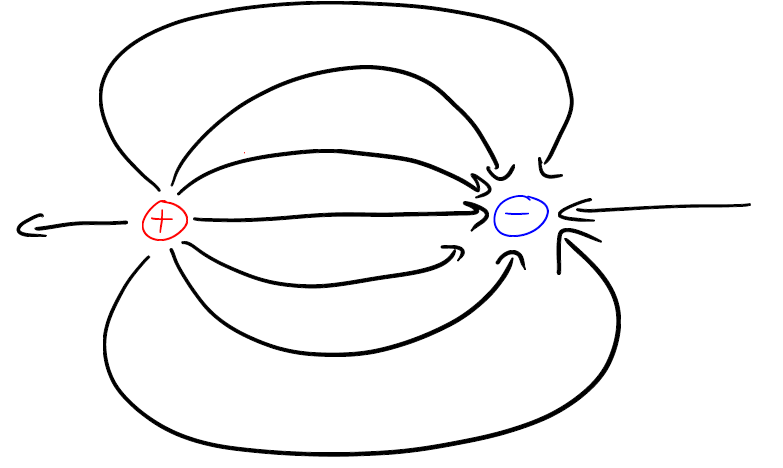
  • The direction of the electric field vector for a positive charge is outward and for a negative charge is inward (relative to the charge position). Electric field lines always point from positive to negative.
Image illustrating Electric Field Lines
  • Electric field lines show the direction of an electric force that would act on a positive charge at that point.
  • If the electric field line is curved at a point, the tangent to the electric field line gives the direction of the field at that point.
  • The density of field lines in a region of space is proportional to the magnitude of the electric field at that point.

Create a free account to get started

Unlock full course notes by signing up

  • Video lessons taught by top educators
  • Practice questions with guided solutions
  • Written review notes for reference
  • Expert answers anytime from course tutors

Example: Drawing Electric Field Lines (two point charges)


a) Draw the electric field line distribution for two positive charges of equal magnitude.

b) Draw the electric field line distribution for a positive charge and a negative charge of equal magnitude.

c) Draw the electric field line distribution for a positive charge and a negative charge, where the positive charge has double the magnitude of charge compared to the negative charge.


Part a)
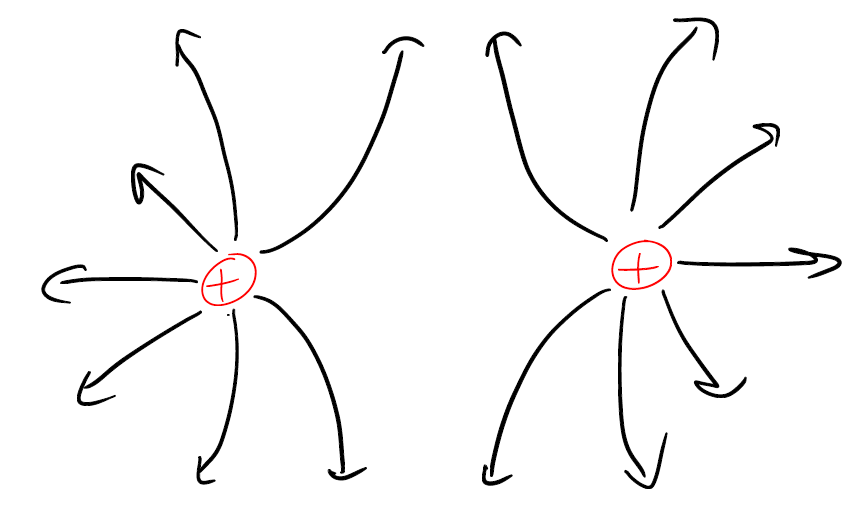
Image illustrating Example


Part b)


Image illustrating Example


Part c)


For this part, we make sure there are twice as many field lines on the 2Q charge to show that the charge is twice as high.
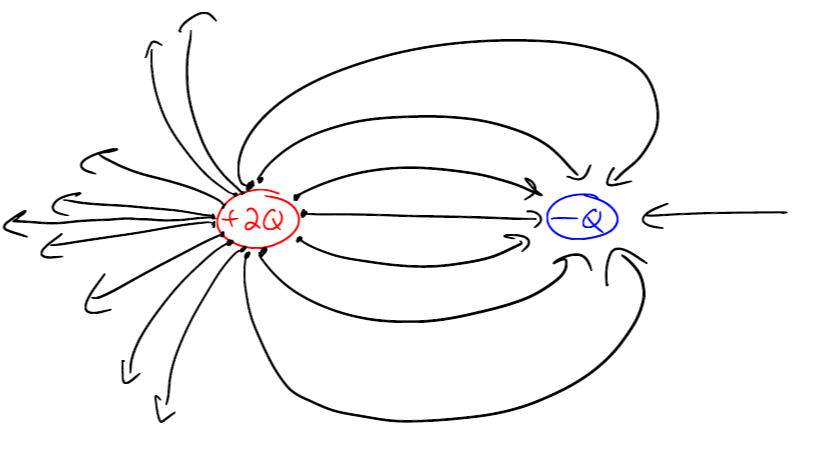

Image illustrating Example


Mark Yourself Question

  1. Grab a piece of paper and try this problem yourself.
  2. When you're done, check the "I have answered this question" box below.
  3. View the solution and report whether you got it right or wrong.

Practice: Drawing Electric Field Lines (three point charges)


Draw the electric field lines for each charge configuration.


a)


Illustration for practice question: Drawing Field lines (point charges)


b)


Illustration for practice question: Drawing Field lines (point charges)


c)


Illustration for practice question: Drawing Field lines (point charges)


Create a free account to get started

Unlock full course notes by signing up

  • Video lessons taught by top educators
  • Practice questions with guided solutions
  • Written review notes for reference
  • Expert answers anytime from course tutors

Mark Yourself Question

  1. Grab a piece of paper and try this problem yourself.
  2. When you're done, check the "I have answered this question" box below.
  3. View the solution and report whether you got it right or wrong.

Practice: Net Electric Field

Two charges are located at the vertices of a triangle, as shown below. Find the net electric field at point A with its direction.

Illustration for practice question: Principle of Superposition: Several Point Charges

Create a free account to get started

Unlock full course notes by signing up

  • Video lessons taught by top educators
  • Practice questions with guided solutions
  • Written review notes for reference
  • Expert answers anytime from course tutors

Practice: Magnitude of Electric Field of Point Charges

Find the magnitude of the electric field at point p in the diagram below


Illustration for practice question: Practice: Magnitude of Electric Field of Point Charges


Choose an answer

Create a free account to get started

Unlock full course notes by signing up

  • Video lessons taught by top educators
  • Practice questions with guided solutions
  • Written review notes for reference
  • Expert answers anytime from course tutors